
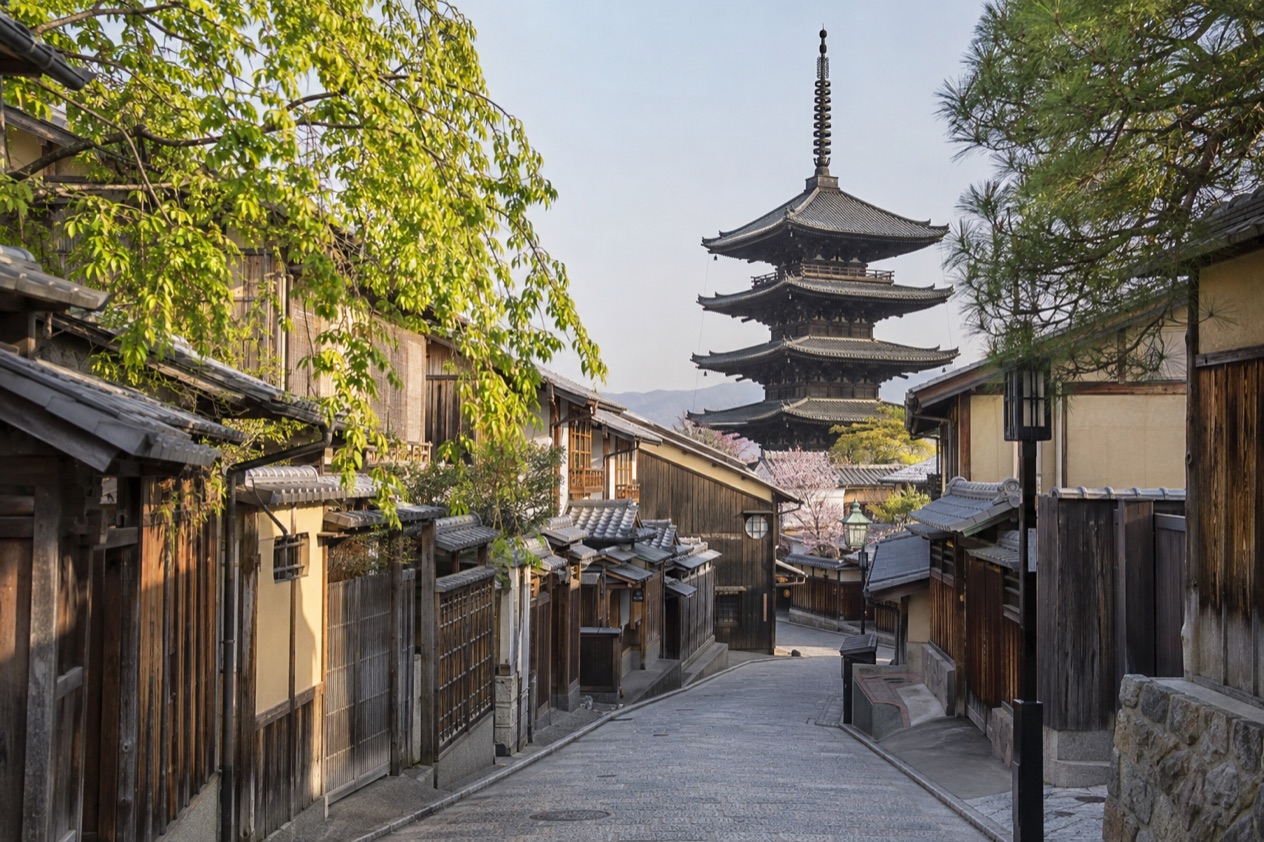
In May the maples along the Kamo River are a fresh, bright green, and the courtiers of the Aoi Matsuri parade pass in Heian-era robes with hollyhock leaves pinned to their hats and their ox-drawn carriages. The cherry blossoms are long gone, and the city has moved on to azaleas, wisteria and the first new tea.
What is the weather like in Kyoto in May?
May in Kyoto is warm and green, with comfortable afternoons, mild nights and a good amount of sunshine before the humid weeks of June set in.
| Month | Average high (°F) | Average low (°F) | Precipitation (in) | Days with 1 mm or more of precipitation | Hours of sunshine | Daylight on the 15th |
|---|---|---|---|---|---|---|
| April | 68.2 | 48.6 | 4.61 | 9.4 | 177 | 13 h 02 min |
| May | 77.2 | 58.1 | 5.96 | 9.7 | 182 | 13 h 58 min |
| June | 82.6 | 66.6 | 7.86 | 11.5 | 133 | 14 h 30 min |
Afternoons run into the upper 70s, warm enough for short sleeves while you walk between temples, and the lows in the high 50s mean you will still want a thin layer once the sun is down. Spring in Japan suits a light jacket or a simple sweater, and in Kyoto that is exactly what May evenings call for. Humidity sits around 60 percent, so the air feels soft rather than sticky.
Rain in May arrives as passing showers and the occasional gray day, with roughly one day in three bringing some. A compact umbrella is enough for most of them, and wet stone paths and moss gardens look their best after a shower. The true rainy season comes later, from about mid-June, and May stays clear of it.
The light is generous. Days are long enough to fit a late temple visit and a slow dinner without feeling rushed, and sunshine hours stay high compared with the grayer weeks ahead. Photographers get a clean, bright green on the leaves, and the lack of summer haze keeps the hills around the city sharp.
What to do in Kyoto in May
The best of May in Kyoto happens outdoors, in temple gardens, along the river and under the new leaves of the hillside shrines. The month has its own festival, its own flowers and its own flavors, and the weather is comfortable enough to walk from one to the next.
The cherry season belongs to spring’s first act. In Kyoto, seasonal flowers bloom in sequence from March, with plum blossoms first, then cherries, then azaleas, wisteria and irises.
By May you are on the later end of that run, so the pink gives way to the clipped azalea hedges of temple precincts, wisteria trailing from trellises and iris beds in garden ponds. Cherry viewing is for April, but the green that follows has its own appeal.
Aoi Matsuri and the festival calendar
The Aoi Matsuri is the big event of Kyoto’s May, usually held in mid-May. It is a procession that re-creates the court of the Heian era, with riders on horseback, oxcarts with huge wheels, and several hundred people in layered silk robes. Everyone wears or carries leaves of aoi (hollyhock), which gives the festival its name, and the procession links the Imperial Palace area with the two Kamo shrines.
Watching it is a slow pleasure. The pace is stately, the colors are soft and the music is the thin sound of court instruments. The festival depends on the weather and can be postponed if it rains, so a flexible day is a good idea if your dates are close. The other great Kyoto festival, the Gion Matsuri, belongs to July and its processions are not part of May.
Temples and gardens in May green
Kinkaku-ji, the Golden Pavilion, is formally Rokuon-ji and is one of the 17 Historic Monuments of Ancient Kyoto. In May its gold leaf reflects against a pond ringed with fresh green pines and maples, and the view is a favorite for good reason. The path around the pond is a one-way loop through the garden, ending at a small tea garden and a stall selling matcha sweets.
Kiyomizu-dera, founded over 1250 years ago, stands on a wooden stage held up by a lattice of beams. Looking out from it in May, you see a sea of new leaves rolling down the hillside toward the city. The lanes leading up are lined with shops selling pickles, sweets and ceramics, and you can step in to browse between photos.
Nijo Castle was built in 1603 by Tokugawa Ieyasu, the first shogun of the Edo period. Inside, the corridors have nightingale floors that chirp like birds underfoot, an old security system meant to warn guards of intruders. The painted sliding doors and the gardens outside suit a day when the sky is gray and you want something with a roof.
Fushimi Inari and the hills
Fushimi Inari Taisha, established in 711 AD, sits at the base of Mount Inari, and its thousands of red torii gates form tunnels that climb into the forest. In May the cedar and bamboo above them are deep green, and the shade is welcome as the days warm up. Small fox statues, the messengers of the Inari deity, watch from the side shrines, some holding keys or scrolls in their mouths.
You can walk a little way beneath the gates or follow the paths further up the mountain, with tea houses and small shrines along the way. Sturdy shoes and a bottle of water make more sense than any schedule, because the route is long and the stairs are many. Back at the foot of the hill, the stalls near the main gate grill skewers and sell inari sushi, the sweet tofu pouches stuffed with rice.
Tea, bamboo shoots and the May table
May is the season of new tea in the Kyoto area, and cafés and shops lean into it with matcha parfaits, tea jellies, warabi-mochi and cups of freshly whisked green tea. A tea house with a garden view is a good way to spend the part of the day when you want to sit down. Fresh green tea tastes brighter than the powder you buy in tins at home.
Spring cooking in Kyoto leans on takenoko (bamboo shoots), simmered gently or served in rice, and on tofu in every form, from silky yudofu in hot broth to fried and grilled skewers. Kaiseki, the multi-course meal built around the season, shows off these lighter flavors. At the covered Nishiki market you can graze on pickles, skewers, tamagoyaki (rolled omelet) and soy-milk doughnuts as you walk.
A two-day itinerary for Kyoto in May
Day 1 begins in the east of the city with Kiyomizu-dera, early, while the light is soft over the hillside. Walk down the lanes below the temple, stopping for a matcha sweet, then drift toward the Gion streets, where wooden teahouses line the lanes. Lunch can be a bowl of soba or a tofu set meal in one of the small restaurants nearby.
In the afternoon, cross to the Kamo River and walk its banks, where the new leaves make the shade welcome. Then browse the covered Nishiki market and the shopping arcades around it for snacks and tea. Long May evenings leave room for dinner at a kaiseki restaurant or an izakaya (Japanese pub) near the river, followed by a stroll along its banks in the lingering dusk.
Day 2 starts at Fushimi Inari Taisha, climbing the torii path while the air is still cool. Come down for an inari sushi snack, then head to Nijo Castle for the nightingale floors and the painted rooms. Lunch could be yudofu or a simple noodle shop near the castle, before the afternoon at Kinkaku-ji, where the Golden Pavilion shines against the green.
If rain sets in, give Nijo Castle more time and add a tea house with a garden view. Covered arcades, the Nishiki market and department store food halls offer shelter and plenty to eat. The temples look wonderful in a light shower, so a thin rain jacket and a patient mood can keep the original plan alive. End with a quiet bowl of ramen or a dinner of grilled skewers.
Is Kyoto busy in May?
May opens with the busiest travel stretch of Japan’s year, because Golden Week runs from late April to May 5 and contains several public holidays.
Four of those days are official holidays: Showa Day on April 29, Constitution Memorial Day on May 3, Greenery Day on May 4 and Children’s Day on May 5. When a national holiday falls on a Sunday, the next working day becomes a holiday as well, and a day sandwiched between two holidays becomes one too. The early days of May therefore carry the mood of a long national vacation.
After that stretch ends, the pace of the city eases into the rhythm of an ordinary spring. The days stay long and bright, the festival season is underway and the city’s gardens are in full leaf, so there is a steady flow of visitors but not a rush tied to a single bloom. Cherry season belongs to April, which is when the largest flower-viewing gatherings happen.
If your dates are flexible, the second half of the month asks less of you in terms of holiday timing, and it is when the Aoi Matsuri falls. The rainy season waits until mid-June.
What to pack for Kyoto in May
May calls for light clothes in layers, shoes that handle temple stairs and a plan for passing showers.
- A light jacket or sweater, because evenings cool off after warm afternoons.
- A compact umbrella or thin rain jacket for the passing showers.
- Comfortable walking shoes that slip on and off easily, since shoes come off at the entrance of many temple halls and teahouses.
- A sun hat and sunscreen for long afternoons in the open gardens.
- Short sleeves and light trousers for the warm hours between temples.
- A small bag for snacks and tea from the Nishiki market.
Good to know before you go
The first days of May fall inside Golden Week, a run of national holidays that shapes how Japan travels. Mid-June brings the start of Kyoto’s rainy season, which lasts until the end of July, and most travelers avoid that period, so May sits comfortably before it. The typhoon season in Kyoto comes in late August and September.
The Kyoto Online Tourist Information Center publishes disaster-preparedness guides and maps of evacuation sites, and the staff at Kyoto’s tourist information centers speak English and many other languages. The Kyoto City Official Travel Guide lists the main emergency numbers.
Kyoto in May vs April and June
Moving the trip four weeks earlier puts you in April, with cooler days, chilly mornings and the cherry blossoms in Kyoto, where flowering comes in late March to early April. The days are shorter, evenings need a proper jacket and the city is dressed in pink instead of green. If petals are the point of your trip, April is the month to choose.
Four weeks later you reach June, which is hotter, wetter and more humid, with far fewer hours of sun. The rainy season starts around mid-June and runs to the end of July, and the city is lush and damp rather than bright. The days are at their longest, which suits late evening walks, and the Gion Matsuri is just around the corner in July.
Choose May if you want green gardens, warm afternoons, the Aoi Matsuri and good walking weather without the heat of summer. Choose April for blossoms and cooler air, and June only if you do not mind rain and humidity in exchange for the long evenings.
Is May a good time to visit Kyoto?
Yes, May is a very good time for anyone who likes to walk outdoors, with temples and gardens at their greenest and weather that suits long days.
It will suit garden lovers, photographers, tea drinkers and travelers who want to see a Kyoto festival rather than a flower season. It is less right for anyone set on cherry blossoms, who should aim for April, and for anyone who wants the cooler air of early spring.
On arrival, start with the places that are outdoors, such as Fushimi Inari or the Kamo riverbank, so that the long light of the first day goes to the best use. Keep a flexible afternoon for a tea house if a shower rolls in. What stays with you from May in Kyoto is the green: moss, maples, bamboo and tea, all lit by long days and set against the red of the torii and the gold of the pavilion.
Sources
- Japan Meteorological Agency (JMA), Normal values 1991-2020, monthly (https://www.data.jma.go.jp/stats/etrn/view/nml_sfc_ym.php?prec_no=61&block_no=47759), station Kyoto, elevation 41 m, checked October 11, 2026
- Computed from the date and the latitude of the place (sunrise equation, solar elevation -0.833 degrees), October 11, 2026
- Japan National Tourism Organization, shop and attraction hours, national holidays (https://www.japan.travel/en/plan/business-hours-and-holidays/), checked October 11, 2026
- Wikipedia, Golden Week (Japan) (https://en.wikipedia.org/wiki/Golden_Week_(Japan)), checked October 11, 2026
- Wikipedia, Public holidays in Japan (https://en.wikipedia.org/wiki/Public_holidays_in_Japan), checked October 11, 2026
- Japan National Tourism Organization, flowers by season: cherry blossom, plum, wisteria, hydrangea, where and when (https://www.japan.travel/en/see-and-do/flowers/), checked October 11, 2026
- Wikipedia, Wisteria (https://en.wikipedia.org/wiki/Wisteria), checked October 11, 2026
- Japan Meteorological Agency, sakura2020.pdf (https://www.data.jma.go.jp/sakura/data/sakura2020.pdf), checked October 11, 2026
- Japan National Tourism Organization, spring in Japan (https://www.japan.travel/en/guide/spring-guide/), checked October 11, 2026
- Wikipedia, Kanda Matsuri (https://en.wikipedia.org/wiki/Kanda_Matsuri), checked October 11, 2026
- Wikipedia, Sanja Matsuri (https://en.wikipedia.org/wiki/Sanja_Matsuri), checked October 11, 2026
- Japan National Tourism Organization, festivals and events (https://www.japan.travel/en/see-and-do/festivals-and-events/), checked October 11, 2026
- Wikipedia, Gion Matsuri (https://en.wikipedia.org/wiki/Gion_Matsuri), checked October 11, 2026
- Kyoto City Official Travel Guide, safety information (https://kyoto.travel/en/safety-info/), checked October 11, 2026
- Kyoto City Official Travel Guide, seasonal information (https://kyoto.travel/en/seasonal-info), checked October 11, 2026
- Wikipedia, Kyoto (https://en.wikipedia.org/wiki/Kyoto), checked October 11, 2026
- Wikivoyage, Kyoto (https://en.wikivoyage.org/wiki/Kyoto), checked October 11, 2026
- Japan National Tourism Organization, Kyoto (https://www.japan.travel/en/destinations/kansai/kyoto/central-kyoto/), checked October 11, 2026
- Fushimi Inari Taisha, official site (https://inari.jp/en/), checked October 11, 2026
- Wikipedia, Fushimi Inari-taisha (https://en.wikipedia.org/wiki/Fushimi_Inari-taisha), checked October 11, 2026
- Wikipedia, Kinkaku-ji (https://en.wikipedia.org/wiki/Kinkaku-ji), checked October 11, 2026
- Kiyomizu-dera Temple, official site (https://www.kiyomizudera.or.jp/en/), checked October 11, 2026
- Wikipedia, Kiyomizu-dera (https://en.wikipedia.org/wiki/Kiyomizu-dera), checked October 11, 2026
To plan your stay
- Things to Do in Kyoto: Temples, Gardens, Food and Day Trips
- Where to Stay in Kyoto: Kyoto Station, Central and Eastern Districts, and Ryokan Stays
- Kyoto from Tokyo: Shinkansen Trains, Nozomi vs. Hikari and Kodama, and a First Day in Kyoto
- Know Before You Go to Kyoto: Entry, Money, Getting Around and Local Etiquette