
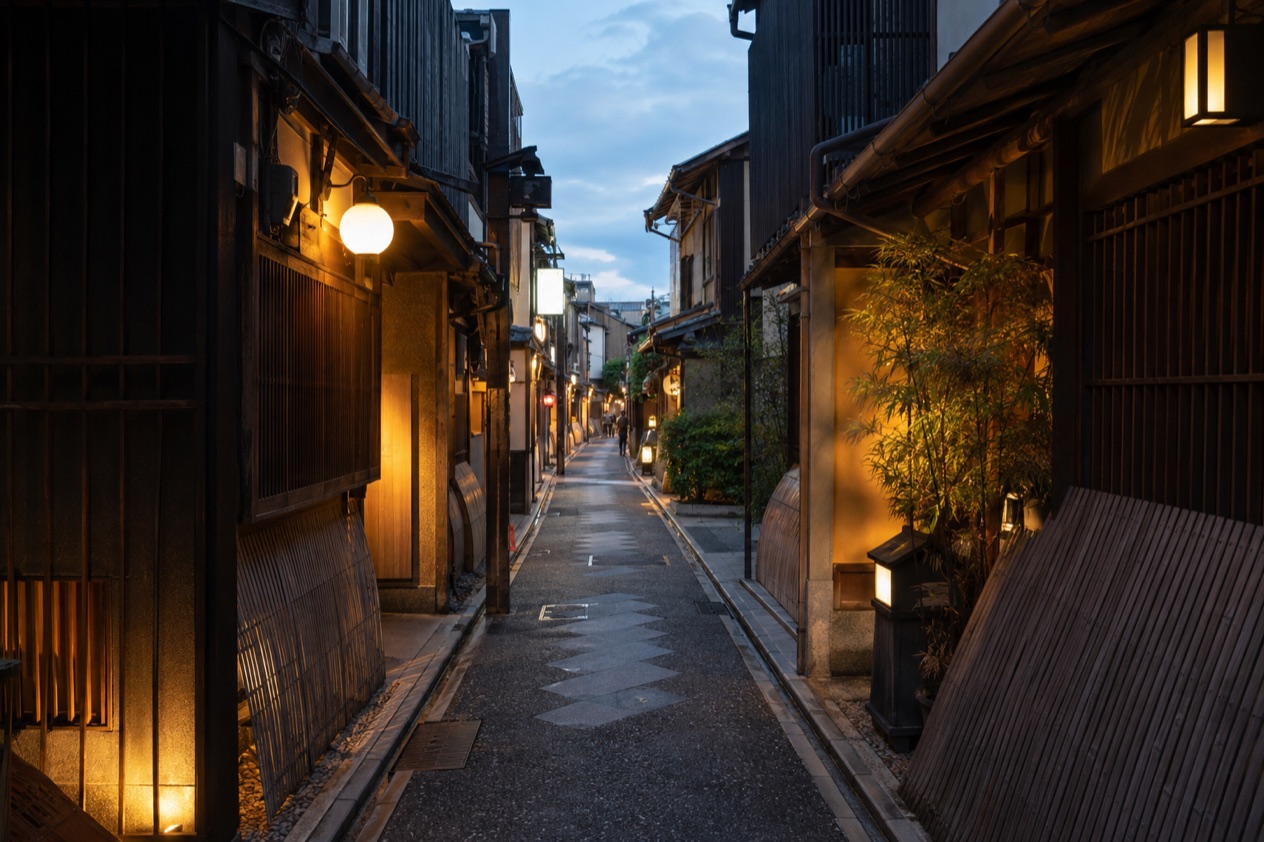
As dusk settles over Kyoto, paper lanterns flicker on along a long, narrow lane one block from the Kamo River, and the smell of grilled skewers drifts out of doorways barely wider than a person’s shoulders. Wooden latticed facades line both sides, and now and then a glimpse of a riverside patio opens between the buildings. Pontocho is a place for an evening stroll and a slow dinner, in a district where geiko and maiko still work.
Is visiting Pontocho worth it?
Yes, if you like to wander at night, look at old wooden architecture and eat well in atmospheric surroundings. It suits couples, solo travelers and groups of friends who enjoy picking a doorway and seeing where it leads. It is less rewarding for anyone who wants a list of sights to tick off, because the pleasure here is the lane itself, the lanterns and the table you eventually settle at.
Pontocho is a hanamachi, one of the districts in Kyoto known for its geiko (the Kyoto word for geisha) and maiko, their apprentices. Like Gion, it is known for preserving forms of traditional architecture and entertainment.
What sets it apart from similar places nearby is its shape. The district is built around one long alleyway running from Shijo-dori to Sanjo-dori, so the whole experience is a single, continuous walk rather than a grid of streets to get lost in.
The mix of places is also wide. Exclusive restaurants sit beside geisha houses, tea houses, bars and cheap eateries, so a plate of something simple and a long formal dinner are both possible within a few steps of each other. The setting adds to Kyoto’s larger story, since the city has a cultural heritage that has developed over the past 1,200 years, and hanamachi districts such as this one are among the traditions that carry it forward.
If your main wish is to see a performance rather than just soak up the atmosphere, the annual dance described below is the thing to plan around. Otherwise, treat Pontocho as an evening of looking, eating and drifting, with no fixed agenda.
What to see at Pontocho
The alleyway itself
The heart of the district is the lane, a long, narrow passage running from Shijo-dori to Sanjo-dori. Walk it slowly in one direction and then back, because the view changes completely when you turn around. Look up at the lanterns, then at the latticed windows, and notice how small the doorways are. Restaurant menus are posted by the entrances, and the little side passages between buildings are part of the character.
At night the area is lit by traditional lanterns, and that glow is the reason most people come. Between the buildings you may catch a flash of the river, a reminder of how close the water is. Allow yourself time to simply stop and watch the doors open and close as diners come and go.
Riverside patios
On the river side of the district, many restaurants have outdoor dining on wooden patios, set above the Kamo River. This is one of the distinctive features of the area, and a meal here gives you a view of the water and the opposite bank while the lights of the lane glow behind you.
Across the river stands a statue of Izumo no Okuni, the founder of kabuki. It is a fitting neighbor, given that the district has its own long link to dance and theater. Even if you do not dine on a patio, the view from the riverbank gives you a sense of how the district hangs together along the water.
Kaburenjo Theatre
At the Sanjo-dori end of the street stands the Pontocho Kaburenjo Theatre. It works as a practice hall for geiko and maiko, which means that the building is tied closely to the working life of the district rather than being a museum piece.
It is also the home of the Kamogawa Odori, an annual performance that combines traditional dance, kabuki-like theater, singing and the playing of traditional instruments. It has been held at the theater since the 1870s. Even outside the performance season, the entrance is worth a look as you finish your walk of the lane.
Teahouses, geisha houses and bars
Many of the doors you pass belong to places that are not open to casual walk-ins in the way a ramen counter might be: geisha houses and tea houses are part of the working fabric of the district. They are best appreciated from the outside, as part of the architecture and mood of the lane.
Alongside them, bars and cheap eateries keep the street lively and varied. Looking at the different signs, curtains and lanterns, you start to read the street as a layered place where formal and casual dining sit side by side.
When to visit Pontocho
The district is most characteristic after dark, when the lanterns are lit and the restaurants are serving dinner. Kyoto’s advice for visiting shrines at less crowded times, early morning or late evening when they are illuminated, points to the same rhythm of the city: the evening is when much of the old capital’s atmosphere comes into its own. Walk Pontocho at dusk to see the lanterns come on, then stay for dinner.
The outdoor riverside patios depend on the weather, so the season shapes your meal. October is mild, with highs in the mid-70s and lows in the upper 50s, and it brings a moderate number of rainy days, so an evening outdoors is realistic, with a light layer for later. April is also comfortable, with highs in the high 60s and cooler nights, though showers come on a fair number of days.
July is the other extreme. Highs reach the upper 80s, lows stay in the mid-70s, and humidity is high, with rain on many days, so an evening walk feels warm and sticky even after sunset. In January, highs are in the upper 40s and lows around freezing, with snow or sleet on many days, so the lane is cold, and you will want to dress warmly for the walk between restaurants.
| Month | Average high (°F) | Average low (°F) | Precipitation (inches) | Days with rain of 1 mm or more |
|---|---|---|---|---|
| January | 48.4 | 34.7 | 2.10 | 6.4 |
| April | 68.2 | 48.6 | 4.61 | 9.4 |
| July | 89.6 | 74.5 | 8.80 | 11.6 |
| October | 74.1 | 57.9 | 5.64 | 8.2 |
If you want to see a performance, look to the Kamogawa Odori, which is held every year at the Kaburenjo Theatre. Its schedule is not given here, so treat it as something to plan around once you have your travel dates in mind. Even without a ticket, the weeks around it add a sense of occasion to the district.
Tips for your visit
Come hungry and without a rigid plan. The lane rewards slow decisions: walk it once to see what is on offer, then choose a place that suits your mood, whether that is a formal dinner, a bar, or a cheap and cheerful bite. Because the street is narrow and lined with small doorways, it works best on foot.
Pair your evening with the rest of Kyoto. Central Kyoto holds Nijo Castle, built in 1603 by Tokugawa Ieyasu, the first shogun of the Edo period, and known for its nightingale floors, which make a bird-like sound when walked on, an old security system meant to alert guards of intruders. That makes for a good daytime counterpart to an evening in the lanterns of Pontocho.
If you are arriving in the city, Kyoto Station is served by the Tokaido Shinkansen line and houses a floor of ramen restaurants, an Isetan department store, a theater and a Granvia hotel. Kyoto Tower stands a few steps from the main entrance. These are useful landmarks to orient yourself before heading to the district.
Dress for the season, since the riverside patios put you outside. In summer that means light clothes and something to cope with humidity, in winter a warm coat, and in spring and autumn a layer for the evening. Bring a camera if you like lantern light and old wooden facades, and wear comfortable shoes for the walk.
Pontocho is a place for an evening, and an evening is about the right length of time to give it. Walk the lane, dine, then stroll back along the river to see the lights from another angle. Since the lane is narrow, move at an easy pace and step aside for people heading to their reservations.
Good to know before you go
Pontocho is a working district where people live, dine and perform, so treat it as you would any neighborhood: keep your voice low in the narrow lane and be mindful of the doors of geisha houses and tea houses. Mind the weather too. Rain falls on a good number of days in most seasons, and in July it is heavy, so an umbrella is a sensible companion if you plan to eat outdoors.
Sources
- Wikipedia, Pontochō (https://en.wikipedia.org/wiki/Pontoch%C5%8D), checked October 11, 2026
- Japan National Tourism Organization, Kyoto (https://www.japan.travel/en/destinations/kansai/kyoto/), checked October 11, 2026
- Japan Meteorological Agency (JMA), Normal values 1991-2020, monthly (https://www.data.jma.go.jp/stats/etrn/view/nml_sfc_ym.php?prec_no=61&block_no=47759), station Kyoto, elevation 41 m, checked October 11, 2026
To plan your stay
- Best Time to Visit Japan: Cherry Blossoms, Autumn Colors, Weather and Festivals
- Where to Stay in Japan: Ryokan, Temple Stays, Capsule Hotels and the Best Cities to Base In
- Sending Luggage from the Airport in Japan: Hands-Free Travel, Hotel Delivery and Coin Lockers
- Know Before You Go to Japan: Entry, Money, Etiquette and Getting Around