
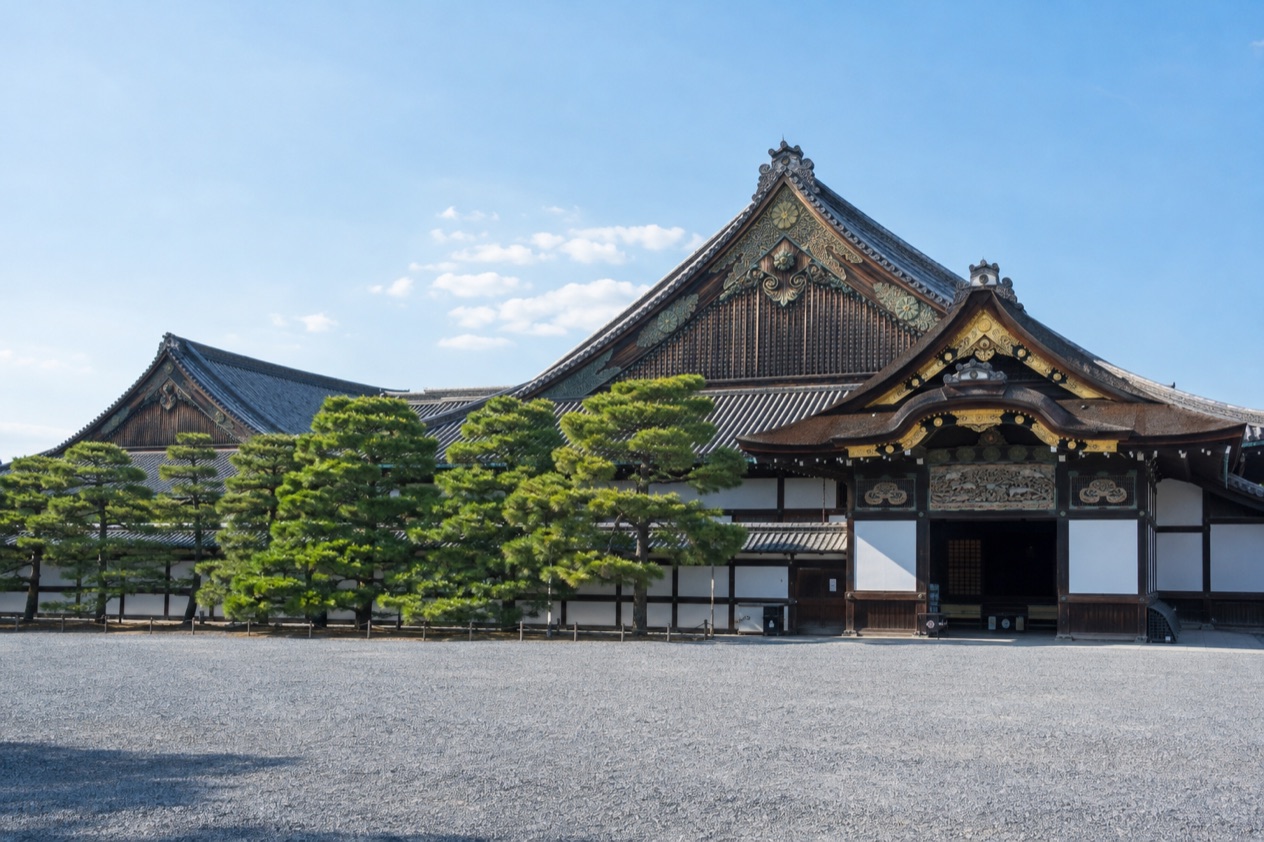
Somewhere inside the Ninomaru Palace, a floorboard chirps under a visitor’s stocking feet, then another, and the whole corridor takes up the sound like a flock of small birds. Beyond the walls, Kyoto goes about its day, but here the Tokugawa shoguns’ former city residence keeps its gold-leaf screens, its cypress beams and its gravel courtyards. Nijo Castle is a visit of rooms and gardens rather than towers and battlements, and it suits anyone curious about how power looked in Japan’s Edo period.
Is visiting Nijo Castle worth it?
Yes, if you want to see where a shogun actually received visitors, and especially if you are curious about the feudal side of Kyoto, a city better known for emperors, temples and tea houses. Nijo Castle is one of the seventeen Historic Monuments of Ancient Kyoto designated by UNESCO as a World Heritage Site, and it earns the place with architecture that still carries the confidence of the family that built it.
What sets it apart from the temples and shrines around Kyoto is its purpose. Most of the city’s great sites were built for worship or for the imperial court. Nijo Castle was built by the Tokugawa shogunate, the military government that ruled Japan from Edo, and it was designed to impress.
Construction began in 1603 under Tokugawa Ieyasu, the first shogun of the Edo period, and the castle was completed in 1626 during the reign of Tokugawa Iemitsu. Every room tells you something about rank: who sat on which level of the floor, who stayed outside the sliding doors, who was allowed to look the shogun in the eye.
It is also a different kind of castle from the ones people picture. This is a flatland castle, set in the middle of the city rather than on a hilltop, and the grounds cover 68 acres. Yet only a small part of that is built up. The rest is moat, stone wall, garden and open ground, so a visit mixes interior rooms with long outdoor stretches, and you can set your own pace between them.
It suits history lovers, anyone interested in Japanese design (painted screens, carved transoms, timber construction), and travelers who enjoy a place with a story about security and status. Garden fans will find a modern landscape beside the old palace. If you prefer temples with incense and chanting, Kyoto has those in abundance, and Nijo Castle offers something quite different next to them: the worldly, political side of the same city, which was Japan’s capital and the emperor’s residence for over a thousand years.
What to see at Nijo Castle
The castle is a sequence of spaces, each from a different moment in its story: a great palace of audience halls, an inner compound rebuilt in the late nineteenth century, and a garden made in the twentieth. Taking them in the order they were built gives the visit a natural arc, from shogunal show to modern ceremony.
Ninomaru Palace
The Ninomaru Palace is the heart of the castle and the reason people come. It has six connected main buildings, and together they spread over roughly 36,000 square feet of floor. Almost the whole structure is built of Hinoki cypress, a pale, fine-grained wood prized in Japanese building, and you notice its warm color in the corridors and under the deep eaves.
Inside, the rooms step down in importance from the shogun’s own seat. The sliding doors and walls carry large painted scenes, pines, birds and tigers on gold ground, meant to impress visiting lords.
The Great Audience Hall is where, in the story people know, the last shogun announced he was handing authority back to the emperor, which makes the room a hinge in Japanese history. Look up as well as around: the coffered ceilings and carved wooden panels above the doorways repay a slow look.
The nightingale floors
The corridors of the Ninomaru Palace are laid with what are called nightingale floors, uguisubari in Japanese. Walk on them and the boards make a chirping, bird-like sound. The story told about them is that they worked as an ancient security system, alerting guards to anyone creeping through the halls.
Whether or not you believe every detail of that tale, the effect is real and strangely charming. Each step produces a different note, and a group moving along the corridor makes a sound like a rustling aviary. Children and adults alike tend to start walking more softly, then give up and listen. It is one of the small, sensory surprises that make this castle stay in the memory longer than a list of rooms would.
Honmaru Palace
Deeper in the grounds, the Honmaru Palace has a smaller footprint, about 17,000 square feet. The original structures of this inner compound were replaced between 1893 and 1894, when one part of the former Katsura Palace within the Kyoto Imperial Enclosure was moved here. So what stands today is a nineteenth-century transplant, a reminder that Nijo Castle changed hands and purposes long after the shoguns lost their power.
That layered history is part of the appeal. The castle did not freeze in 1626. It passed through the imperial era and its buildings were rearranged to fit new uses. Seen beside the older Ninomaru Palace, the Honmaru Palace shows a calmer, more domestic style, closer to the architecture of a court residence than a seat of warrior government.
Seiryu-en garden
The Seiryu-en garden is the newest part of the castle, built in 1965 to receive official guests of Kyoto and to serve as a venue for cultural events. It blends two garden traditions, with Japanese-style ponds, stone arrangements and plantings set alongside open lawns, so it reads as a place for gatherings rather than quiet contemplation alone.
Because it was designed for hosting, it gives a different mood from the palace rooms: open sky, water and greenery after the dim, gilded interiors. In every season the planting shifts, with fresh green in spring, deep shade in summer and warm colors in autumn, so a second visit in another month feels like a different garden.
When to visit Nijo Castle
Spring and autumn give the most comfortable walking, and the garden and surrounding grounds change with each season. The visit is partly indoors in the palaces and partly outdoors in the courtyards and gardens, so the weather matters less than at a hilltop temple, but it still shapes how pleasant the stretches between buildings feel. Kyoto’s climate runs from cold, damp winters to hot, humid summers.
| Month | Average high (°F) | Average low (°F) | Precipitation (in) | Days with rain or more | Sunshine (hours) |
|---|---|---|---|---|---|
| January | 48.4 | 34.7 | 2.10 | 6.4 | 124 |
| April | 68.2 | 48.6 | 4.61 | 9.4 | 177 |
| July | 89.6 | 74.5 | 8.80 | 11.6 | 143 |
| October | 74.1 | 57.9 | 5.64 | 8.2 | 156 |
Spring and autumn
April brings mild days, comfortable for a long walk between buildings, with plenty of sun and a fair chance of a shower. It is the month when Kyoto’s gardens fill with new growth. Kyoto’s cherry blossoms and autumn leaves come on their own schedule from one year to the next, so the exact timing in the castle grounds is not something to plan around.
The sky is often bright, with the occasional wet day, and the garden begins its turn toward autumn color. Nights have a fresh edge, which suits a day of walking outdoors followed by a late dinner in the city.
Summer and winter
July is hot and humid, with frequent rain and the heaviest precipitation of the four months in the table. Afternoons can be heavy, so the shaded interior of the palace is a relief and an umbrella is useful. The grounds are lush and deep green, and the wooden corridors feel cooler than the open courtyards.
January is cold, with highs well below what an American winter coat would call mild. Sleet or snow turns up on about sixteen days of the month, so a snowfall on the pines and roof tiles is a real possibility, and it can make the castle look quite different from its summer self. Sunshine is limited and the days are short, so plan a visit around the daylight you have.
Time of day
Kyoto’s visitors are advised to see its shrines at less crowded times, such as early morning or late evening when they are illuminated. That advice is about shrines, though, and Nijo Castle has its own schedule of visiting times.
Whatever the hour, the palace corridors are where the sense of crowds is strongest, because the nightingale floors make every footstep audible. A slow, unhurried pace through the rooms gives the best sense of the place.
Tips for your visit
Plan for a visit that blends indoor and outdoor walking, with the Ninomaru Palace as the centerpiece and the gardens as a long, open counterpoint. Leave yourself room to linger in the corridors, since the nightingale floors invite a slower pace, and to sit in the garden afterward.
What to bring and how to pace the visit
Bring a light layer in spring and autumn, since the palace interior can feel cooler than the courtyards, and an umbrella in July when the rain comes in showers. A camera is useful for the carved transoms and the gate decorations, though the interiors are a place to look rather than to photograph. Let your eyes adjust to the dim light of the audience halls, and the painted screens come into focus.
Think of the visit in three parts: the Ninomaru Palace first, then the Honmaru Palace and the open grounds, then the Seiryu-en garden to finish. That order follows the castle’s own history and ends in the place that was made for relaxed gatherings. Kyoto’s gardens reward unhurried walking, and the grounds here are big enough to take your time over.
Combining it with the rest of Kyoto
Nijo Castle pairs well with the city’s temples and shrines, because it shows the other side of Kyoto, the warrior government beside the court and the monasteries.
Travelers arrive by train. Kyoto Station is served by the Tokaido Shinkansen line, and the station building houses a full floor of ramen restaurants, an Isetan department store, a theater and a Granvia hotel. Kyoto Tower, over 130 meters tall, stands a few steps from the main entrance. A bowl of ramen in the station is a handy way to start or end a day of sightseeing, before heading out to the castle.
Families and travelers with mobility concerns
The palace is a place of corridors, raised floors and sliding doors, and the grounds are broad. Children often enjoy the chirping floors more than anything else, and the garden gives them room to move. For anyone with mobility concerns, the layout of the buildings and grounds is worth asking the castle itself about, since the details of access are the castle’s to give.
Good to know before you go
Kyoto has a rainy stretch in summer and a cold, sometimes sleety winter, so the month you choose changes what you pack more than what you see. The best habit is to carry a small umbrella in the warm months and to dress in layers in the cooler ones, since a visit moves between shaded corridors and open courtyards. Bring a little cash and a card for the rest of your day in the city, and keep a camera ready for the gate decorations, the palace roofs and the garden ponds.
Sources
- Wikipedia, Nijō Castle (https://en.wikipedia.org/wiki/Nij%C5%8D_Castle), checked October 11, 2026
- Japan National Tourism Organization, Kyoto (https://www.japan.travel/en/destinations/kansai/kyoto/), checked October 11, 2026
- Japan Meteorological Agency (JMA), Normal values 1991-2020, monthly (https://www.data.jma.go.jp/stats/etrn/view/nml_sfc_ym.php?prec_no=61&block_no=47759), station Kyoto, elevation 41 m, checked October 11, 2026
To plan your stay
- Best Time to Visit Japan: Cherry Blossoms, Autumn Colors, Weather and Festivals
- Where to Stay in Japan: Ryokan, Temple Stays, Capsule Hotels and the Best Cities to Base In
- Sending Luggage from the Airport in Japan: Hands-Free Travel, Hotel Delivery and Coin Lockers
- Know Before You Go to Japan: Entry, Money, Etiquette and Getting Around