
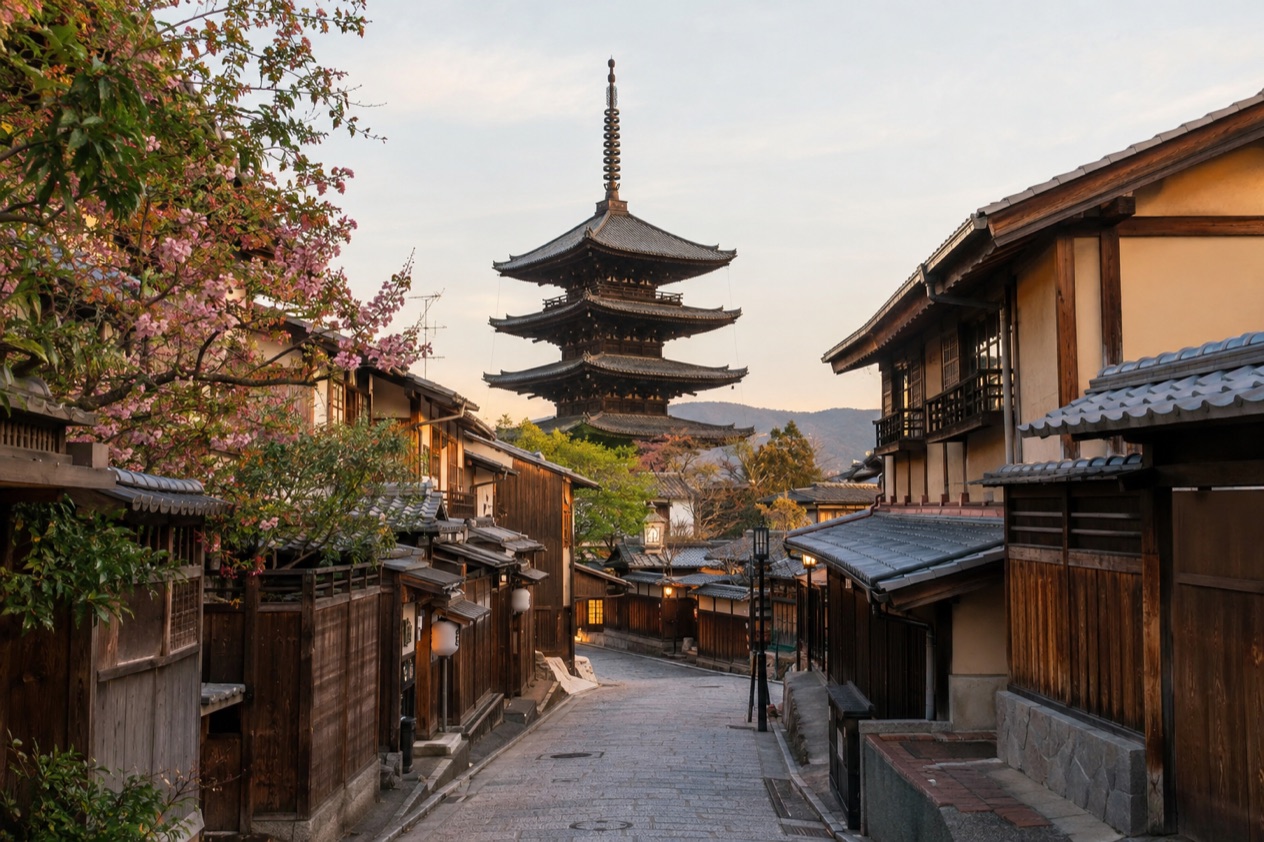
Spring in Kyoto arrives as pale pink over the wooden gates of the temples. In autumn, the maples turn Kyoto’s hillsides red and orange.
Summer settles in damp and heavy, with cicadas in the trees and festival drums in the evenings, and then winter brings cold mornings, steaming bowls of tofu and the occasional dusting of snow. Kyoto, a city of machiya townhouses and temple gardens, has a different face in every season, and each one suits a different kind of trip.
When is the best time to visit Kyoto?
April and November are the best months for most first visits built around temples and gardens, with late March, May and October close behind. Late March and early April belong to the cherry blossoms, and the first blooms in Kyoto usually open around March 26, though in recent years they have come anywhere from mid to late March. November belongs to the maples, since across Japan the leaves turn from mid-November into early December.
For sightseeing, those weeks match what a temple city asks of you. The Japan National Tourism Organization describes autumn in Japan as a time of moderate temperatures ideal for walking, and spring days warm up without the weight of summer.
Food follows the calendar too. Spring kaiseki (the multi-course meals of Kyoto’s restaurants) leans on the first greens and bamboo shoots, summer brings chilled noodles and hamo, a pike conger eel tied to Gion Matsuri season, and winter is for yudofu, tofu simmered in a pot, and other hot dishes.
Matcha sweets and a bowl of ramen on the top floors of Kyoto Station fit any month. For nature, the Keihoku area offers farm stays that put you among fields and farmland.
If you want room to breathe, the cold months of January and February and the wet weeks of June are the stretches when fewer people plan around Kyoto, and the city’s pace feels different. July and August are hot and humid, so frequent breaks indoors help.
Kyoto weather by month
Kyoto moves from cold winters through a hot, humid summer, with mild stretches in spring and autumn.
| Month | Average high (°F) | Average low (°F) | Precipitation (in) | Days with 1 mm or more of precipitation | Hours of sunshine | Daylight on the 15th |
|---|---|---|---|---|---|---|
| January | 48.4 | 34.7 | 2.10 | 6.4 | 124 | 10 h 02 min |
| February | 50.0 | 34.9 | 2.56 | 7.3 | 122 | 10 h 54 min |
| March | 57.4 | 39.7 | 4.18 | 9.5 | 155 | 11 h 54 min |
| April | 68.2 | 48.6 | 4.61 | 9.4 | 177 | 13 h 02 min |
| May | 77.2 | 58.1 | 5.96 | 9.7 | 182 | 13 h 58 min |
| June | 82.6 | 66.6 | 7.86 | 11.5 | 133 | 14 h 30 min |
| July | 89.6 | 74.5 | 8.80 | 11.6 | 143 | 14 h 18 min |
| August | 92.7 | 76.5 | 6.06 | 8.3 | 183 | 13 h 31 min |
| September | 84.6 | 69.3 | 7.03 | 9.8 | 143 | 12 h 27 min |
| October | 74.1 | 57.9 | 5.64 | 8.2 | 156 | 11 h 22 min |
| November | 63.1 | 47.1 | 2.91 | 6.3 | 141 | 10 h 22 min |
| December | 52.9 | 38.3 | 2.26 | 6.6 | 134 | 9 h 49 min |
Winter asks for a real coat. Afternoons stay around 50°F at best and nights hover just above freezing in January and February, with snow or sleet showing up on a good share of those days, though the total stays small.
Rain days are fewer than in summer, but the rain that does come is cold and thin, so a warm layer, gloves and a waterproof shell matter more than an umbrella alone. Spring warms fast, and a sweater that comes off by afternoon is the right companion in April.
June and July are the wettest stretch, with the most rain days of the year and the heaviest totals.
August has fewer rain days and plenty of sun, but the highs reach the low 90s and nights stay warm, so thin, breathable clothes and a hat are the baseline. By October the highs have eased back into the 70s and evenings cool enough for a light sweater.
Daylight shapes how you plan a day. In December the sun is up for just under ten hours, so temple visits compress into the middle of the day. In June the light runs past fourteen hours, which leaves long evenings for walking the lantern-lit streets of Gion after dinner.
What is there to do in Kyoto in each season?
Each season in Kyoto has its own best use, and the calendar decides whether you spend your days under blossoms, in covered temple halls or beneath the maples. The seasons below give a sense of what each one is for.
Spring: cherry blossoms and temple days
Spring is for walking under the cherry trees and for seeing the temples and shrines at their lightest. The blossoms follow a first bloom around the end of March, then drift through the city for days, over canals, castle moats and temple grounds. April highs in the high 60s and May in the high 70s make long days outdoors possible, and the light stretches past thirteen hours by April.
Spring is a good time for the places that reward time on foot. Fushimi Inari Taisha offers a guided tour from DMO Kyoto as one of the featured activities in Kyoto, and its path climbs through rows of torii gates.
The Japan National Tourism Organization suggests visiting shrines early in the morning or late in the evening, when they are illuminated.
The rainy season and summer: indoor Kyoto and festival evenings
June and July are the months to turn toward interiors and details. Nijo Castle, built in 1603 by Tokugawa Ieyasu, the first shogun of the Edo period, has nightingale floors that chirp like birds underfoot, a security system meant to warn guards of intruders.
A samurai experience at Myokakuji Temple includes a sword fighting lesson taught by a professional actor, and Central Kyoto offers an activity to turn your name into kanji and carve a Japanese stamp. These fill a gray day well.
When the sun is out, summer belongs to the evening. Gion Matsuri fills the streets in July, and meals shift to cold noodles and chilled sweets. In the Keihoku area, farm stays offer a green stretch of countryside away from the heat of the city. August is the hottest month on the table, and the plan is simple: early starts, long lunches indoors and walks once the day cools.
Autumn leaves and winter
Autumn is the other season built for walking. Across Japan the leaves turn from red to yellow and orange from mid-November into early December, and Kyoto’s temple gardens and hillsides are where people go to see them. October is a mild lead-in, with the first cool evenings and rain days dropping off. November brings the strongest color and the cooler air that goes with it, so layers become useful again.
Winter is the season for what is left when the crowds around the blooms and leaves are gone: tofu and hot pots, the nightingale floors of Nijo Castle, the machiya streets in cold light and the occasional snow on a temple roof. The cold and the early dusk call for a coat and a plan that finishes before dark. Leave the long walks and the hillside paths for spring or autumn.
When is Kyoto least crowded?
The weeks with the most room are usually the cold ones of January and February and the wet ones of June, since few people build a trip around them. By contrast, the blossom weeks in late March and April and the color weeks from mid-November into early December are the seasons that draw a trip toward Kyoto, so they ask for the most planning.
National holiday stretches also move the calendar. Golden Week in late April and early May, Obon in mid-August and the New Year days are times when Japanese families travel, and a city with this much heritage feels those weeks. If your dates fall in them, build the plan around the places that matter most to you and keep the rest loose.
Time of day matters as much as the month. The Japan National Tourism Organization recommends visiting shrines at less crowded times, such as early morning or late evening when they are illuminated.
A shrine like Fushimi Inari with its gates, or a temple in the eastern hills, reads differently with that light, and the approach holds a different mood. The same advice carries across seasons, so a day in April or November can be shaped around it.
Which months should you avoid in Kyoto?
No month is closed to visitors, but July and August are the hardest for heat and June and July for rain, so those are the months to approach with a plan. Highs sit in the upper 80s and low 90s, nights stay warm, and the humidity keeps afternoons heavy. September stays hot and wet as well, with a high total of rain, before the air turns in October.
The rainy season in June and into July has the most rain days of the year and the grayest skies. Temples and gardens look deeply green in the wet, but plan indoor stops, carry rain gear and keep outdoor plans flexible. Nothing promises a dry day in any month, so keep every outdoor plan flexible.
Winter brings a different test. January and February are cold, with lows near freezing and snow or sleet on many days, though the total stays small. The early dusk shortens the day, and the hillside paths of the temples are less pleasant in cold rain. Spring and autumn ask for a different kind of planning: the bloom dates move from one spring to the next, and the leaves turn on their own schedule, so plan around the seasons rather than a fixed date.
Festivals and events in Kyoto through the year
Spring and early summer
Hanami is the spring custom of gathering beneath the cherry blossoms. Families and friends spread out blankets under the blossoms with food and drink, and the lanterns of Gion and the temple grounds lit in the evening. Dates follow the bloom, which usually begins around the end of March.
In May, Kyoto holds the Aoi Matsuri, a procession of courtiers in Heian-period dress that crosses the city between two of its old shrines. It is a slow, colorful parade of oxcarts, horses and costumes, held around the middle of the month. It suits anyone who likes pageantry and history and is willing to find a spot along the route.
Summer: Gion Matsuri and Obon
Gion Matsuri is the festival most closely tied to Kyoto’s traditions, and it fills the whole month of July. The center of it is the procession of tall wooden floats, the yamaboko, which are pulled through the streets by teams in the middle of the month, with evenings before the parades given over to lantern-lit streets and street food. A float can take days to assemble without nails, and watching one move is a lasting memory.
In mid-August, Obon marks the time when families honor their ancestors, and Kyoto closes it with Daimonji Gozan Okuribi, in which large bonfires are lit on the hills around the city to send spirits back. It is watched from the streets and riverbanks, in the heat of the evening, in a yukata (a light cotton robe) if you like.
Autumn and winter
Jidai Matsuri, held in late October, is a procession of costumes that walks through the centuries of Kyoto’s history, from the Heian court to the late Edo period. It is a good fit for the weeks before the leaves turn, when the days are mild.
The year closes with New Year, when people visit shrines in the first days of January for hatsumode, the first prayers of the year. Fushimi Inari and the large shrines in the city draw visitors in their best clothes, and food stalls line the approaches. In early February, Setsubun marks the turn toward spring with bean-throwing rituals at temples and shrines, and it is a lively way to see a Kyoto tradition in the cold.
Sources
- Japan Meteorological Agency (JMA), Normal values 1991-2020, monthly (https://www.data.jma.go.jp/stats/etrn/view/nml_sfc_ym.php?prec_no=61&block_no=47759), station Kyoto, elevation 41 m, checked October 11, 2026
- Computed from the date and the latitude of the place (sunrise equation, solar elevation -0.833 degrees), October 11, 2026
- Japan National Tourism Organization, Kyoto (https://www.japan.travel/en/destinations/kansai/kyoto/), checked October 11, 2026
- Kyoto City Official Travel Guide, activities (https://kyoto.travel/en/activities), checked October 11, 2026
- Kyoto City Official Travel Guide, areas (https://kyoto.travel/en/areas), checked October 11, 2026
- Japan National Tourism Organization, autumn in Japan (https://www.japan.travel/en/guide/autumn-guide/), checked October 11, 2026
- Japan National Tourism Organization, spring in Japan (https://www.japan.travel/en/guide/spring-guide/), checked October 11, 2026
- Japan Meteorological Agency, cherry blossom first-bloom dates 2021-2026 and 1991-2020 normal (https://www.data.jma.go.jp/sakura/data/sakura003_07.html), checked October 11, 2026
To plan your stay
- Things to Do in Kyoto: Temples, Gardens, Food and Day Trips
- Where to Stay in Kyoto: Kyoto Station, Central and Eastern Districts, and Ryokan Stays
- Kyoto from Tokyo: Shinkansen Trains, Nozomi vs. Hikari and Kodama, and a First Day in Kyoto
- Know Before You Go to Kyoto: Entry, Money, Getting Around and Local Etiquette