
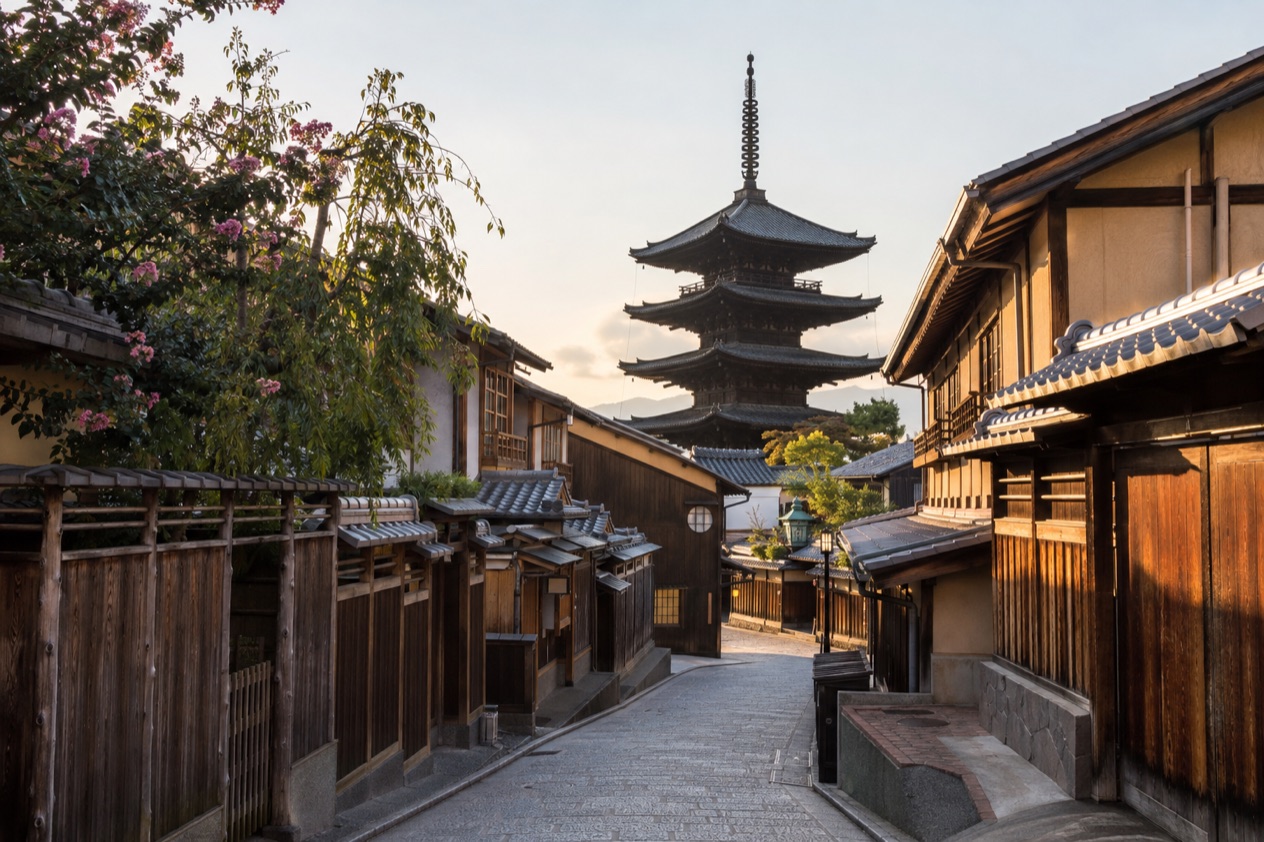
At dusk in Gion, lanterns come on along the wooden fronts of the old teahouses, and the sound of geta sandals sometimes carries down a stone-paved lane. Water slides quietly past willow branches and weathered lattice windows while a few doors slide open to let someone slip inside.
What is Gion like?
Gion is a district of narrow lanes, wooden townhouses and evening entertainment, still organized around the world of geisha and their teahouses. It began in the Sengoku period as an amusement quarter spread out in front of Yasaka Shrine, serving people who came to the shrine and stayed on to eat, drink and be entertained. That mix of the sacred and the pleasure-seeking explains the district’s character to this day: a shrine at one edge, teahouses and restaurants through the middle, and a long temple wall at the other end.
Two hanamachi, the traditional geisha districts, share the neighborhood: Gion Kobu and Gion Higashi. Gion Kobu is the larger and holds Hanamikoji street, while Gion Higashi is the smaller one, tucked into the northeast corner.
Many of the buildings are machiya, old-style wooden townhouses with narrow frontages, and some work as ochaya, teahouses where geisha entertain guests. Walking past them, you see slatted windows, small lanterns, noren curtains and the plain doors that give away very little about what happens behind them.
Gion suits travelers who like to wander at an unhurried pace and look closely at details: a carved sign, a tidy gravel entrance, a stone lantern beside a canal. It also pleases people planning around performances, since the district’s dance seasons tie it to cherry blossoms in April and to autumn leaves in early November.
Henshin studios in the area will dress visitors up as maiko or geisha for a fee. By Kyoto law, those visitors are dressed deliberately inaccurately, so that nobody is mistaken for a real geisha or maiko.
Kyoto’s own traditions are on display here in a compact form: the machiya townhouses, the hanamachi districts where geisha live and work, and the Gion Matsuri festival that takes the district’s name. If you want a single neighborhood in which to feel how that heritage shapes everyday streets, this is it.
Things to do in Gion
Gion rewards walking more than ticking off sights. The main pleasures are a long stroll down its best-known street, an hour along the river, a performance if the calendar lines up, and the shrine that gave the district its start.
Hanamikoji Street
Hanamikoji is the famous street of Gion Kobu, running from Shijo Street at its north end down to the temple of Kennin-ji at the south. Near the Shijo end stands Ichiriki Tei, the celebrated teahouse that anchors the street. Between the two ends you pass rows of machiya with lattice fronts, some of them ochaya, along a stone-paved lane lined with lanterns and wooden signs.
The street is for looking and listening rather than for ticking off monuments. Evenings add the most atmosphere, when the lanterns are lit and you may glimpse a maiko or geisha heading to an appointment.
If you keep walking south, the street opens toward the grounds of Kennin-ji, a change of mood from teahouse lane to temple. It suits anyone who likes architecture and street-level detail, and it pairs well with the river walk nearby.
The Shirakawa River
The stretch of the Shirakawa River in Gion, just before it joins the Kamo River, is a popular preserved area. On the south bank, traditional establishments face the water with their wooden backs and lattice windows. On the north bank runs a pedestrian street shaded by cherry trees, which makes for a pleasant path on any walk through the district.
In spring the cherry blossoms along the water are lit in the evening, and the pale petals against the dark wooden houses are the image visitors carry home. Outside blossom time, the willows, the stone bridges and the reflections of lanterns still make the riverside worth a slow loop. Come once in daylight to see the details of the buildings and once after dark for the glow on the water.
Geisha dances: Miyako Odori and Gion Odori
Two seasonal dances bring the districts onto the stage. The Miyako Odori, performed by the geisha of Gion Kobu, runs throughout April, in step with the cherry blossoms. Gion Higashi holds its own dance, the Gion Odori, in early November, when the autumn leaves are turning.
If you are planning a trip around Gion, these performances are good anchors for a season. Spring pairs the dance with blossoms along the Shirakawa, and autumn offers the quieter, smaller-district counterpart with leaf color across Kyoto. Both are chances to see the art of the geisha as a performance rather than a glimpse in a lane.
Yasaka Shrine and the district’s edge
Yasaka Shrine is where Gion’s story starts, since the entertainment quarter grew up in front of it in the Sengoku period. Standing there, you can picture the original logic of the place: a shrine drawing crowds, and teahouses and stalls forming around them. The shrine is also tied in the minds of Kyotoites to the Gion Matsuri festival, which carries the district’s name.
The Japan National Tourism Organization recommends visiting Kyoto’s shrines at less crowded times, such as early morning or late evening when they are illuminated. That fits Gion well, since the same hours bring the lanterns and the quiet to the nearby lanes.
Within reach of Gion
Gion sits within the wider area of Higashiyama, the eastern part of Kyoto across the Kamo River. From the Tozai Line, Keage Station is near Nanzen-ji, and Kiyomizu Temple lies within the same Higashiyama area, where its Jishu Shrine has two love stones that the lovelorn walk between with eyes closed. Ginkakuji is the northern end of the bus route that runs through the major attractions there.
Eating and drinking in Gion
Eating in Gion means kaiseki, the multi-course meal of small seasonal dishes served in the hushed rooms of traditional restaurants, along with a scattering of tea shops, sweet counters and small bars tucked behind wooden doors. The old townhouses that line the lanes hold many of the places to eat, so a meal often comes with a view into a narrow garden or a tatami room.
The ochaya are different. They are teahouses where geisha entertain guests, not casual restaurants, so expect to look at them from the street.
For something lighter, look for places serving matcha, the powdered green tea whisked to a froth, alongside wagashi, the delicate sweets made to go with it. Kyoto’s cooking leans toward tofu, pickles and seasonal vegetables, so a lunch of tofu dishes or a bowl of soba noodles fits the surroundings well.
In the evening, izakaya, the small Japanese pubs where food comes in shared plates, give a more relaxed route into the night. Grilled skewers, simmered dishes, tempura and a glass of sake or Japanese beer are typical orders. The streets around Shijo hold a different, busier kind of dining, while the lanes closer to Hanamikoji lean toward the intimate and the traditional.
If you want a break from tradition, Kyoto Station has a full floor of ramen restaurants, an option for a hearty bowl when you are passing through. In Gion itself, a good habit is to walk a lane or two off the main path and read the menus posted by the door, since the smallest places often reveal the most about the neighborhood.
Staying in Gion
Gion suits travelers who want to wake up inside the old Kyoto they came to see, with teahouse lanes and the river a few steps from the door. Lodging here tends toward small, traditional places, the kind of ryokan and machiya-style stays that suit a couple or a solo traveler who values atmosphere over size. If you are drawn to sleeping on futons over tatami floors and eating a Japanese breakfast, this is the neighborhood that fits the idea.
Nights are the neighborhood’s identity. The evening is when lanterns glow and the teahouses are at work, so the streets have their own rhythm after dark, with diners and passersby moving between restaurants and the river. If you plan to spend your evenings out in the lanes, being nearby is a gift, because you can walk back rather than plan a ride.
Compared with the area around Kyoto Station, the contrast is clear. Kyoto Station is served by the Tokaido Shinkansen and its building holds an Isetan department store, a theater and a luxury Granvia hotel, so it works as a base for travelers who want rail connections close at hand.
Gion trades that convenience for atmosphere. Higashiyama, the wider eastern region, offers a base closer to the temples and the Tozai Line stops, which suits those who plan to spend their days among Kyoto’s eastern sights.
Pick Gion if the neighborhood itself is a reason for the trip, and pick the station area if rail links are your priority. Travelers split the difference, with a few nights in each.
Getting to Gion
Gion is reached on the east side of the Kamo River, in the part of Kyoto known as Higashiyama, and the train and subway lines serving that side make the approach straightforward to plan. Keihan Railway serves the whole of Eastern Kyoto. It links to Northern Kyoto at Demachiyanagi Station, where you can walk to Shimogamo Shrine or change to the Eizan Railway to go as far as Kurama.
Keihan also runs south to Southern Kyoto and on toward Hirakata and Osaka, with connections to Uji at Chushojima Station. That makes it a natural thread if your trip links Kyoto with Osaka. On the municipal subway, the Tozai Line has Higashiyama Station north of Gion and Keage Station near Nanzen-ji, both convenient for reaching Higashiyama on foot.
If you arrive at Kyoto Station, served by the Tokaido Shinkansen, Kyoto City Bus route 100 runs from the station to Ginkakuji, stopping only at the major attractions in Higashiyama. Kyoto Tower, steps from the station’s main entrance, is a landmark you can see across the city as you get your bearings. Once you are in Gion, walking is how the district is meant to be seen, from Shijo Street along Hanamikoji and down to Kennin-ji, and along the Shirakawa riverside.
Good to know before you go
Gion is a working neighborhood where people live, so it pays to move through its lanes quietly and with respect for the private doors, the teahouses and the residents who pass through them. Keep in mind that the geisha you may spot are on their way to work.
Spring brings the blossoms and the Miyako Odori, and early November brings the Gion Odori, so the calendar shapes what the district feels like. Bring a good pair of walking shoes for stone lanes and bridges, and leave time for a second evening stroll, since the lanterns and the river change the place entirely after dark.
Sources
- Wikipedia, Gion (https://en.wikipedia.org/wiki/Gion), checked October 11, 2026
- Wikivoyage, Kyoto/Higashiyama (https://en.wikivoyage.org/wiki/Kyoto/Higashiyama), checked October 11, 2026
- Japan National Tourism Organization, Kyoto (https://www.japan.travel/en/destinations/kansai/kyoto/), checked October 11, 2026
To plan your stay
- Best Time to Visit Japan: Cherry Blossoms, Autumn Colors, Weather and Festivals
- Where to Stay in Japan: Ryokan, Temple Stays, Capsule Hotels and the Best Cities to Base In
- Sending Luggage from the Airport in Japan: Hands-Free Travel, Hotel Delivery and Coin Lockers
- Know Before You Go to Japan: Entry, Money, Etiquette and Getting Around