
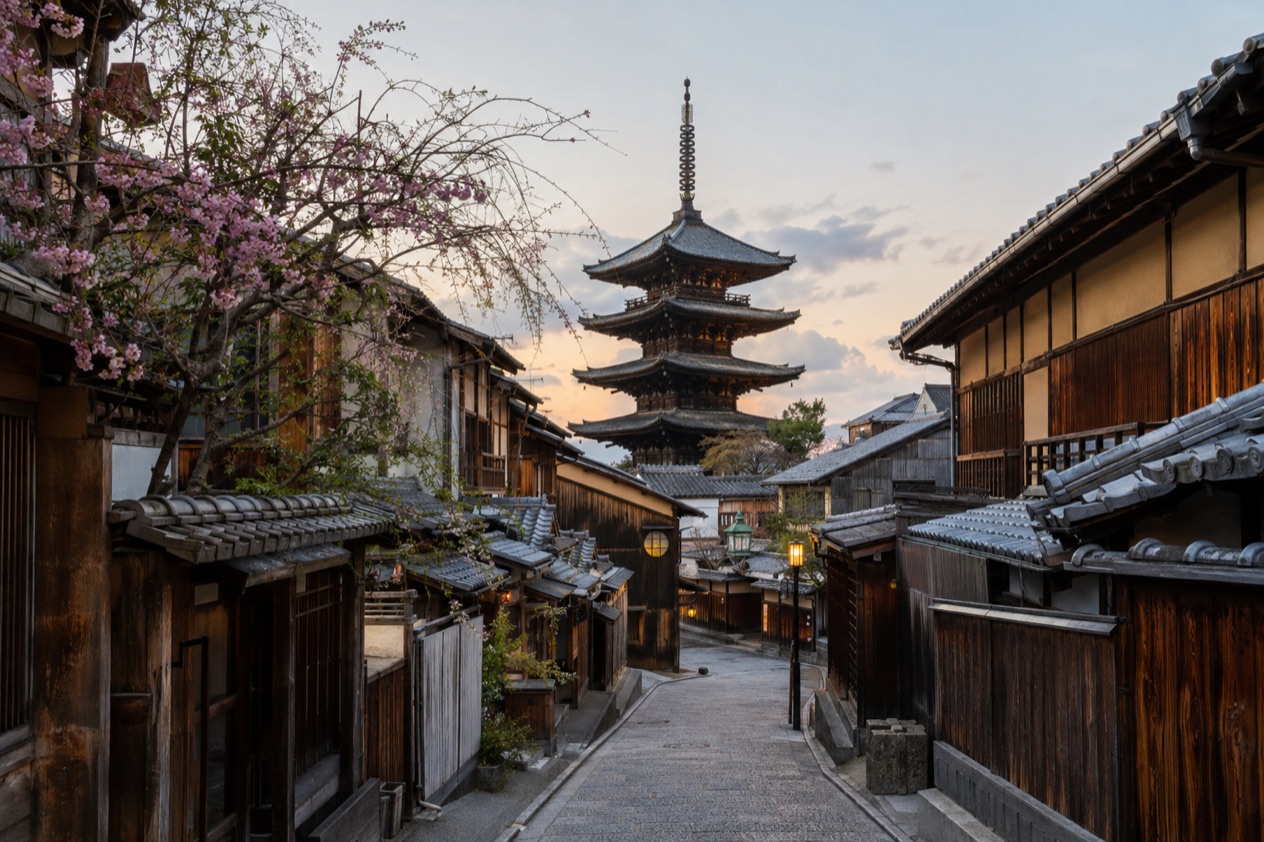
At dusk in Gion, the paper lanterns come on one by one along the wooden machiya townhouses, and the clatter of wooden sandals on stone carries down the lane. Kyoto is a city for travelers who like to spend their days among temples, gardens and tea houses, and their evenings over a long dinner.
What are the best things to do in Kyoto?
The best things to do in Kyoto are to walk through its great temples and shrines, wander its old neighborhoods and gardens, eat the city’s own cooking, and leave room for an excursion into the hills or toward the Sea of Japan. Around that grid, the city is split into five main areas: Central, Eastern, Northern, Southern and Western Kyoto.
Kyoto served as Japan’s capital and the emperor’s residence for over 1000 years, and it shows in almost every block. Its traditions include machiya townhouses, the Gion Matsuri festival and the hanamachi districts where geishas live and work. The list below picks the essentials, and the sections after it open each one up.
- Walk the torii-lined trails of Fushimi Inari Taisha, a shrine that climbs straight into a forested mountain.
- Stand before the Golden Pavilion at Kinkaku-ji, whose upper floors glow with gold leaf above a mirror pond.
- Look out over the city from the wooden stage of Kiyomizu-dera, halfway up the Higashiyama hills.
- Cross the creaking nightingale floors of Nijo Castle, a shogun’s residence turned museum.
- Stroll the Philosopher’s Walk between Ginkaku-ji and Nanzen-ji, a canal path lined with trees.
- Enter the Arashiyama Bamboo Grove and continue to the monkeys of Iwatayama.
- Spend an evening in Gion, where the hanamachi tradition still shapes the streets.
- Eat your way through Kyoto’s tofu, kaiseki, matcha sweets and pickles.
A few of these pair well. Ginkaku-ji and the Philosopher’s Walk belong to one afternoon, and Kiyomizu-dera leads naturally into the lanes of Gion once the lights come on. Fushimi Inari and Arashiyama each deserve a stretch of the day to themselves, because both are places where you keep walking and keep finding another corner.
Sights and landmarks in Kyoto
Kyoto’s landmarks are temples, shrines, a castle and a palace, scattered across all five areas and joined by city buses and the subway. Kyoto City buses and the subway reach Kiyomizu-dera, Gion and Ginkaku-ji, and the city also runs a Sightseeing Limited Express Bus for visitors. Several of the great sites share one distinction, as part of the Historic Monuments of Ancient Kyoto, a UNESCO World Heritage listing.
Fushimi Inari Taisha
Fushimi Inari Taisha stands in Fushimi-ku, at the base of Mount Inari, and it was established in 711 AD. It is the head shrine of all the Inari shrines across Japan, and you will notice stone foxes at the gates, the messengers of Inari, the deity of rice and prosperity. Thousands of vermilion torii gates, each donated by a person or a business, close over the path like a tunnel.
The trails up the mountain span 2.5 miles and take approximately 2 hours to walk up. Along the way, small sub-shrines, tea stalls and clearings open between the gates, with views back over the city.
A guided tour by DMO Kyoto is a featured activity here, for travelers who want the stories behind the gates. Visitors are also recommended to come at less crowded times, early morning or late evening when the shrine is illuminated.
Kinkaku-ji, the Golden Pavilion
Rokuon-ji, better known as Kinkaku-ji, is designated a World Heritage Site. Its Golden Pavilion has top two floors covered with pure gold leaf, and the building doubles itself in the pond in front of it. The grounds are arranged as a stroll garden, so you follow a set path past pines, small islands and stone lanterns, with the pavilion reappearing from new angles.
Pair it with a bowl of matcha and a sweet at the tea house near the end of the route, a small pleasure that suits the setting. It is a visit built around one view, so it fits comfortably in the same day as other sights nearby.
Kiyomizu-dera
Kiyomizu-dera was founded over 1250 years ago and stands halfway up Mt. Otowa, one of the peaks of the Higashiyama mountain range. Its main hall has a broad wooden veranda held up by a lattice of pillars, and from it you look across rooftops and trees toward the city. Beyond the hall, a spring falls into three streams that visitors drink from with long-handled cups.
The temple is part of the Historic Monuments of Ancient Kyoto. Each year on 12 December it holds the Kanji of the Year ceremony, when a monk paints the chosen character on a very large sheet of paper. On the approach, steep lanes of ceramics shops and sweet stalls make the walk up part of the visit.
Nijo Castle
Nijo Castle is a flatland castle built in 1603 by Tokugawa Ieyasu, the first shogun of the Edo period. Inside, the corridors have nightingale floors, planks that make a bird-like sound when walked on, an ancient security system meant to alert guards to intruders. Painted sliding doors and gilded ceilings show how a warlord liked to receive his guests.
The castle is also one of the Historic Monuments of Ancient Kyoto. Outside, a landscaped garden and an orchard of ornamental plum trees surround it, along with many maples that take on exceptional colors in autumn.
Ginkaku-ji, the Imperial Palace and the station
Ginkaku-ji was founded by Ashikaga Yoshimasa, and its main structure is the two-storied Kannon-den, or Kannon hall. The temple is known for its raked sand garden and its moss, and it sits at one end of the Philosopher’s Walk. Back in the city center, the Kyoto Imperial Palace in Kamigyo-ku was the palace of the Emperor of Japan from 1331 to 1869, and its walled grounds are a place to see the court’s old architecture.
Even Kyoto Station is a sight in its own right. The building houses a full floor of ramen restaurants, an Isetan department store, a theater and a Granvia luxury hotel, and Kyoto Tower stands a few steps from the main entrance.
Outdoor things to do in Kyoto
Outdoors in Kyoto means canal paths, bamboo, temple gardens and wooded mountains that begin at the edge of the city. The seasons give each of these a different face, from plum and cherry blossoms to maples that turn deep red in autumn.
The Philosopher’s Walk
The Philosopher’s Walk is a pedestrian path between Ginkaku-ji and Nanzen-ji, following a narrow canal under a canopy of trees. It first opened in 1890 and was extended in 1912, and its name comes from the thinkers who strolled it. Small cafés, craft shops and tiny shrines appear along the way, so the walk breaks easily into pauses.
In spring, petals drift on the water of the canal, and in autumn the leaves turn. Because it joins two temples, you can start at either end, and the path leads you on into the Higashiyama temples nearby.
Arashiyama
The Arashiyama Bamboo Grove, also known as the Sagano Bamboo Forest, is a notable site in Arashiyama. The stalks rise on both sides of the path and rustle in the wind, filtering the light to a green glow.
Iwatayama Monkey Park lies on the slopes of Arashiyama, where Japanese macaques roam in the open and the hillside looks out over Kyoto. Here the climb is part of the pleasure, and the macaques are watched from a respectful distance. The grove, the river and the park together make Arashiyama a place to linger.
Takao and the Sanbi temples
The Takao area has three mountains collectively known as the Sanbi, known for their temples and lush greenery. This is the Kyoto of forest paths, wooden halls tucked among cedars and mountain air. The maples here are a draw in autumn, when the hillsides turn red and gold.
It suits travelers who have already seen the central temples and want a different kind of Kyoto, with trees rather than city blocks around the buildings. The stone steps and the shade make it a place for slow walking.
Gardens, orchards and farm country
Many of Kyoto’s temples are really gardens with a building attached. The grounds of Nijo Castle include a plum orchard and many maples, Ginkaku-ji is known for moss and raked sand, and Kinkaku-ji is laid out as a stroll garden around its pond. In the Keihoku area, farm stays put visitors in touch with nature and agriculture, a different kind of green space altogether.
Day trips from Kyoto
The day trips from Kyoto lead to a seaside sandbar, to mountain villages, to a neighboring ancient capital and to the cities of the Kansai plain. Kyoto Station is served by the Tokaido Shinkansen line, which makes it a starting point to connect to major cities across Japan. Traveling from Tokyo Station to Kyoto by the most direct shinkansen line takes about 2 hours and 20 minutes.
Amanohashidate and Ine
In northern Kyoto, near the Sea of Japan, lies the sandbar Amanohashidate, a long strip of pines stretching across a bay. People walk or cycle along it, and a classic way to see it is from a lookout with your back to the view, bending over to see it upside down. The name is often translated as the bridge to heaven.
The fishing village of Ine is known for its boat houses, wooden buildings with the water at their doors. A day in this part of the prefecture is a different pace from the city, built around the water and the open horizon. It suits travelers who have had their fill of temples and want a day of sea air and small-town scenery.
Keihoku and Miyama
Keihoku and Miyama show the natural splendor of northern Kyoto, in a landscape of forested hills and rural villages. Keihoku has farm stays, so you can see how vegetables and rice are grown in the area. Miyama is known for its thatched farmhouses, which give the valley a look from another century.
These are outings for travelers who like photography and slow walks over sightseeing lists. Plan around the day’s light and bring comfortable shoes, since a village visit means walking on country roads.
Nara and the Kansai cities
Nara, Japan’s other ancient capital, is the trip travelers pair with Kyoto. Its large park is home to deer that bow for crackers, and its temple Todai-ji holds an enormous bronze Buddha. The city has a gentler scale than Kyoto, with wide lawns between the sights.
Osaka, Kobe and other Kansai cities also lie within reach of Kyoto, and each brings its own character, from Osaka’s street food to Kobe’s harbor. Travelers who stay in Kyoto several days sometimes use it as a base for one or two such excursions.
What to eat in Kyoto
Kyoto eats in a style of its own, built on seasonal vegetables, tofu, delicate broths and sweets made for the tea ceremony. The cooking grew up around temples and the imperial court, so it favors subtle flavors and careful presentation over bold seasoning. Even the humble dishes are served with attention to the season.
Kaiseki and temple cooking
Kaiseki is Kyoto’s refined multi-course meal, a procession of small dishes that follows the season. Bamboo shoots arrive in spring, and in autumn there are mushrooms and chestnuts. Each course comes on its own plate, chosen to match the food and the month.
Shojin ryori, the vegetarian cooking of Buddhist temples, shares the same spirit with no meat or fish. Tofu, sesame, seasonal vegetables and pickles are laid out in lacquer bowls. Some ryokan serve kaiseki dinners as part of the stay, a habit worth knowing about when you choose where to sleep.
Tofu, obanzai and pickles
Yudofu, tofu simmered in a hot pot of kelp broth, is a classic of the temple districts. The soft, silky tofu is dipped in sauce and eaten with a few vegetables. Obanzai is the term for Kyoto’s home-style dishes, small plates of simmered vegetables, fish and eggs that make up an everyday meal.
Tsukemono, Kyoto pickles, come in shades of pink, green and yellow, from turnips to eggplant. They appear at almost every meal and are sold by weight in the market stalls of the city. Nishiki Market is the long covered lane where many of these foods are on display, from pickles to skewers and sweets.
Matcha, wagashi and ramen
The tea of the Kyoto region is a point of pride, and matcha appears in everything from a ceremonial bowl to ice cream, parfaits and soft cakes. Wagashi, the traditional sweets, are shaped by hand into leaves, flowers and fruit that follow the season. They are made to go with bitter tea, and the pairing is the point.
For something heartier, Kyoto Station building has a full floor of ramen restaurants, so a bowl of noodles is easy to find on arrival or departure. Kyoto’s ramen tends to come in many styles, and a floor like this lets you compare them within a single building.
Things to do in Kyoto at night
At night Kyoto turns to its lantern-lit lanes, riverside dining and illuminated temples. The tradition of the hanamachi districts, where geishas live and work, gives Gion its after-dark character. Some of the shrines are open late, and visitors are recommended to see them when they are illuminated in the late evening.
Gion after dark
As evening falls, you may see maiko and geiko hurrying to appointments in their kimono, though sightings are never certain. The pleasure is in walking the lanes and watching the light change on the old facades.
Treat the district as a place where people live and work. Many of the houses are private, so you look from the street rather than step into the doorways. A walk through Gion fits naturally after a visit to Kiyomizu-dera, as the lanes lead down from the hills.
Dinner, drinks and lantern light
Kyoto’s evenings revolve around food. Izakaya, the Japanese pubs, serve small plates alongside beer, sake and shochu, and a long evening of sharing dishes is the usual way to eat in them. Narrow alleys in the center hold tiny bars with only a few seats, where the owner pours and talks.
Kyoto Tower stays visible across the entire city, a landmark you can use to find your way back toward the station. The station building itself holds restaurants, a theater and a department store, so there is something to do there even when you arrive late.
Shrines and temples by evening light
Visitors are recommended to see Kyoto’s shrines at less crowded times, such as early morning or late evening when they are illuminated. Fushimi Inari Taisha, with its gates stretching up the mountain, is a shrine travelers associate with lantern light. Seeing the vermilion gates in the dusk is quite different from seeing them in the middle of the day.
In autumn, some temples in the city are lit up for evening viewing of the maples, with the leaves glowing against the dark. Nijo Castle, with its many maples, is a place where those colors are celebrated.
Things to do in Kyoto with kids
Children in Kyoto enjoy the things that let them do rather than only look: dressing up, swinging a sword, feeding deer, watching monkeys and walking under tunnels of red gates. The city has experiences designed for visitors that turn history into play. Distances between sights are real, so a day works best with one or two main stops and time between them.
Samurai, kimono and kanji
A samurai experience at Myokakuji Temple includes a sword fighting experience taught by a professional actor. Children can try the movements of the old warriors, and the lesson is a performance as much as a class. It makes the samurai history of the city something to act out, not only to read about.
In Eastern Kyoto, Kyoto Kimono Rental Kyokomachi offers a kimono experience, and wearing traditional dress changes the way a child sees the streets. In Central Kyoto, an activity lets you turn your name into kanji and carve a Japanese stamp, a souvenir that children make themselves.
Animals, gates and open space
Iwatayama Monkey Park on the slopes of Arashiyama puts children among monkeys in an open setting, with a view of the city as a reward for the climb. The Arashiyama Bamboo Grove close by gives them a green tunnel to walk through. Fushimi Inari Taisha is another place where children tend to enjoy the game of counting the gates, though the full trails up the mountain take approximately 2 hours.
Nara, a day trip, has deer in its park, a draw for young travelers. For a break from temples, Kyoto Station building has a theater, and the ramen floor is a convenient place to feed a hungry family. With the north of the prefecture, the farm stays of Keihoku let children see where food comes from.
Good to know before you go
Getting around Kyoto is mostly a matter of City buses and the subway, which reach Kiyomizu-dera, Gion and Ginkaku-ji, along with the Sightseeing Limited Express Bus and the Kyoto Okazaki Loop Bus. JR-WEST RAIL PASS holders can use the Subway & Bus 1-Day Pass in Kyoto. Kyoto Station, served by the Tokaido Shinkansen, is the arrival point for travelers, and the five main areas of the city, from Central to Western Kyoto, give a simple way to organize your days.
Sources
- Japan National Tourism Organization, Kyoto (https://www.japan.travel/en/destinations/kansai/kyoto/), checked October 11, 2026
- Kyoto City Official Travel Guide, activities (https://kyoto.travel/en/activities), checked October 11, 2026
- Kyoto City Official Travel Guide, areas (https://kyoto.travel/en/areas), checked October 11, 2026
- Kyoto City Transportation Bureau, bus and subway guide (https://www2.city.kyoto.lg.jp/kotsu/webguide/en/), checked October 11, 2026
- Fushimi Inari Taisha, official site (https://inari.jp/en/), checked October 11, 2026
- Wikipedia, Fushimi Inari-taisha (https://en.wikipedia.org/wiki/Fushimi_Inari-taisha), checked October 11, 2026
- Wikipedia, Kinkaku-ji (https://en.wikipedia.org/wiki/Kinkaku-ji), checked October 11, 2026
- Kiyomizu-dera Temple, official site (https://www.kiyomizudera.or.jp/en/), checked October 11, 2026
- Wikipedia, Kiyomizu-dera (https://en.wikipedia.org/wiki/Kiyomizu-dera), checked October 11, 2026
- Wikipedia, Arashiyama (https://en.wikipedia.org/wiki/Arashiyama), checked October 11, 2026
- Wikipedia, Nijō Castle (https://en.wikipedia.org/wiki/Nij%C5%8D_Castle), checked October 11, 2026
- Wikipedia, Kyoto Imperial Palace (https://en.wikipedia.org/wiki/Kyoto_Imperial_Palace), checked October 11, 2026
- Wikipedia, Ginkaku-ji (https://en.wikipedia.org/wiki/Ginkaku-ji), checked October 11, 2026
- Wikipedia, Philosopher's Walk (https://en.wikipedia.org/wiki/Philosopher%27s_Walk), checked October 11, 2026
To plan your stay
- Best Time to Visit Kyoto: Cherry Blossoms, Autumn Leaves, Weather by Month and Festivals
- Where to Stay in Kyoto: Kyoto Station, Central and Eastern Districts, and Ryokan Stays
- Kyoto from Tokyo: Shinkansen Trains, Nozomi vs. Hikari and Kodama, and a First Day in Kyoto
- Know Before You Go to Kyoto: Entry, Money, Getting Around and Local Etiquette