
In August, Kyoto’s cicadas start up in the temple groves long before the day warms, and by evening the sound gives way to wind chimes and the smell of incense drifting from family altars. Obon brings the old capital’s ancestors home, and the city marks it with prayers, lanterns and fires lit on the hillsides. It is a month for cool noodles, riverside tables, shaded temple halls and slow nights in Gion.
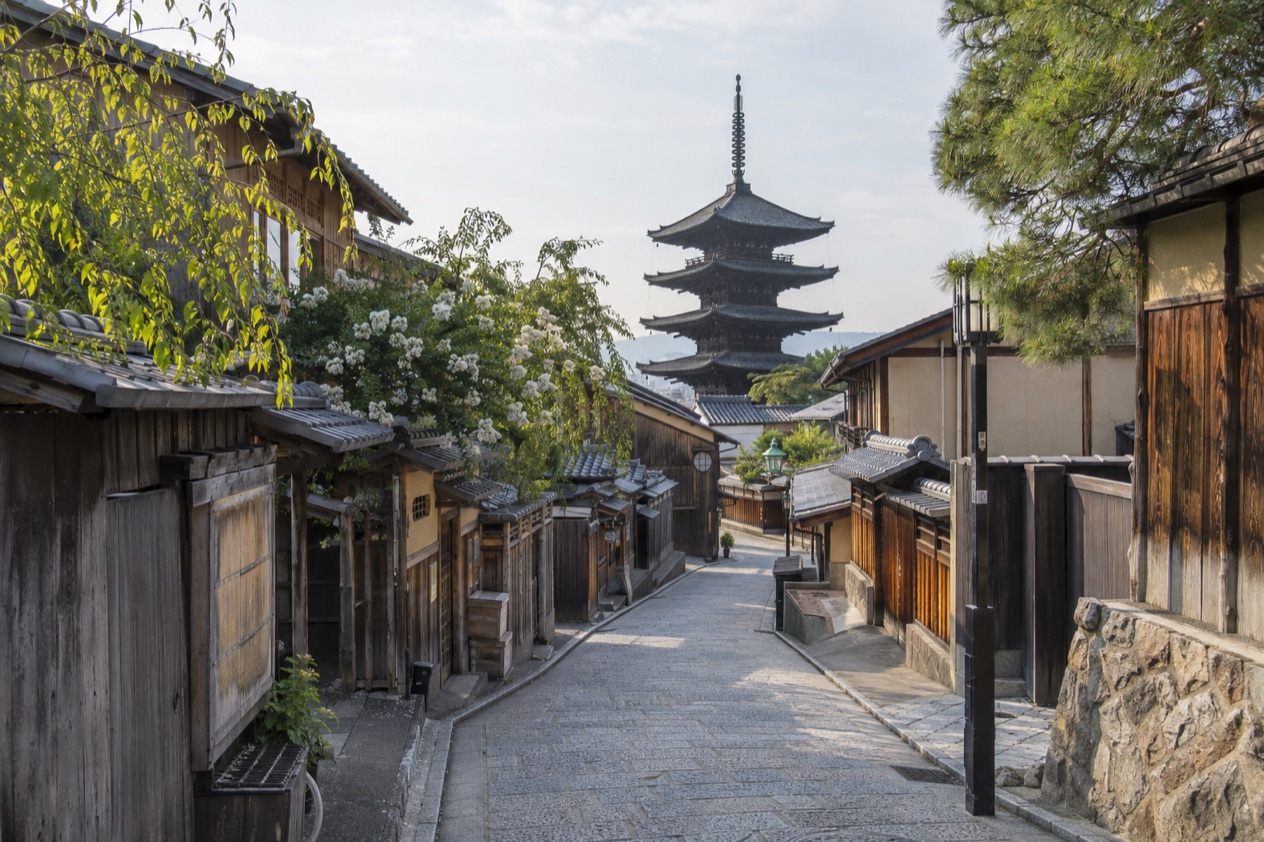
What is the weather like in Kyoto in August?
August in Kyoto is hot, humid and sunny, a little drier than July but with no relief from the heat. The rainy season is over, and the sky is clearer than in the weeks before.
| Month | Average high (°F) | Average low (°F) | Precipitation (in) | Days with 1 mm or more of precipitation | Hours of sunshine | Daylight on the 15th |
|---|---|---|---|---|---|---|
| July | 89.6 | 74.5 | 8.80 | 11.6 | 143 | 14 h 18 min |
| August | 92.7 | 76.5 | 6.06 | 8.3 | 183 | 13 h 31 min |
| September | 84.6 | 69.3 | 7.03 | 9.8 | 143 | 12 h 27 min |
Nights stay warm, so a jacket never comes out of the bag. The humidity is part of the picture, and the coolest hours are not cool. Plan on thin, breathable clothes you can rinse out in the hotel sink, and expect to change a shirt once in the course of a day of sightseeing.
Rain still falls on a handful of days, and when it does it tends to come as a heavy shower rather than a gray, settled day. A compact umbrella earns its place, and it doubles as shade when the sun is hard on the stone paths of the temples. Late August also opens Kyoto’s typhoon season, which can bring wind and heavy rain to the city.
Daylight is generous but already shortening compared with July, so evenings begin a little earlier than they did a month ago. That suits a city that comes alive after dark, with lanterns lit along the lanes of Gion and the Kamo River bank filling with people.
What to do in Kyoto in August
The big event of the month is Obon, the Buddhist custom of honoring the spirits of one’s ancestors. Families return to ancestral places, visit and clean the family graves, and the festival lasts three days. In Kyoto it is less a spectacle than a mood: temples hold services, incense burns at household altars, and the city’s rhythm slows around it.
Obon and the fires on the mountains
Kyoto closes Obon with Gozan no Okuribi, the sending-off fires. On the last night of the festival, bonfires are lit one after another on the hills ringing the city, among them the giant character for “large” that gives the event its popular name, Daimonji. The idea is to guide the returning spirits back to the other world.
You watch from the streets, bridges and riverbanks rather than from any one place, and the city goes quiet and dark around the flames. Streetlights and some signs are dimmed in the neighborhoods with a view, and people stand together looking up at the slopes. It is a moving thing to see, and the fires burn for a short time only, so give yourself an evening with nothing else planned.
Nijo Castle and the other shaded sights
Nijo Castle, built in 1603 by Tokugawa Ieyasu, the first shogun of the Edo period, is a good August choice because so much of the visit happens under deep eaves and across polished corridors. You hear them with every step.
Kiyomizu-dera, Gion and Ginkaku-ji are reached by Kyoto City buses and the subway, and the city also runs a Sightseeing Limited Express Bus for visitors. Fushimi Inari Taisha, with its tunnels of vermilion torii gates climbing the hillside, has a guided tour by DMO Kyoto among the featured activities in Kyoto. In summer the gates and the trees give some shade along the way.
Hands-on Kyoto when the sun is too much
Some of Kyoto’s best August hours are spent indoors. In Central Kyoto you can turn your name into kanji and carve it into a Japanese stamp, a small souvenir you make yourself.
For a change of scene, the Keihoku area offers farm stays that put visitors in touch with nature and agriculture. Kyoto is split into five main areas: Central, Eastern, Northern, Southern and Western Kyoto, and the city center follows a grid pattern modeled on Chang’an, the capital of China’s Tang dynasty. That grid makes it simple to read a map when you are choosing what to do next.
Summer food in Kyoto leans cold and light. Look for somen noodles, sometimes served in a trickle of water down bamboo, chilled soba, kakigori shaved ice with syrup or matcha, and hamo, the summer pike conger that kaiseki restaurants prepare with careful knife work. Matcha desserts, tofu dishes and pickles round out a table that never feels heavy in the heat.
In the evening, riverside terraces called kawadoko are set out over the water in the city’s riverside districts, and sitting at one with a cold drink is one of the pleasures of a Kyoto summer. Yukata, the light cotton summer robes, appear on the streets of Gion and around the temples, and Nishiki Market is a place to graze through pickles, skewers and sweets while the afternoon passes.
A two-day itinerary for Kyoto in August
Day 1 starts at Fushimi Inari Taisha, where the climb through the torii gates is the main business of the morning and the cover of trees gives some relief from the sun. Head back into town for a cold noodle lunch, then take a bus or the subway to Eastern Kyoto and Kiyomizu-dera. The wooden stage and the hillside around it fill a good part of the afternoon.
As the light softens, walk the lanes of Gion past the teahouses, then settle in for dinner at a kaiseki restaurant or an izakaya, the casual pub where small plates arrive in a steady stream. If Obon’s last night falls during your stay, keep the evening free and find a spot with a view of the hills.
Day 2 begins at Nijo Castle in Central Kyoto, with the nightingale floors and the long, cool corridors. Lunch can be a grazing walk through Nishiki Market, with pickles, tofu and skewers, followed by a cold dessert of shaved ice or matcha in a tea shop.
Spend the afternoon on a hands-on activity indoors, either carving your name stamp or trying the samurai sword lesson at Myokakuji Temple. Finish the evening with a table over the water at a riverside kawadoko. If a heavy shower rolls in, move everything indoors: the castle, the market arcades and the craft workshops all keep the day intact.
Is Kyoto busy in August?
August is a month of heat rather than a season of blossoms or red maples, and that shapes the pace of the city more than anything else. Without a flower or leaf season to draw people, the rhythm of the days follows the weather and the calendar of Obon.
Obon is when people return to ancestral family places, so the movement of the month is as much about Japanese families going home as about visitors arriving. In Kyoto, that means a mood of remembrance in the temples and neighborhoods, with the closing fires on the hills as its high point.
The heat sets the daily rhythm. Temples and gardens are visited in short stretches, with long pauses in tea shops, department store arcades and cool restaurants between them. Evenings then take over, with the river terraces, the lantern-lit lanes of Gion and the markets filling with people once the sun is lower. Plan the day in two halves and you will find the city moves the same way.
What to pack for Kyoto in August
Pack for heat and humidity, with a plan for wet shoes and damp clothes. Most of the month is about walking between shaded stops.
- Light, breathable shirts and shorts or skirts, since the humidity makes heavy fabrics uncomfortable.
- A compact umbrella, useful for sudden showers and for shade on stone paths.
- Comfortable walking sandals or shoes that dry quickly, for the torii stairs and temple grounds.
- A small towel or handkerchief, because you will wipe your face often between stops.
- A reusable water bottle for long days of sightseeing.
- A light layer for the strongly air-conditioned shops, trains and restaurants.
Good to know before you go
Kyoto’s rainy season runs from about mid-June to the end of July, so by August it has passed. A typhoon season begins in late August and continues through September, which means a heavy day of wind and rain is possible toward the end of the month, and a flexible plan with indoor options is useful.
Obon lasts three days and shapes the mood in the temples and neighborhoods, with families visiting graves and returning to ancestral places. When a national holiday falls on a Sunday, the next working day becomes a public holiday, and a day between two holidays becomes one too.
Kyoto in August vs July and September
Moving the trip four weeks earlier means July, the month of the end of the rainy season, with more rain days, grayer skies and the heat building with the humidity. It is also the month of the city’s grand summer festival, Gion Matsuri, which belongs to July, and August lacks it. Choose July if the festival is what you want and you can take the damp.
Moving four weeks later takes you to September, when the heat is easing and the days are shorter, but the typhoon season is in full swing. Evenings are milder and long walks are more comfortable, though showers become more frequent than in August. It is a better month for covering ground on foot than the peak of summer.
August suits travelers who want the sunniest stretch of the summer, the sending-off fires of Obon and long evenings on the river. September suits those who want gentler walking days and are happy to keep a rain plan. July suits the festival fans who accept the damp air. Heat-sensitive travelers will probably be happier in September.
Is August a good time to visit Kyoto?
Yes, for travelers who can take the heat and want to see the city in its Obon mood. Those who love the evening, the lantern light and the cold dishes of summer will find a lot to like, and those who struggle with humid heat should look at another month.
On arrival, set your days around the heat. Put the big outdoor sights in the part of the day when you feel strongest, and use the afternoons for Nijo Castle, the market arcades, a tea shop or a craft workshop. Keep the last night of Obon free for the fires on the hills.
Sources
- Japan Meteorological Agency (JMA), Normal values 1991-2020, monthly (https://www.data.jma.go.jp/stats/etrn/view/nml_sfc_ym.php?prec_no=61&block_no=47759), station Kyoto, elevation 41 m, checked October 11, 2026
- Computed from the date and the latitude of the place (sunrise equation, solar elevation -0.833 degrees), October 11, 2026
- Japan National Tourism Organization, shop and attraction hours, national holidays (https://www.japan.travel/en/plan/business-hours-and-holidays/), checked October 11, 2026
- Wikipedia, Obon (https://en.wikipedia.org/wiki/Obon), checked October 11, 2026
- Wikipedia, Public holidays in Japan (https://en.wikipedia.org/wiki/Public_holidays_in_Japan), checked October 11, 2026
- Japan National Tourism Organization, summer in Japan (https://www.japan.travel/en/guide/summer-guide/), checked October 11, 2026
- Japan National Tourism Organization, festivals and events (https://www.japan.travel/en/see-and-do/festivals-and-events/), checked October 11, 2026
- Wikipedia, Hanabi (https://en.wikipedia.org/wiki/Hanabi), checked October 11, 2026
- Japan Meteorological Agency, Emergency Warnings (https://www.jma.go.jp/jma/en/Emergency_Warning/ew_index.html), checked October 11, 2026
- Japan National Tourism Organization, safety information (https://www.japan.travel/en/japan-safe-travel-information/), checked October 11, 2026
- Japan National Tourism Organization, weather and seasons in Japan (https://www.japan.travel/en/plan/weather/), checked October 11, 2026
- Wikipedia, Awa Odori (https://en.wikipedia.org/wiki/Awa_Odori), checked October 11, 2026
- Wikipedia, Climate of Japan (https://en.wikipedia.org/wiki/Climate_of_Japan), checked October 11, 2026
- Japan National Tourism Organization, Mount Fuji guide (https://www.japan.travel/en/fuji-guide/), checked October 11, 2026
- Official website for Mt. Fuji climbing, about the climb (https://www.fujisan-climb.jp/en/about/), checked October 11, 2026
- Wikipedia, Nebuta (https://en.wikipedia.org/wiki/Nebuta), checked October 11, 2026
- Wikivoyage, Kyoto (https://en.wikivoyage.org/wiki/Kyoto), checked October 11, 2026
- Japan National Tourism Organization, Kyoto (https://www.japan.travel/en/destinations/kansai/kyoto/central-kyoto/), checked October 11, 2026
- Kyoto City Official Travel Guide, activities (https://kyoto.travel/en/activities), checked October 11, 2026
- Kyoto City Official Travel Guide, areas (https://kyoto.travel/en/areas), checked October 11, 2026
- Kyoto City Transportation Bureau, bus and subway guide (https://www2.city.kyoto.lg.jp/kotsu/webguide/en/), checked October 11, 2026
To plan your stay
- Things to Do in Kyoto: Temples, Gardens, Food and Day Trips
- Where to Stay in Kyoto: Kyoto Station, Central and Eastern Districts, and Ryokan Stays
- Kyoto from Tokyo: Shinkansen Trains, Nozomi vs. Hikari and Kodama, and a First Day in Kyoto
- Know Before You Go to Kyoto: Entry, Money, Getting Around and Local Etiquette