
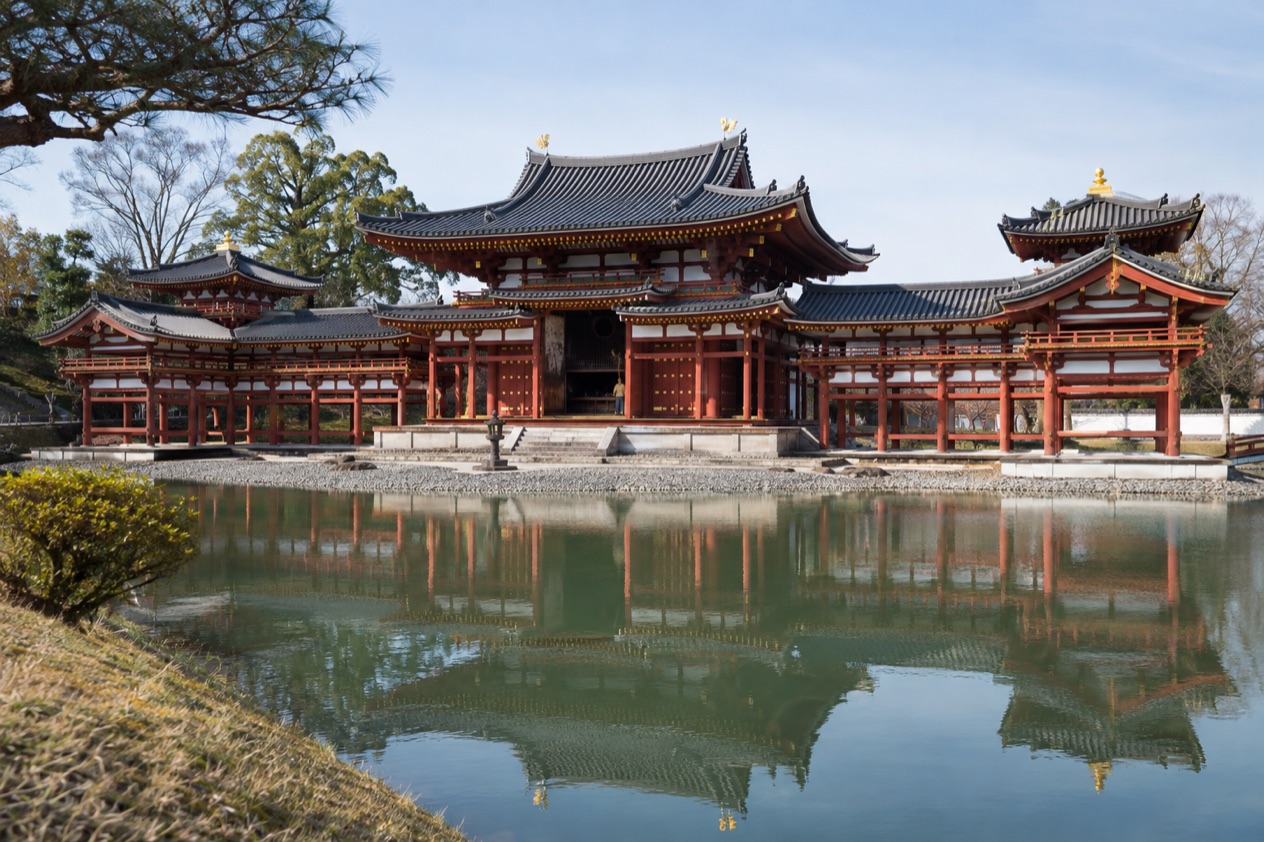
The first glimpse of Byodo-in comes across a pond: a vermilion hall with its wings spread wide, mirrored in still water, while two bronze birds stand on the roof ridge. Visitors pause at the water’s edge before they do anything else, because the view asks for a moment. This is a temple in the town of Uji, in Kyoto Prefecture, and the visit centers on one famous hall, its garden and a cup of local tea.
Is visiting Byodo-in worth it?
Yes, if you like seeing a single building in its setting, and it suits travelers who enjoy Buddhist art, garden design and slow looking more than a checklist of halls. The Phoenix Hall (Hoo-do) was completed in 1053 and is the only original building left on the grounds. The visit naturally centers on the hall, the pond, the garden paths and the views across the water.
What sets it apart from the temples inside the city of Kyoto is that it is built around one composition. Many Kyoto temples are compounds of halls, gates and gardens that you move through one after another.
Here the hall faces you across the water, and the garden in front of it is a nationally designated Historic Site and Place of Scenic Beauty. The temple also belongs to the group listed by UNESCO in December 1994 as the Historic Monuments of Ancient Kyoto, so it sits alongside the better-known sights of the old capital while being set in Uji, a town with its own identity.
Uji adds a second reason to go. The town is known for its green tea, and you can finish a visit with a tea break on the temple grounds. Travelers who want a day of tea, gardens and a quiet-minded kind of sightseeing will find the pairing satisfying. Those who prefer sprawling castles or crowded markets may find the visit more compact in spirit than in the lively streets of central Kyoto.
Culture-minded visitors get the most from it. The hall is a model of paradise, a vision of the Pure Land of Amida Buddha rendered in wood, lacquer and water. Knowing that changes how you look at the symmetry of the wings, the lotus-like pond and the birds on the roof, which stop being decoration and become part of a story about the afterlife.
What to see at Byodo-in
The Phoenix Hall
The Phoenix Hall is the reason most people come, and it is the most famous building at Byodo-in. Its name comes from the shape of the building and from the pair of phoenix figures on the roof. The central block rises in the middle with long corridors reaching out like wings, and a tail corridor behind completes the bird in the plan.
Look at the details more than the overall silhouette. Under the eaves the timber is painted and carved with fine patterns, and the proportions feel light for such a large structure. Inside, a seated Amida Buddha is the focus of the hall, and the building was designed so that the figure could be seen from across the pond, as if the paradise were opening to the worshipper on the far shore.
Stand on the near side of the water first and take in the whole hall at once. Then walk around the pond edge, because the reflection and the angle change with every few steps. The hall is the only original building, so it carries the whole weight of the temple’s history.
The pond garden
The Jodo-shiki garden in front of the hall is a nationally designated Historic Site and Place of Scenic Beauty. Jodo-shiki means a Pure Land style garden, one built to evoke the paradise of Amida Buddha, with the hall as the palace and the pond as the sea of lotus that separates this world from the next.
A path follows the water, with pines and carefully set stones leaning toward the surface. The garden changes with the weather and the light, so the same view can look glassy on a still gray morning and crisp on a bright afternoon. Visitors who like to photograph the hall often wait for the surface to settle, and the reflection rewards the patience.
The tour inside the Phoenix Hall
The tour inside the hall is conducted in Japanese, but an English paper guidebook is provided. That means non-Japanese speakers can still follow what they are seeing, reading as the guide speaks and matching the text to the Buddha and the carved details around it.
Inside you are close to the figure of Amida that you saw from across the water. The interior is where the temple’s symbolism becomes concrete, with the lacquered, gilded and painted surfaces that the exterior only hints at. Treat it as a short, focused look at the heart of the site rather than a full museum visit.
Tea Salon Toka and Uji tea
The Byodoin Tea Salon Toka is on the grounds and gives the visit a natural pause. Uji is famous for its tea, and a cup of green tea, perhaps with a sweet made with matcha, is a fitting way to follow a walk around the pond.
If the salon is closed on the day you come, the town of Uji itself is full of places that sell matcha, ice cream flavored with it and boxed tea to take home. The tea culture is part of why a trip here feels distinct from the rest of a Kyoto itinerary.
Kannon-do Hall
The Kannon-do Hall is currently under renovation and not open to the public. You will not be able to go inside, so plan the visit around the Phoenix Hall, the garden and the tea salon. Scaffolding or covers may affect how some parts of the grounds look when you arrive.
Hours, tickets and rules
The one place on the grounds with set hours is the tea salon, which is open every day except Tuesday and takes its last orders half an hour before closing. The salon is the practical anchor of the day, so it helps to fit your walk around the pond with a stop there in mind.
| Site | Open |
|---|---|
| Byodoin Tea Salon Toka | Monday to Sunday, closed Tuesday, 10:00 to 16:30 (last orders 16:00) |
The tour inside the Phoenix Hall is conducted in Japanese, with an English paper guidebook provided. The Kannon-do Hall is under renovation and not open to the public.
When to visit Byodo-in
Any season gives the hall a different mood, and the pond garden is designed to be seen as the weather and the light change. That is a recommendation for the city’s sights, and .
Spring and fall are mild, summer is hot and humid, and winter is cold with some snow.
| Month | Avg. high (°F) | Avg. low (°F) | Precipitation (in) | Days with rain |
|---|---|---|---|---|
| January | 48.4 | 34.7 | 2.10 | 6.4 |
| April | 68.2 | 48.6 | 4.61 | 9.4 |
| July | 89.6 | 74.5 | 8.80 | 11.6 |
| October | 74.1 | 57.9 | 5.64 | 8.2 |
January is cold, with sunshine in short supply and snow or sleet falling on many days, so a walk around an open pond calls for warm layers. April is mild, and it is the month when a long outdoor stroll feels comfortable. Some days bring rain, so a light waterproof layer is useful.
July is hot and humid with the heaviest rainfall of the four months. Showers can be frequent, and the heat can make a long garden walk tiring, so a hat and a drink are sensible. October is warm by day and cool by evening, with more sun than July and fewer wet days, which makes a pleasant window for lingering by the water and stopping for tea.
Tips for your visit
Start at the edge of the pond and look at the hall from a distance before you do anything else. The building was designed to be seen across the water, so the view from the far side is part of its meaning. Then circle the pond, keeping your eyes on how the reflection shifts.
Pick up the English paper guidebook for the tour inside the Phoenix Hall, since the commentary is in Japanese. Read it ahead of time if you can, and notice the Amida Buddha and the symbolism of paradise that the guidebook explains. Plan the tea salon for a moment when you want a rest, remembering that it is closed on Tuesday and takes last orders at four in the afternoon.
Byodo-in pairs well with a tea-focused stroll through Uji, where matcha sweets and green tea are the specialty. It also fits into a longer Kyoto trip.
Kyoto Station is served by the Tokaido Shinkansen line, and the station building has a floor of ramen restaurants, a department store and a hotel. In central Kyoto, Nijo Castle was built by Tokugawa Ieyasu, the first shogun of the Edo period, and has nightingale floors that chirp when walked on.
Kyoto has a heritage that has developed over the past 1,200 years, with machiya townhouses, the Gion Matsuri festival and hanamachi districts where geishas live and work. Byodo-in gives a calmer counterpoint to that city energy, a place to look closely at one masterpiece rather than to hop between many.
Good to know before you go
Pack for the weather of the month you choose, with an umbrella for the rainy days that come in summer and a warm layer for winter. The hall is outdoors and the garden is a walking visit, so comfortable shoes help. Because the Kannon-do Hall is closed for renovation and the Tuesday closure applies to the tea salon, it helps to keep the day flexible and to treat the pond, the hall and the tea as three parts of one visit.
Sources
- Wikipedia, Byōdō-in (https://en.wikipedia.org/wiki/By%C5%8Dd%C5%8D-in), checked October 11, 2026
- Japan National Tourism Organization, Kyoto (https://www.japan.travel/en/destinations/kansai/kyoto/), checked October 11, 2026
- Japan Meteorological Agency (JMA), Normal values 1991-2020, monthly (https://www.data.jma.go.jp/stats/etrn/view/nml_sfc_ym.php?prec_no=61&block_no=47759), station Kyoto, elevation 41 m, checked October 11, 2026
To plan your stay
- Best Time to Visit Japan: Cherry Blossoms, Autumn Colors, Weather and Festivals
- Where to Stay in Japan: Ryokan, Temple Stays, Capsule Hotels and the Best Cities to Base In
- Sending Luggage from the Airport in Japan: Hands-Free Travel, Hotel Delivery and Coin Lockers
- Know Before You Go to Japan: Entry, Money, Etiquette and Getting Around