
Once the sun goes down on the yoiyama evenings, downtown Kyoto turns into one long pedestrian street. Lanterns glow on towering floats, the smell of grilled chicken and sweet batter drifts from the night stalls, and flute and gong music rolls out from the carriage platforms. The Gion Matsuri is a month-long Kyoto festival in July, and this is a visit about walking, watching and eating among the crowds.
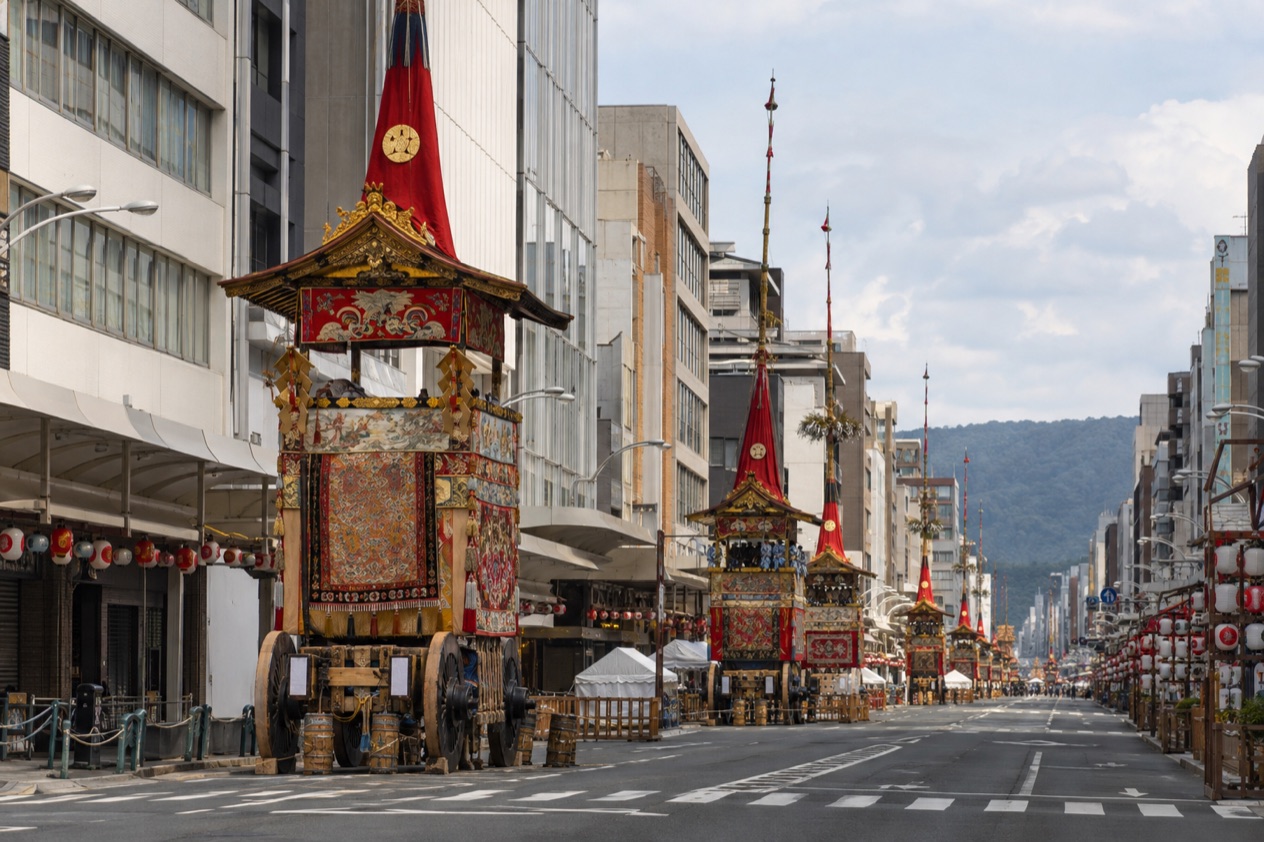
Is visiting the Gion Matsuri worth it?
Yes, for anyone who likes festivals, crafts, street food and the sight of enormous things moving slowly through a city, and for travelers who want to see Kyoto in motion rather than only in its temples. The Gion Festival is one of the largest and most famous festivals in Japan, and it has been held in central Kyoto since 869. That long thread of history is easy to feel as the floats roll by, each one tended by a neighborhood association that has looked after it for generations.
What sets it apart from the other festivals the country holds is how much of it happens at street level, in the middle of an ordinary downtown. Elsewhere you may watch a parade from a grandstand, or a shrine festival inside a precinct.
Here the center of the city is handed over to pedestrians for the evenings before each procession, and old merchant houses open their doors so you can look inside. The Hakata Dontaku in Fukuoka draws crowds with participants and parades, and the Sanja Festival in Asakusa is known for its mikoshi, but the Gion Matsuri adds the floats, the lantern-lit evenings and the private houses in one stretch of town.
It also suits people who like to wander without a fixed plan. You can drift between floats, stop for a skewer, look into a house, and drift on again. The festival works for couples, friends and curious families, though the July heat and the press of people are part of the experience, and the page is honest about that below in the timing and tips.
What to see at the Gion Matsuri
The Yamaboko Junko processions
The festival is best known for its two Yamaboko Junko processions of floats, which take place on July 17 and 24. The hoko floats are the giants, about 27 meters tall and weighing about 12 tons, built as wooden towers that rise above the rooftops and the electric wires. Alongside them move the smaller yama floats, carried and pulled by teams of neighborhood men.
Look at the details more than the size: the woven textiles that hang from the floats, the musicians seated inside playing flutes, bells and drums, and the way the crews turn a huge wooden structure around a street corner. Each float has its own character, and the order in which they appear is not fixed by tradition alone, since the neighborhood associations draw lots in early July in a ceremony attended by the Mayor of Kyoto.
The yoiyama evenings
During the three nights leading up to each procession, called yoiyoiyoiyama, yoiyoiyama and yoiyama, Kyoto’s downtown area is reserved for pedestrian traffic. This is when the floats stand in their home streets, lit and open to admire up close. Many visitors find this the most atmospheric part of the whole festival, because you can walk right up to the wooden frames and hear the music rehearsed and played from the platforms.
The streets fill with night stalls selling yakitori, taiyaki, takoyaki, okonomiyaki and traditional Japanese sweets. Eat as you walk, pause at a corner to listen to the flute, and let the crowd carry you from float to float. Some people come in a yukata, the light summer robe, which suits the mood of the evenings.
The Folding Screen Festival
On the yoiyama evenings, some traditional private houses near the floats open their entryways to the public, exhibiting family heirlooms in a custom known as the Folding Screen Festival. These are machiya townhouses, the narrow wooden merchant homes that Kyoto’s traditions are known for, and glimpsing their front rooms is a rare chance to see what lies behind the latticed facades.
What you see are painted screens and treasured family objects, set out as the household’s gift to the street. You look from the entryway, take in the long, dim interior leading toward the back, and move on. It takes only a few minutes at each house, and it adds a quiet note to the loud, bright evening outside.
The mikoshi procession
On the evening of July 17, hundreds of men carry Yasaka Shrine’s resident deities in portable mikoshi shrines through Kyoto’s neighborhoods to the otabisho, a temporary dwelling in central Kyoto. It is a different mood from the floats: loud, rhythmic and physical, with carriers shouting and swaying under the weight of the shrines.
If you have seen the lively mikoshi parades of the Sanja Festival in Asakusa, you will recognize the spirit, though here it follows the float procession and carries the sacred core of the festival. It is the part that reminds you the Gion Matsuri is, at heart, a Shinto shrine festival.
Hours, tickets and rules
The festival unfolds in the streets of central Kyoto, so there is no gate and no single entrance. The processions and the yoiyama evenings happen in the open, and the key dates are the ones tied to the two processions. The details that can be given are the dates themselves, set out here.
| Event | Date |
|---|---|
| First Yamaboko Junko procession | July 17 |
| Mikoshi procession to the otabisho (evening) | July 17 |
| Second Yamaboko Junko procession | July 24 |
| Yoiyama evenings | The three nights before each procession |
| Float order lottery ceremony | Early July |
Downtown Kyoto is reserved for pedestrian traffic during the three nights leading up to each procession. For the Gion Festival, it is recommended to book accommodation several months in advance.
When to visit the Gion Matsuri
The festival takes place annually during the month of July, and the two procession days, July 17 and 24, are the headline dates. The evenings before each one are when the streets are given over to walkers, so a visit can be built around either set. Choosing between them is a matter of taste: the first brings the mikoshi on the evening of July 17, while the later date gives you the second procession.
July in Kyoto is hot and damp. Afternoons average in the upper 80s, nights stay warm in the mid-70s, and humidity hovers around the high 60s in percentage terms. Rain falls on a good share of days, often in showers or heavy bursts, so a gray or wet day is a real possibility. Expect to be sweating by the time the evening crowds arrive.
| Kyoto in July | Value |
|---|---|
| Average high (°F) | 89.6 |
| Average low (°F) | 74.5 |
| Mean (°F) | 81.1 |
| Precipitation (inches) | 8.80 |
| Days with at least 1 mm of precipitation | 11.6 |
| Hours of sunshine | 143 |
| Relative humidity (%) | 69 |
The evenings are the best match for the festival’s rhythm, since the yoiyama nights are when the lanterns and the stalls come alive. Whatever the weather, the floats and the streets around them are the stage, and the heat is part of the season’s character.
Tips for your visit
Dress for heat and a crowd. Light, breathable clothes, a small towel or fan, and comfortable shoes for hours on foot make the evenings more enjoyable, and a compact umbrella or light rain layer covers the showers that July can bring. Bring a bottle for the long walks between floats and stop for food and sweets at the night stalls when you need a rest.
Plan on spending an evening or two among the floats rather than a few minutes. A good way to use the time is to walk the pedestrian streets slowly, stop at the houses that open for the Folding Screen Festival, and snack along the way on yakitori, takoyaki or taiyaki. Then keep one procession day for watching the floats pass.
Kyoto Station is served by the Tokaido Shinkansen line, which connects to major cities across Japan, and the station building houses a full floor of ramen restaurants, an Isetan department store, a theater and a Granvia hotel, handy for a meal before or after the evening. Kyoto Tower stands a few steps from the main entrance and is visible across the entire city.
The festival pairs well with Kyoto’s other sights. Nijo Castle in central Kyoto was built in 1603 by Tokugawa Ieyasu, the first shogun of the Edo period, and its nightingale floors make a bird-like sound when walked on, an old security system meant to alert guards of intruders. Kyoto’s shrines are recommended at less crowded times, such as early morning or late evening when they are illuminated, which fits well with a festival schedule that fills the middle of the day with heat.
Families and anyone who tires in crowds may want to pick one evening, enter the festival streets in the early part of the night and leave before the densest hour. The festival rewards a relaxed pace over a checklist.
Good to know before you go
Bring cash for the food stalls and small purchases, and carry a little patience for the crowd, which moves slowly along the pedestrian streets. Kyoto’s traditions, from the machiya townhouses to the Gion Matsuri itself, are woven into daily life here, and the festival is a neighborhood affair as much as a spectacle.
July brings warm, humid weather and frequent rain, so pack with showers in mind. Several months of lead time is recommended for accommodation.
Sources
- Japan National Tourism Organization, festivals and events (https://www.japan.travel/en/see-and-do/festivals-and-events/), checked October 11, 2026
- Wikipedia, Gion Matsuri (https://en.wikipedia.org/wiki/Gion_Matsuri), checked October 11, 2026
- Japan National Tourism Organization, Kyoto (https://www.japan.travel/en/destinations/kansai/kyoto/), checked October 11, 2026
- Japan Meteorological Agency (JMA), Normal values 1991-2020, monthly (https://www.data.jma.go.jp/stats/etrn/view/nml_sfc_ym.php?prec_no=61&block_no=47759), station Kyoto, elevation 41 m, checked October 11, 2026
To plan your stay
- Best Time to Visit Japan: Cherry Blossoms, Autumn Colors, Weather and Festivals
- Where to Stay in Japan: Ryokan, Temple Stays, Capsule Hotels and the Best Cities to Base In
- Sending Luggage from the Airport in Japan: Hands-Free Travel, Hotel Delivery and Coin Lockers
- Know Before You Go to Japan: Entry, Money, Etiquette and Getting Around