
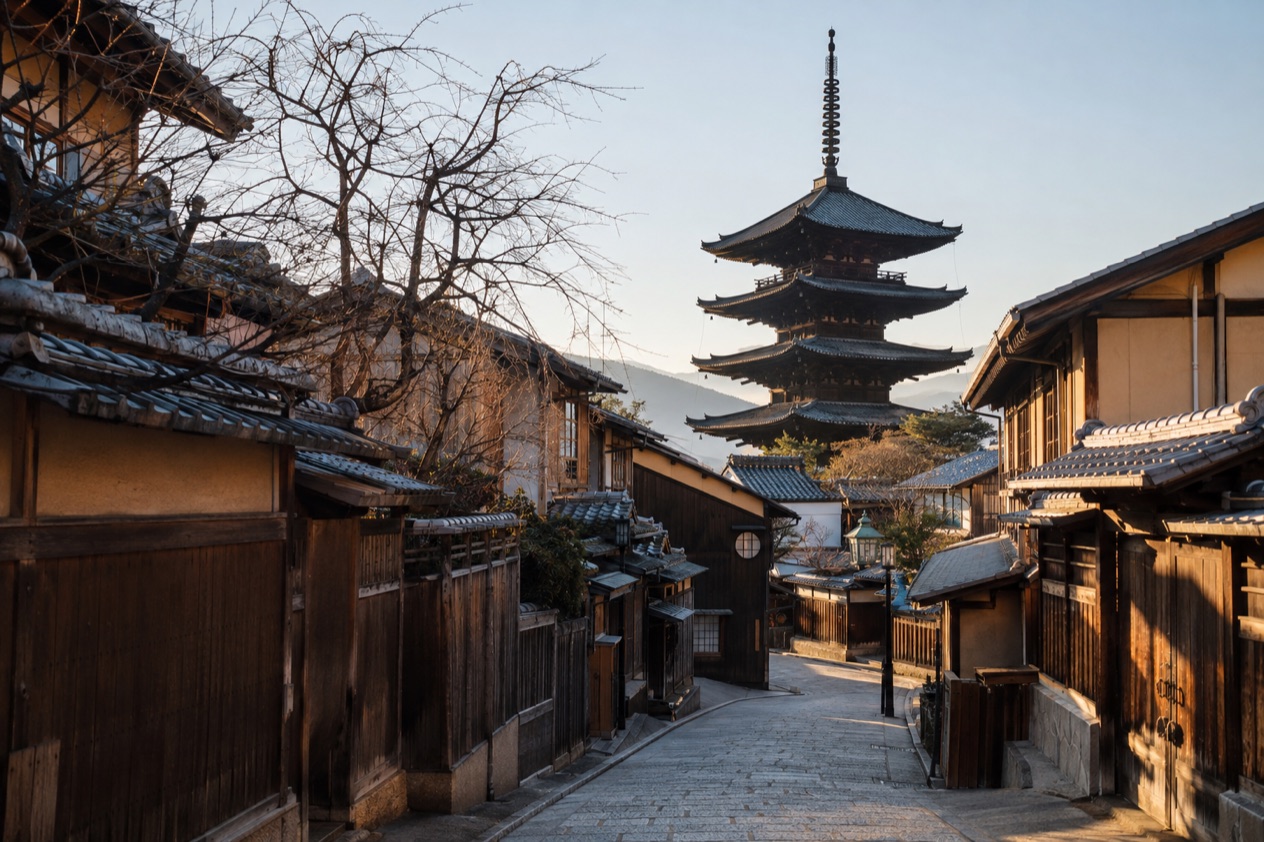
On the first days of the year, Kyoto’s shrines fill with people in coats and scarves who have come for hatsumode, the first visit of the new year, to bow, toss a coin and buy a paper fortune. Osechi boxes sit on family tables, the incense smoke hangs over the temple courtyards, and the cold sharpens every sound. Kyoto in January is a month of winter sightseeing, with temples and gardens set against bare branches and the first plum buds near the end.
What is the weather like in Kyoto in January?
January in Kyoto is cold and often gray, with highs in the upper 40s, nights just above freezing and light snow or sleet that falls on many days without piling up for long.
| Month | Average high (°F) | Average low (°F) | Precipitation (in) | Days with 1 mm or more of precipitation | Hours of sunshine | Snowfall (in) | Daylight on the 15th |
|---|---|---|---|---|---|---|---|
| December | 52.9 | 38.3 | 2.26 | 6.6 | 134 | 0.8 | 9 h 49 min |
| January | 48.4 | 34.7 | 2.10 | 6.4 | 124 | 2.0 | 10 h 02 min |
| February | 50.0 | 34.9 | 2.56 | 7.3 | 122 | 2.8 | 10 h 54 min |
What this means in practice is layers. A wool sweater under a proper winter coat, a scarf and gloves keep you comfortable on the walk between temples, and you will want something warm for the evening, when the thermometer drops toward freezing. Humidity is moderate, so the cold feels damp rather than sharp.
Snow here is a visitor, not a resident. It shows up as flurries or sleet on a good share of days, and it leaves only a thin dusting on roofs and stone lanterns, which is just enough to change how a garden looks. Most major cities in Japan rarely see snow, and Kyoto’s totals stay small, while the mountains and northern regions get heavy cover.
Sunshine is modest, so a gray sky is a fair expectation, and a compact umbrella or a hooded waterproof layer earns its place in the bag. Daylight is short, so the day’s outdoor sights fit better into a tidy plan than a sprawling one. Shoes with a good grip help on wet stone steps and temple paths.
What to do in Kyoto in January
The year begins here with hatsumode, and the first days of January are the heart of the month. Japan’s official New Year falls on January 1, and the holiday rhythm shapes the opening days. Shrines and temples are the center of attention, while many restaurants and attractions close for the New Year holidays. After that, the city settles into a winter routine of tea houses, hot meals and slow walks.
New Year traditions and winter food
Osechi-ryori is the dish of the season, a set of small foods packed in tiered lacquer boxes and eaten during the New Year celebration. Each item carries a wish for the year ahead, from health to good fortune, and the boxes are as pretty to look at as they are to eat. In Kyoto, where the cooking leans delicate, osechi has a refined look, and shops and restaurants often sell their own versions around the holiday.
Once the holiday passes, the cold weather brings out the warming dishes. Think of hot pots simmering at the table, bowls of udon with a thick broth, tofu served in steaming water, and sweet red bean soup with grilled mochi. A tea house with a heated room and a bowl of matcha with a seasonal sweet makes a good break in the middle of a gray day.
Fushimi Inari and Kiyomizu-dera in winter
Fushimi Inari Taisha stands at the base of Mount Inari in Fushimi-ku, and its path of vermilion torii gates climbs into the wooded hillside. In January the red lacquer stands out against bare trees and sometimes a light dusting of snow, and the cold keeps the air clear and sharp. The shrine was established in 711, and the New Year visits keep an old habit alive here, with offerings of coins and prayers for a good year.
Kiyomizu-dera is a temple founded over 1250 years ago and part of the Historic Monuments of Ancient Kyoto UNESCO World Heritage Site. Its wooden main hall looks out from the hillside over the city, and in winter you see rooftops and bare branches rather than leaves. City buses and the subway serve Kiyomizu-dera, Gion and Ginkaku-ji, so these three sights link up in a single outing.
Nijo Castle and Kinkaku-ji
Nijo Castle in central Kyoto was built in 1603 by Tokugawa Ieyasu, the first shogun of the Edo period. Its nightingale floors make a bird-like chirp underfoot, an old security system meant to warn guards of intruders. Walking the corridors in socks is an experience that suits a cold day, since much of the visit takes place indoors, among painted screens and tatami rooms.
Kinkaku-ji, officially Rokuon-ji, is a World Heritage Site and one of the 17 Historic Monuments of Ancient Kyoto. The gold-covered pavilion sits beside its pond, and on a winter day the reflection and the gray sky make a striking pairing. If snow falls, the scene changes completely, though you cannot count on it.
Hands-on experiences and plum buds
When the weather is raw, Kyoto offers indoor activities. At Myokakuji Temple, a samurai experience includes a sword fighting lesson taught by a professional actor, and in Central Kyoto you can turn your name into kanji and carve a Japanese stamp. Both are good plans for a wet afternoon, and each leaves you with a story or a souvenir.
Toward the end of the month, look for plum trees. Prunus mume typically flowers from January until late February in East Asia, so early buds can appear on temple grounds and in gardens while the air is still cold. They are a first hint of spring, and they pair well with a warm cup of tea.
Shops in urban areas are generally open every day into the evening, so shopping arcades, department stores and covered streets are available when you want to get out of the cold. The grid pattern of the city center, modeled on Chang’an, helps with orientation as you move between neighborhoods.
A two-day itinerary for Kyoto in January
Day 1 belongs to Eastern Kyoto. Start at Kiyomizu-dera, where the wooden stage looks over the city rooftops, then walk down through the lanes toward Gion, the old entertainment district of tea houses and wooden facades. Lunch can be a bowl of noodles or a set meal at a small restaurant nearby, something hot to take the chill off.
In the afternoon, take a city bus or the subway to Ginkaku-ji, where the garden of raked sand and moss looks quite different in winter light. Winter days are short, so this order keeps the outdoor sights together and leaves the evening for dinner in Gion or a tea house. If rain or sleet sets in, turn the afternoon into the kanji stamp activity in Central Kyoto, where you carve your own name stamp indoors.
Day 2 heads south to Fushimi Inari Taisha and the torii path that climbs Mount Inari. Walk up as far as you like, then return for a break with a hot drink or grilled snacks at the stalls near the entrance. This is the outing that benefits most from sturdy shoes, since stone steps can be wet.
After lunch, continue to Nijo Castle in central Kyoto, where the nightingale floors and painted rooms keep you indoors for much of the visit. Evening suits a stroll through the covered shopping streets and an izakaya dinner, with small plates and warm sake.
Is Kyoto busy in January?
January in Kyoto starts with a holiday rush at the shrines and settles into a winter pace afterward, though the city does not close down.
The first days of the year are the most distinctive. Hatsumode draws families to the great shrines, and during the New Year holidays many restaurants and attractions are closed. That mix of full shrine grounds and shuttered doors is a mood of its own, and it shapes what you can plan for those days.
After the holiday, the city goes back to its everyday rhythm. Urban shops are generally open every day into the evening, and the sights, from Fushimi Inari to Nijo Castle, carry on as usual. The season has no cherry blossoms or red maple leaves to draw crowds, and the first plum buds near the end of the month are a small, gentle attraction rather than a headline.
If you want the New Year atmosphere, the first days are the time, and if you prefer the city in its working winter mode, later in the month suits you better. Public holidays that fall on a Sunday are carried over to the next working day, a detail worth knowing when you map out the days around the long weekend in the middle of the month.
What to pack for Kyoto in January
Pack for cold, damp days spent mostly outdoors, with room to peel layers when you step into a heated shop or temple hall.
- A warm winter coat, for temple courtyards and evenings near freezing.
- Thermal or wool layers, since you will go in and out of heated buildings.
- A scarf, hat and gloves, for torii paths and garden walks in the cold.
- A compact umbrella or waterproof shell, for rain, sleet and light snow.
- Shoes with good grip that slip off easily, for wet stone steps and places where shoes come off.
- Warm socks, for floors like the nightingale floors of Nijo Castle.
Good to know before you go
The New Year holidays are the main thing to plan around in January. Many restaurants and attractions close during them, so the first days of the month call for a flexible plan.
Japan’s official New Year is celebrated on January 1, and when a national holiday falls on a Sunday, the next working day becomes a public holiday. A day that falls between two other national holidays is also a holiday, which can stretch a long weekend. Rural shops often close earlier than urban ones, which matters if you head out of the city center for the day.
Kyoto in January vs December and February
Moving the trip four weeks earlier brings milder air, with highs a few degrees warmer and almost no snow. December leads up to the New Year holidays, so you get the build-up rather than the shrine visits themselves, and a few more hours of sunshine come with it. If you want the hatsumode tradition, December is too early.
Moving four weeks later gives a month that is slightly wetter, with the most snowfall of the three and the longest daylight. February is also the heart of the plum season, so the buds that were only beginning in January are more likely to be open. The holiday closures are well behind you by then, and the city runs at its normal pace.
Choose January if you want the New Year atmosphere and the full cold of midwinter. Shift to December if you prefer milder days, or to February if you care more about plum blossoms and a longer day.
Is January a good time to visit Kyoto?
Yes, for travelers who like winter and want to see Kyoto’s temples and shrines in the cold season, with a holiday atmosphere at the start and a slower, working city afterward.
January suits those who enjoy cultural sights more than outdoor beauty. Nijo Castle, Kiyomizu-dera, Fushimi Inari and Kinkaku-ji all carry on, and hot food and tea make the cold part of the pleasure. People who rely on cherry blossoms or red leaves, or who dislike gray, damp days, should pick another month.
On arrival, check which restaurants and sights are open during the holiday days, then start with Fushimi Inari or Kiyomizu-dera. Keep the indoor options, like the kanji stamp and the samurai experience, in reserve for the wet days. What stays with you from January in Kyoto is the sight of vermilion gates and wooden halls under a pale winter sky, with a bowl of something hot waiting after each walk.
Sources
- Japan Meteorological Agency (JMA), Normal values 1991-2020, monthly (https://www.data.jma.go.jp/stats/etrn/view/nml_sfc_ym.php?prec_no=61&block_no=47759), station Kyoto, elevation 41 m, checked October 11, 2026
- Computed from the date and the latitude of the place (sunrise equation, solar elevation -0.833 degrees), October 11, 2026
- Japan National Tourism Organization, shop and attraction hours, national holidays (https://www.japan.travel/en/plan/business-hours-and-holidays/), checked October 11, 2026
- Wikipedia, Japanese New Year (https://en.wikipedia.org/wiki/Japanese_New_Year), checked October 11, 2026
- Wikipedia, Public holidays in Japan (https://en.wikipedia.org/wiki/Public_holidays_in_Japan), checked October 11, 2026
- Japan National Tourism Organization, winter in Japan (https://www.japan.travel/en/guide/winter-guide/), checked October 11, 2026
- Japan National Tourism Organization, skiing and snowboarding in Japan: regions, resorts, seasons (https://www.japan.travel/en/sports/snow/), checked October 11, 2026
- Wikipedia, Climate of Japan (https://en.wikipedia.org/wiki/Climate_of_Japan), checked October 11, 2026
- Japan National Tourism Organization, weather and seasons in Japan (https://www.japan.travel/en/plan/weather/), checked October 11, 2026
- Japan National Tourism Organization, skiing guide (https://www.japan.travel/en/guide/skiing/), checked October 11, 2026
- Wikipedia, List of ski areas and resorts in Japan (https://en.wikipedia.org/wiki/List_of_ski_areas_and_resorts_in_Japan), checked October 11, 2026
- Japan National Tourism Organization, flowers by season: cherry blossom, plum, wisteria, hydrangea, where and when (https://www.japan.travel/en/see-and-do/flowers/), checked October 11, 2026
- Wikipedia, Prunus mume (https://en.wikipedia.org/wiki/Prunus_mume), checked October 11, 2026
- Japan National Tourism Organization, Kyoto (https://www.japan.travel/en/destinations/kansai/kyoto/central-kyoto/), checked October 11, 2026
- Kyoto City Official Travel Guide, activities (https://kyoto.travel/en/activities), checked October 11, 2026
- Kyoto City Official Travel Guide, areas (https://kyoto.travel/en/areas), checked October 11, 2026
- Kyoto City Transportation Bureau, bus and subway guide (https://www2.city.kyoto.lg.jp/kotsu/webguide/en/), checked October 11, 2026
- Kyoto City Official Travel Guide, discover Kyoto (https://kyoto.travel/en/discover), checked October 11, 2026
- Fushimi Inari Taisha, official site (https://inari.jp/en/), checked October 11, 2026
- Wikipedia, Fushimi Inari-taisha (https://en.wikipedia.org/wiki/Fushimi_Inari-taisha), checked October 11, 2026
- Wikipedia, Kinkaku-ji (https://en.wikipedia.org/wiki/Kinkaku-ji), checked October 11, 2026
- Kiyomizu-dera Temple, official site (https://www.kiyomizudera.or.jp/en/), checked October 11, 2026
- Wikipedia, Kiyomizu-dera (https://en.wikipedia.org/wiki/Kiyomizu-dera), checked October 11, 2026
To plan your stay
- Things to Do in Kyoto: Temples, Gardens, Food and Day Trips
- Where to Stay in Kyoto: Kyoto Station, Central and Eastern Districts, and Ryokan Stays
- Kyoto from Tokyo: Shinkansen Trains, Nozomi vs. Hikari and Kodama, and a First Day in Kyoto
- Know Before You Go to Kyoto: Entry, Money, Getting Around and Local Etiquette