
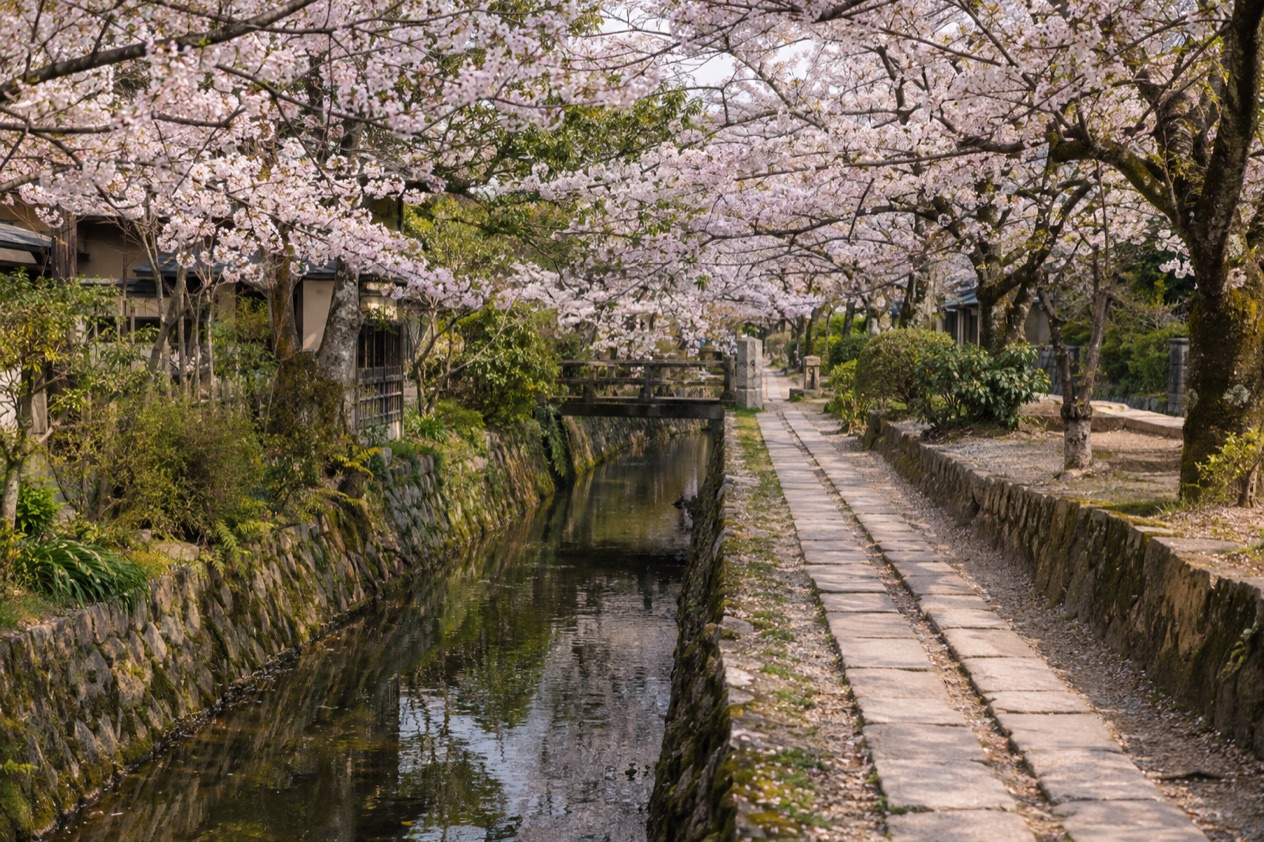
Water runs quietly beside the path, and the stone edges of the channel are lined with trees that lean over it. Walkers drift along at the pace of the current, stopping at a bridge or a gate half hidden among the branches.
Is visiting the Philosopher’s Path worth it?
Yes, if you like walks that unfold slowly and you want something that connects several sights rather than a single monument. It suits couples, solo travelers and friends who enjoy wandering, and it rewards anyone who likes to stop when something catches the eye: a small shrine, a gap in the trees, a bench above the water. If you prefer a destination with one big building to tick off, the path will feel more like a thread than a headline.
What sets it apart from other walks in Kyoto is the way it ties together a canal, a chain of temples and shrines, and a long literary and intellectual reputation. The path follows an irrigation channel fed by the Lake Biwa Canal, so the water is the guide and you simply follow it. It is named after two philosophers who taught at Kyoto University and are thought to have used it for daily exercise, which gives the walk a thoughtful, unhurried character.
Many sights in Kyoto ask you to enter a compound and look at one building. Here the experience is the movement itself, with temples appearing beside the path rather than at the end of a long approach. The result is a visit that can be a brisk stroll or an entire afternoon, depending on how many doors you decide to open.
What to see at the Philosopher’s Path
The canal and the path itself
The water is the heart of the walk. The path follows an irrigation channel that brings water from the Lake Biwa Canal, and it was first opened in 1890 before being extended in 1912. You walk beside a channel that was built to serve the city, which is why the whole route feels like a long, narrow garden made from a working waterway.
Look at how the banks are shaped, how small bridges cross the water, and how the trees arch above it. In hanami season, when people come to view the cherry blossoms, the path becomes one of the places in Kyoto that both visitors and locals choose for the occasion. In other seasons the same trees give the walk a different mood, with greens in summer and a changing palette later in the year.
Temples and shrines along the way
Several religious sites sit beside the route. Honen-in, Otoyo Shrine and Eikan-do Zenrin-ji are the ones named among the sights you can see along the walk, and each has its own character. A temple compound tends to offer a gate, a garden and a hall, while a shrine is marked by a torii gate and a small precinct, so the path moves between two quite different atmospheres.
You do not need to enter every one. Many walkers pick one or two for a longer look and let the rest pass as glimpses between the trees. Kyoto’s traditions of wooden architecture and carefully kept grounds are easy to notice here, because the sites are set so close to the path that you move from street to sacred space in a few steps.
The view of Daimonji
On the northern part of the path there are good views of Daimonji, the mountain slope that Kyoto associates with its well-known fire character. It is one of the few moments when the walk lifts your eyes from the water and the trees to the hills that frame the city. Pause where the trees open and look up.
This is a good reason to walk with your head up as well as down. The canal keeps your gaze at the water for most of the route, and then the hillside appears and gives the walk a sense of place.
The two ends: Ginkaku-ji and Nanzen-ji
The path runs between Ginkaku-ji and Nanzen-ji, and these two temples give the walk its start and finish. You can begin at either one and walk toward the other, treating the whole route as a bridge between two very different visits. Each is a destination in its own right, with its own grounds, so the path works well as the connection that makes one outing out of two.
People shape the day around the ends, spending time at a temple, walking the path and then continuing into the second one. That way the walk is neither an afterthought nor the whole plan, but the quiet middle of a longer itinerary through eastern Kyoto.
Hours, tickets and rules
The Philosopher’s Path is a pedestrian path between Ginkaku-ji and Nanzen-ji, so what you walk is a public route rather than one building with a front desk. The sites beside it, the temples and shrines, are separate places, and each handles its own visits.
What matters most is how the route is used. It is a path for walking, which is why it is described as a pedestrian way, and the walk itself takes about thirty minutes, though people spend more time visiting sights along the way. That makes it simple to fit between other plans, whether you cover the whole length or only a part.
Because the route links several separate places, it helps to think of the day as a sequence. The path is the continuous part, and the temples and shrines are the stops that vary in how long they hold you. Walk the water, enter the compounds you like, and leave the others as views from the path.
How to get to the Philosopher’s Path
Travelers reach Kyoto through Kyoto Station, which is served by the Tokaido Shinkansen line and connects to major cities across Japan. It is described as an ideal starting point for exploring all of Kyoto’s attractions, which makes it the base to think from when you plan a day on the path.
The station building itself is part of the visit. It houses a full floor of ramen restaurants, an Isetan department store, a theater and a Granvia hotel, and Kyoto Tower stands a few steps from the main entrance. If you are arriving by Shinkansen, you can eat and orient yourself before heading out toward the temples.
From there, the path is defined by its two ends. You can aim for Ginkaku-ji or for Nanzen-ji and walk toward the other, and either choice gives you the same route in the opposite direction. Pick the end that fits the rest of your day, then follow the canal for the length of the walk.
When to visit the Philosopher’s Path
Spring is the season most associated with the path, because it is a destination for hanami, the custom of viewing cherry blossoms, and both tourists and locals come for it. Other months give the walk a different tone, with the trees changing and the water continuing as a constant companion.
For the temples and shrines along the way, the recommendation for Kyoto’s religious sites is to go at less crowded times such as early morning or late evening when they are illuminated. It is worth keeping that in mind when you decide which hours to give to the compounds beside the path.
The weather shifts a lot over the year in Kyoto. January is cold, with snow or sleet falling on many days. April is mild, July is hot and humid, and October brings a comfortable warmth with moderate rain. The table gives the figures for each of these months.
| Month | Average high (°F) | Average low (°F) | Precipitation (inches) | Days with rain (1 mm or more) | Sunshine (hours) |
|---|---|---|---|---|---|
| January | 48.4 | 34.7 | 2.10 | 6.4 | 124 |
| April | 68.2 | 48.6 | 4.61 | 9.4 | 177 |
| July | 89.6 | 74.5 | 8.80 | 11.6 | 143 |
| October | 74.1 | 57.9 | 5.64 | 8.2 | 156 |
In practice, a walk in January means dressing warmly and being ready for snow flurries. April has some of the sunniest hours and the mildest air, which suits a long ramble. July is steamy and wet, so the shade of the trees matters. October is warm enough for a light layer and often pleasant for a long stroll beside the canal.
Tips for your visit
Plan around the thirty minutes the walk takes end to end, then add time for each temple or shrine you decide to enter. People spend more time on the way than the bare walk suggests, so leave room for stops.
Pair the path with the places it connects. Ginkaku-ji and Nanzen-ji bracket the walk, and Honen-in, Otoyo Shrine and Eikan-do Zenrin-ji lie along it. That gives you five named stops to choose among, so you can match the day to your interest in gardens, halls or shrine precincts.
Keep your eyes open for the view of Daimonji on the northern part of the route. It is easy to walk past it while watching the water, so pause when the trees open and look toward the hills.
- Start from either Ginkaku-ji or Nanzen-ji and walk toward the other.
- Leave time for the temples and shrines that catch your eye along the canal.
- Look up on the northern part of the path for the view of Daimonji.
- Go to the temples and shrines at less crowded times, such as early morning or late evening when they are illuminated.
If you are building a longer day in Kyoto, remember that the city has a cultural heritage that has developed over the past 1,200 years and traditions that include machiya townhouses, the Gion Matsuri festival and the hanamachi districts where geishas live and work. The path is one thread in that larger fabric, and it fits well beside other temple visits.
Good to know before you go
The path is best taken as a walk with the weather in mind. Rain falls on a fair number of days in every season in Kyoto, and July is the wettest of the four months in the table, so a light rain layer belongs in the bag in summer.
In winter, snow or sleet is common in January, and warm clothing is the better choice. Whatever the month, comfortable walking shoes suit a route that follows a canal and leads into temple grounds.
Sources
- Wikipedia, Philosopher's Walk (https://en.wikipedia.org/wiki/Philosopher%27s_Walk), checked October 11, 2026
- Japan National Tourism Organization, Kyoto (https://www.japan.travel/en/destinations/kansai/kyoto/), checked October 11, 2026
- Japan Meteorological Agency (JMA), Normal values 1991-2020, monthly (https://www.data.jma.go.jp/stats/etrn/view/nml_sfc_ym.php?prec_no=61&block_no=47759), station Kyoto, elevation 41 m, checked October 11, 2026
To plan your stay
- Best Time to Visit Japan: Cherry Blossoms, Autumn Colors, Weather and Festivals
- Where to Stay in Japan: Ryokan, Temple Stays, Capsule Hotels and the Best Cities to Base In
- Sending Luggage from the Airport in Japan: Hands-Free Travel, Hotel Delivery and Coin Lockers
- Know Before You Go to Japan: Entry, Money, Etiquette and Getting Around