
In early December, the last maples in Kyoto burn red against dark temple roofs, and the gravel paths fill with fallen leaves that crunch underfoot. The air has turned cold and dry enough to see your breath at dusk, and tea shops start serving hot drinks and sweet bean soup. December is the month when autumn is ending and winter has not yet taken over the old capital.
What is the weather like in Kyoto in December?
December in Kyoto is cold but manageable, with chilly days, frosty nights and mostly modest rain, a clear step down from November’s mildness.
| Month | Average high (°F) | Average low (°F) | Precipitation (in) | Days with 1 mm or more of precipitation | Hours of sunshine | Daylight on the 15th |
|---|---|---|---|---|---|---|
| November | 63.1 | 47.1 | 2.91 | 6.3 | 141 | 10 h 22 min |
| December | 52.9 | 38.3 | 2.26 | 6.6 | 134 | 9 h 49 min |
| January | 48.4 | 34.7 | 2.10 | 6.4 | 124 | 10 h 02 min |
The numbers say that afternoons are cool rather than freezing, so a warm coat and a scarf carry you through a day of temple-hopping. Nights drop close to freezing, which makes evenings feel properly wintry. The leap from November is noticeable, and you feel it in the first hour outdoors.
Rain falls on roughly one day in five, usually as a gray, drizzly day rather than a downpour. Snow or sleet shows up on several days in an average December, though it is a light dusting in town that rarely settles. A compact umbrella and shoes that handle wet stone are worth having.
Daylight is short, with the sun setting early in the afternoon, so the light turns low and golden well before dinner. Plan outdoor visits for the middle of the day, and keep the evening for lantern-lit streets, warm restaurants and a hot bath.
What to do in Kyoto in December
The big seasonal draw is the tail end of the maple season.
In recent years the change has come a bit later still, as it did around December 10 in 2025. Temple gardens with maples, moss and ponds are the places to look, and the fallen leaves carpeting the ground can be as striking as the trees.
As the month moves on, the mood shifts toward the end of the year. Kyoto is the cultural capital of Japan, and December is when the temples and shrines prepare for the New Year.
Many families clean their houses and gather the dishes for osechi, the set of New Year foods eaten on January 1. Christmas is not a national holiday in Japan, but gifts are sometimes exchanged, and you will see lights and cakes in shop windows.
Temples, shrines and gardens in the cold light
Kyoto holds 17 historic monuments inscribed as UNESCO World Heritage Sites in 1994, and December suits them well. Wooden halls, gold-leaf pavilions and rock gardens look sharp when the air is dry and the trees are bare or half-bare. Walking between them is pleasant in a warm coat, and the low sun throws long shadows across the verandas.
Pick a few sites rather than many. Temple halls are often unheated, so floors feel icy through socks, and a pair of warm socks makes a real difference when you take off your shoes at the door. Photography is prohibited in parts of shrines and temples, so watch for signs before raising a camera.
Between visits, duck into a tea house for matcha with a small sweet, or a bowl of hot udon. These breaks are part of the rhythm of a winter day in Kyoto, and they break up the cold stretches of walking neatly.
Gion and the old streets
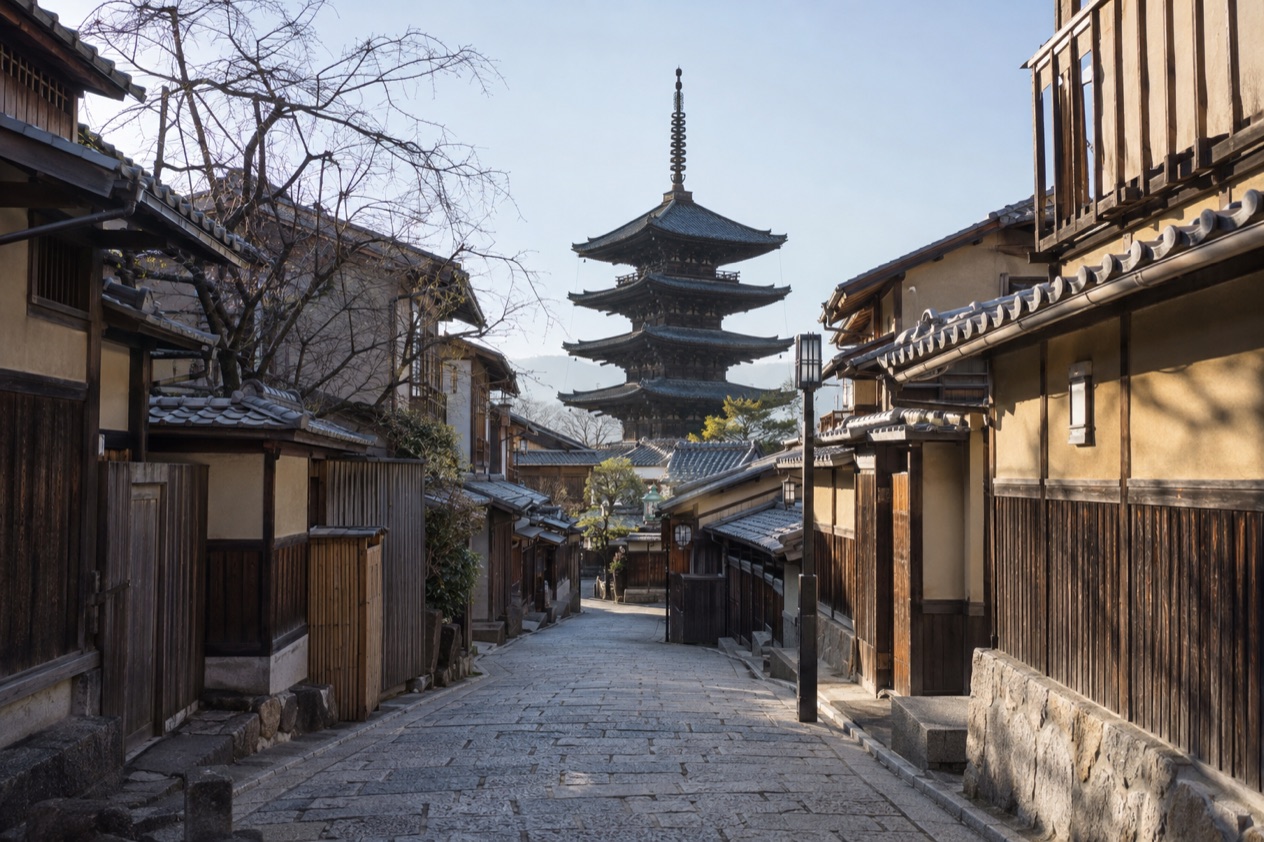
The wooden machiya townhouses of Gion look their best at dusk in winter, when lanterns glow and the air is crisp. You may spot a geiko or maiko hurrying to an appointment. Visitors must not stop, touch, follow or take unauthorized photos or videos of them, and photography is prohibited in many Gion areas.
To actually watch geiko and maiko perform, travelers can attend public Kyomai shows held throughout the year, by inquiring at their hotel or with a licensed tour guide. It is a more rewarding way to see the tradition than chasing a glimpse in an alley.
Winter food and warm drinks
Cold weather is the time for hot pots, simmered tofu, noodle soups and grilled foods. Kyoto cooking leans on delicate broths and vegetables, and a winter lunch of tofu in a steaming pot, a bowl of soba or a set of small seasonal dishes suits the chill. Sweet shops offer warm zenzai (red bean soup with rice cakes), and tea houses pour hot sencha and matcha.
In the evening, izakaya (casual pubs) serve warm sake alongside skewers and small plates. Urban shops are generally open from 10:00 a.m. to 8:00 p.m. every day, which leaves time for a browse before dinner. Rural areas often close earlier, sometimes by 6:00 p.m.
Toward the end of the month, the New Year holidays begin, and many restaurants and attractions close. Plan meals and sightseeing for the first three weeks of December if you want the full range of options open.
A two-day itinerary for Kyoto in December
Day 1 starts with the temples and gardens while the light is good. Daylight lasts under ten hours in mid-December, so begin in the morning with a garden where maples may still hold color, then move to a second temple around midday. Stop for a lunch of tofu or noodles in a small restaurant near the temples to warm up before the afternoon.
In the afternoon, wander the old lanes of Gion and the stone-paved streets around them as the light softens. When dusk comes early, step into a tea house for a hot drink, then have dinner at an izakaya or a kaiseki-style restaurant, where a meal arrives as a series of small seasonal dishes.
Day 2 moves to a different side of the city. Spend the morning at a shrine with a long path or a hillside temple, keeping on the move to stay warm, then take a late lunch in a covered market or arcade where food stalls and shops shelter you from the wind.
If the day turns gray or drizzly, shift to indoor stops: a museum, a tea ceremony, a craft workshop or a long lunch. In the late afternoon, return to a temple garden for the low light, then finish the evening with a hot meal and a warm drink.
Is Kyoto busy in December?
The first part of December still draws visitors for the last maple leaves, while the second half grows calmer as the leaves fall and the cold deepens. The pace of the city shifts with the calendar, from autumn sightseeing toward year-end preparations.
Once the foliage passes, the mood in the streets slows, and the cold keeps casual strollers at home. The evenings feel quieter, with lanterns and steam rising from food stalls.
Toward the end of the month, the New Year holidays begin. Many restaurants and attractions close during that period, so the city takes on a hushed, domestic feel as people head home to their families. Christmas is not a national holiday, so the shops and trains keep working as normal until the year-end break begins.
What to pack for Kyoto in December
Winter temperatures in Kyoto can drop below 41°F, so layers are the key to a comfortable trip of walking and sightseeing.
- A warm coat, since afternoons stay cool and evenings turn cold.
- Thin layers underneath, to add or remove as you move between outdoors and heated rooms.
- Warm socks, because you often remove your shoes at temples and restaurants.
- A compact umbrella for the gray, drizzly days.
- A scarf and gloves for the long walks and evening lantern strolls.
- Comfortable shoes that grip wet stone and gravel.
Good to know before you go
December is outside Kyoto’s rainy season, which runs from about mid-June to the end of July, and outside its typhoon season of late August and September. The cold and short days are the main factors to plan around.
The New Year holidays bring closures at many restaurants and attractions, so confirm what you want to visit before the final days of the month. Urban shops are generally open from 10:00 a.m. to 8:00 p.m. every day. Kyoto’s Tourist Information Centers have English-speaking staff, and the Kyoto Online Tourist Information Center offers disaster preparedness guides and maps of evacuation sites.
Kyoto in December vs November and January
Moving the trip four weeks earlier brings milder days, a bit more sunshine and longer daylight, plus the full show of maple leaves. Choose November if foliage is the point of the trip.
Moving four weeks later puts you in the heart of winter. January is colder, with a lower sun, and snow or sleet falls on many more days than in December, though it still tends to be light in town. The New Year closures pass, and the city regains its normal rhythm, but the leaves are gone and the gardens look bare and stark.
December sits between the two. It suits travelers who want a touch of leaf color early in the month, cooler air, and a feeling of the year winding down. If you want the autumn show, go earlier. If you like stark winter scenes, go later. If you want a bit of both, stay in early December.
Is December a good time to visit Kyoto?
Yes, December is a good time for travelers who like cold, crisp air, temple gardens and warm food, and who do not mind short days. It suits people who want the last of the maples in the first days of the month, or who prefer a calmer city to the busiest autumn weeks.
It is less suited to anyone who wants mild weather for long outdoor days, or who plans to visit in the final days of the month, when many restaurants and attractions close for the New Year holidays. Those travelers might look to November instead.
On arrival, start with the outdoor sights while the light is good, and save the warm interiors for the afternoon and evening. Kyoto in December is a city of bare branches, lantern light and steaming bowls, with the last red maple leaves lying on the temple paths.
Sources
- Japan Meteorological Agency (JMA), Normal values 1991-2020, monthly (https://www.data.jma.go.jp/stats/etrn/view/nml_sfc_ym.php?prec_no=61&block_no=47759), station Kyoto, elevation 41 m, checked October 11, 2026
- Computed from the date and the latitude of the place (sunrise equation, solar elevation -0.833 degrees), October 11, 2026
- Japan National Tourism Organization, winter in Japan (https://www.japan.travel/en/guide/winter-guide/), checked October 11, 2026
- Wikipedia, Christmas in Japan (https://en.wikipedia.org/wiki/Christmas_in_Japan), checked October 11, 2026
- Japan National Tourism Organization, shop and attraction hours, national holidays (https://www.japan.travel/en/plan/business-hours-and-holidays/), checked October 11, 2026
- Wikipedia, Japanese New Year (https://en.wikipedia.org/wiki/Japanese_New_Year), checked October 11, 2026
- Wikipedia, Public holidays in Japan (https://en.wikipedia.org/wiki/Public_holidays_in_Japan), checked October 11, 2026
- Japan National Tourism Organization, skiing guide (https://www.japan.travel/en/guide/skiing/), checked October 11, 2026
- Japan National Tourism Organization, skiing and snowboarding in Japan: regions, resorts, seasons (https://www.japan.travel/en/sports/snow/), checked October 11, 2026
- Wikipedia, List of ski areas and resorts in Japan (https://en.wikipedia.org/wiki/List_of_ski_areas_and_resorts_in_Japan), checked October 11, 2026
- Wikipedia, Climate of Japan (https://en.wikipedia.org/wiki/Climate_of_Japan), checked October 11, 2026
- Japan Meteorological Agency, maple color-change dates 2025-2026 with difference from the 1991-2020 normal (https://www.data.jma.go.jp/sakura/data/phn_014.html), checked October 11, 2026
- Kyoto City Official Travel Guide, responsible travel (https://kyoto.travel/en/responsible-travel), checked October 11, 2026
- Kyoto City Official Travel Guide, safety information (https://kyoto.travel/en/safety-info/), checked October 11, 2026
- Kyoto City Official Travel Guide, seasonal information (https://kyoto.travel/en/seasonal-info), checked October 11, 2026
- Wikipedia, Kyoto (https://en.wikipedia.org/wiki/Kyoto), checked October 11, 2026
- Wikivoyage, Kyoto (https://en.wikivoyage.org/wiki/Kyoto), checked October 11, 2026
To plan your stay
- Things to Do in Kyoto: Temples, Gardens, Food and Day Trips
- Where to Stay in Kyoto: Kyoto Station, Central and Eastern Districts, and Ryokan Stays
- Kyoto from Tokyo: Shinkansen Trains, Nozomi vs. Hikari and Kodama, and a First Day in Kyoto
- Know Before You Go to Kyoto: Entry, Money, Getting Around and Local Etiquette