
You arrive at Tofuku-ji beneath a huge timber gate whose roofline seems to hold the whole temple precinct in place, and the first thing you notice is the wood: dark, weathered, enormous. Beyond it the grounds open into a Zen monastery of gravel courts, moss, stone and maples. This is a visit for people who like to take in a temple slowly, looking at gardens and old carpentry rather than ticking off a long list of sights in Kyoto.
Is visiting Tofuku-ji worth it?
Yes, especially if you care about Zen gardens, big old wooden architecture and autumn color, and less if you want a single dramatic photo stop. Tofuku-ji is a Buddhist temple in Higashiyama-ku in Kyoto, founded in 1236 by the imperial chancellor Kujo Michiie.
What sets it apart from other Kyoto temples is the combination. The main gate is the oldest sanmon in Japan and a National Treasure, so you get serious architecture.
The gardens are not medieval at all but a bold modern design by the landscape architect Mirei Shigemori, so you get abstraction rather than the usual pond-and-pavilion scene. And the grounds hold a large number of Japanese maple trees, which turn the complex into one of the places people plan their autumn around.
It is also a working complex of sub-temples rather than one building with one hall, so a visit feels like walking through a small monastic district. Some of the objects here are curiosities in the best sense: a painting that almost never comes out of storage and Japan’s oldest communal toilet. Together they give the temple more personality than its calm gardens alone would suggest.
If you have time for only one or two temples in a day, Tofuku-ji pairs well with a visit to a very different Kyoto sight, such as a castle or a shrine, because it offers texture, space and a Zen mood that those places do not.
What to see at Tofuku-ji
The Sanmon main gate
The main gate is the oldest sanmon in Japan and a National Treasure. It stands two stories high and five bays wide, with the central three bays used as doors, which gives it a broad, grounded look rather than a soaring one. The heavy beams, the deep eaves and the weathered color of the timber are what hold your eye.
A sanmon is the symbolic entrance of a Zen temple, a gate you pass through to leave the everyday world behind. Stand back first and take in the whole frame, then move close to look at the joinery and the thickness of the pillars. Few Kyoto gates let you appreciate raw structure this clearly, and it is worth lingering over before you head deeper into the grounds.
The Shigemori gardens
The current gardens were designed by Mirei Shigemori in the summer and autumn of 1939, and they read as a deliberate break with tradition. The effect is playful and severe at once.
Look at how each garden frames the building it belongs to, and how the patterns change as you move along the veranda. Sit for a while on the edge of the floor and let your eyes move across the stones, because these gardens are meant to be viewed slowly. They are also a good place to understand how Zen aesthetics could be pushed into modern art without losing their discipline.
Tsuten-kyo bridge and the maples
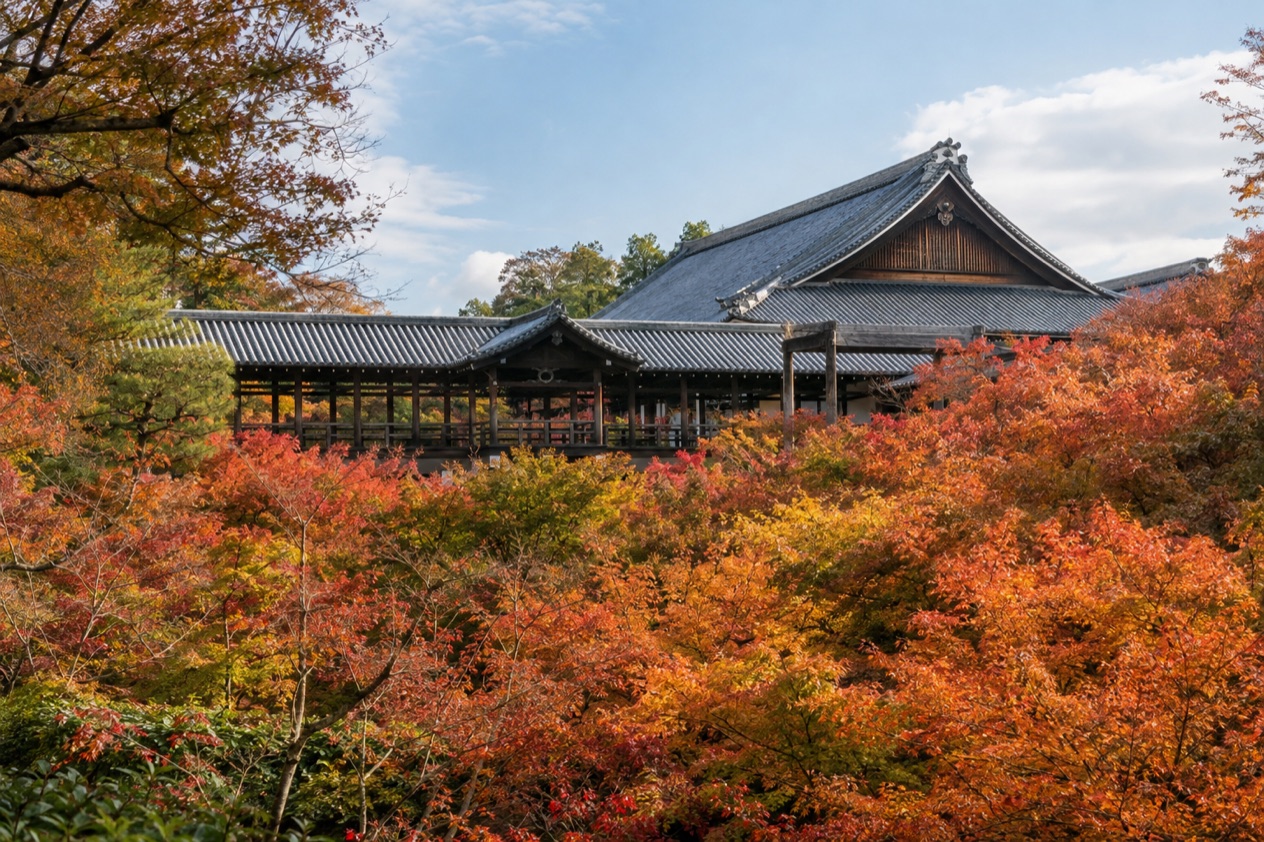
It is a tradition to view the autumn leaves at Tofuku-ji from the Tsuten-kyo bridge, a covered walkway that crosses a small valley full of Japanese maples. Looking down from the bridge, you see the canopy spread beneath you, a sea of red and orange broken by dark roof ridges. The temple is most crowded in autumn, when people flock here for exactly this view.
Outside the foliage season the same valley is green, and you can look at the shapes of the trees and the temple roofs without competing for space at the railing. The maples give the whole complex a lighter, brighter feel in spring, when new leaves open in a soft green, and a deeper shade in the summer months.
Sub-temples, the oldest toilet and the nehan-zu
The complex currently includes 24 sub-temples, though in the past the number has been as high as 53, which tells you how large the monastery once was. Among the buildings is Japan’s oldest communal toilet, built in the first half of the Muromachi period. It was damaged in October 2022 when a car crashed through the wooden doors and supporting pillars at its entrance.
The temple also holds a large nehan-zu, a painting of the Buddha on his death bed, which is the second largest in Japan. It is rarely displayed, most recently in 2003 for three days only, so treat it as a piece of the temple’s story rather than something to plan around. Knowing it is stored here adds weight to the quiet halls you walk through.
When to visit Tofuku-ji
Autumn is the season that defines Tofuku-ji, and it is also the time when the temple is most crowded. The maples are the reason, and the Tsuten-kyo bridge is where the tradition of viewing them is centered. If the foliage is your goal, expect company and plan your day around that. If gardens and architecture matter more, the other seasons give you more room to look.
For the time of day, the Japan National Tourism Organization recommends visiting Kyoto’s shrines at less crowded times, such as early morning or late evening when they are illuminated. That is advice for shrines in general, not a statement about Tofuku-ji’s own hours, so treat it as a rule of thumb for Kyoto sightseeing.
The weather changes a lot across the year, and it affects how you spend your time on the grounds. In October the days are mild, with a good number of dry hours, which suits walking between buildings and standing on the bridge.
In April the air is fresh and the maples are in new leaf. Summer is hot and humid, so plan on slow, shaded stops, and January is cold, with snow or sleet on many days.
| Month | Average high (°F) | Average low (°F) | Precipitation (inches) | Days with rain (1 mm or more) | Sunshine (hours) |
|---|---|---|---|---|---|
| January | 48.4 | 34.7 | 2.10 | 6.4 | 124 |
| April | 68.2 | 48.6 | 4.61 | 9.4 | 177 |
| July | 89.6 | 74.5 | 8.80 | 11.6 | 143 |
| October | 74.1 | 57.9 | 5.64 | 8.2 | 156 |
In practice, October and April are comfortable for a long walk through the gardens and across the bridge. In January you may see snow or sleet, which gives the stone gardens a stark, graphic look, though you will want warm layers while you stand on a veranda.
Tips for your visit
Wear shoes that come off easily, because moving through temple halls and along garden verandas is easier when you are not wrestling with laces. Bring a light layer for the cooler months and something to carry a camera and a small bottle of water. Allow time to stop rather than rush: the gardens are designed for sitting and looking, and the bridge deserves a pause of its own.
Think of Tofuku-ji as a place to wander. The grounds hold many buildings, the sub-temples spread through the complex, and the route you take is up to you. Start with the main gate, continue to the gardens, and then follow the paths toward the bridge and the maple valley, leaving yourself room to double back for anything that caught your eye.
To combine it with something else in the city, think about contrast. Nijo Castle in central Kyoto was built in 1603 by Tokugawa Ieyasu, the first shogun of the Edo period, and its nightingale floors make a bird-like sound when walked on, an old security system meant to alert guards of intruders. After the bare stone and moss of a Zen garden, a shogun’s castle makes a very different second stop.
Kyoto has a cultural heritage that has developed over the past 1,200 years, and its traditions include machiya townhouses, the Gion Matsuri festival and hanamachi districts where geishas live and work. A day at Tofuku-ji slots naturally into that longer story, so you can pair it with an evening in one of those districts if you like to finish the day among older streets.
If you are traveling with children or relatives who tire quickly, keep expectations modest and let them choose where to pause. The gardens and the bridge are the heart of the visit, and a slower pace costs you very little. Photographers will find plenty of subjects in the gate timbers, the moss patterns and the layered maples, so bring spare battery power.
Good to know before you go
The temple is at 15-Chome 778 Honmachi in Higashiyama-ku, Kyoto, which is the address to show a taxi driver or type into a map. Rain is a real part of Kyoto’s year, falling on many days in July and on a smaller share of October days, so a compact umbrella or light rain jacket earns its place in the bag. Temple grounds reward a calm pace and a quiet voice, and a camera used with a light touch fits the mood of the place.
Sources
- Wikipedia, Tōfuku-ji (https://en.wikipedia.org/wiki/T%C5%8Dfuku-ji), checked October 11, 2026
- Japan National Tourism Organization, Kyoto (https://www.japan.travel/en/destinations/kansai/kyoto/), checked October 11, 2026
- Japan Meteorological Agency (JMA), Normal values 1991-2020, monthly (https://www.data.jma.go.jp/stats/etrn/view/nml_sfc_ym.php?prec_no=61&block_no=47759), station Kyoto, elevation 41 m, checked October 11, 2026
To plan your stay
- Best Time to Visit Japan: Cherry Blossoms, Autumn Colors, Weather and Festivals
- Where to Stay in Japan: Ryokan, Temple Stays, Capsule Hotels and the Best Cities to Base In
- Sending Luggage from the Airport in Japan: Hands-Free Travel, Hotel Delivery and Coin Lockers
- Know Before You Go to Japan: Entry, Money, Etiquette and Getting Around