
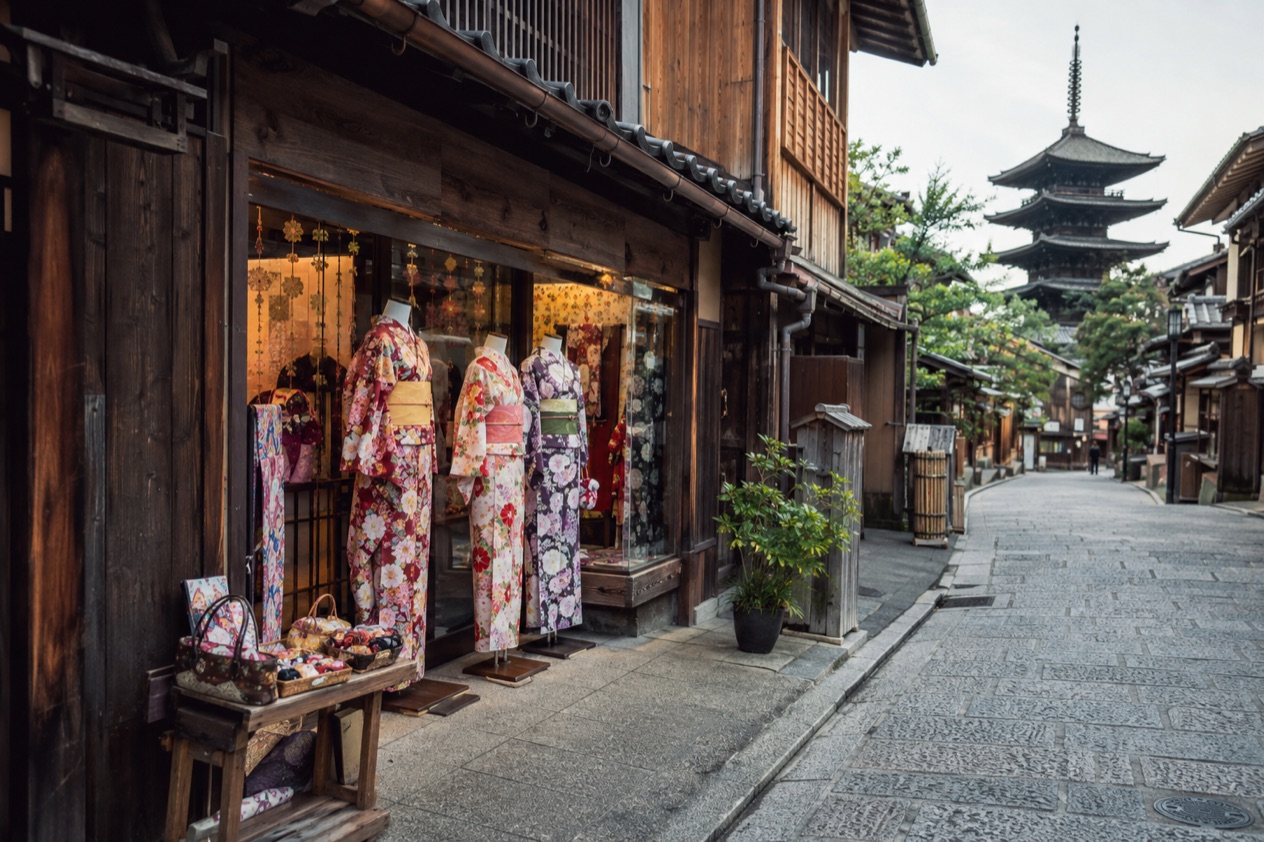
A woman in a silk kimono steps carefully down a stone lane, her sandals clicking, the long sleeves swaying with each step. In Kyoto, this scene is part of the streets themselves, from the wooden machiya townhouses to the lanes of the hanamachi districts.
Is visiting kimono rental in Kyoto worth it?
Yes, for travelers who like to walk through a city in costume and who care about the look and feel of old Kyoto more than a checklist of sights. It suits couples, friends traveling together, anyone who enjoys photography and visitors who want a different way to experience temples and lanes. It matters less if your plans are all about museums, long train rides or hurried sightseeing, because a kimono invites a slower pace.
What makes Kyoto different from other places where you can dress up is the setting. The city has a cultural heritage that developed over the past 1,200 years, and it served as Japan’s capital and the emperor’s residence for over 1000 years.
Its traditions include machiya townhouses, the Gion Matsuri festival and hanamachi districts where geishas live and work. A kimono here is not a costume in an empty theme park but clothing worn against the very streets, wooden facades and shrine gates that it was made for.
There is also a practical side to the experience. Kimono is clothing with its own rhythm: small steps, a straight back, a sash tied snugly around the middle. You will walk differently, sit differently and probably look at things for longer. People find that the dressing itself, with layers wrapped and tied by someone who does it every day, becomes a small ritual that sets the mood for the whole outing.
It is also a way to learn what you are looking at. Ordinary women’s kimono sleeves are 19 inches long, and the obi, the wide sash, can be a work of art in itself: a used, well-kept, high-quality secondhand women’s obi can cost upwards of US$300. Looking closely at fabrics, patterns and knots turns a walk into a small lesson in textiles, and gives you something to notice at every shop window and temple gate.
What to see at kimono rental in Kyoto
Kimono and the art of dressing
A kimono is a T-shaped robe wrapped left over right and held by an obi. Layers, collars and cords sit beneath what you see, and the shape of the sleeves tells part of the story. Ordinary women’s kimono and tomesode sleeves reach 19 inches, a hip-length cut that gives the garment its swaying outline when you walk.
Look at the fabrics and seasons. Ro, a plain-weave fabric with leno weave stripes, is worn only in high summer, in July and August, which is why summer kimono look airy and slightly see-through.
In summer you will also notice the yukata, the most informal type of kimono, which people wear at summer festivals across Japan. Color and pattern often follow the time of year, so a spring pattern and an autumn one look quite different on the same street.
The lanes of the hanamachi districts
Kyoto’s hanamachi are the districts where geishas live and work, and they hold some of the city’s most photographed streets, with wooden facades, lanterns and narrow stone lanes. A rented kimono looks at home here, and the setting rewards slow walking more than quick photo stops.
If you see apprentice geisha, you may notice that their kimono has shoulder tucks (kata-nuiage) and a hip overfold (koshi-nuiage) kept as an anachronism, details that set them apart from visitors in rented outfits. Treat the district as a place where people work and live, and keep to the lane rather than crowding doorways.
Shrines, temples and Nijo Castle
Shrines and temples are where people choose to wear a kimono. Visitors are recommended to visit shrines at less crowded times, such as early morning or late evening when they are illuminated, and that suits photographs as well as comfort. The vermilion gates, stone steps and wooden halls give the colors of a kimono something to play against.
In central Kyoto, Nijo Castle was built in 1603 by Tokugawa Ieyasu, the first shogun of the Edo period. Its nightingale floors make a bird-like sound when walked on, an old security system meant to alert guards of intruders. Walking those boards in small kimono steps is a memorable way to hear them.
Around Kyoto Station
Kyoto Station is served by the Tokaido Shinkansen line, which makes it a handy starting point for exploring Kyoto’s attractions and for connecting to other major cities. The station building holds a full floor of ramen restaurants, an Isetan department store, a theater and a Granvia hotel, and Kyoto Tower stands a few steps from the main entrance, over 130 meters tall and visible across the entire city.
It is a place to begin or end the day, to meet friends before the kimono fitting or to return for a bowl of ramen once the sash comes off.
When to visit kimono rental in Kyoto
Kyoto’s setting favors the early and late hours. Visitors are recommended to see shrines early in the morning or in the late evening when they are illuminated, and a kimono day follows the same logic, with the first hours giving you open lanes and soft light for photos, and evening bringing lantern glow to the hanamachi.
Spring is the season people picture. In April highs average 68.2°F and lows 48.6°F, which is comfortable for layers of silk, with rain on about nine days and around 177 hours of sunshine across the month. The mild air suits long walks, and the kimono’s layers are not a burden.
Autumn is just as appealing. October highs reach 74.1°F and lows 57.9°F, and rain falls on about eight days, with 156 hours of sunshine.
Summer is hot and humid. July highs average 89.6°F and lows 74.5°F, with rain on nearly twelve days and humidity near 69 percent.
This is the month for the yukata, the light cotton kimono of summer festivals, and for ro, the plain-weave fabric worn only in July and August. Kyoto’s Gion Matsuri is one of the festivals of the season, so the month has its own atmosphere, but plan for heat and drink water often.
Winter is cold and gray. January highs average 48.4°F and lows 34.7°F, snow or sleet falls on many days, and the month brings about two inches of snowfall in total. A kimono in the cold calls for warm layers underneath, but the bare trees and quiet streets give the city a different, stark beauty.
| Month | Average high (°F) | Average low (°F) | Rain days | Sunshine (hours) |
|---|---|---|---|---|
| January | 48.4 | 34.7 | 6.4 | 124 |
| April | 68.2 | 48.6 | 9.4 | 177 |
| July | 89.6 | 74.5 | 11.6 | 143 |
| October | 74.1 | 57.9 | 8.2 | 156 |
Tips for your visit
Plan the day around walking. A kimono shortens your stride, so let a few well-chosen places fill the hours rather than a long list. Pair a temple or shrine in the morning with a lane in a hanamachi district later, and keep the evening for lantern light when shrines are illuminated.
Dress for the season underneath. In January, with highs near 48°F and snow or sleet on many days, warm layers matter. In July, with highs near 90°F and humidity high, light fabrics and a lot of water make the day more pleasant. In spring and autumn, the weather is milder, though rain falls on several days of each month, so keep a small umbrella in mind.
Combine the day with places that suit the outfit. Nijo Castle, with its nightingale floors, gives you a sound to listen for as you walk. Kyoto Station, with its ramen floor and Isetan department store, is a place to meet before or after. The Gion Matsuri and the summer festivals are good moments to see kimono and yukata worn by locals.
- Take small steps and keep your back straight, as the sash will encourage you to do anyway.
- Look at the details on other kimono: sleeve shapes, fabrics and the knot of the obi.
- Treat the hanamachi as living neighborhoods, since geishas live and work there.
- Choose early morning or late evening for shrines when you want fewer people around.
Families and travelers with limited mobility should think about how the outfit affects movement. The sash and narrow skirt make steps, stairs and uneven stone paths slower, and the day suits a relaxed pace more than a packed schedule.
Good to know before you go
A kimono day is a small, slow outing, so keep the schedule loose and leave time for breaks. Rain falls on a good share of days in every season, with July the wettest of the four months here at nearly twelve days, so a flexible plan helps.
Most of what you see, from the lanes to the shrine grounds, is outdoors and shaped by the weather. Wear shoes you can walk in comfortably and enjoy the city at the pace the outfit sets.
Sources
- Wikipedia, Kimono (https://en.wikipedia.org/wiki/Kimono), checked October 11, 2026
- Japan National Tourism Organization, Kyoto (https://www.japan.travel/en/destinations/kansai/kyoto/), checked October 11, 2026
- Japan Meteorological Agency (JMA), Normal values 1991-2020, monthly (https://www.data.jma.go.jp/stats/etrn/view/nml_sfc_ym.php?prec_no=61&block_no=47759), station Kyoto, elevation 41 m, checked October 11, 2026
To plan your stay
- Best Time to Visit Kyoto: Cherry Blossoms, Autumn Leaves, Weather by Month and Festivals
- Where to Stay in Kyoto: Kyoto Station, Central and Eastern Districts, and Ryokan Stays
- Kyoto from Tokyo: Shinkansen Trains, Nozomi vs. Hikari and Kodama, and a First Day in Kyoto
- Know Before You Go to Kyoto: Entry, Money, Getting Around and Local Etiquette