
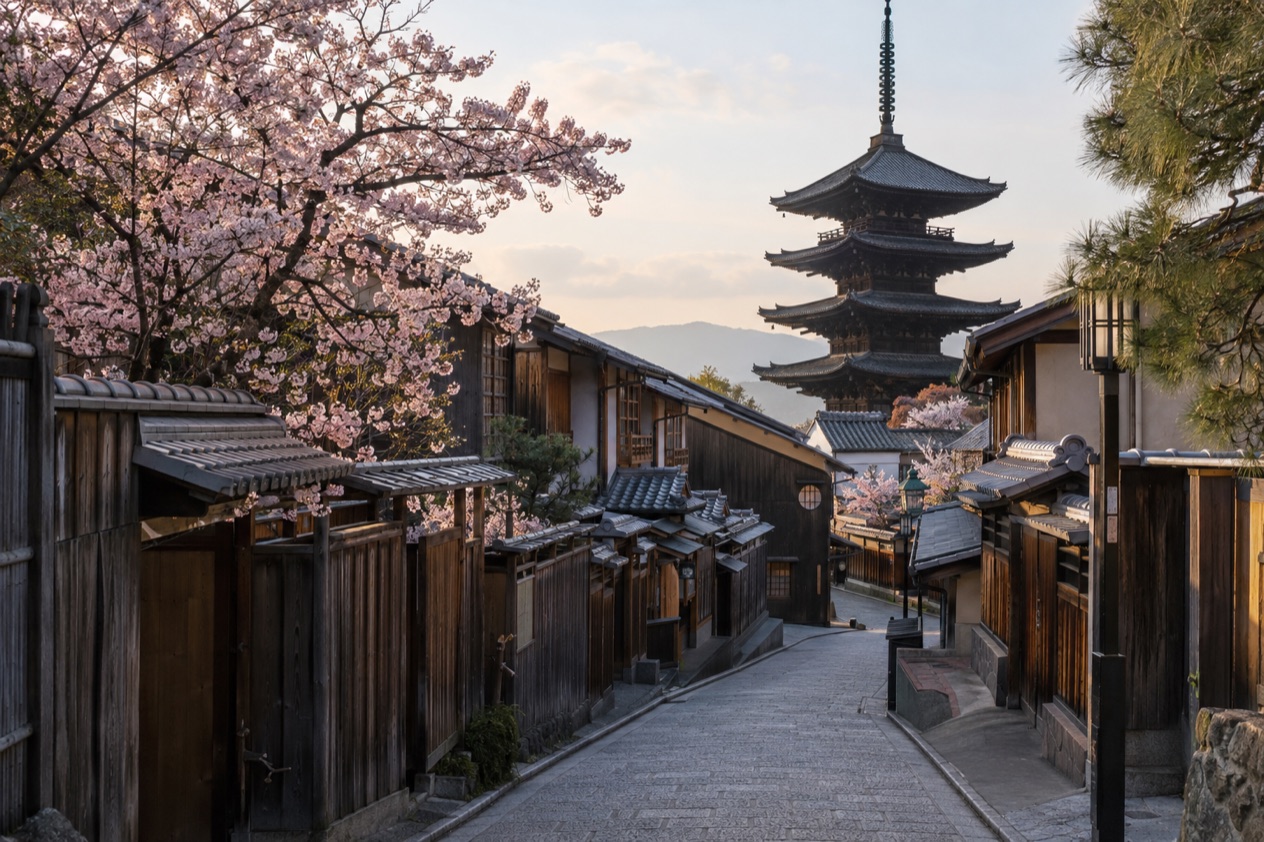
In early April, petals come down on the canal below Ginkaku-ji and collect in pale drifts along the stones, while families spread tarps under the trees in Maruyama Park and the first sakura mochi, a pink rice cake wrapped in a salted cherry leaf, appear in the sweet shops. Temple gardens turn the soft green of new maple leaves, and the evening light goes long over the Kamo River.
What is the weather like in Kyoto in April?
April in Kyoto is mild and spring-like, with comfortable afternoons, cool nights and a rain shower now and then.
| Month | Average high (°F) | Average low (°F) | Precipitation (in) | Days with 1 mm or more of precipitation | Hours of sunshine | Daylight on the 15th |
|---|---|---|---|---|---|---|
| March | 57.4 | 39.7 | 4.18 | 9.5 | 155 | 11 h 54 min |
| April | 68.2 | 48.6 | 4.61 | 9.4 | 177 | 13 h 02 min |
| May | 77.2 | 58.1 | 5.96 | 9.7 | 182 | 13 h 58 min |
The step from March is large. Afternoons now feel like spring rather than the tail end of winter, and the mornings no longer bite the way they do a few weeks earlier.
Japan’s national tourism office says a light jacket or a simple sweater is enough for spring travel, and that fits Kyoto well. You will want a layer for the early hours and for the evenings, which still turn cool once the sun drops behind the western hills.
Rain falls on roughly one day in three, and it is a month of passing wet spells rather than one long gray stretch. A foldable umbrella earns its place in the bag. Wet days do not spoil the city, since rain darkens the temple roofs, brings out the green in the moss gardens and sends everyone under the eaves of a tea house.
The light is the quiet gift of the month. Days are clearly longer than in March, so an evening stroll through Gion or along the river still begins in daylight, and the lanterns come on as the sky fades. Sunshine hours climb as well, which suits long days outdoors among the trees.
What to do in Kyoto in April
The month belongs to the cherry blossom, and in Kyoto the full bloom usually falls around the fourth of April, after a first bloom in the last days of March. That makes the first week the heart of the season, and from one spring to the next the timing can shift earlier or later. Once the main wave has passed, the petals fall and the trees turn to fresh leaf, while later-blooming double-flowered cherries often carry on in temple gardens.
April is also the month of the Miyako Odori, the spring dance performed by the maiko and geiko of Gion Kobu, held through much of the month. Seeing geiko and maiko on stage is done through public Kyomai shows, which travelers can arrange by asking at their hotel or a licensed tour guide. The Aoi Matsuri parade belongs to May, so April has no single big procession. The month is about trees, gardens and walking.
Cherry trees along the water and in the parks
The Philosopher’s Path, a stone-paved lane beside a canal with cherry trees leaning over it, is the walk people think of first. It leads from Ginkaku-ji, the Silver Pavilion, whose raked sand garden and mossy grounds suit the green of April. City buses and the subway serve Ginkaku-ji, as well as Kiyomizu-dera and Gion.
In Maruyama Park, next to Gion, a great weeping cherry is lit in the evenings, and the lawns fill with hanami picnics, the custom of eating and drinking under the blossom. Food stalls sell grilled skewers, dango and warm drinks. The Kamo River embankment is another spot where locals sit with a bento and watch the water, with petals sometimes riding the current.
Higashiyama temples and the lanes of Gion
Kiyomizu-dera hangs its wooden stage out over a hillside of trees, and in April the view from it is a mix of pink blossom and young green. The old lanes that run down from the temple are lined with pottery shops, pickle sellers and tea rooms serving matcha with a seasonal sweet. These streets are best taken slowly, with a stop whenever something smells good.
Gion, a few minutes along from there, has dark wooden machiya townhouses and tea houses. Visitors must not stop, touch, follow or take unauthorized photos of geiko and maiko walking the streets, and photography is prohibited in many Gion areas, in parts of shrines and temples, and in some restaurants. Look at the lanterns, the lattice windows and the small shrines, and leave the cameras for the open streets.
Spring on the table
Kyoto cooks by the season, and April means bamboo shoots, or takenoko, simmered with wakame seaweed, grilled, or tucked into rice. Kaiseki, the multicourse dinner built around the moment, leans on spring vegetables, delicate fish and sweets shaped like blossoms. Sakura mochi and pink wagashi turn up in tea houses and department store basements alike.
Yudofu, tofu poached in a clear kombu broth, is a Kyoto habit that suits a damp spring day. Nishiki Market, the narrow covered food street, gathers pickles, skewered snacks, tofu doughnuts and tamagoyaki, the sweet rolled omelet, under one roof, so a rainy hour disappears happily there.
Toward the end of the month Golden Week begins, and the city’s rhythm shifts again as holiday travel starts. Fushimi Inari, with its tunnels of vermilion torii gates climbing the hillside, and the gardens of Arashiyama fit in around the blossom if you have more than a weekend. Kinkaku-ji, the Golden Pavilion shining over its pond, rounds out a first visit.
A two-day itinerary for Kyoto in April
Day 1 belongs to the eastern hills. Start at Kiyomizu-dera in the morning, with the wooden stage and the view over the treetops, then drift down through the pottery and pickle shops of the lanes below. Lunch can be a bowl of soba or a set of yudofu at one of the tea houses along the way, followed by a matcha and a sakura sweet.
In the afternoon, walk on into Gion and Maruyama Park, where the weeping cherry draws the picnickers and the stalls. As the light fades, the evening is for a kaiseki dinner, or an izakaya, the casual pub that serves small plates, and a stroll back past the lanterns. If a spell of rain arrives, a tea house or a museum turns the afternoon around without losing the day.
Day 2 moves to other parts of the city. Begin at Fushimi Inari beneath the torii, and let the climb set the pace of the morning. Return for lunch at Nishiki Market, tasting your way along the covered street, since it works in any weather.
The afternoon goes to Ginkaku-ji and the Philosopher’s Path, following the canal under whatever blossom or fresh green the season has left. Finish with dinner somewhere in the center, perhaps a bowl of ramen or a plate of spring bamboo shoots. For a wet day, swap the path for the market arcades, a long tea break and a visit to one of the city’s temples where the rain on the garden is part of the view.
Is Kyoto busy in April?
April is one of Kyoto’s headline months, built around the cherry blossom at the start and Golden Week at the end.
The blossom sets the tone. With the full bloom usually falling around the fourth of the month, the city’s attention turns to its trees in the first days, and parks, temple gardens and canal banks become the places everyone wants to be. The timing shifts from one spring to the next, so a trip planned around the blossom is a hope more than a promise.
The second half of April has a different mood. The petals are gone from the main trees, the green comes in, and the festival calendar is lighter. Then Golden Week starts on April 29, a run of holidays that sends people across Japan to travel, and Kyoto is one of the places they go.
For the traveler, this means the pace of the city follows the calendar more than the weather. The mood in the streets is cheerful, with picnics under the trees and long evenings that tempt everyone out. If you want to see the blossom itself, aim for the first week. If you prefer a lighter touch, the middle of the month still carries the spring gardens, the tea houses and the Miyako Odori.
What to pack for Kyoto in April
The days call for layers rather than heavy clothing, and for shoes that can take a lot of walking on stone paths and temple steps.
- A light jacket or a simple sweater, for cool mornings and evenings.
- A foldable umbrella, since rain comes in short spells on about a third of the days.
- Comfortable walking shoes that slip on and off easily, as shoes come off at many temple and tea house entrances.
- Short-sleeved layers, for afternoons that feel like spring.
- A small bag or tote for picnic food and sweets bought along the lanes.
- A light scarf, useful on the cooler evenings along the river.
Good to know before you go
Golden Week starts on April 29 with Showa Day, and the other holidays, Constitution Memorial Day, Greenery Day and Children’s Day, follow in early May. When a national holiday falls on a Sunday, the next working day becomes a public holiday, and a day sandwiched between two holidays becomes one as well, so the break can stretch further. In Gion, photography is prohibited in many areas, and geiko and maiko walking the streets are not to be stopped, touched or followed.
Kyoto in April vs March and May
The cherry trees begin to open at the very end of the month, so you risk seeing buds rather than blossom. The days are shorter, and the gardens are still waking up.
Move it four weeks later and May is warmer and greener, with the afternoons clearly summery and more rain falling in total. The blossom is long gone, but the Aoi Matsuri brings a procession of about 500 people in courtly Heian dress from the Imperial Palace to two historic shrines on May 15. Golden Week, which straddles the two months, is the stretch in between.
Choose March if you like cool air and don’t mind skipping the blossom. Choose April for the cherry trees, the first green and the tea houses at a comfortable temperature. Choose May for warm days, the festival and the lush gardens, and accept the heavier rain.
Is April a good time to visit Kyoto?
Yes, April suits travelers who want blossom, gardens and walking weather, and it asks a little flexibility from those who want a guaranteed bloom date.
It will please people who like to wander, eat seasonally and sit under a tree with a bento. Photographers and garden lovers will find plenty to look at, and so will anyone who enjoys a tea house. It is less right for those who want the same weather every day, since showers pass through, or for travelers who dislike holiday periods, since Golden Week closes the month.
On arrival, start in the eastern hills, since Kiyomizu-dera, Gion and Maruyama Park all sit along one thread of lanes, and see the blossom first while it lasts. Then move to Ginkaku-ji and the canal, and leave the market and the temples for the damp hours.
What is special about April in Kyoto is that the old capital, which served as the seat of the court for over a thousand years, lets its gardens do the talking. Petals on stone, a sweet wrapped in a leaf, a lantern at dusk.
Sources
- Japan Meteorological Agency (JMA), Normal values 1991-2020, monthly (https://www.data.jma.go.jp/stats/etrn/view/nml_sfc_ym.php?prec_no=61&block_no=47759), station Kyoto, elevation 41 m, checked October 11, 2026
- Computed from the date and the latitude of the place (sunrise equation, solar elevation -0.833 degrees), October 11, 2026
- Japan Meteorological Agency, cherry blossom first-bloom dates 2021-2026 and 1991-2020 normal (https://www.data.jma.go.jp/sakura/data/sakura003_07.html), checked October 11, 2026
- Japan Meteorological Agency, cherry blossom full-bloom dates 2021-2026 and 1991-2020 normal (https://www.data.jma.go.jp/sakura/data/sakura004_07.html), checked October 11, 2026
- Japan Meteorological Agency, sakura2020.pdf (https://www.data.jma.go.jp/sakura/data/sakura2020.pdf), checked October 11, 2026
- Japan National Tourism Organization, spring in Japan (https://www.japan.travel/en/guide/spring-guide/), checked October 11, 2026
- Japan National Tourism Organization, flowers by season: cherry blossom, plum, wisteria, hydrangea, where and when (https://www.japan.travel/en/see-and-do/flowers/), checked October 11, 2026
- Wikipedia, Wisteria (https://en.wikipedia.org/wiki/Wisteria), checked October 11, 2026
- Japan National Tourism Organization, shop and attraction hours, national holidays (https://www.japan.travel/en/plan/business-hours-and-holidays/), checked October 11, 2026
- Wikipedia, Golden Week (Japan) (https://en.wikipedia.org/wiki/Golden_Week_(Japan)), checked October 11, 2026
- Wikipedia, Public holidays in Japan (https://en.wikipedia.org/wiki/Public_holidays_in_Japan), checked October 11, 2026
- Kyoto City Transportation Bureau, bus and subway guide (https://www2.city.kyoto.lg.jp/kotsu/webguide/en/), checked October 11, 2026
- Kyoto City Official Travel Guide, discover Kyoto (https://kyoto.travel/en/discover), checked October 11, 2026
- Kyoto City Official Travel Guide, festivals and events (https://kyoto.travel/en/events), checked October 11, 2026
- Kyoto City Official Travel Guide, history and religion (https://kyoto.travel/en/history-and-religion), checked October 11, 2026
- Kyoto City Official Travel Guide, responsible travel (https://kyoto.travel/en/responsible-travel), checked October 11, 2026
To plan your stay
- Things to Do in Kyoto: Temples, Gardens, Food and Day Trips
- Where to Stay in Kyoto: Kyoto Station, Central and Eastern Districts, and Ryokan Stays
- Kyoto from Tokyo: Shinkansen Trains, Nozomi vs. Hikari and Kodama, and a First Day in Kyoto
- Know Before You Go to Kyoto: Entry, Money, Getting Around and Local Etiquette