
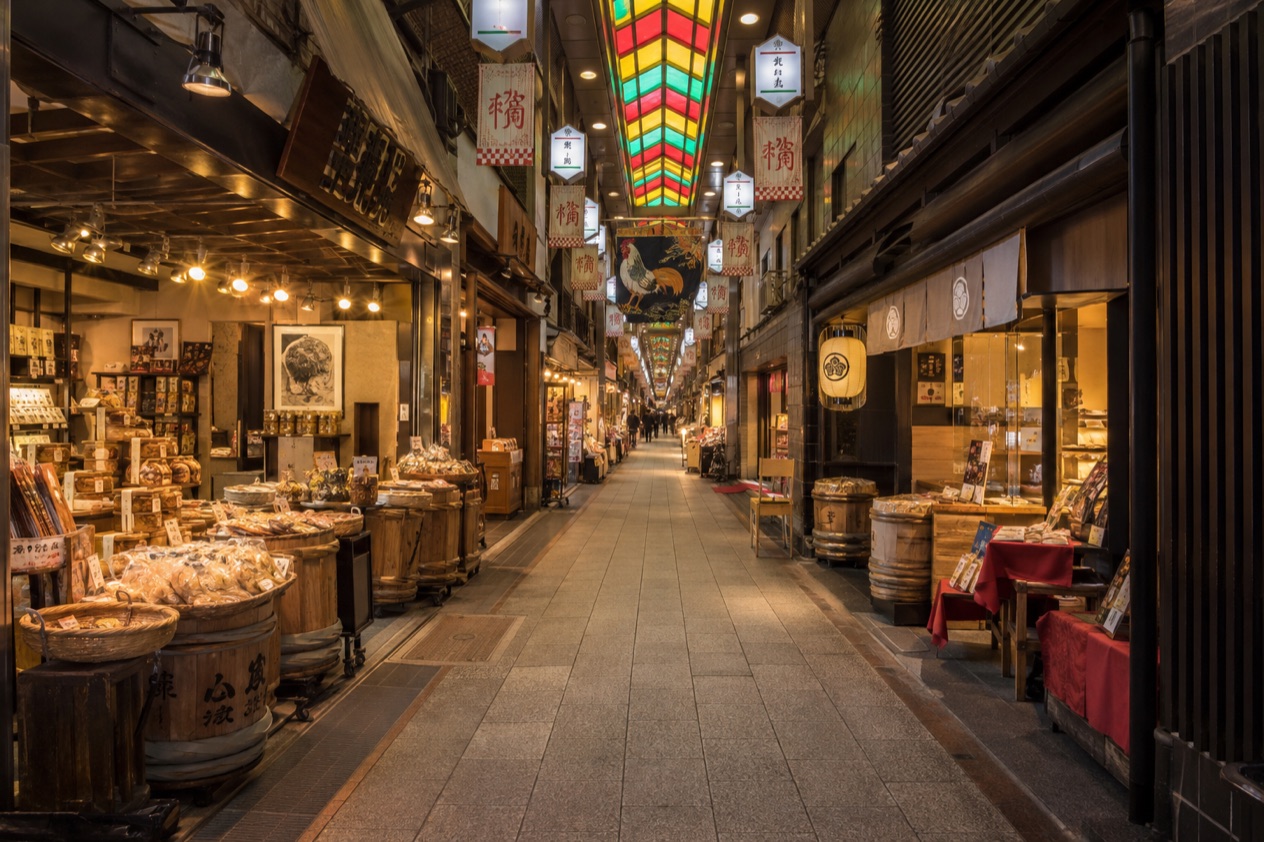
You step under the canopy and the street narrows. Cobblestones run ahead between stalls stacked with pickles in every shade, skewers on the grill, tofu, dried fish and trays of sweets, and the smell of grilled seafood drifts out from one counter to the next. Nishiki Market is Kyoto’s food street, a place to graze, taste and browse for kitchen goods rather than to tick off a monument.
Is visiting Nishiki Market worth it?
Yes, if you like food, markets and watching how a city shops for its meals, and it suits couples, friends and families who are happy to eat in small bites as they go. It is less a sight than an appetite, so it rewards people who arrive curious and a little hungry. If you prefer a sit-down lunch with a menu and a table, treat it as a tasting stop rather than the meal.
The market is called “Kyoto’s kitchen” for a reason: about 130 shops line the arcade, selling fruit, vegetables, fish, dry goods and much more. Other places in Kyoto show you temples, gardens and castles, and the Kyoto of the past is easy to find there.
Here you see the food side of the city, the ingredients behind kaiseki meals and home cooking. Shopkeepers wrap, slice and hand over samples of what they have made, and the pleasure lies in the small things you can taste on the spot.
It also differs from a modern food hall or a department store basement. The market sits in an old commercial street downtown, with centuries of trade behind it, and shops of very different ages stand side by side. A knife maker with a long lineage can neighbor a counter selling a new kind of snack. That mix of old trade and new tastes is what you come for.
What to see at Nishiki Market
The arcade and its setting
Nishiki Market is a narrow, covered shopping street in downtown Kyoto. It sits on the east end of Nishikikoji Street, one block north of Shijo Street and parallel to it, and it ends at Teramachi Street on the east side. The lane runs for about 400 meters between Takakura Street and Teramachi Street, so you can walk it end to end and still have time to go back for what caught your eye.
Look up and down as you go. The cobblestones underfoot and the roof overhead give the street the feel of a single indoor lane, with shop signs, hanging lanterns and display cases pressing in from both sides. Seasonal produce and fresh seafood change what the stalls show from one month to the next, so the same street looks different each time you return.
Fish, groundwater and a long history
The market’s story begins with fish. As early as the year 782, fish was being sold in this area, helped by cold groundwater that kept the catch fresh near the Kyoto Imperial Palace. In 1615 the site received official permission from the Bakufu government to sell fish for the first time, and trade grew from there.
The market changed with the times. In 1927 the Central Wholesale Market of Kyoto opened and many stores moved there. A new association then promoted shops offering fruits, vegetables, meats and other foods, and from 1928 the market began to be known as Kyoto’s kitchen. Today you still find fish counters, and Tsunori, a fresh fish and charcoal grill shop that has been open since the late Edo period, is one of the places that carries the old trade forward.
Aritsugu and the knife shops
Aritsugu is a shop famous for hand-crafted knives, founded by the master swordsmith Aritsugu Fujiwara in 1560. Its roots in sword making show in the blades on display, from slim slicers for fish to broad vegetable knives. Even if you are not buying, it is worth stopping to look at how a kitchen knife is shaped, polished and finished.
Knife shops sit comfortably beside food stalls here because the same cooks who shop for fish and vegetables also need the tools to prepare them. Browsing the blades gives you a sense of the craft that sits behind Kyoto’s cuisine, and shows why a market of food can also be a market of kitchen craft.
What to taste
Think in small bites. Kyoto-style pickles (tsukemono) come in many colors and textures, and counters hand out toothpick samples. Look for rolled omelet (dashimaki tamago) cooked in layers with dashi stock, soft tofu and fresh yuba (tofu skin), skewers of grilled seafood and tiny octopus stuffed with a quail egg. Sweet stalls offer mochi, soy-milk doughnuts and matcha treats, and a few shops pour sake or green tea.
Pace yourself rather than filling up at the first counter. A good plan is to walk the whole lane once, note what looks best, and then double back to buy. That way you taste a wider range and do not miss the dishes at the far end of the arcade.
Hours, tickets and rules
Nishiki Market is a covered street of individual shops rather than a single site with one gate, and what you spend depends on what you choose to eat and buy at each counter. The setting itself has a few dates worth knowing, because they explain what you see underfoot and overhead. The current cobblestone floor was installed in 1984 and the current arcade canopy in 1993.
The name itself is protected: in 2005 “Nishiki Market” was registered as a trademark, a sign of how much the market stands for in the city’s food identity. That identity rests on the shops, from the fishmongers to the pickle sellers and the knife makers, each running its own stall in its own way.
One habit shapes the visit in a way you can see for yourself. Many vendors practice sustainable methods, reducing plastic use and using biodegradable packaging, in line with Kyoto’s wider efforts toward environmental preservation. Expect paper wrapping and simple containers at many counters, and keep your own bag for what you buy.
When to visit Nishiki Market
Any season works, because the market sits under a canopy and the food changes with the calendar. The weather decides how you feel on the walk to and from the arcade. Kyoto’s tourism authorities suggest visiting shrines at less crowded times, such as early morning or late evening, and the same thinking can help you plan a day that combines the market with temples.
| Month | Avg. high (°F) | Avg. low (°F) | Days with rain | Sunshine (hours) |
|---|---|---|---|---|
| January | 48.4 | 34.7 | 6.4 | 124 |
| April | 68.2 | 48.6 | 9.4 | 177 |
| July | 89.6 | 74.5 | 11.6 | 143 |
| October | 74.1 | 57.9 | 8.2 | 156 |
January is cold, with snow or sleet falling on many days, and a warm drink from a stall is welcome. Winter is also when the shops show their cold-season produce, and you can browse in a coat without worrying about the sun. The canopy overhead gives some cover on wet days, though the lane is still open at its ends.
April brings mild afternoons and cool mornings, with showers that tend to come and go. It is a comfortable month for a long wander through the lane and the neighborhood around it. July is hot and humid, the wettest of the four months in the table, so a market under a roof with cold drinks and sweet ices makes sense, and light clothes help.
October is warm by day and pleasant in the evening, with some rain but also many hours of sun. It suits a walk that mixes the market with the rest of downtown. Autumn stalls tend to show seasonal produce, and the cooler air makes it easy to browse at a leisurely pace.
Tips for your visit
Bring an appetite, a small bag for purchases and a willingness to taste. A light tote makes it easier to carry what you buy, and a small packet of tissues or wipes is handy after sticky skewers. Because many vendors cut back on plastic, a bag of your own is a sensible companion.
Plan the market as a slow stop within a day in downtown Kyoto, not as a rushed errand. It sits near Shijo Street and ends at Teramachi Street, so you can pair it with the shopping streets around it. Kyoto has a cultural heritage that has developed over the past 1,200 years, and the districts nearby include machiya townhouses and the hanamachi areas where geishas live and work, which make good additions to a walk.
Pairing the market with a temple visit works well, since food and sights balance each other. If you are arriving from elsewhere in Japan, Kyoto Station is served by the Tokaido Shinkansen, and the station building itself holds a floor of ramen restaurants if you want a different kind of meal. Kyoto Tower stands a few steps from the main entrance of the station and can be seen across the city.
Families will find the stalls full of things to point at, from bright sweets to seafood, and children often enjoy choosing a snack. The cobblestones are uneven underfoot, so those with strollers or with limited mobility should take the surface into account and move slowly.
Good to know before you go
Prices at the stalls are in yen, and you buy by the piece, the skewer or the portion, so it is easy to taste a little at a time. As on any busy lane, keep a hand on your bag when you stop to look at a counter. In the rainy months of summer, the canopy gives welcome cover, and in winter a hot drink goes a long way.
Sources
- Wikipedia, Nishiki Market (https://en.wikipedia.org/wiki/Nishiki_Market), checked October 11, 2026
- Japan National Tourism Organization, Kyoto (https://www.japan.travel/en/destinations/kansai/kyoto/), checked October 11, 2026
- Japan Meteorological Agency (JMA), Normal values 1991-2020, monthly (https://www.data.jma.go.jp/stats/etrn/view/nml_sfc_ym.php?prec_no=61&block_no=47759), station Kyoto, elevation 41 m, checked October 11, 2026
To plan your stay
- Best Time to Visit Japan: Cherry Blossoms, Autumn Colors, Weather and Festivals
- Where to Stay in Japan: Ryokan, Temple Stays, Capsule Hotels and the Best Cities to Base In
- Sending Luggage from the Airport in Japan: Hands-Free Travel, Hotel Delivery and Coin Lockers
- Know Before You Go to Japan: Entry, Money, Etiquette and Getting Around