
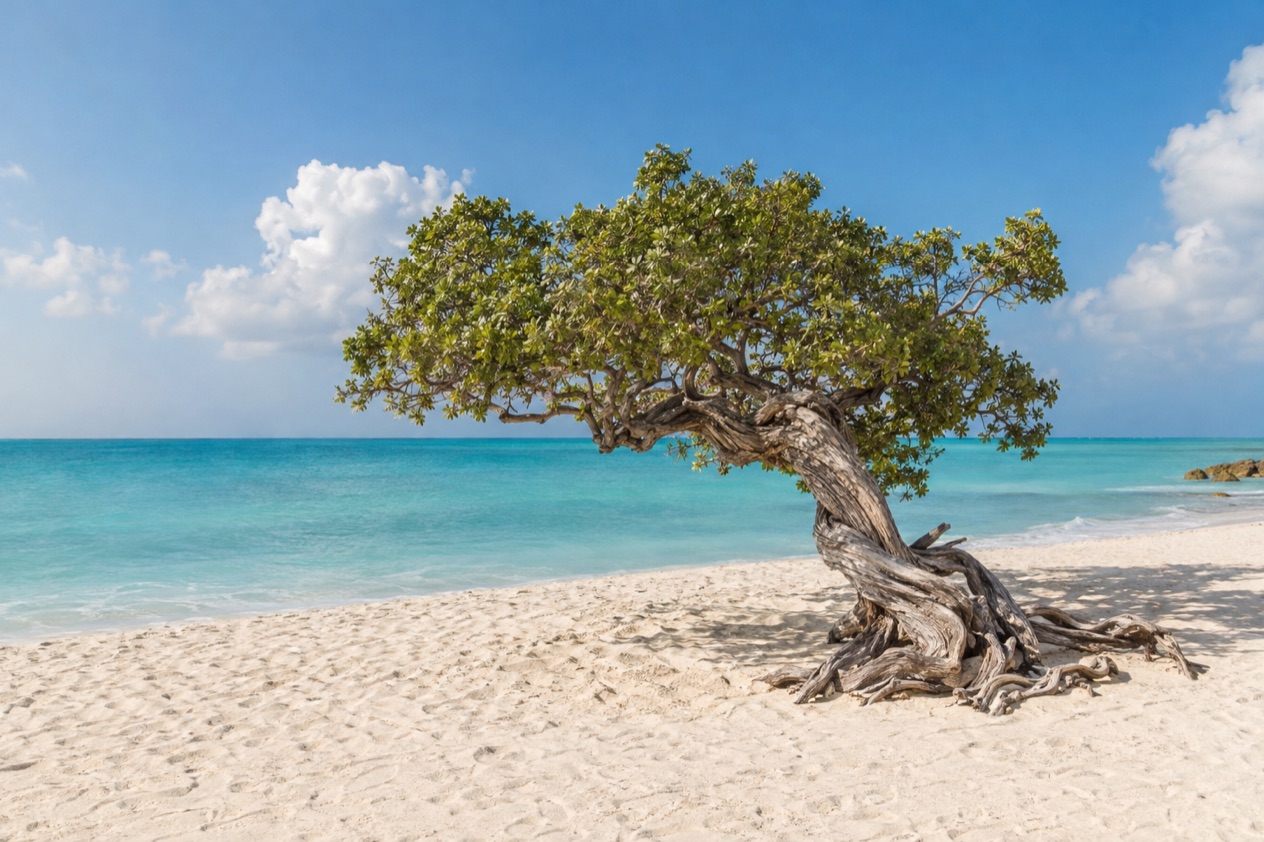
Early on Eagle Beach, the fofoti trees all lean the same way, bent by a trade wind that never changes its mind. Down the coast in San Nicolas, a pastechi, a fried pastry stuffed with cheese or meat, is still hot in its paper napkin, and a few words of Papiamento drift across the counter. Aruba puts resort beaches, cactus desert, a Dutch-colored capital and a wild northern shore on one small island, and it suits sun seekers, walkers and food-curious travelers alike.
Where is Aruba and what is it like?
Aruba is a small, flat island in the southern Caribbean Sea, set just off the coast of Venezuela. Only about 18 miles of water separate it from the Paraguaná peninsula, which puts it well to the south of the islands most Americans picture when they think of the Caribbean. Politically it is an autonomous country within the Kingdom of the Netherlands, and that Dutch thread runs through the street names, the pastel facades of the capital and the habit of speaking several languages in a single conversation.
The island covers 70 square miles, so a day of driving can take you from a glass-fronted hotel strip to a stretch of cactus-studded desert and then to a coast where the waves hit limestone cliffs. Regions here really do differ from one another, from the dry interior to the colonial-flavored harbor of Oranjestad.
The west and southwest side, the leeward coast, holds the resort beaches. The north and east, the windward coast, faces the open Atlantic swell and the wind, and it is rough and wild.
Dutch and Papiamento are the official languages. Papiamento is a Creole language that grew up in this region, and you will hear it on the radio, in markets and on the street.
Most Arubans speak at least four languages, English and Spanish among them, which means a visitor can order dinner, ask directions or chat with a taxi driver without much trouble. The island runs on Atlantic Standard Time all year, and the clocks never change.
The beaches are public, every one of them, so a stretch of sand is never off limits because of the hotel behind it. That opens the island to very different trips. Some travelers settle on Palm Beach and spend the week between the water, the pool and the restaurants.
Others rotate between snorkeling, rock formations, old gold-mill ruins and a long lunch in a fishing village. Couples, families with older children, divers and travelers who like a little desert scenery with their beach all find a version of Aruba that fits.
What you will not find is a lush green island. Aruba is dry, windy and sun-baked, with aloe, divi-style bent trees, cacti and bare boulders where other islands have rainforest. That is part of the charm, and it explains the light, the long sunsets and why people come back for the same stretch of sand year after year.
Where to go in Aruba
Aruba is organized around a few clear destinations, each with its own mood. The first decision is whether you want the resort coast, the capital, the south, the interior or the wild northeast. Most trips mix at least three of them.
Palm Beach and Noord
Noord means north in Dutch, and the district covers the northern reaches of the island. Palm Beach, a two-mile strip of sand, is the epicenter of tourism here, with the high-rise hotel area behind it, and it has a reputation for glamour and resorts. Evenings bring a parade of restaurants, bars and beachfront tables, and the strip stays lively after dark.
It suits travelers who want everything within a short stroll of the sand: sunset drinks, dinner and a morning on the beach. The Butterfly Farm sits in the Palm Beach area, just across from the Aruba Divi Phoenix, and makes a gentle outing between beach hours. Complimentary water taxis carry guests to Renaissance Island every 15 minutes.
Eagle Beach lies nearby, and several of the island’s low-rise hotels sit close to it or just across the road. Its leaning fofoti trees are the postcard image of Aruba, a good place for a late-afternoon walk along the sand.
Oranjestad
Oranjestad, the capital, is a colorful harbor city that blends old and new. Streets and malls carry international luxury retailers, boutiques and jewelry stores, and the harbor fills with boats and cruise visitors. The green stadhuis, or city hall, is where legal marriages are performed, and couples in wedding clothes are a common sight on its steps.
Fort Zoutman takes its name from a Dutch rear admiral who never set foot on Aruba but beat the English in the North Sea, a nice little piece of colonial trivia to carry around the old quarter. Come here for a half-day of strolling, shopping, a late lunch in a harborside restaurant and a look at the Dutch-style buildings painted in sherbet colors.
San Nicolas and the south coast
San Nicolas, the Sunrise City, is a quiet coastal town twelve miles southeast of Oranjestad. It is where you come for murals, small local restaurants and a slower rhythm than the resort side. Baby Beach lies in the southern part of the island, close to town, and Rodger’s Beach is about a minute’s drive from it.
Boca Grandi is a five-minute drive from downtown. Its wide, wind-exposed shoreline attracts kitesurfers and walkers rather than sunbathers with umbrellas. Savaneta, on the southwestern coast, sits about a 20-minute drive from Oranjestad and is reached easily by car. It is a fishing village, and the pleasure is a seafood lunch near the water and a look at the working boats.
Santa Cruz and the interior
Santa Cruz is a centrally located district, and Route 4, one of the main highways, runs through it. This is the heart of the island’s cactus country, where the landscape turns to scrub, goats and huge boulders. Hooiberg rises from the middle of the island, a lone, steep hill you can spot from many points, and it works as your compass.
The Casibari formations stand in a residential area just off the main road to Santa Cruz, near Oranjestad. The Ayo Rock Formation, a site with large tonalite boulders, has a trail among the rocks. Bringamosa holds the Donkey Sanctuary, and from the ostrich farm’s lodge you can look out over the island’s northern coast. Alto Vista chapel draws pilgrims every January 18 for the Feast of Santa Filomena.
Arikok National Park and the windward coast
The north and east shores belong to rough water, limestone and wind. Arikok National Park covers a big part of this side, and a ticket is required to enter. The small fee supports preservation, educational programs and the animals. Inside lie the Natural Pool on the northeast coast and Boca Prins along the same shoreline.
Andicuri Beach lies on the windward coast just south of the collapsed Natural Bridge, a reminder of how hard the sea works here. The Bushiribana gold mill ruins stand on the northern coast. This is the Aruba for people who want geology, wide skies and loud surf instead of lounge chairs.
Things to do in Aruba
Beaches come first, and the island has more than 20 public beaches and coves. Palm Beach and Eagle Beach hold the long stretches of sand. Arashi Beach lies at the northern tip, just beyond Malmok and on the road to the California Lighthouse. Boca Catalina is a bay where weekdays can feel like your own private cove, while weekends bring a fun mix of local families and island guests.
Under the water
Malmok sits near reefs and sunken wrecks that offer excellent diving, and snorkelers and divers head to this northwestern corner for that reason.
Aruba’s constant breeze also shapes what happens on top of the water, so you will see windsurfers and kitesurfers working the coast. The sea changes character with the side of the island, so the conditions on the leeward resort coast are not those of the windward shore.
Rocks, ruins and lookouts
The north coast shows what the wind and waves have done to limestone. The Natural Bridge, once the island’s largest and most popular, collapsed in 2005, a shock to locals and guests alike, but smaller formations along the coast remain, all sculpted by thousands of years of pounding surf. Bushiribana’s gold mill ruins recall the island’s gold-rush past, and the California Lighthouse watches over the northwestern tip from the Hudishibana area.
Inland, Hooiberg, Casibari and Ayo give you boulders, cacti and wide views. The Donkey Sanctuary in Bringamosa is a stop for animal lovers, and the Butterfly Farm in Palm Beach does the same for those who like a shaded stroll. Aloe is another local story, with a shop and visit in Oranjestad.
Food, language and festivals
Eat the local food. Keshi yena is a hollowed-out round of cheese filled with spiced meat and baked until it melts, a dish you may meet on menus across the island. Pastechi, the fried pastry, is the snack of choice at breakfast. Seafood is the obvious pleasure in fishing villages like Savaneta.
Carnival is the big seasonal party. The season opens every year on the eleventh of November, at eleven minutes past eleven in the morning, and it builds through parades and music until Shrove Tuesday, the day before Ash Wednesday, when King Momo is burned at midnight. Arikok, the lighthouse and the rock formations fit nicely around it.
When to visit Aruba
Aruba is a warm-weather island all year, and the climate barely shifts. The best time to visit, in general, runs from February to August. Peak season falls between December and April, when hotels fill and rates reflect the holidays. The off-season stretches from September to November, with fewer crowds and rooms that are easier to find.
| Month | Average high (°F) | Average low (°F) | Rain (inches) | Rain days | Wind (mph) |
|---|---|---|---|---|---|
| January | 86.5 | 76.6 | 1.73 | 10.8 | 16 |
| April | 89.4 | 78.8 | 0.34 | 1.5 | 18 |
| July | 90.3 | 80.1 | 1.24 | 4.1 | 18 |
| October | 90.3 | 80.1 | 3.01 | 7.3 | 13 |
January brings the most showers of the three months before the summer, short ones that pass between long sunny spells. The nights are warm enough for dinner outside in a light shirt. April is the driest of these months, with almost no rain and the strongest breeze, which keeps the heat bearable on the beach and gives kitesurfers their best days.
July is hot and sunny, with the trade wind still blowing from the east. It sits in the middle of the best-time window, a good choice for travelers who prefer to avoid peak crowds and rates. October is the softest month for wind, and the rain comes in short, sometimes heavy bursts that interrupt a sunny day instead of ruining it.
Dates also shape what you see. Carnival season begins in the second week of November, so the off-season is not without color. The annual pilgrimage to Alto Vista chapel falls in the middle of January, in the thick of peak season. A midwinter trip suits those who want the liveliest evenings, while spring and summer suit travelers who would rather trade a little of that buzz for easier bookings.
Getting around Aruba
Getting to Aruba is straightforward from the United States. Over 100 direct flights a week reach the island, and they leave from 14 North American gateways. From New York City the flight takes four hours, which is why a long weekend here is realistic for East Coast travelers.
Once you land, the island’s small size does the work. It is about 70 square miles in all, with the capital, the airport and the resort strip all on the western half of the island. The roads are modern and safe, and the main highways cut across the middle to the south coast and the windward side.
Distances between the main stops
San Nicolas lies twelve miles southeast of Oranjestad, and the town works as the gateway to the south coast. Boca Grandi is a five-minute drive from downtown San Nicolas, Baby Beach is in the southern part of the island close to town, and Rodger’s Beach sits about a minute’s drive from Baby Beach. Savaneta, on the southwestern coast, is about a 20-minute drive from Oranjestad.
Route 4 runs through Santa Cruz in the center, where Hooiberg dominates the horizon, and Casibari sits just off the main road to Santa Cruz, near Oranjestad. At the northern end, Arashi Beach lies beyond Malmok on the road to the California Lighthouse near the northwestern tip. On the north and east coasts, the road moves toward Arikok National Park, the Natural Pool and Boca Prins.
By water and on the coast
Complimentary water taxis connect to Renaissance Island every 15 minutes, a short boat hop from the Palm Beach side that gives the day a different start. Plan your days by coast, since this keeps drives short and lets you match the weather and wind to the right shore. The resort side is the place for an easy-going morning, and the windward side is the place for a rugged afternoon.
Clocks stay on Atlantic Standard Time all year, so schedules do not shift with the seasons. A day usually settles into a rhythm: breakfast with a pastechi, a morning on one coast, lunch in a village, and sunset back on the west side where the sky turns orange over the water.
Good to know before you go
The U.S. State Department rates Aruba Level 1, ‘Exercise normal precautions,’ and says Aruba is generally a safe destination for travelers, with petty crime the main concern in popular tourist areas.
U.S. citizens do not need a visa, but they do need a current passport valid for the whole stay. Everyone, including infants and children, must complete the ED Card (Embarkation-Disembarkation Card) within 7 days before travel on the official platform, edcardaruba.aw. Be ready to show proof that you can return to your country of departure or transit through another country, and that you have enough money to cover your stay and other expenses.
The local currency is the Aruban florin, though U.S. dollars are widely accepted, and cash is exchanged at Afl 1.77 to the dollar. Most Arubans speak English, so language is rarely an obstacle. The main safety concern in busy tourist areas is petty crime.
Sources
- Aruba Tourism Authority, Where is Aruba (https://www.aruba.com/us/our-island/island-facts/where-is-aruba), checked October 9, 2026
- Aruba Tourism Authority, Is Aruba a country (https://www.aruba.com/us/our-island/history-and-culture/is-aruba-a-country), checked October 9, 2026
- Aruba Tourism Authority, Aruba regions (https://www.aruba.com/us/our-island/regions), checked October 9, 2026
- Wikipedia, Aruba (https://en.wikipedia.org/wiki/Aruba), checked October 9, 2026
- Aruba Tourism Authority, Best time to visit (https://www.aruba.com/us/our-island/one-happy-island/when-is-the-best-time-to-visit-aruba), checked October 9, 2026
- Aruba Tourism Authority, Language (https://www.aruba.com/us/our-island/island-facts/language), checked October 9, 2026
- Aruba Tourism Authority, Currency (https://www.aruba.com/us/plan-your-visit/tips-for-visitors/currency), checked October 9, 2026
- Aruba Tourism Authority, Time zone (https://www.aruba.com/us/our-island/island-facts/aruba-time-zone), checked October 9, 2026
- Aruba Tourism Authority, Oranjestad region (https://www.aruba.com/us/our-island/regions/oranjestad), checked October 9, 2026
- Aruba Tourism Authority, Noord region (https://www.aruba.com/us/our-island/regions/noord), checked October 9, 2026
- Aruba Tourism Authority, San Nicolas region (https://www.aruba.com/us/our-island/regions/san-nicolas), checked October 9, 2026
- Aruba Tourism Authority, Santa Cruz region (https://www.aruba.com/us/our-island/regions/santa-cruz), checked October 9, 2026
- Aruba Tourism Authority, Savaneta region (https://www.aruba.com/us/our-island/regions/savaneta), checked October 9, 2026
- Aruba Tourism Authority, Passports and visas (https://www.aruba.com/us/plan-your-visit/getting-to-aruba/passports-and-visas), checked October 9, 2026
- Aruba Tourism Authority, Online ED card (https://www.aruba.com/us/plan-your-visit/getting-to-aruba/online-ed-card), checked October 9, 2026
- Aruba Tourism Authority, Beaches and coves (https://www.aruba.com/us/things-to-do/beaches-and-coves), checked October 9, 2026
- Aruba Tourism Authority, Natural wonders (https://www.aruba.com/us/things-to-do/natural-wonders), checked October 9, 2026
- Aruba Tourism Authority, Flying into Aruba (https://www.aruba.com/us/plan-your-visit/getting-to-aruba/flying-into-aruba), checked October 9, 2026
- Aruba Tourism Authority, Getting around Aruba (https://www.aruba.com/us/plan-your-visit/getting-around-aruba), checked October 9, 2026
- Aruba Tourism Authority, Arikok National Park (https://www.aruba.com/us/explore/arikok-national-park), checked October 9, 2026
- Aruba Tourism Authority, Carnival in Aruba (https://www.aruba.com/us/our-island/history-and-culture/carnival-in-aruba), checked October 9, 2026
- Meteorological Department Aruba (meteo.aw), Summary Climatological Normals 1991-2020, Queen Beatrix Airport station (http://www.meteo.aw/files/Download/climatnormals19912020.pdf), checked October 9, 2026
- Aruba Tourism Authority, Baby Beach (https://www.aruba.com/us/explore/baby-beach), checked October 9, 2026
- Aruba Tourism Authority, Rodgers Beach (https://www.aruba.com/us/explore/rodgers-beach), checked October 9, 2026
- Aruba Tourism Authority, Bushiribana Gold Mill Ruins (https://www.aruba.com/us/explore/bushiribana-gold-mill-ruins), checked October 9, 2026
- Aruba Tourism Authority, Historic Gold Mines (https://www.aruba.com/us/explore/historic-gold-mines), checked October 9, 2026
- Aruba Tourism Authority, California Lighthouse (https://www.aruba.com/us/explore/california-lighthouse), checked October 9, 2026
- Aruba Tourism Authority, Natural Pool (Conchi) (https://www.aruba.com/us/explore/natural-pool), checked October 9, 2026
- Aruba Tourism Authority, Natural Bridges (https://www.aruba.com/us/explore/natural-bridges), checked October 9, 2026
- Aruba Tourism Authority, Hooiberg (https://www.aruba.com/us/explore/hooiberg), checked October 9, 2026
- Aruba Tourism Authority, Casibari Rock Formations (https://www.aruba.com/us/explore/casibari-rock-formations), checked October 9, 2026
- Aruba Tourism Authority, Ayo Rock Formation trail (https://www.aruba.com/us/ayo-rock-formation-trail), checked October 9, 2026
- Aruba Tourism Authority, Alto Vista Chapel (https://www.aruba.com/us/explore/alto-vista-chapel), checked October 9, 2026
- Aruba Tourism Authority, Donkey Sanctuary (https://www.aruba.com/us/explore/donkey-sanctuary), checked October 9, 2026
- Aruba Tourism Authority, Aruba Ostrich Farm (https://www.aruba.com/us/explore/aruba-ostrich-farm), checked October 9, 2026
- Aruba Tourism Authority, Aruba Aloe museum and factory (https://www.aruba.com/us/explore/aruba-aloe-museum-and-factory), checked October 9, 2026
- Aruba Tourism Authority, Butterfly Farm (https://www.aruba.com/us/explore/butterfly-farm), checked October 9, 2026
- Aruba Tourism Authority, Arashi Beach (https://www.aruba.com/us/explore/arashi-beach), checked October 9, 2026
- Aruba Tourism Authority, Malmok Beach (https://www.aruba.com/us/explore/malmok-beach), checked October 9, 2026
- Aruba Tourism Authority, Boca Catalina (https://www.aruba.com/us/explore/boca-catalina), checked October 9, 2026
- Aruba Tourism Authority, Boca Grandi (https://www.aruba.com/us/explore/boca-grandi), checked October 9, 2026
- Aruba Tourism Authority, Andicuri Beach (https://www.aruba.com/us/explore/andicuri-beach), checked October 9, 2026
- Aruba Tourism Authority, Boca Prins (https://www.aruba.com/us/explore/boca-prins), checked October 9, 2026
- Wikipedia, San Nicolaas, Aruba (https://en.wikipedia.org/wiki/San_Nicolaas,_Aruba), checked October 9, 2026
- Aruba Tourism Authority, Fort Zoutman Historical Museum (https://www.aruba.com/us/explore/fort-zoutman-historical-museum), checked October 9, 2026
- Aruba Tourism Authority, Eagle Beach (https://www.aruba.com/us/explore/eagle-beach), checked October 9, 2026
- Aruba Tourism Authority, Palm Beach (https://www.aruba.com/us/explore/palm-beach), checked October 9, 2026
- Aruba Tourism Authority, Renaissance Island (https://www.aruba.com/us/explore/renaissance-island), checked October 9, 2026
- U.S. Department of State, Aruba Travel Advisory, Level 1, issued August 19, 2026 (https://travel.state.gov/content/tsg_aem/us/en/home/international-travel/travel-advisories/destination.abw.html), checked October 9, 2026
All our pages
When to go
- Best Time to Visit Aruba: Weather by Month, Peak Season and Festivals
- Aruba Weather: Rain, Trade Winds, Sea Temperatures and Heat by Month
- Aruba in January: Carnival Season, Trade-Wind Weather and Where to Go
- Aruba in February: Carnival, Dry-Season Weather and Beaches
- Aruba in March: Weather, Trade Winds, Flag Day and Snorkeling
- Aruba in April: Weather, Easter Season, Beaches and Wind Sports
- Aruba in May: Weather, Beaches and What to Do
- Aruba in June: Weather, Dera Gai, Beaches and What to Do
- Aruba in July: Trade Winds, Warm Sea, Beaches and What to Do
- Aruba in August: Weather, Snorkeling, Beaches and Island Food
- Aruba in September: Weather, Sea Temperature, Where to Go and What to Do
- Aruba in October: Rainy-Season Showers, Warm Sea, Snorkeling and What to Do
- Aruba in November: Weather, Beaches, Snorkeling and What to Do
- Aruba in December: Weather, Where to Go, Holiday Traditions and Snorkeling
- Aruba Hurricane Season: Dates, Storm Risk and Whether to Go
- Aruba Rainy Season: When It Falls, How Much Rain Comes and What to Expect
Things to do
- Things to Do in Aruba: Beaches, Arikok National Park, Island Tours and Food
- 3 Days in Aruba: Beaches, Arikok National Park, Oranjestad and a Sunset Sail
- 5 Days in Aruba: Itinerary with Arikok, Beaches and Murals
- 7 Days in Aruba: Itinerary Through Beaches, Arikok and San Nicolas
- Aruba Aloe Factory: Museum, Factory Tour, Hours and How to Visit
- Alto Vista Chapel: Hilltop Views, Aruba's Yellow Church and the Feast of Santa Filomena
- Andicuri Beach: Bodyboarding Surf, Coral-Stone Cliffs and Aruba's Windward Coast
- Antilla Shipwreck in Aruba: WWII History, Snorkeling and Planning Your Visit
- Arashi Beach: Snorkeling, Shade Huts and the Road to the California Lighthouse
- Arikok National Park: Caves, Hikes, Rugged Coast and Visitor Tips
- Ayo Rock Formations: Boulders, Rock Drawings and Climbing in Paradera
- Baby Beach Aruba: Shallow Water, Snorkeling, Food and Rodger's Beach
- Best Beaches in Aruba: Eagle Beach, Palm Beach, Baby Beach and the Wild North Coast
- Boca Catalina: Snorkeling, Calm Water and How to Get There
- Boca Grandi: The Red Anchor, Kitesurfing, Strong Currents and How to Get There
- Boca Prins: Dunes, Rugged Coast, Wooden Stairs and Arikok Park Details
- Aruba Butterfly Farm: Life Cycle Garden, Guided Tour, Photography and Visit Tips
- California Lighthouse Aruba: Climbing the Tower, Sunset Views and the Story of the S.S. California
- Aruba Carnival: Parades, Jouvert Morning, Tumba and the Burning of King Momo
- Casibari Rock Formations: Boulder Trails, Stairway Climbs and Views Across Aruba
- Casinos in Aruba: Where to Play, the Age Limit and Opening Hours
- Aruba Customs: What You Can Bring: Duty-Free Shopping, Food, Pets and What to Leave Behind
- De Palm Island: All-Inclusive Day, Snorkeling, Water Park and Flamingos
- Do You Need a Passport for Aruba? Visa, Validity, ED Card and Length of Stay
- Aruba Donkey Sanctuary: Hugging Sessions, Island History and How to Visit
- Dos Playa in Aruba: Arikok Coast, the Conchi Trail and When to Go
- Driving in Aruba: U.S. License, Road Rules, Accidents and Parking
- Druif Beach: Calm Water, Low-Rise Resorts and Eagle Beach Sunsets
- Aruba ED Card: What It Is, When to Fill It Out, the Sustainability Fee and the Airport
- Aruba Festivals and Events: Carnival, Soul Beach, Jazz Nights and Bon Bini
- Fontein Cave in Aruba: Arawak Drawings, Stalactites and the Arikok Park Ticket
- Aruban Food: Keshi Yena, Fresh Fish, Beach Restaurants and Local Snacks
- Fort Zoutman and the Aruba Historical Museum: Willem III Tower, Replica Kitchen and Oranjestad's Oldest Building
- Hadicurari Beach: Fisherman's Huts, Kite Surfing and the Aruba Hi-Winds
- Aruba Health and Vaccines: Yellow Fever Rules, Tap Water, Medical Care and Mosquitoes
- Hiking in Aruba: Arikok Trails, Hooiberg's Staircase and Heat and Wind
- Aruba Honeymoon: Beach Resorts, Sunset Sails and Weddings by the Sea
- Hooiberg: The Haystack Hill, Its Concrete Staircase, Summit Views and Visiting Tips
- Aruba Island Tours and Excursions: Jeep Convoys, Arikok Park, ATV Rides and Horseback Trails
- Kitesurfing and Windsurfing in Aruba: Boca Grandi, Hi-Winds and Learning on the South Shore
- Languages in Aruba: Papiamento, Dutch, English and Spanish
- LGBTQ Travel in Aruba: Laws, Gay Nightlife in Oranjestad, Hotels and Weddings
- Malmok Beach: Clear Water, Snorkeling and the Road to Arashi
- Mangel Halto: Mangrove Snorkeling, Reef Walks and How to Get There
- Aruba Natural Bridge: The Collapsed Arch, Baby Bridge and the North Coast Trail
- Aruba Natural Pool (Conchi): Swimming, Getting There and When to Go
- Aruba Nightlife: Bars, Casinos, Live Music and Staying Safe After Dark
- Aruba Nude Beaches: Topless Rules, Resort Privacy and Local Customs
- Aruba Ostrich Farm: Guided Tour, Emus, Savanna Lodge Views and Nearby Bushiribana
- Quadirikiri Cave in Aruba: Sunlit Domes, Petroglyphs, Bats and Park Hours
- Renaissance Island and Flamingo Beach: Water Taxi, Pink Flamingos, Private Beaches and Hours
- Rodgers Beach: Calm Bay, Fishing Boats and Snorkel Gear Next Door
- Santa Cruz Travel Guide: Arikok National Park, Hooiberg, Casibari and When to Go
- Savaneta Travel Guide: Mangel Halto Snorkeling, Kayaking to the Spanish Lagoon and Fresh Fish
- Scuba Diving in Aruba: Antilla Wreck, Dive Sites, Certification and Medical Care
- Snorkeling in Aruba: Best Beaches, the Antilla Wreck, Sea Life and Reef-Safe Rules
- Aruba Sunset Cruises and Catamaran Tours: Snorkel Sails, Dinner Cruises and Private Islands
- Surfside Beach in Aruba: Beach Bar, Planes Overhead, Happy Hour and How to Get There
- Aruba Sustainability Fee: Amount, Who Pays, the ED Card and Arrival Day
- Taxis in Aruba: Fixed Rates, Airport Fares, Surcharges and Tipping
- Aruba Time Zone: Atlantic Standard Time, No Clock Changes and Sunrise and Sunset
- Getting Married in Aruba: Beach Ceremonies, Wedding Planners, Venues and Honeymoon
- Aruba with Kids: Baby Beach, the Butterfly Farm, Donkeys and Family Resorts
Where to stay
- Where to Stay in Aruba: Palm Beach, Eagle Beach, Oranjestad and All-Inclusives
- Adults-Only Resorts in Aruba: Palm Beach, Eagle Beach, Couples and Friends Getaways
- All-Inclusive Resorts in Aruba: Where to Stay, What's Included and Whether It Pays Off
Getting there
- Aruba Airport (AUA): Arrival, Getting to Your Hotel, U.S. Preclearance and Departure
- Bushiribana Gold Mill Ruins: Gold Rush History, Windswept Coast and Nearby Stops
- Aruba Cruise Port: Where Ships Dock, Walking Distances, the Downtown Trolley and Beach Options
- Flights to Aruba: Direct Routes from the U.S., Queen Beatrix Airport, Pre-Clearance and Check-In Timing
- Arubus: Aruba Public Bus: Fares, Day Pass, Routes and the Airport Stop
Practical
- Know Before You Go to Aruba: Entry Forms, Money, Water and Local Customs
- Aruba vs Curacao: Beaches, Things to Do, Weather and Which Island Suits You
- Aruba Currency: Florins, U.S. Dollars, Cards and Tipping
- Is Aruba Safe? Petty Theft, San Nicolas at Night, Driving and Sun
- What to Pack for Aruba: Sun Gear, Plugs, Prohibited Items and Water
Places
- Palm Beach Travel Guide: White Sand, Sunsets, Nightlife and Getting Around
- Eagle Beach Travel Guide: Fofoti Trees, White Sand and Low-Rise Resorts
- Oranjestad Travel Guide: Harbor Walks, Fort Zoutman, Duty-Free Shopping and the Tram
- San Nicolas Travel Guide: Street Murals, Baby Beach and Aruba's Sunrise Side