
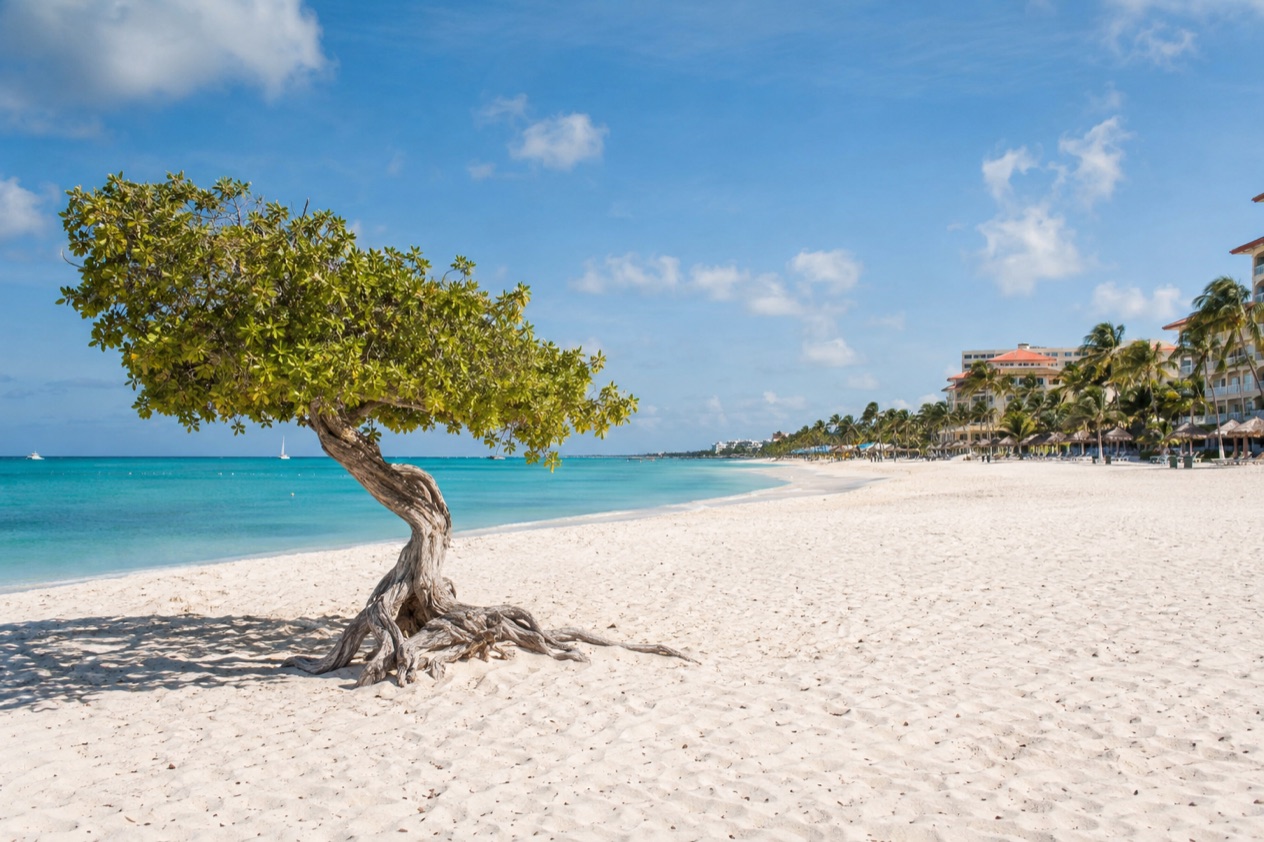
At Palm Beach, the evening begins with tangerine light on the water and tables set barefoot in the sand, candles flickering as the first casino signs switch on behind the hotels. A little farther down the coast at Eagle Beach, the fofoti trees lean over a broad stretch of soft white sand, and people stand in line with their cameras to photograph them.
Both are on Aruba’s leeward side and both are lovely, but they feel different once you settle in. One is the lively resort strip, the other a wider, calmer-looking beach with low-rise hotels across the road.
Which is better, Palm Beach or Eagle Beach?
Palm Beach suits travelers who want restaurants, casinos, water sports and nightlife within a few steps of the hotel, while Eagle Beach suits those who want space, a lower skyline and a quieter rhythm. Neither one is better in the abstract. The choice is about how you want your evenings to feel and how much of your day you plan to spend simply lying on the sand.
Palm Beach is the epicenter of tourism on the island and home to the high-rise hotel area. Eagle Beach sits in Oranjestad West and is known for its many low-rise resorts. That one difference, tall towers versus lower buildings, shapes nearly everything else, from the amount of activity around you to the kind of dinner you end up eating.
| Category | Palm Beach | Eagle Beach |
|---|---|---|
| Beaches | White sand on a two-mile strip, with piers, beach bars and water sports concessions | The widest beach in Aruba, with soft white sand and fofoti trees |
| Vibe | Glamorous, lively, resort-centered | Relaxed, open and spacious, with low-rise hotels |
| Things to do | Swimming, snorkeling, parasailing, watersports, shopping, malls, casinos | Water sports, beach huts, beach bars, beachfront dining |
| Nightlife | Buzzing clubs and casinos just off the beach | Cocktails at beach bars and fine dining by the sea |
| Weather | Same warm, windy island climate | Same warm, windy island climate |
| Getting there | Hotel strip in Noord, with public transport and public parking | Neighborhood of Oranjestad West, with hotels just across the road |
| Best for | Honeymooners, nightlife fans, families at big resorts, water sports lovers | Beach purists, couples, families who like low-rise hotels |
Beaches and the sea
Palm Beach is a long ribbon of white sand backed by palm trees, hotels, casinos, piers, beach bars and water sports concessions. The sand is soft, and the beach is busy in the way a resort strip should be, with parasailing overhead, kiosks along the shore and people strolling toward dinner as the sun drops.
The water here is described as calm, a comfortable haven for swimmers and snorkelers, and floaters drift easily in it. Off the north end lies a sunken ship, a detail that gives snorkelers and boat passengers something to look for.
Dawn and sunset are the two best hours on this beach. Early walkers have the sand almost to themselves, while the evening belongs to couples heading to candle-lit tables on the beach itself. It is the sort of place where you can go from a morning swim to a parasailing flight to a beachfront dinner without ever leaving the same stretch of shore.
Eagle Beach is the widest beach in Aruba, and that width is the first thing you notice. There is room to spread out, to walk a long way before you reach the next group of umbrellas, and to see the Caribbean opening up in front of you without a wall of towers behind. The sand is pristine and soft, which is why the beach has been rated one of the best in the world and was voted third among the Caribbean’s Best of the Best beaches in the Travelers’ Choice Awards.
Two of the most photographed fofoti trees in Aruba grow here, bent by the steady trade wind into shapes that have become a small symbol of the island. Water sports are on offer, and some hotels near the beach set out cabanas and lounges for their guests. Others rely on the public beach huts, where you can cool off in the shade. Dining runs from cocktails at beach bars to fine dinners at beachfront restaurants.
Who wins depends on what you want from the sea. For swimming and snorkeling, Palm Beach is the one the sources describe as calm and comfortable, so it takes that round. For sheer sand, space and views, Eagle Beach wins easily, with its width, its trees and its open horizon. Many visitors end up wanting both: Palm Beach for the water and Eagle Beach for the long, unhurried hours on the sand.
Things to do
The two beaches offer quite different days. Palm Beach is built around doing things, from water sports in the morning to shopping and dinner and clubs after dark. Eagle Beach is built around staying put, with the odd water sport to break up the sun and a good dinner when the light turns gold.
Around Palm Beach
By day the beach is the activity: swimming, snorkeling, parasailing and other watersports from the concessions and kiosks along the sand. Walkers head out at dawn or at sunset, and the sunken ship off the north end gives the shoreline a point of interest. Two of the largest shopping malls in Aruba stand nearby, with cinema theaters, water fountain shows, bowling and spa facilities, which makes them a useful plan for a day when you want a break from the sun.
After dark, the area just off the beach comes alive with clubs and casinos. The scene is described as lively yet laid-back, with local dining mixed in among the bars, so a night out can be as quiet as a long dinner or as late as you want it to be. For something calmer, book a candle-lit table with your feet in the sand and watch the sky turn tangerine.
Beyond the strip, the wider district of Noord offers more to see. Noord means north in Dutch, and the district takes in the Bubali Plas Bird Sanctuary, a protected wetland, and the historic California Lighthouse, recently refurbished.
Boca Catalina and Arashi are spectacular snorkeling spots, Fisherman’s Huts is a windsurfing and kite boarding mecca, and the Alto Vista Chapel, built in 1750, is a quiet historic stop. Golfers can head to Tierra del Sol Resort & Golf, the island’s PGA Championship course.
Around Eagle Beach
The main event at Eagle Beach is the beach itself, and a day here is a slow one. You walk the wide sand, photograph the fofoti trees, try a water sport or sit in the shade of a beach hut with a drink. Beach bars serve cocktails through the afternoon, and beachfront restaurants take over as the sun sinks, with fine dining for those who want a proper evening.
Because the beach sits in a neighborhood of Oranjestad, the capital’s life is close at hand. Several of the island’s low-rise hotels stand nearby or just across the road, so the day tends to be spent between your room, the sand and the table you reserved for dinner.
Families will find that some resorts here have water slides, and travelers with kids should mention the One happy family package when booking. Couples hotels, meanwhile, are designed for a romantic vacation for two.
Weather and the best time to go
The weather is the same at both beaches, because Aruba has one climate: hot, sunny and windy all year, with the trade wind blowing from the east. The two beaches are a short distance apart on the same leeward coast, so you should not expect one to be sunnier or showerier than the other. What changes is the month, and the differences between a winter and a summer visit are modest but real.
| Month | Average high (°F) | Average low (°F) | Rain (inches) | Rain days | Wind (mph) |
|---|---|---|---|---|---|
| January | 86.5 | 76.6 | 1.73 | 10.8 | 16 |
| July | 90.3 | 80.1 | 1.24 | 4.1 | 18 |
January is warm rather than scorching, with afternoons hot enough for the beach and nights mild enough to dine outdoors without a jacket. Rain does come, spread over many days, but in short showers rather than all-day gray, so a morning may begin with a passing cloud and end in full sun. The wind is a little gentler than in summer, which many beachgoers find more comfortable for lounging.
July is hotter, and the nights stay warm too, so the sea breeze matters. Rain is much rarer in this month, which means most days are dry and bright. The wind is slightly stronger, which cools the afternoons and keeps the fofoti trees bent in their familiar lean. It also means a walk along Palm Beach or Eagle Beach at sunset feels breezy rather than still.
For choosing between the two beaches, weather is not a deciding factor. Pick Palm Beach if you want the sunset scene and the evening buzz in any month, and Eagle Beach if the long, open stretch of sand is what you are after. In both places the best hours are early morning and late afternoon, when the light is soft and the heat is easier to handle.
Getting there and getting around
Both beaches feel like an easy ride from Queen Beatrix Airport, where you also get your first warm welcome to the island. Palm Beach is located 7 miles from the airport, on the northwest end of the island, in the district of Noord. Eagle Beach sits in Oranjestad West, in a neighborhood of the capital itself. The two are in different parts of the leeward coast, so choosing one means choosing the setting around it.
At Palm Beach, the amenities include places to eat and drink, shops, public transport and public parking. That means the hotel strip is set up for visitors who arrive in different ways.
Many hotels stand just steps from the sand, and some, such as the Hilton Aruba Caribbean Resort & Casino, are right beside the beach and close to dining, shopping and nightlife. Once you are there, a good part of the day can be spent on foot, walking the shore at dawn or sunset.
At Eagle Beach, the setting is more spread out, with several low-rise hotels either near the sand or just across the road. You step out of your hotel, cross to the beach and settle in.
Beach bars and beachfront restaurants provide food and drinks without a trip elsewhere, so the area works well for a vacation that stays in one place. Outings beyond the beach, such as a visit to Oranjestad, are part of its appeal as a neighborhood of the capital.
If you plan to explore, Palm Beach has the advantage of being in Noord, the northern district where the bird sanctuary, the lighthouse, the snorkeling spots and the golf course are found. Eagle Beach gives you a different kind of base, with the capital’s neighborhood around you and the beach as your main stage. Either way, the island is small, so a hotel at either beach does not shut you out of the other.
Who should choose which
Choose Palm Beach if you want everything within a few steps: the glamorous high-rise resorts, the casinos, the clubs, the malls and the water sports. It suits honeymooners and couples who want romantic walks along the shore at sunset, and it suits families too. The Hilton has family rooms and a kids club, Playa Linda Beach Resort can house a group of 8 in one room and has ground-floor suites that suit seniors, Hyatt Regency Aruba Resort, Spa & Casino welcomes pets, and Barceló Aruba offers views of the beach from a private balcony or terrace.
Choose Eagle Beach if the beach is the point of the trip. It is the widest beach on Aruba, with soft white sand, ocean views and the fofoti trees, and the low-rise hotels around it keep the skyline open.
Families can look for resorts with water slides and ask about the One happy family package, while couples can choose hotels designed for a romantic vacation for two. If your ideal day is a long one on the sand, a drink in the shade and an unhurried dinner, this is your beach.
You do not have to choose only one. Many travelers stay at one beach and spend an afternoon or an evening at the other.
If you sleep at Eagle Beach, you can still go to Palm Beach for a sunset dinner and a night of casinos and clubs. If you stay at Palm Beach, you can visit Eagle Beach to see the trees and walk the wide sand. The island is small enough that each visit is an outing rather than a move.
A good rule of thumb is to book your hotel for the atmosphere you want to wake up in, then treat the other beach as a day out. For those who love both the lively evening scene and the open sand, splitting a longer stay between the two also works nicely, giving you the full range of what the leeward coast offers.
Good to know before you go
The U.S. State Department rates Aruba Level 1, ‘Exercise normal precautions,’ and says Aruba is generally a safe destination for travelers, with petty crime the main concern in popular tourist areas.
Both beaches are popular tourist areas, where petty crime is the main concern, so the usual habits apply: keep valuables out of sight on the sand and lock your room. The wind blows steadily from the east all year, which keeps the heat bearable but can dry your skin quickly, so sun protection matters at both beaches. Plan your sunsets for the west-facing shore, where Palm Beach and Eagle Beach both give you an open view of the sea as the light turns gold.
Sources
- Aruba Tourism Authority, Palm Beach (https://www.aruba.com/us/explore/palm-beach), checked October 9, 2026
- Aruba Tourism Authority, Eagle Beach (https://www.aruba.com/us/explore/eagle-beach), checked October 9, 2026
- Wikivoyage, Palm Beach (Aruba) travel guide (https://en.wikivoyage.org/wiki/Palm_Beach_(Aruba)), checked October 9, 2026
- Wikipedia, Eagle Beach (https://en.wikipedia.org/wiki/Eagle_Beach), checked October 9, 2026
- Aruba Tourism Authority blog, Palm Beach family resorts (https://www.aruba.com/us/blog/palm-beach-family-resorts-in-aruba), checked October 9, 2026
- Aruba Tourism Authority, Noord region (https://www.aruba.com/us/our-island/regions/noord), checked October 9, 2026
- Meteorological Department Aruba (meteo.aw), Summary Climatological Normals 1991-2020, Queen Beatrix Airport station (http://www.meteo.aw/files/Download/climatnormals19912020.pdf), checked October 9, 2026
- U.S. Department of State, Aruba Travel Advisory, Level 1, issued August 19, 2026 (https://travel.state.gov/content/tsg_aem/us/en/home/international-travel/travel-advisories/destination.abw.html), checked October 9, 2026