
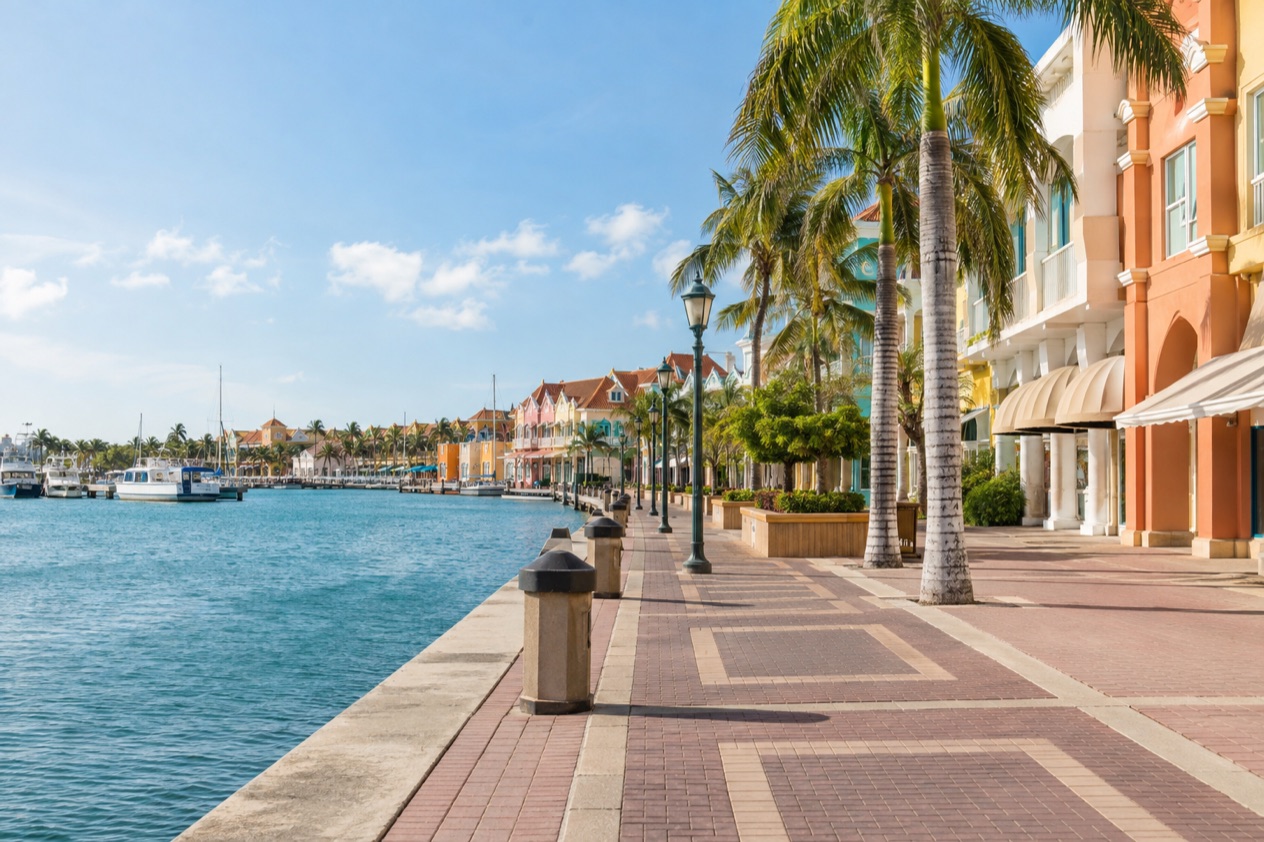
Under the pastel Dutch-colonial facades of Oranjestad, two men stroll hand in hand toward the harbor while a bartender ahead sets out glasses for the evening. Nobody turns a head. The trade wind pushes through the streets, music drifts from open doorways, and the island’s motto, One Happy Island, reads less like a slogan than a habit. Aruba is a Caribbean destination that many LGBT travelers return to again and again.
Is Aruba LGBTQ-friendly?
Yes, Aruba is widely regarded as a welcoming destination for LGBT travelers, and many come back year after year. It is described as a safe and secure place to be, and the island says openly that it welcomes all races, religions and lifestyles. That attitude is part of how Aruba presents itself, from the airport to the hotel lobby.
A tolerance with Dutch roots
Aruba is a constituent country of the Kingdom of the Netherlands, and its open-minded character is partly credited to that Dutch influence. You hear it in the everyday mix of Papiamento (the local language, a blend of Portuguese, Spanish, Dutch and African influences), Dutch, Spanish and English. A small island that has long absorbed many peoples tends to be unbothered by one more kind of difference.
One frequent visitor reports never having met mistreatment or discrimination over his sexual orientation during his stays. That is one traveler’s account, not a guarantee, but it matches the island’s reputation. The Aruban people’s progressive mindset is also given as the reason couples feel comfortable walking around hand in hand and enjoying a vacation without worry.
Hotels that train for it
Many hotels on the island are approved by the Travel Alternative’s Group, known as TAG. That approval means the staff have been trained to accept diversity, and some hotels employ members of the LGBT community themselves. For a couple checking in, the point is simple: the person at the front desk has probably heard your situation before and will treat it as ordinary.
The hotel strip along Palm Beach in the Noord district and the hotels near Eagle Beach, where the leaning fofoti trees frame the sand, are where most beach vacations are based. Look for the TAG approval when you compare properties, since many, not all, carry it.
Weddings and honeymoons
Same-sex wedding ceremonies have gained popularity in Aruba. A beach setting, a sunset and a trade wind that lifts veils and shirt collars alike make the island an easy place to imagine a ceremony or a celebration with close friends. Couples also come simply to mark an anniversary with a week of slow mornings and long dinners.
If a wedding is on your mind, think of the island as a backdrop rather than a checklist. The pleasures are the ones every visitor shares: an open horizon, warm evenings, a table by the water, a day spent exploring the rough, wild windward coast in the north and east and returning to the calmer resort side in the west and southwest for dinner.
What it feels like day to day
Day to day, the experience is mostly unremarkable in the best sense. You eat pastechi (a fried pastry, often filled with cheese or meat) at a roadside stand, drink a cold local beer on a terrace, watch the sky turn orange over the water. You can do all of it as a couple without planning how to behave.
That ease is what repeat visitors describe. There is no need to seek out a single protected corner, because the island’s welcome is not limited to a few venues. Still, a small island has its own pace and manners, so a friendly greeting and a relaxed attitude go a long way, as they would anywhere.
What are the laws?
There are no legal restrictions on same-sex sexual relations in Aruba, and none on organizing LGB events either. That puts the island among the Caribbean destinations where the law is on the traveler’s side, and it fits with a long Dutch tradition of legal equality.
Relationships, events and civil unions
Aruba voted for an LGBT civil union, and it is described as the first island in the Caribbean to do so. For a visitor, that history says something about the local mood: this is a place where the question has been debated openly and answered in favor of recognition. It sits alongside the wider Dutch story, since the Netherlands was the first country to legalize gay marriage in 2001.
Because there is no restriction on organizing LGB events, gatherings, parties and group trips can be planned like any other. The legal picture is a background comfort rather than something you will think about on a beach day.
Laws that apply to every visitor
Friendly does not mean lax. You are subject to local laws, and if you break them, even unknowingly, you may be expelled, arrested or imprisoned. Drug laws are the clearest example. Aruba’s enforcement of drug possession differs significantly from the Netherlands, and laws against controlled substances are enforced rigorously, including against tourists with marijuana for personal use.
People detained in Aruba do not have the option of posting bond for their release. If you are ever arrested or detained, ask the police or prison officials to notify the U.S. Consulate immediately. It is the kind of detail you hope never to need, and worth knowing before a festival weekend or a late night out.
Small print on goods and nationality
Counterfeit and pirated goods are illegal under local law, so a bargain bag or a copied watch can cost you a fine or be taken from you, and the same can happen when you bring such items back to the United States. Souvenirs are better chosen from real local crafts.
Dutch law, in principle, does not permit dual nationality, though there are exceptions. This mostly matters to travelers with family ties to the Kingdom of the Netherlands, for example those marrying on the island and thinking about long-term plans.
Access and the law
Local law prohibits discrimination against people with physical, sensory, intellectual or mental disabilities, and it is enforced. In practice, however, sidewalks and crossings in many areas are not wheelchair accessible, and many buildings lack ramps. Travelers who use a wheelchair should keep that in mind when imagining a stroll through town.
Where is the LGBTQ scene?
The LGBTQ scene is centered on Oranjestad, the capital, where gay bars and clubs are found throughout the city. Gay nightlife on the island is growing, and the capital is where an evening out tends to begin and end.
Oranjestad after dark
Oranjestad is a compact port city of candy-colored Dutch facades, cruise-ship docks and waterfront restaurants. By day it is for shopping and wandering. By night the bars and clubs scattered through town take over, and the mood is mixed and sociable rather than segregated. Because the venues are spread across the city rather than packed into one street, an evening can drift from a dinner table to a drink to a dance floor.
Many travelers pair the city with a beach base. Palm Beach in the Noord district and Eagle Beach are the resort areas on the sheltered western side, and Oranjestad is the place you go out to. Nightlife is growing, so what you find from one visit to the next may change.
Music festivals for every taste
Aruba’s festival calendar is where the scene turns into a crowd. Music festivals here are held in breezy, outdoor venues, with genres that run from jazz, blues and soul to Latin, electronic and reggae. Whatever your taste, there is usually a stage where the trade wind is part of the sound system.
The Aruba Soul Beach Music Festival takes place every Memorial Day weekend, with concerts, comedy events and beach parties. It is the one to look at if you want a weekend with a party atmosphere. The Aruba Summer Festival features Latin, hip-hop and pop performers, and the Aruba Summer Music Festival brings in international Grammy award winning artists alongside Aruba’s best bands.
Caribbean Sea Jazz Festival
For jazz and blues lovers, the Caribbean Sea Jazz Festival is the highlight. It lasts two nights and draws over 7,000 visitors, making it one of the largest music festivals in Aruba. Picture warm air, a stage under the sky and an audience of couples, friends and solo travelers swaying together.
It suits anyone who would rather spend an evening listening than clubbing, and it makes a good anchor for a trip. Build the rest of the week around the beach, the capital’s restaurants and the island’s wilder coasts, and let the festival be the evening everyone remembers.
Beyond the bars
Not every LGBTQ trip is about nightlife. Plenty of couples treat Aruba as a place to be together in public without a second thought: a long lunch in Oranjestad, a walk by the fofoti trees at Eagle Beach, a sunset on the west coast. The island’s welcome shows in these quiet hours as much as at any club.
If you want company, the hotels with TAG approval are a natural starting point, and the festivals give you a ready-made crowd. If you want privacy, the island has room for that too. Aruba works for both kinds of trip.
Good to know before you go
The U.S. State Department rates Aruba Level 1, ‘Exercise normal precautions,’ and says Aruba is generally a safe destination for travelers, with petty crime the main concern in popular tourist areas.
Aruba is easy to enjoy as an LGBT traveler, but the same everyday habits apply here as anywhere: keep an eye on your belongings in busy tourist areas, since petty crime is the main concern. Remember that local law applies to everyone, drugs included, and that detainees cannot post bond. Beyond that, pick a TAG-approved hotel, plan a festival weekend if the music appeals, and spend your evenings in Oranjestad.
Sources
- Aruba Tourism Authority, LGBTQ vacations (https://www.aruba.com/us/plan-your-visit/aruba-vacations/lgbt-vacations), checked October 9, 2026
- U.S. Department of State, Aruba Travel Information, Local laws and special circumstances (https://travel.state.gov/content/travel/en/international-travel/International-Travel-Country-Information-Pages/Aruba.html), checked October 9, 2026
- Aruba Tourism Authority, Festivals (https://www.aruba.com/us/things-to-do/nightlife/festivals), checked October 9, 2026
- U.S. Department of State, Aruba Travel Advisory, Level 1, issued August 19, 2026 (https://travel.state.gov/content/tsg_aem/us/en/home/international-travel/travel-advisories/destination.abw.html), checked October 9, 2026
To plan your stay
- Best Time to Visit Aruba: Weather by Month, Peak Season and Festivals
- Where to Stay in Aruba: Palm Beach, Eagle Beach, Oranjestad and All-Inclusives
- Aruba Airport (AUA): Arrival, Getting to Your Hotel, U.S. Preclearance and Departure
- Know Before You Go to Aruba: Entry Forms, Money, Water and Local Customs