
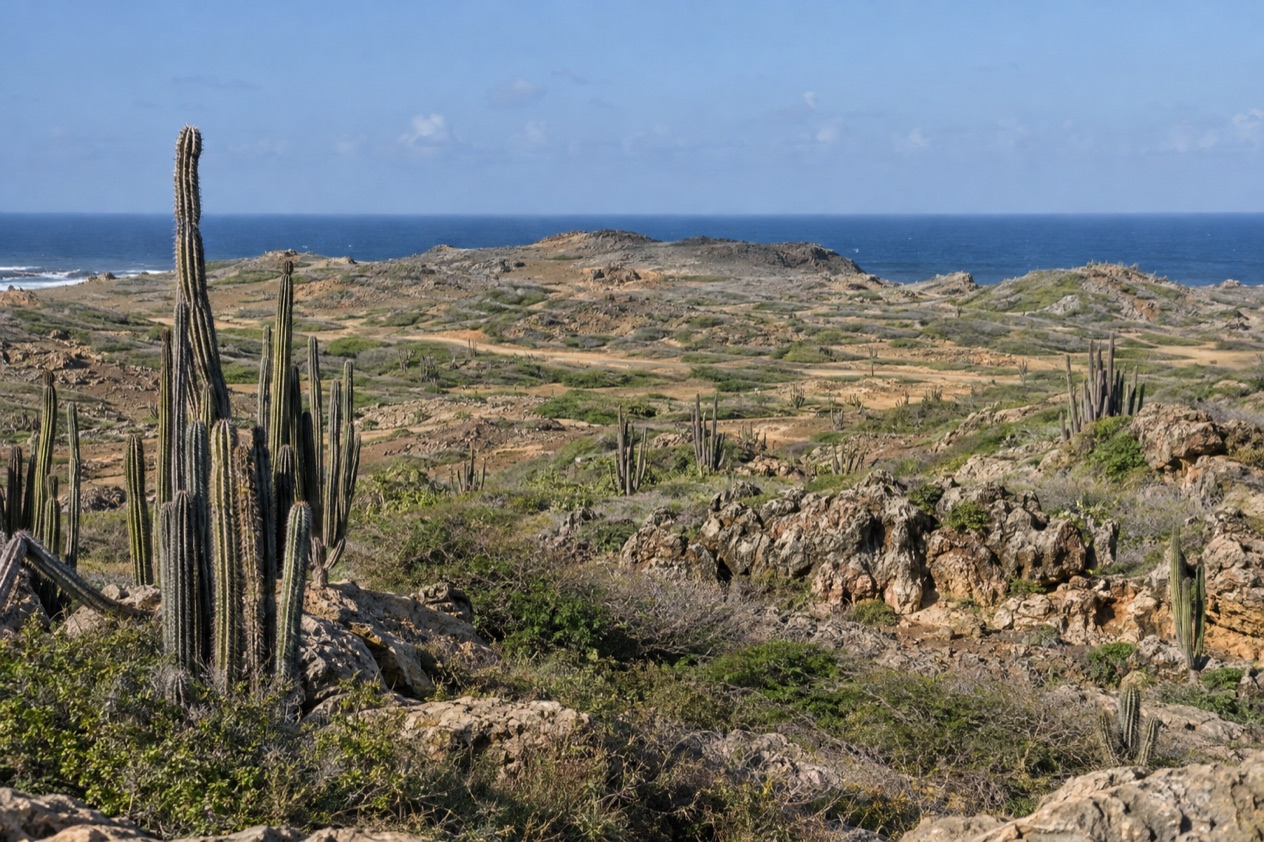
Past the last paved stretch of road, the cactus country begins: columnar candelabras, sharp divi-free scrub, and goats picking their way over dry hillsides. Then the land tilts toward the north coast, where black lava rock meets a loud, rough sea. Arikok National Park is the wild side of Aruba, a place for hiking boots, caves and long views rather than a beach towel.
Is visiting Arikok National Park worth it?
Yes, if you want to see what Aruba looks like beneath the resort strip, and it suits hikers, nature lovers, bird-watchers and anyone curious about geology. It is a great place to spend an entire day, and the landscapes are dramatic enough to fill one: lava formations, limestone, quartz diorite, caves, old Indian rock drawings and secluded bays.
What sets it apart from the beaches along the leeward coast is the sense of space and the wildlife. The park covers a large share of the island, roughly a fifth of its land, and it shelters species found nowhere else, such as the cascabel (a rattlesnake), the shoco (burrowing owl) and the prikichi (Aruban parakeet).
Rangers lead organized tours that bring the flora, fauna and viewpoints to life, and a private guided hike lets you take in birds, flowers and geology at your own pace. It is not a place for a quick photo stop. It rewards a slow day.
Your entrance fee also does real work. It supports preservation, educational programs and the animals living in the park, which is governed by the Aruba Conservation Foundation.
What to see at Arikok National Park
Fontein Cave and the rock drawings
Caves are one of the park’s signature draws, and Fontein Cave is the one you enter with park staff only. It is open solely to visitors on guided tours, so plan to join one rather than wander in. Inside, you step out of the glare into cool rock, and the walls carry the kind of history that makes the island’s earliest people feel close.
Look for the Indian rock drawings that give the park part of its cultural weight. They are a reminder that Aruba was lived in long before hotels. A guide helps you read what you are seeing, from the marks on the stone to the way the cave formed.
Conchi Natural Pool and the north coast
The natural pool, also called Aruba’s natural pool, is the best-known destination in the park. It is ringed by ancient lava stone and sits among some of the most rugged terrain on the island. The trail from the visitor center runs along the coast, with views of the rough seas of the northern shore crashing against the rock.
Visitors are encouraged to take a refreshing dip in the pool to cool off after the walk. The hike is out and back and generally rated moderately challenging, so the pool feels like a reward. Hikers on the Rooi Tambu and Dos Playa route also reach Dos Playa, a bay where, with relatively calm seas, it is possible to surf or bodyboard.
Boca Prins, Moro and Dos Playa
The park shelters secluded bays, among them Moro, Boca Prins and Dos Playa. Boca Prins is a beach where turtles nest, so it is a place to look and linger rather than to rush. Each bay has its own character, shaped by the cliffs and dunes behind it.
Dos Playa is the one to pick for surf or bodyboarding. The bays are quieter and wilder than anything on the resort side, and they make a natural halfway point for a day of exploring.
Seroe Arikok, Miralamar and Hofi Shon Shoco
Seroe Arikok, or Arikok Hill, is a viewpoint from which you can see much of the island, a good place to understand how small and varied Aruba is. In the Miralamar area, the abandoned gold mines are visible, closed since 1916, a rusted footnote to the island’s mining past.
Hofi Shon Shoco is a garden of local flora and fauna, including the candelabra cactus. It is a gentle way to meet the plants that define the landscape, and the park’s seven vegetation types, mostly found in and around arroyos and on the leeward sides of hills, give botanists plenty to notice.
Hours, tickets and rules
A ticket is required to enter the park, and the San Fuego Visitor Center is where the day starts. You can grab an adult day pass and see the open hours right here, and if you want a guided hike, that comes with its own fee for a group of up to ten people.
| Site | Open | Admission |
|---|---|---|
| San Fuego Visitor Center, Parke Nacional Arikok | Daily, 8:00am to 3:30pm | Adult conservation day-pass: USD 22 per person |
| Guided hike: Rooi Tambu & Dos Playa (7.5 km / 4.6 miles) | Guided | $25, maximum 10 people |
| Guided hike: Jamanota Hill (4.8 km / 2.9 miles) | Guided | $25, maximum 10 people |
| Guided hike: Miralamar | Guided | $25, maximum 10 people |
Rules are few but firm. All-terrain vehicles, utility task vehicles and motorbikes are prohibited in protected nature areas, and Fontein Cave is open only on guided tours with park staff. The trail to the natural pool lists reef-safe sunscreen among its recommended items.
How to get to Arikok National Park
The park lies in the northeastern region of Aruba, and the main trail begins at the Arikok National Park Visitor’s Centre. That is your starting point whichever base you choose on the island, whether you are staying in the resort area or in town.
Since no drive times, bus service or transfer details are listed, the practical step is simply to aim for the visitor center. The route to the natural pool begins there, and so do the guided hikes. From the visitor center, the trail to the pool is 4.8 miles out and back, with an average time of 2 hours and 40 minutes.
Motorbikes, ATVs and utility task vehicles are prohibited in protected nature areas, so they are not a way into the park. Once inside, the landscape is meant to be seen on foot or with a ranger-led tour.
When to visit Arikok National Park
Start early. The visitor center opens at 8:00am and closes at 3:30pm, so the cool first hours are the natural window for a hike, and the last hours are for finishing up. On an exposed trail across rock and cactus, shade is scarce, which is why a cap and plenty of water matter.
As for months, the best time to visit Aruba in general runs from February to August, while the peak season falls between December and April. That means the park fits well into the long stretch from February onward, when the island is in its favored season. Whatever the month, the trade wind keeps the north coast rough and lively.
Hurricane season is the one calendar note to keep in mind for the island, though Aruba sits on the southern fringes of the hurricane belt where damaging storms are rare. Nature clean-ups are scheduled at protected areas on October 31 and November 28, 2026, with locations still to be announced, for visitors who like to give back.
Tips for your visit
Plan a full day. The park is a great place to spend an entire day, and a guided hike plus a stop at a viewpoint or bay will fill it nicely. Bring comfortable hiking shoes, at least one liter of drinking water, reef-safe sunscreen and a cap, the items recommended for the trail to the natural pool.
If you want company, organized tours led by park rangers are highly recommended to fully experience the flora, fauna and viewpoints. A private guided hike is also available for exploring birds, flowers and geology at your own pace. For shorter outings, Jamanota Hill is the shorter of the three guided hikes, while Rooi Tambu and Dos Playa is longer and finishes at the bay.
Keep your eyes open for wildlife. The shoco and prikichi are the birds to look for, and the blue kododo lizard, Aruba’s whiptail, darts across the rocks. The park is also home to the rare Hummelinck’s vesper mouse, though you are unlikely to see it. Pair the visit with a stop at the garden of Hofi Shon Shoco for a closer look at the cacti.
For mobility, note that sidewalks and crossings in many areas of Aruba are not wheelchair accessible and many buildings lack ramps. The trails here are rugged, and the route to the natural pool is rated moderately challenging.
Good to know before you go
The U.S. State Department rates Aruba Level 1, ‘Exercise normal precautions,’ and says Aruba is generally a safe destination for travelers, with petty crime the main concern in popular tourist areas.
Aruba’s drug laws are enforced rigorously, including against tourists with marijuana for personal use, and visitors are subject to local laws. Anyone arrested or detained should ask police to notify the U.S. Consulate immediately. The park’s entrance fee supports its preservation, so every ticket helps protect the endemic species you came to see.
Sources
- Aruba Tourism Authority, Arikok National Park (https://www.aruba.com/us/explore/arikok-national-park), checked October 9, 2026
- Wikipedia, Arikok National Park (https://en.wikipedia.org/wiki/Arikok_National_Park), checked October 9, 2026
- Aruba Conservation Foundation (ACF), experiences (https://acf.aw/experiences), checked October 9, 2026
- Aruba Conservation Foundation (ACF), nature conservation (https://acf.aw/nature-conservation), checked October 9, 2026
- Aruba Tourism Authority, Hiking trail Arikok visitor center to Dos Playa (https://www.aruba.com/us/explore/hiking-trail—arikok-visitor-center-to-dos-playa), checked October 9, 2026
- U.S. Department of State, Aruba Travel Information, Local laws and special circumstances (https://travel.state.gov/content/travel/en/international-travel/International-Travel-Country-Information-Pages/Aruba.html), checked October 9, 2026
- Aruba Tourism Authority, Best time to visit (https://www.aruba.com/us/our-island/one-happy-island/when-is-the-best-time-to-visit-aruba), checked October 9, 2026
- U.S. Department of State, Aruba Travel Advisory, Level 1, issued August 19, 2026 (https://travel.state.gov/content/tsg_aem/us/en/home/international-travel/travel-advisories/destination.abw.html), checked October 9, 2026
To plan your stay
- Best Time to Visit Aruba: Weather by Month, Peak Season and Festivals
- Where to Stay in Aruba: Palm Beach, Eagle Beach, Oranjestad and All-Inclusives
- Aruba Airport (AUA): Arrival, Getting to Your Hotel, U.S. Preclearance and Departure
- Know Before You Go to Aruba: Entry Forms, Money, Water and Local Customs