
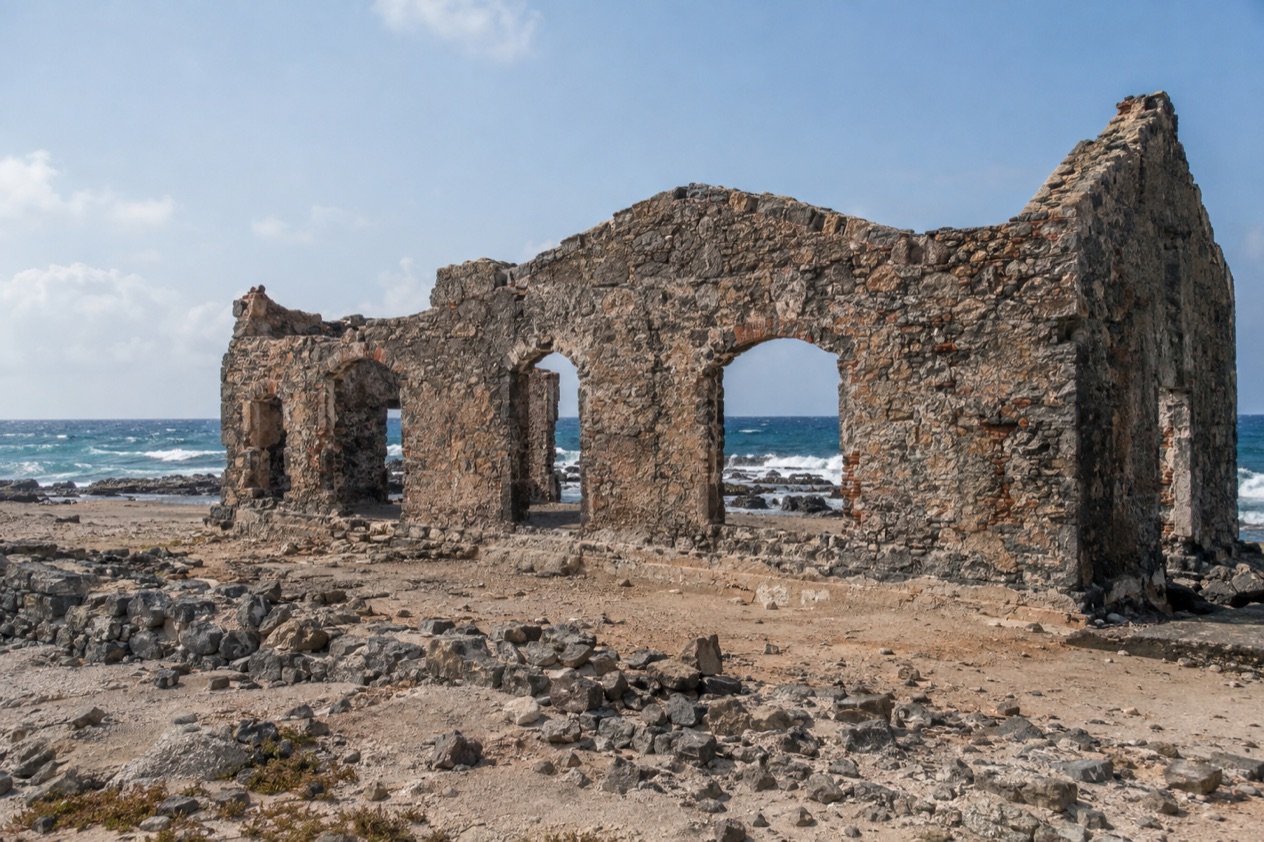
The first thing you notice at Bushiribana is the wind, which pushes in off the sea and hums through the gaps in a heap of weathered stone. Then the walls come into view, dark and broken against a pale sky, like a small fortress someone abandoned mid-sentence. This is the northern coast of Aruba, and the ruins of the old gold mill make a visit about history, light and open air rather than about a polished attraction.
Is visiting the Bushiribana Gold Mill Ruins worth it?
Yes, if you like places that tell a story through what is left standing, and especially if you are curious about the side of Aruba that has nothing to do with resort beaches. It suits history fans, photographers, families with curious older kids and anyone who wants a break from the sunbathing routine. If you expect displays, a gift shop or a guided exhibit, this is not that kind of stop.
What sets it apart from other places nearby is the plain fact that you are standing inside the real thing. The ruins were once a gold production facility, and today they are a sightseeing spot where you walk, look and take in the windswept stone ruins on their own terms.
Nothing has been rebuilt to look neat, so the broken arches and thick walls feel honest. Next to the soft sand of the west coast, the mood here is raw, exposed and a little melancholy, and that contrast is exactly the reason to come.
It also works as a window onto the island’s past. Many visitors know Aruba as a place of sun and calm water, so learning that people once came here chasing gold changes how the landscape reads.
The name of the island itself is tied to the idea, since its historical name roughly translates to ‘There was Gold’. A stop at the mill makes that phrase feel real rather than like a curious bit of trivia. Pair it with a drive along the rugged coast and the visit becomes a small chapter in a bigger day, a way to see the wilder, windward face of the island that most beach-focused trips skip.
What to see at the Bushiribana Gold Mill Ruins
The mill walls and stone shell
The core of the visit is the mill building itself, a mass of heavy stone that looks part castle, part quarry. This was where ore was processed, and the thick walls and open openings give you a sense of how serious the operation was. Take your time walking around the outside first, noticing how the stone has weathered and how the shapes change as you move.
Inside and around the structure, look for the way the rooms and openings frame the sky and the sea. These framed views are what most photographers come for, especially when the light is low and warm. The ruins reward slow looking, so linger and let the wind and the sound of the surf do some of the work.
The coastline around the ruins
The mill sits on the northern coast, and the setting is as much a part of the experience as the stone. The north side of Aruba faces the open sea and takes the full force of the trade wind, so the shoreline is rough and wild rather than gentle. Dark rock, spray and a wide horizon surround you, and it feels a world away from the leeward resort beaches.
Stand near the ruins and look along the shore, and you can see why the place feels so dramatic. The contrast between the man-made stone and the pounding natural coast is the visual signature of Bushiribana. It is a good spot to simply stand still and listen.
The gold rush story behind the stones
The mill processed ore from mines in the nearby hills during Aruba’s gold rush of the nineteenth century. That rush began in 1824, though prospectors had been drawn to the island as far back as the 1400s and 1500s. Picture carts and workers bringing rock down from the hills to be crushed and processed at this exposed spot by the sea.
Over the life of the industry, the island produced the equivalent of 3 million pounds of gold or more, a figure that surprises most people who know Aruba only as a vacation spot. The business wound down and ended in 1916. What remains at Bushiribana is the physical memory of that boom, a ruin that makes the numbers feel human.
Other gold-era remnants on the island
Bushiribana is not the only trace of the gold years. The Balashi Gold Mill was built at the tip of the Spanish Lagoon, and its remnants are visible near Frenchman’s Pass.
It was a smelting business built in 1899 by the Aruba Gold Concessions, and it is one of the oldest remnants on the island. Its materials and spare parts were mostly of German descent, and the building has stayed intact since the First World War.
Arikok National Park also houses the remains of historic gold mines at Miralamar. Seeing these other sites alongside Bushiribana gives you the full picture, from the mines in the hills to the mills that processed the ore.
Hours, tickets and rules
Bushiribana is an open-air ruin on the coast rather than a museum with a front desk, so the visit is about walking around the stone and taking in the view. There is no exhibit to follow and no set route, which means you set your own pace, whether that is a quick look or a long stop with a camera.
The experience itself is simple and physical. You walk, you look and you take in the windswept stone ruins, as the island’s own description of the visit puts it. That is the whole program, and for many travelers it is the charm.
One rule is worth knowing for any outing on the island, and it matters at a coastal spot like this. Aruba has banned sunscreens containing oxybenzone since 2019. Visitors should use mineral-based reef-safe sunscreens, which are more likely to be biodegradable and minimize environmental impact. Sunscreen can be purchased on the island from local companies such as Aruba Aloe and Arubalife Organics, so you can pick one up after you arrive.
How to get to the Bushiribana Gold Mill Ruins
The ruins lie on the northern coast of Aruba, on the rougher windward side of the island. That places them well away from the resort strips of the west and south-west, so the trip feels like a real outing rather than a stroll from your hotel. Whatever base you use, you are heading toward the wilder north.
Once you are in the area, the surroundings help you orient yourself. Within one mile of the ruins are the Historic Gold Mines and the Aruba Ostrich Farm, which makes the neighborhood a cluster of things to see rather than a lone stop. If you find one of these, you are close to the others.
It helps to think of the day as a loop through the north and the interior. Bushiribana belongs with the gold story, so it sits naturally with the other remnants of that era, including the mills and mines at Balashi, Frenchman’s Pass and Miralamar in Arikok National Park. Those are in different parts of the island, so treat each as its own stop and plan the order of your day around where you are starting.
Because the coast is open and exposed, the approach is part of the pleasure. You leave the sheltered, greener parts of the island behind and watch the landscape turn drier and more rugged. By the time the stone walls appear, you have already seen the character of Aruba’s north shore.
When to visit the Bushiribana Gold Mill Ruins
The best time of day is when the sun is low, in the morning or later in the afternoon, because the stone turns warm and golden and the shadows give the walls depth. Midday light is flat and strong, and an exposed ruin with little cover can feel hot. The wind, which blows from the east all year, offers some relief, but it also means you will want something to protect your eyes and skin.
For the season, the best time to visit Aruba in general runs from February to August, and that holds for a coastal outing like this one. Peak season on the island occurs from December to April, so those months bring the busiest stretch of the year for flights and rooms, even if the ruins themselves are a quiet kind of place.
Aruba has one climate, so the weather does not change much from one corner of the island to another. What changes at Bushiribana is the mood. On a bright day the sea is deep blue against dark stone, and on a hazier one the ruins feel moody and remote. Both are worth seeing, and photographers often like the contrast.
If you are planning a full day of sightseeing in the north, put Bushiribana early, when the light is kind and you have energy to explore. Then continue to the nearby stops and finish elsewhere on the island once the sun gets higher.
Tips for your visit
Bring a hat, sunglasses and a reef-safe mineral sunscreen, since the site is open to the sky and the sun reflects off pale stone. Wear shoes with a decent grip, because you will be walking among rough, uneven rock and the ground is not a paved promenade. A bottle of water is sensible for any outing on a dry island, and a camera or phone is the one thing everyone ends up using.
As for time, let the place set the length. Some visitors walk around the walls and move on, while others settle in for photos and for reading up on the gold rush story. Because there is no fixed route, you can fit it into a morning or an afternoon without strain.
Combine it with the nearby stops. The Historic Gold Mines and the Aruba Ostrich Farm both lie within one mile, so you can build a themed half day around gold history and a bit of animal-watching. If you want to deepen the story, the Balashi Gold Mill near Frenchman’s Pass and the mine remains at Miralamar in Arikok National Park round out the picture.
Families with older children who like exploring will probably enjoy the sense of discovery here, and the history gives parents an easy story to tell. Anyone who finds uneven stone difficult should keep in mind that this is a rugged ruin on a wild coast and that the terrain is natural, not groomed. Take it at your own pace and enjoy the view from wherever you feel comfortable.
Good to know before you go
The U.S. State Department rates Aruba Level 1, ‘Exercise normal precautions,’ and says Aruba is generally a safe destination for travelers, with petty crime the main concern in popular tourist areas.
Bushiribana is a place to enjoy with your eyes and your camera, so travel light and leave the rest of your day open. Keep the oxybenzone ban in mind when you pack sunscreen, and let the story of the gold rush guide your route through the north, from the stone mill on the coast to the other remnants scattered across the island.
Sources
- Aruba Tourism Authority, Bushiribana Gold Mill Ruins (https://www.aruba.com/us/explore/bushiribana-gold-mill-ruins), checked October 9, 2026
- Aruba Tourism Authority, Historic Gold Mines (https://www.aruba.com/us/explore/historic-gold-mines), checked October 9, 2026
- Aruba Tourism Authority, Balashi Gold Mill (https://www.aruba.com/us/explore/balashi-gold-mill), checked October 9, 2026
- Aruba Tourism Authority, Best time to visit (https://www.aruba.com/us/our-island/one-happy-island/when-is-the-best-time-to-visit-aruba), checked October 9, 2026
- Aruba Tourism Authority blog, Responsible guest (https://www.aruba.com/us/blog/how-to-be-a-responsible-guest-protecting-arubas-beaches-and-marine-life), checked October 9, 2026
- U.S. Department of State, Aruba Travel Advisory, Level 1, issued August 19, 2026 (https://travel.state.gov/content/tsg_aem/us/en/home/international-travel/travel-advisories/destination.abw.html), checked October 9, 2026