
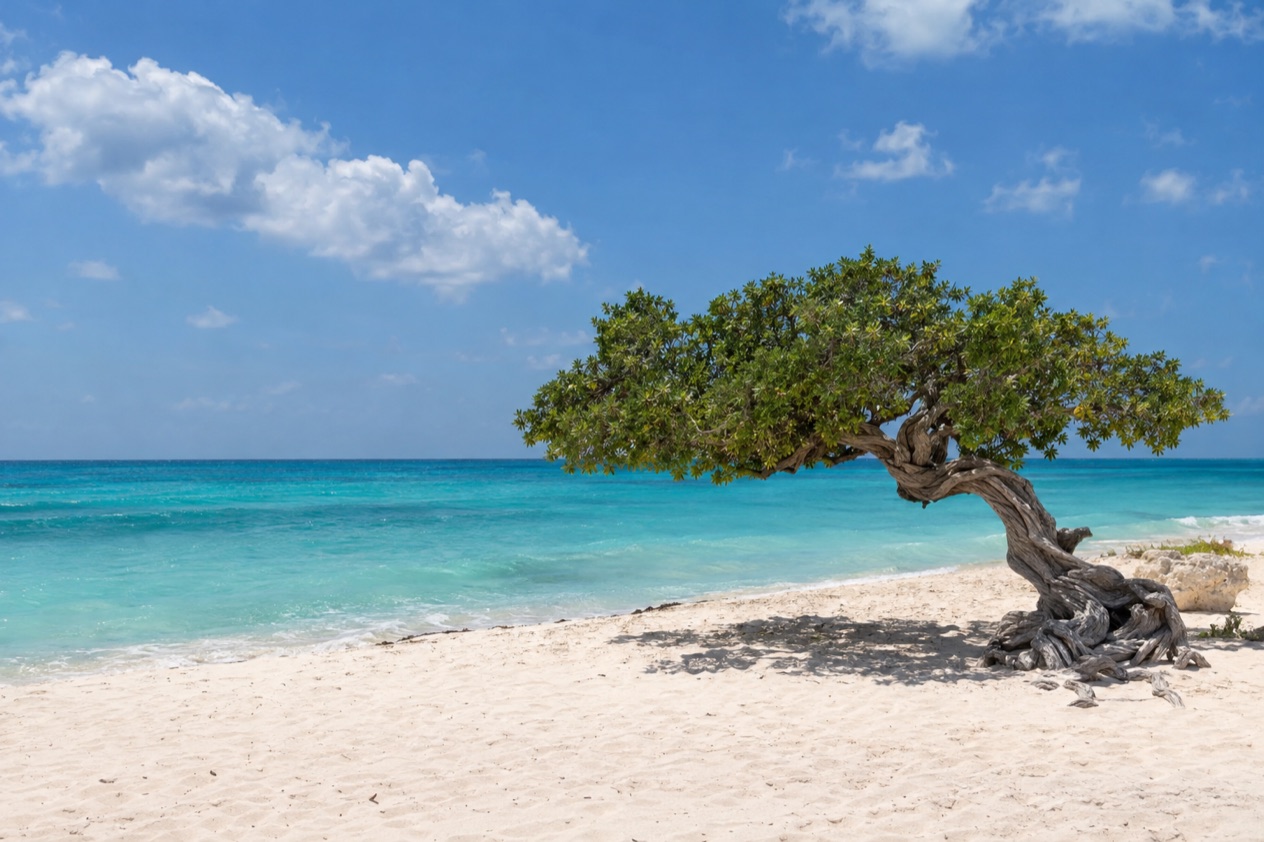
On Eagle Beach the fofoti trees lean to the west, bent over by a trade wind that has hardly paused for as long as anyone remembers. Winter days are bright and dry, the weeks from Christmas into spring bring the crowds, and the late months of the year trade some sunshine for short, warm showers. Aruba is hot in every season, and the real question is which kind of hot, windy or still, busy or quiet, you want for your own days on the island.
When is the best time to visit Aruba?
For most travelers the best time to visit Aruba runs from February through August, when the sky is at its sunniest, rain is a rare event and the trade wind keeps the heat bearable. Peak season stretches from December to April, so the early part of that window is the classic choice if you want dry weather and do not mind sharing the beach. If you would rather have the same sunshine with a little more room, May through August delivers it.
For beach and sea days, the spring months are hard to beat. Rain is almost absent, the water is warm, and the resort beaches along the leeward coast, Palm Beach and Eagle Beach among them, get long cloudless afternoons. Kitesurfers and windsurfers have their own calendar, since the wind is strongest from spring into early summer, and Aruba is described as one of the most popular spots on earth for both sports, with constant trade winds of 15 knots.
Sightseeing suits the cooler end of the dry season, from February to April, when a morning at Arikok National Park, the California Lighthouse at the northwest tip or the ruins of the Bushiribana gold smelter on the north coast is not a test of endurance. In the late summer months the sun is harder and the air heavier, so those outings feel different, slower and sweatier, and lovers of heat may like that.
Budget travelers and anyone craving quiet should look at the off-season, September to November, when the island exhales and the wind drops. The trade-off is rain, which becomes a real possibility from October. Families should know that March brings spring break, and the beaches, pool decks and evening bars are loud and full of students, so a family that wants calm will be happier in late April, May or June, once the break crowds are gone.
Aruba weather by month
Aruba has one climate, hot and breezy all year, and the differences between months are in the rain, the wind and the last few degrees of heat.
| Month | Average high (°F) | Average low (°F) | Rain days | Sea (°F) |
|---|---|---|---|---|
| January | 86.5 | 76.6 | 10.8 | 81.0 |
| February | 87.1 | 76.6 | 4.5 | 80.3 |
| March | 88.0 | 77.5 | 2.0 | 80.2 |
| April | 89.4 | 78.8 | 1.5 | 80.8 |
| May | 89.6 | 80.1 | 1.7 | 82.1 |
| June | 90.5 | 80.4 | 2.8 | 82.6 |
| July | 90.3 | 80.1 | 4.1 | 82.2 |
| August | 91.8 | 81.0 | 3.1 | 83.7 |
| September | 91.8 | 81.1 | 3.3 | 85.3 |
| October | 90.3 | 80.1 | 7.3 | 86.5 |
| November | 88.7 | 78.8 | 9.6 | 85.0 |
| December | 87.3 | 77.5 | 11.0 | 82.4 |
The year has a clear shape. From February to June rain almost disappears, nights are warm and the wind is at its liveliest. July to September is the hottest stretch, with a stray storm now and then and a wind that softens.
October to January is the wet end, and rain days pile up even though the totals stay modest, because the showers are short, sometimes heavy, and often followed by sun within the hour. January belongs to this group in the table, so do not treat it as a fully dry month. Across the whole year Aruba collects just 18 inches of rain, and the island has a reputation for more sunny days than any other Caribbean island.
What is there to do in Aruba in each season?
Each season in Aruba favors a different kind of day, from windy spring beaches to slow, humid autumn evenings. The year divides into distinct stretches, each with its own weather and its own reasons to visit.
February to June: dry, bright and windy
This is the season for everything outdoors. The beaches along the western shore are most reliable, with Palm Beach lined with water sports and Eagle Beach wide and open under the leaning fofoti trees. The south, near Baby Beach by San Nicolas, adds another stretch of sand. Kitesurfing and windsurfing peak while the wind blows hardest, and sailing trips along the coast carry the same breezy energy.
Inland, this is also the time for the desert-like interior. Arikok National Park, with its rocky, cactus-studded landscape, the hill of Hooiberg rising in the middle of the island and the old Bushiribana smelter are all more pleasant before the summer heat settles in.
Cactus and rock formations look sharp in the clear light, and sunsets over the water are long and gold. Leave the quieter, humid evening pace for later in the year.
July to September: hot, calmer and quieter
Late summer is the hottest stretch, and the sea is warm enough that getting in feels like stepping into a bath, which makes long beach days and snorkeling pleasant. The wind eases through September, so the air is stickier, and days build toward a warm, sleepy afternoon. Mornings and evenings are the comfortable hours for walking, and the late sun makes the island’s colors deepen.
Oranjestad is a good place to spend the hottest afternoons, with its pastel Dutch-colonial buildings, shops and the harbor, and the weekly Bon Bini Festival at Fort Zoutman gives evenings a folkloric turn. This stretch sits inside the hurricane season, but weather on the island generally stays typical, with sunny days and breezy trade winds. Save the strenuous outings for another season.
October to January: showers, calm evenings and holiday lights
The island’s rainy season runs from October to December, and these months are the wettest of the year. Showers arrive in short, sometimes heavy bursts, and the sun usually comes back quickly. The wind is at its lightest, the sea is at its warmest, and the island feels slow, green by Aruban standards and unhurried. Museums, restaurants, the murals of San Nicolas and the shopping in Oranjestad make good rain-day plans.
Then the mood shifts. From the middle of the season, Christmas lights go up, Carnival preparations begin and the island fills with visitors again. December and January bring the winter holiday crowds, with beaches busy and dinner tables in demand. If you want a cooler head, travel early in the season, and if you want festivity, come as the year turns.
When is Aruba cheapest and least crowded?
The quietest stretch is September through November, the off-season, when the beaches have space, restaurants rarely have a wait and rooms are easier to find. Lower demand usually shows up in more relaxed rates and more flexible choices, though what you actually pay depends on the hotel and the week.
The busiest weeks are the ones tied to the American calendar. Peak season runs from December through April, and within it the heaviest stretches are Christmas and New Year, the weeks around Presidents’ Day, the whole of March with its spring break, and Easter week, which moves from year to year.
Those weeks come with peak-season rates, fuller beaches and louder evenings. Summer, from late June through August, is the next busy block, as school vacations send American families to the island.
The spaces in between are the sweet spot. Late April and May, once Easter and spring break are over and before summer vacation begin, give you dry weather with calmer beaches. The first weeks of December, before the holiday rush, are a similar window, as is September if you are willing to accept a hotter, stickier island. A midweek stay will also feel quieter than a weekend almost anywhere.
A last point about crowds is where you stand. Palm Beach is the most developed strip and feels busy whenever the island is, while Eagle Beach and the southern shore have more room to spread out, and the wild windward coast on the north and east sees far fewer people in any month.
Which months should you avoid in Aruba?
No month is truly off-limits, but October through December asks for the most flexibility because that is when the rain falls and the weather can turn unsettled. The official hurricane season runs from June 1 to November 30, yet Aruba lies on the South American continental shelf, on the southern fringes of the hurricane belt, where damaging storms are rare.
Rare is not never. Hurricane Ivan passed north of the island in 2004 and brought high waves, some inland flooding and lasting changes to the coastline.
Tropical systems elsewhere in the Caribbean can still affect the island, bringing more rain, gusty winds, a total lack of wind or a muggier feel. In general, though, weather in the season stays much as it is the rest of the year, with sunny days and breezy trade winds, so most visitors experience it as ordinary warm weather.
For rain, the wettest months are November, December and January, when showers come on most days but pass quickly. A trip then calls for a loose plan, with a rainy-day idea in your pocket, such as a museum, a long lunch or a drive to the murals of San Nicolas.
Heat is the other consideration. August and September are the hottest months, with the wind at its softest in autumn, and the air can feel heavy by midday. If heat bothers you, aim for February through April, when the same sunshine comes with a steadier breeze. If you like it hot and quiet, the late summer will suit you better than any brochure suggests.
When can you swim in Aruba?
You can swim in Aruba in every month, because the sea stays warm all year, with its coolest spell in February and March and its warmest in October, when the water feels like a bath.
The winter and spring sea is pleasantly warm, refreshing in the afternoon heat, while from summer into autumn it is warmer still, close to body temperature by October. Most swimmers will not need a wetsuit at any time of year, and the water is welcoming for snorkeling at any time.
What changes more than the temperature is the wind and the shoreline. The resort beaches lie on the leeward coast in the west and southwest, sheltered from the prevailing trade wind, and the wind itself is strongest in spring and early summer, easing in autumn. The north and east coast is rough and wild, with surf that pounds the rocks, and it is a place to watch the sea rather than treat as a swimming beach.
Rainy days in the last months of the year rarely mean a lost beach day. Showers pass quickly, and the sea is at its warmest then, so a swim between clouds is often possible.
Festivals and events in Aruba through the year
Winter holidays and Carnival
Carnival season in Aruba officially opens every year on November 11 at 11:11 a.m., and it builds for weeks with rehearsals, music and costume making. The best Carnival dates are in January and February, when most events and parades take place, with lively processions through Oranjestad and San Nicolas, glittering costumes, steel bands and roadside crowds. It ends on Shrove Tuesday, the day before Ash Wednesday, with the midnight burning of King Momo, the effigy that stands for the party itself.
Before that comes Christmas, with lights in the streets of Oranjestad and holiday meals that mix Dutch and Caribbean traditions, then New Year, which Arubans welcome with fireworks over the water and music into the early morning. Visitors who come at this time arrive for the festivity and accept busy beaches in return.
Music, folklore and national days
All year long, the Bon Bini Festival gives you a free introduction to local culture. Bon Bini means welcome in Papiamento, the island’s own language, and the weekly folkloric music and dance show takes place in the outdoor courtyard of Fort Zoutman, Aruba’s oldest building, in downtown Oranjestad. Expect traditional dress, dancers and songs, and a relaxed evening mood.
In late spring the Aruba Soul Beach Music Festival fills Memorial Day weekend with concerts, comedy events and beach parties, and the island’s music scene reaches across jazz, blues, soul and R&B, Latin, electronic and reggae. National days add their own color, among them Flag Day on March 18, with flags, songs and gatherings across the island, and King’s Day in late April. Around late June, the harvest and folk tradition of Dera Gai brings bonfires, music and dancing, an older Aruban celebration that is more local than touristy.
Nature seasons and the wind
Aruba’s natural calendar is shaped most of all by the wind. Windsurfers and kitesurfers see their best conditions when the trade wind blows steadily, from spring into early summer, and the water off Palm Beach and the island’s windward shores becomes a stage for colorful sails. Watching them from the beach is an easy way to fill an afternoon without getting wet.
In the warmer months sea turtles sometimes come ashore to nest on quieter stretches of sand, a chance rather than a promise, and the dry hills inland are most photogenic in the clear light of the dry season. The rains at the end of the year briefly soften the landscape, so the cactus country around Arikok looks a little greener than usual.
Sources
- Meteorological Department Aruba (meteo.aw), Summary Climatological Normals 1991-2020, Queen Beatrix Airport station (http://www.meteo.aw/files/Download/climatnormals19912020.pdf), checked October 9, 2026
- Open-Meteo Marine API, average 2015-2024, checked October 9, 2026
- sunrise-sunset.org, sunrise and sunset calculated for the 15th of the month, checked October 9, 2026
- Aruba Tourism Authority, Best time to visit (https://www.aruba.com/us/our-island/one-happy-island/when-is-the-best-time-to-visit-aruba), checked October 9, 2026
- Aruba Tourism Authority, Weather and climate (https://www.aruba.com/us/our-island/island-facts/weather-and-climate), checked October 9, 2026
- Aruba Tourism Authority, Aruba hurricane season (https://www.aruba.com/us/blog/aruba-hurricane-season), checked October 9, 2026
- NOAA National Hurricane Center, Climatology (https://www.nhc.noaa.gov/climo/), checked October 9, 2026
- Aruba Tourism Authority, Carnival in Aruba (https://www.aruba.com/us/our-island/history-and-culture/carnival-in-aruba), checked October 9, 2026
- Aruba Tourism Authority, Festivals (https://www.aruba.com/us/things-to-do/nightlife/festivals), checked October 9, 2026
- Aruba Tourism Authority, Soul Beach Music Festival (https://www.aruba.com/us/calendar/soul-beach-music-festival-aruba), checked October 9, 2026
- Aruba Tourism Authority, Bon Bini Festival (https://www.aruba.com/us/calendar/bon-bini-festival), checked October 9, 2026
- Aruba Tourism Authority, Kite and windsurfing (https://www.aruba.com/us/things-to-do/on-the-water/kite-windsurfing), checked October 9, 2026
- Aruba Tourism Authority, Passports and visas (https://www.aruba.com/us/plan-your-visit/getting-to-aruba/passports-and-visas), checked October 9, 2026
- U.S. Department of State, Aruba Travel Advisory, Level 1, issued August 19, 2026 (https://travel.state.gov/content/tsg_aem/us/en/home/international-travel/travel-advisories/destination.abw.html), checked October 9, 2026
To plan your stay
- Things to Do in Aruba: Beaches, Arikok National Park, Island Tours and Food
- Where to Stay in Aruba: Palm Beach, Eagle Beach, Oranjestad and All-Inclusives
- Aruba Airport (AUA): Arrival, Getting to Your Hotel, U.S. Preclearance and Departure
- Know Before You Go to Aruba: Entry Forms, Money, Water and Local Customs