
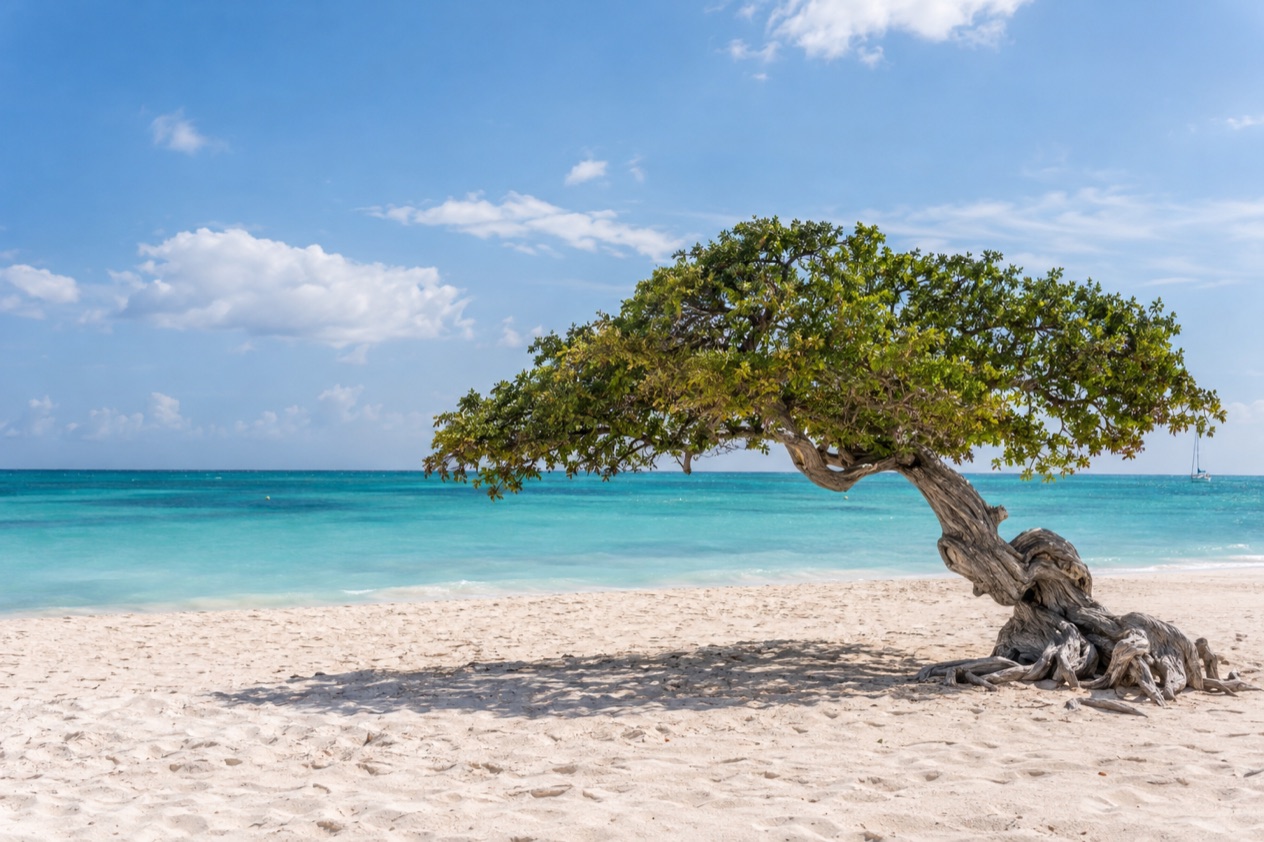
On a July afternoon the trade wind pushes steadily across Eagle Beach, rattling the palm fronds and bending the fofoti trees a little further along their permanent lean. Out on the water, kites and sails cut across the bay, while a few paces from the sand someone is pulling a pastechi (a fried pastry filled with cheese or meat) out of a paper bag. July in Aruba is a hot, windy, sea-centered month, and it suits travelers who want long beach days, snorkeling and a slow evening meal.
What is the weather like in Aruba in July?
July in Aruba is hot, bright and breezy, with warm nights and only a few short showers, and the whole island sits under the same steady easterly wind. If you stay along the leeward (sheltered, west and southwest) coast, where the town and the resort beaches lie, that is what the weather feels like.
| Place | Region | Average high (°F) | Average low (°F) | Rain (in) | Rain days | Sea (°F) |
|---|---|---|---|---|---|---|
| Oranjestad | Leeward coast | 90.3 | 80.1 | 1.24 | 4.1 | 82.2 |
Afternoons are hot enough that most people plan the middle of the day around shade, a swim or a long lunch, and nights stay warm enough to eat outside without a layer. The wind is the great equalizer.
It blows from the east all year, and in July it is brisk, which is why a sun that feels fierce still comes with a moving breeze. Daylight lasts nearly thirteen hours in mid-July, so evenings stay bright well past dinnertime.
The sea is the other half of the picture. Off Palm Beach the water runs a touch warmer than off Oranjestad, at 82.4°F, and the water off San Nicolas matches Oranjestad. Rain comes in brief passing showers rather than gray days, and the clouds usually clear quickly. The windward north and east coasts face the wind head-on and are rougher than the sheltered western shore.
Where to go in Aruba in July
Aruba is small, less than 70 square miles, so the question is less which region than which coast suits your day. July favors the sheltered western side for beach time and the wilder sides for those who like wind and open scenery.
The leeward coast: Palm Beach, Eagle Beach and Oranjestad
The leeward coast carries the resort beaches. Palm Beach, in the Noord district, is the strip of resorts and restaurants, with the sea at its warmest in the shallows and the wind softened by the island’s shape. Eagle Beach, a little south toward Oranjestad, is wider and quieter, lined with the leaning fofoti trees that appear on every postcard.
Oranjestad, the capital, gives you a change of pace when the sun is at its height. Its pastel Dutch-colonial facades, harbor and shops make a good late-afternoon walk once the heat eases, and the waterfront restaurants fill as the light turns gold. This coast suits first-time visitors, couples and anyone who wants a swim, a sunset and dinner within a short stretch of shoreline.
The rough north and east coast
The windward coast is the island’s other face, rough and wild, shaped by the same east wind that cools the resorts. Bushiribana on the north coast is a ruined gold smelter standing above the rocky shore, and Arikok National Park covers much of the island’s rugged interior and coast. Hooiberg, the haystack-shaped hill in the middle of the island, rises above the flat landscape and is easy to spot from almost anywhere.
This side is for scenery, not for lounging. You come for the cactus country, the crashing surf against the cliffs and the sense of a different island, and the heat makes the morning the natural time to be out. This coast is rough, so treat it as a place to look at the sea rather than plan a beach day around.
The south: San Nicolas, Savaneta and Baby Beach
The south has a more local, working feel. San Nicolas is known for its street murals, and a walk through its streets turns into an open-air gallery with a coffee stop or a cold drink along the way. Savaneta is a quiet fishing village, and Baby Beach, in the south near San Nicolas, is one of the beaches named for snorkeling.
Sea temperature here matches the capital’s, so the water is just as warm. The south suits travelers who like their beach days paired with a bit of local life, a plate of fresh fish and a slower rhythm than Palm Beach.
What to do in Aruba in July
July is a month for the water and the wind rather than for a big festival, and the best days are built around the sea. Warm water all year means the clear reefs and wrecks are open to snorkelers and divers, and July is no exception.
Snorkeling and the wreck of the Antilla
Malmok Beach, Boca Catalina, Mangel Halto and Baby Beach are named among the best beaches for snorkeling on the island. Masks go on in the clear shallows and you drift above reef fish and coral, with the water warm enough that you never rush out. Boat tours also stop at the Antilla, the World War II shipwreck that is among the island’s best-known snorkel sites.
Plan the water for the morning when the wind is a little gentler and the light is clear, then spend the hot hours in the shade. Divers can explore wrecks as well as reefs, since the visibility is good here year-round.
Windsurfing and kitesurfing
Aruba is one of the most popular spots on earth for windsurfers and kitesurfers, and July’s brisk trade wind is the reason. The constant breeze keeps colorful sails and kites on the water most afternoons, and even if you never touch a board, watching them from the sand is its own entertainment. Lessons and rentals exist for those who want to try, though what is on offer varies by beach.
Eating your way across the island
Aruba’s home cooking blends Amerindian, European, African, Eastern and Asian influences, and the first Caquetio inhabitants ate fresh fish and conch, both still on menus. Try keshi yena, a baked cheese shell stuffed with spiced chicken or beef, and pastechi at breakfast or as a snack. Papiamento, the island’s language, is mixed from many of the same sources, and you will hear it on the menu boards and in the street.
A July evening suits an outdoor table, with the wind cooling the terrace and grilled fish on the plate. Local snack stands and casual spots reward a wander, especially in Oranjestad and San Nicolas.
Is Aruba busy in July?
July is not the island’s peak, which runs from December to April, but it falls in the stretch between the high winter months and the quieter autumn, which runs from September to November. Summer vacation brings families and travelers with flexible schedules, and the resort strip at Palm Beach is the part of the island you will feel most.
Beyond the resorts the island spreads out. The north and east coasts, the interior and the south around San Nicolas and Savaneta keep a calmer tempo, and a morning at Arikok National Park or on the wild shore feels a world away from the hotels. The best months to visit run from February to August, so July sits inside that window, and you will not be alone in thinking so.
If you want more room on the sand, work the edges of the day. Early mornings and late afternoons are quieter on any beach, and a drive or an excursion away from the hotel strip gives you the island at a different speed.
What to pack for Aruba in July
Packing is simple because the island has a single hot, breezy climate with warm water everywhere, and the main difference is between the sheltered beaches and the windy open coasts. Light clothes for the heat cover the whole island, and the north and east coasts reward something that will not blow away.
- Lightweight, breathable clothing for afternoons in the 90s and nights that stay warm.
- Sun protection: a hat that stays on in the wind, sunglasses and plenty of sunscreen.
- Your own snorkel mask if you like a familiar fit, since the reefs and wrecks are the island’s draw.
- Swimsuits and a quick-dry towel for days that move between the beach and the boat.
- A light layer for a passing shower, which tends to clear fast.
Good to know before you go
The U.S. State Department rates Aruba Level 1, ‘Exercise normal precautions,’ and says Aruba is generally a safe destination for travelers, with petty crime the main concern in popular tourist areas.
Aruba’s hurricane season runs from June 1 to November 30, so July falls inside it. The island sits on the southern fringes of the hurricane belt where damaging storms are rare, though systems passing in the Caribbean can still bring more rain, gusty winds or a spell with no wind at all.
U.S. citizens do not need a visa. You need a passport valid for the whole of your stay, the Aruba ED Card (Embarkation and Disembarkation Card) completed within 7 days before travel, proof that you can return to your country of departure or travel on, and enough money to cover your stay.
Is July a good time to visit Aruba?
July is a good time for travelers who want hot weather, warm water and wind, and the leeward coast around Palm Beach, Eagle Beach and Oranjestad is the best place to base yourself. The sea is warm, the days are long and the rain is brief, which makes beach and snorkel days easy to string together.
Compared with June, July is about the same in temperature, with a little more rain and a slightly cooler sea. August runs a touch hotter and its sea is a shade warmer still, with less rain than July. The three months feel alike, and the choice among them comes down more to your calendar than to the weather.
The one thing to remember is the hurricane season, which has begun, so a flexible plan and travel protection are sensible. The wind that makes Aruba famous for kitesurfing is the same wind that keeps the heat comfortable on the sand, and in July it is blowing from the east, day after day.
Sources
- Meteorological Department Aruba (meteo.aw), Summary Climatological Normals 1991-2020, Queen Beatrix Airport station (http://www.meteo.aw/files/Download/climatnormals19912020.pdf), checked October 9, 2026
- Open-Meteo Marine API, average 2015-2024, checked October 9, 2026
- sunrise-sunset.org, sunrise and sunset calculated for the 15th of the month, checked October 9, 2026
- Aruba Tourism Authority, Weather and climate (https://www.aruba.com/us/our-island/island-facts/weather-and-climate), checked October 9, 2026
- Aruba Tourism Authority, Best time to visit (https://www.aruba.com/us/our-island/one-happy-island/when-is-the-best-time-to-visit-aruba), checked October 9, 2026
- Aruba Tourism Authority, Where is Aruba (https://www.aruba.com/us/our-island/island-facts/where-is-aruba), checked October 9, 2026
- NOAA National Hurricane Center, Climatology (https://www.nhc.noaa.gov/climo/), checked October 9, 2026
- Aruba Tourism Authority, Aruba hurricane season (https://www.aruba.com/us/blog/aruba-hurricane-season), checked October 9, 2026
- Aruba Tourism Authority, Passports and visas (https://www.aruba.com/us/plan-your-visit/getting-to-aruba/passports-and-visas), checked October 9, 2026
- Aruba Tourism Authority, Sustainability (https://www.aruba.com/us/our-island/island-facts/sustainability), checked October 9, 2026
- Aruba Tourism Authority, Beaches and coves (https://www.aruba.com/us/things-to-do/beaches-and-coves), checked October 9, 2026
- Aruba Tourism Authority, On the water (https://www.aruba.com/us/things-to-do/on-the-water), checked October 9, 2026
- Aruba Tourism Authority, Scuba and snorkel (https://www.aruba.com/us/things-to-do/on-the-water/scuba-snorkel), checked October 9, 2026
- Aruba Tourism Authority, Local Aruba cuisine (https://www.aruba.com/us/things-to-do/dining/local-aruba-cuisine), checked October 9, 2026
- Aruba Tourism Authority, Kite and windsurfing (https://www.aruba.com/us/things-to-do/on-the-water/kite-windsurfing), checked October 9, 2026
- U.S. Department of State, Aruba Travel Advisory, Level 1, issued August 19, 2026 (https://travel.state.gov/content/tsg_aem/us/en/home/international-travel/travel-advisories/destination.abw.html), checked October 9, 2026
To plan your stay
- Things to Do in Aruba: Beaches, Arikok National Park, Island Tours and Food
- Where to Stay in Aruba: Palm Beach, Eagle Beach, Oranjestad and All-Inclusives
- Aruba Airport (AUA): Arrival, Getting to Your Hotel, U.S. Preclearance and Departure
- Know Before You Go to Aruba: Entry Forms, Money, Water and Local Customs