
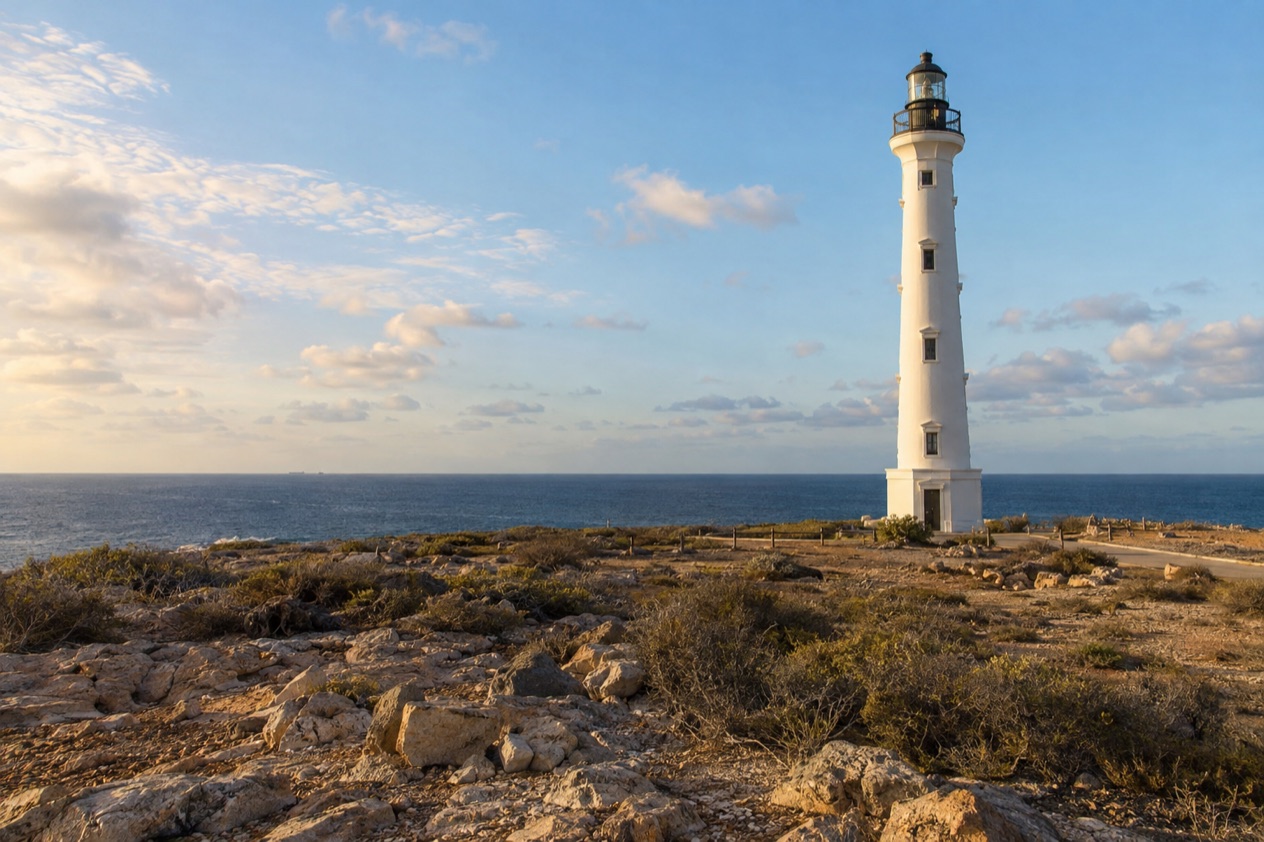
At the northwestern tip of Aruba the land flattens into pale rock and scrub, cactus leans away from the wind, and a white tower rises over it all with the Caribbean spread out behind. The sea hisses against the coral shore below, and the light shifts from bright noon to honey as the afternoon wears on. A visit to the California Lighthouse is a climb, a view and a sunset, and it suits anyone staying anywhere on the island who wants the wide picture of the west coast.
Is visiting the California Lighthouse worth it?
Yes, if you like a view with a bit of effort behind it, and especially if you want to see the island’s western coastline laid out like a map. The lighthouse is a good fit for sunset watchers, photographers, history lovers and anyone who enjoys a staircase that leads somewhere. It is less of a fit if the idea of climbing a spiral stair in the sun does not appeal, because the real reward is at the top.
What sets it apart from the other places nearby is the height and the angle. The beaches around Malmok and the sand dunes are things you walk beside or across, at ground level. Here you look down on them.
The tower gives you the whole sweep of beaches and coral shoreline in one frame, with the open sea beyond, and it carries a real maritime story, tied to a steamship that went down off this coast. Few other stops on the island combine a climb, a shipwreck tale and one of the best seats for the sun going into the water.
It also sits in a corner of Aruba that feels different from the resort strips. The land here is called Hudishibana, a rugged, open stretch where the trade wind blows steadily from the east and the vegetation stays low and tough. Even a short stay at the foot of the tower gives you a sense of the island’s wilder, drier side.
What to see at the California Lighthouse
The tower and its spiral staircase
The first thing you notice is how the tower stands alone on the point, a slim white shaft of about 98 ft set on an octagonal stone base. The stonework at the bottom gives it a sturdy, old-fashioned look, while the tower above is clean and simple. Walk around it before you go in, because the shape changes with the angle and the light.
Visitors can climb to the top, and the way up is a spiraling staircase of 123 steps. The stairwell is narrow and curves tightly, so you climb in a slow circle with small windows letting in glimpses of sky as you rise. Go at your own rhythm. The pause at the top, with wind in your face, is part of the pleasure.
The 360-degree view from the top
At the top the view opens in every direction. To the south and west lies the coastline of beaches and coral shorelines, the pale curves and the dark rock edges that make the west side of the island so photogenic. Turn around and the land inland is flat, scrubby and wide, dotted with the odd rise and a lot of sky.
Take time to look at the colors of the water, which shift from deep blue to turquoise over the sandy shallows. The wind is a constant companion up here, so hold onto hats and light items. Bring a camera, but also put it down for a few minutes and simply look.
The light itself and the name on the tower
The light sits high, at a focal height of about 180 ft, and it shows white and red, flashing twice every 10 seconds. After dark it works as a signal for ships along this corner of the island, which is what a lighthouse has always been for. If you stay for the end of the day, you may notice the beam begin its rhythm as the sky fades.
The tower carries the name of a ship rather than a place. The lighthouse was built in 1910 and named after the S.S. California, a British steamship that sank on September 23, 1891. Standing there, remember that the wreck came well before the tower, and the name stayed as a memorial to the loss.
The wreck beneath the sea
The S.S. California still lies on the seabed, at a maximum depth of about 46 ft. You will not see it from the tower, but knowing it is down there gives the view a second layer. The sea you are looking at holds a ship that gave the whole point its best-known name.
It is not the only wreck in Aruban waters. The SS Antilla was scuttled in 1940 and lies off the island as well, and the two together show how much of Aruba’s story is written along its coast. Both are sea stories, and the lighthouse is the easiest place on land to feel that history.
The point around the lighthouse
The lighthouse stands near Arashi Beach, on the northwestern tip of the island, in the area called Hudishibana. Around the base the ground is rocky and open, and the sea wind carries a salty, mineral smell. It is a place to wander a little, look at the coral shoreline and watch how the light changes the stone.
Nearby you will find Malmok Beach and the sand dunes, both within about a mile. They make good companions to the tower, because they show you at ground level what you just saw from above.
Hours, tickets and rules
The lighthouse welcomes visitors every day, from morning until early evening, which gives you room to choose between a bright midday climb and a late-afternoon visit timed for the sunset. The entrance carries a modest fee, and you do not need to reserve a time in advance, so you can decide on the day.
| Site | Open | Admission |
|---|---|---|
| California Lighthouse | Every day, 9:00 am to 7:00 pm | $5, no reservations required |
Visitors can climb to the top of the lighthouse. Aruba has banned sunscreens containing oxybenzone since 2019, so if you plan to spend the afternoon outside on the point, choose a mineral-based reef-safe sunscreen. Local companies such as Aruba Aloe and Arubalife Organics sell sunscreen on the island.
The lighthouse is managed by Monuments Fund Aruba, the organization that looks after the island’s heritage sites. The fee you pay at the entrance supports the care of a historic landmark, and that is a good thing to remember when you hand it over.
How to get to the California Lighthouse
The address is L.G. Smith Blvd, Noord, Aruba, and the lighthouse stands on the northwestern tip of the island, in the area known as Hudishibana. Noord is also the district that holds the Palm Beach resort strip, so if you are staying there you are in the same part of the island, which makes the lighthouse a natural outing from that base.
The tower stands near Arashi Beach, and you will find it by following the coast toward the northwestern end of the island. It is tall and white against a low landscape, so once you are in the area it is hard to miss. Because the land is so flat, the tower works as a landmark long before you reach it.
If you are coming from Oranjestad or from another part of the island, plan the trip toward the northwest and let the lighthouse be one stop in a longer day on that side. The surroundings are worth the detour in their own right. Malmok Beach, the sand dunes and The Spa at Tierra del Sol all lie within a mile, so you can fold the lighthouse into a morning or afternoon in this corner of Aruba.
For a meal before or after, two restaurants sit within a mile as well: The Birdie Restaurant at Tierra del Sol and Restaurant El Faro Banco Aruba. That gives you a way to pair the climb with lunch or dinner without going far.
When to visit the California Lighthouse
Sunset is considered the best time to visit, when the sun dips into the Caribbean Sea. From the top of the tower you look straight out over the water, and the sky goes from gold to orange to deep pink while the coastline darkens below.
Visitors might even see the green flash, a brief green glint at the moment the sun disappears. It is a chance, never a promise, and it needs a clear horizon, so keep your eyes on the line where sea meets sky.
Because the lighthouse stays open until early evening, you can climb in the golden hour and still have time to stay for the colors. If you prefer to avoid the strongest sun, a late-afternoon arrival gives you softer light for photographs and a gentler time on the open point. A morning visit has its own appeal, with clear light on the water and the sea wind fresh, though you will not have the sunset.
As for the time of year, the best time to visit Aruba in general runs from February to August, and the island is dry and sunny through much of that stretch. The peak season falls from December to April, when the island is at its busiest overall. A lighthouse climb works in any month, but the sunset view is the constant draw all year.
Whatever the month, the trade wind blows from the east, which means the tower and the point are breezy. The wind keeps the climb from feeling stifling, though it can tug at a hat or a loose scarf at the top. Dress for sun and wind rather than for rain.
Tips for your visit
Bring water, a hat, sunglasses and a mineral-based reef-safe sunscreen, since you will be out in the open on a bright, exposed point. Wear shoes that grip, because the staircase is a tight spiral and the ground around the base is rocky. A camera or phone is a must for the top, but keep a hand free for the rail.
Plan on a visit that has two parts: the climb and the time you spend looking afterward. The staircase itself moves at your own pace, and the top deserves a few unhurried minutes. If you are going for the sunset, arrive early enough to climb, look around and settle before the light turns.
Combine the lighthouse with its neighbors. Malmok Beach and the sand dunes lie within about a mile, and they give you a different view of the same shoreline. The Spa at Tierra del Sol offers a quiet way to end a sun-filled day, and The Birdie Restaurant at Tierra del Sol and Restaurant El Faro Banco Aruba are close enough for a meal.
Families and anyone weighing the climb should think about the staircase honestly. It has 123 steps and it winds in a tight spiral, so it asks for steady legs. If someone in your group would rather not climb, the point and the shoreline around the base still offer wind, sea and rock to look at, and the others can go up and report back.
Good to know before you go
The U.S. State Department rates Aruba Level 1, ‘Exercise normal precautions,’ and says Aruba is generally a safe destination for travelers, with petty crime the main concern in popular tourist areas.
The California Lighthouse is a short stop in a large landscape, and it rewards a slow approach. Keep an eye on the sun and the wind, carry water, and let the evening light do its work from the top of the tower.
The point is wide open and the sea is always at your side, so the visit is as much about standing in this corner of Aruba as it is about the climb. Keep your valuables with you in the usual way when you are out on the island, and enjoy the quiet of the northwest, where the island seems to run out of land and begin to be sea.
Sources
- Aruba Tourism Authority, California Lighthouse (https://www.aruba.com/us/explore/california-lighthouse), checked October 9, 2026
- Wikipedia, California Lighthouse (https://en.wikipedia.org/wiki/California_Lighthouse), checked October 9, 2026
- Wikipedia, SS Antilla (https://en.wikipedia.org/wiki/SS_Antilla), checked October 9, 2026
- Aruba Tourism Authority, Best time to visit (https://www.aruba.com/us/our-island/one-happy-island/when-is-the-best-time-to-visit-aruba), checked October 9, 2026
- Aruba Tourism Authority blog, Responsible guest (https://www.aruba.com/us/blog/how-to-be-a-responsible-guest-protecting-arubas-beaches-and-marine-life), checked October 9, 2026
- U.S. Department of State, Aruba Travel Advisory, Level 1, issued August 19, 2026 (https://travel.state.gov/content/tsg_aem/us/en/home/international-travel/travel-advisories/destination.abw.html), checked October 9, 2026
To plan your stay
- Best Time to Visit Aruba: Weather by Month, Peak Season and Festivals
- Where to Stay in Aruba: Palm Beach, Eagle Beach, Oranjestad and All-Inclusives
- Aruba Airport (AUA): Arrival, Getting to Your Hotel, U.S. Preclearance and Departure
- Know Before You Go to Aruba: Entry Forms, Money, Water and Local Customs