
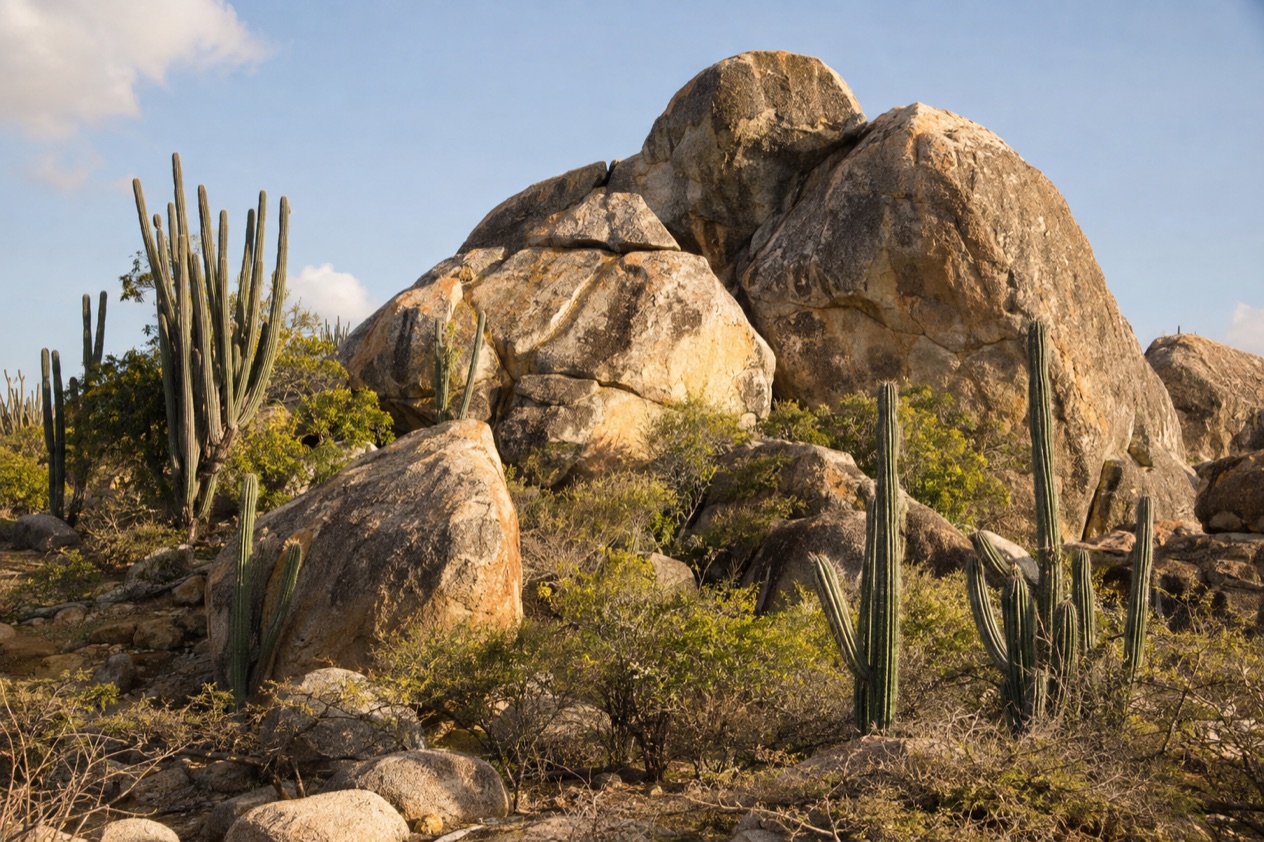
The first thing you notice at Ayo is the size of the stones. Huge, rounded boulders sit piled against one another on the flat, dry land of Aruba, their surfaces pitted and hollowed by wind and time, and a Warawara (the Northern Crested Caracara, a long-legged bird of prey) may be perched on the highest of them, watching you arrive.
Ayo is both a natural wonder and a place where people have left their mark for centuries. It suits anyone who wants a quiet morning of wandering, looking up and climbing among the rocks.
Is visiting the Ayo Rock Formations worth it?
Yes, if you like your sightseeing with a bit of mystery and some scrambling, and especially if you are curious about the people who lived on Aruba long before the resorts. Ayo gives you big, strange stone shapes, a trail that winds among them and drawings made by the island’s first inhabitants. It is a place to slow down, not a place to tick off.
What sets it apart from other rock sites nearby is the layer of human story. Casibari, the neighboring formation, is also open for climbing and exploring, and it shares the same kind of rounded boulders. At Ayo, though, the rock drawings take center stage, and the area was once considered sacred by Aruba’s original inhabitants. You come here as much to feel that history as to enjoy the views.
The site draws thousands of visitors a year, and it is also used by school groups, trekking groups and yoga classes, who come to learn, to exercise or to find a moment of calm. That mix tells you something about the atmosphere. It is a living place, part classroom, part gym, part open-air sanctuary, and it rewards a visitor who arrives with a little curiosity.
What to see at the Ayo Rock Formations
The tonalite boulders
The stones at Ayo are made of tonalite, a coarse granite-like rock. Over a very long time the weather has worked on them in layers, peeling and rounding the surfaces in a process called spheroidal weathering. The result is a landscape of smooth, almost egg-like boulders with scooped-out hollows and concave faces that look carved by hand.
Walk slowly around the bases before you think about climbing. Notice how some boulders lean against others, how the hollows catch shade and how the color of the stone shifts with the light. Early and late in the day the surfaces turn warm and the shadows deepen the curves, which makes this a rewarding place for photographs.
The rock drawings
Ayo holds original pictographs, drawings made on the rock by Aruba’s first peoples. On one single boulder, 27 have been documented, and across the island about 458 are known at 33 sites. Seeing them in place, on the same stone where they were painted, is quite different from looking at a photograph in a museum.
One white-colored drawing at Ayo has been dated to somewhere between the years 1043 and 1275 A.D. The marks are simple and faded, and it takes patience to pick them out against the rough rock. Look at them from a few angles, let your eyes adjust, and imagine who stood here and why this place mattered.
The trail, the wayaca trees and the wildlife
Pathways have been put in place to help you explore the ancient rock sites, so you are not left guessing where to walk. At the entrance you will find wayaca trees, which are native to Aruba and were used by the Caquetios people, the island’s indigenous inhabitants. They are a small botanical clue to how closely the first islanders lived with this dry landscape.
Keep an eye on the tops of the largest boulders. The Warawara, the caracara, likes to sit up there, and you may spot one watching the ground below. Birds are never guaranteed, but the high perches make a good place to look.
The view from the top
The formations are open for visitors to climb and explore, and from the higher rocks you get excellent vantage points over the island. The land spreads out low and scrubby around you, dotted with cacti and the shapes of other boulders. It is a good spot to understand how flat and open Aruba really is, and to see the stones in the context of the whole landscape.
Take your time up there. The view is part of why people come, and it helps you picture the site as the original inhabitants might have known it, as a high, watchful place rising out of the plain.
Hours, tickets and rules
Ayo is a trail and a field of boulders rather than a museum, so your visit follows the rhythm of the place itself: you arrive, follow the pathways, look at the drawings and decide how far up the rocks you want to go. It is a cultural and natural site, and it is treated as both, with the old rock art and the geology sharing equal billing.
The main rule that matters most to visitors is the welcome one. The Ayo and Casibari Rock Formations are open for visitors to climb and explore, so you are invited to get up among the stones and not simply admire them from a distance. The pathways exist to help you explore the ancient sites, and following them is the natural way to move through the area.
Because the drawings are original and very old, they deserve a gentle approach. Treat the whole site as a place of memory, where the first inhabitants once gathered, and move through it the way you would through any sacred ground. Look closely, take your photographs and leave the stone as you found it.
How to get to the Ayo Rock Formations
Ayo Rock Formations sit in Paradera, a district in the interior of Aruba, away from the resort beaches. The location code is G2J3+8CQ, which you can type straight into a map app to find the entrance. That is the surest way to reach the site, since the plus code points to the exact spot and not just to the general neighborhood.
Arriving here feels like leaving the island of hotels and turning toward the older one. The road leads you away from the coast into drier, rockier country, and the boulders appear as clear landmarks once you are close. At the entrance the wayaca trees mark the start of the visit, and the pathways lead you in.
Casibari, the other well-known rock formation open for climbing and exploring, is also in the island’s interior. Because both sites are made of the same kind of stone and offer similar experiences, many travelers think of them as a pair. Seeing both gives you a fuller picture of how this strange rock landscape looks across the island, and of how each site has its own character.
When to visit the Ayo Rock Formations
For Aruba in general, the best time to visit runs from February to August. That stretch suits Ayo well, since the visit is a day spent outdoors among the rocks, and a long, settled season gives you plenty of choice. The peak season for the island runs from December to April, so a trip in the early months of the year overlaps with the busiest weeks, while the later months of the best period tend to feel more relaxed.
Think about the time of day as well. Aruba is a small, dry island with a steady wind from the east, and the boulders have little shade. The light in the early morning and late afternoon brings out the color of the tonalite and softens the shadows in the hollows, which is also when photographs of the drawings and the round stones tend to look their best.
The site has a lively side, with school groups, trekking groups and yoga classes using it for learning, exercise and spirituality. If you prefer a contemplative visit, pick a moment when the trails are quieter, and let yourself linger by the rock art. If you enjoy company, the energy of a group on the pathways adds a pleasant buzz to the stones.
Tips for your visit
Go with curiosity and give the drawings your full attention. They are faint and easy to walk past, so stop at the boulders where they appear, step back and look again. A single stone with its documented drawings can hold your interest much longer than you would expect, and the white-colored pictograph dated to the eleventh or thirteenth century is a reminder of how old this place is.
Combine Ayo with Casibari for a full picture of Aruba’s rock formations. Both are open to climbing and exploring, and each has its own mood. Ayo has the rock art and the trail with the wayaca trees at the entrance. Casibari offers more of the same stony scenery from a different spot. Visiting both lets you compare the shapes, the paths and the views.
The site works for many kinds of visitors. Travelers interested in history will enjoy the pictographs and the story of the Caquetios. Photographers will find endless curves and textures. Nature lovers can watch for the Warawara on the high boulders. And anyone who likes a bit of climbing will appreciate that the formations are open for it. Take the pathways as your guide, and move at a pace that suits your group.
Good to know before you go
The U.S. State Department rates Aruba Level 1, ‘Exercise normal precautions,’ and says Aruba is generally a safe destination for travelers, with petty crime the main concern in popular tourist areas.
Ayo is a place for unhurried looking, so plan to let the visit take the time it needs and do not squeeze it between other stops. Keep your belongings simple and your attention on the stones, the rock drawings and the view. The U.S. State Department rates the island at its lowest advisory level, and petty crime is the main concern in busy tourist areas, so the usual habits of keeping valuables close apply here as anywhere.
Sources
- Aruba Tourism Authority, Ayo Rock Formation trail (https://www.aruba.com/us/ayo-rock-formation-trail), checked October 9, 2026
- Aruba Tourism Authority, Rock formations (https://www.aruba.com/us/explore/rock-formations), checked October 9, 2026
- Aruba Tourism Authority, Best time to visit (https://www.aruba.com/us/our-island/one-happy-island/when-is-the-best-time-to-visit-aruba), checked October 9, 2026
- U.S. Department of State, Aruba Travel Advisory, Level 1, issued August 19, 2026 (https://travel.state.gov/content/tsg_aem/us/en/home/international-travel/travel-advisories/destination.abw.html), checked October 9, 2026
To plan your stay
- Best Time to Visit Aruba: Weather by Month, Peak Season and Festivals
- Where to Stay in Aruba: Palm Beach, Eagle Beach, Oranjestad and All-Inclusives
- Aruba Airport (AUA): Arrival, Getting to Your Hotel, U.S. Preclearance and Departure
- Know Before You Go to Aruba: Entry Forms, Money, Water and Local Customs