
A squall slides across Oranjestad before breakfast, the cactus fields smell of wet earth for an hour, and by the time the second coffee arrives the sun is back on the harbor. That is the rainy season in Aruba in miniature. It runs through the autumn and into the start of winter, and it looks far more like brief interruptions than like a gray, soggy vacation.
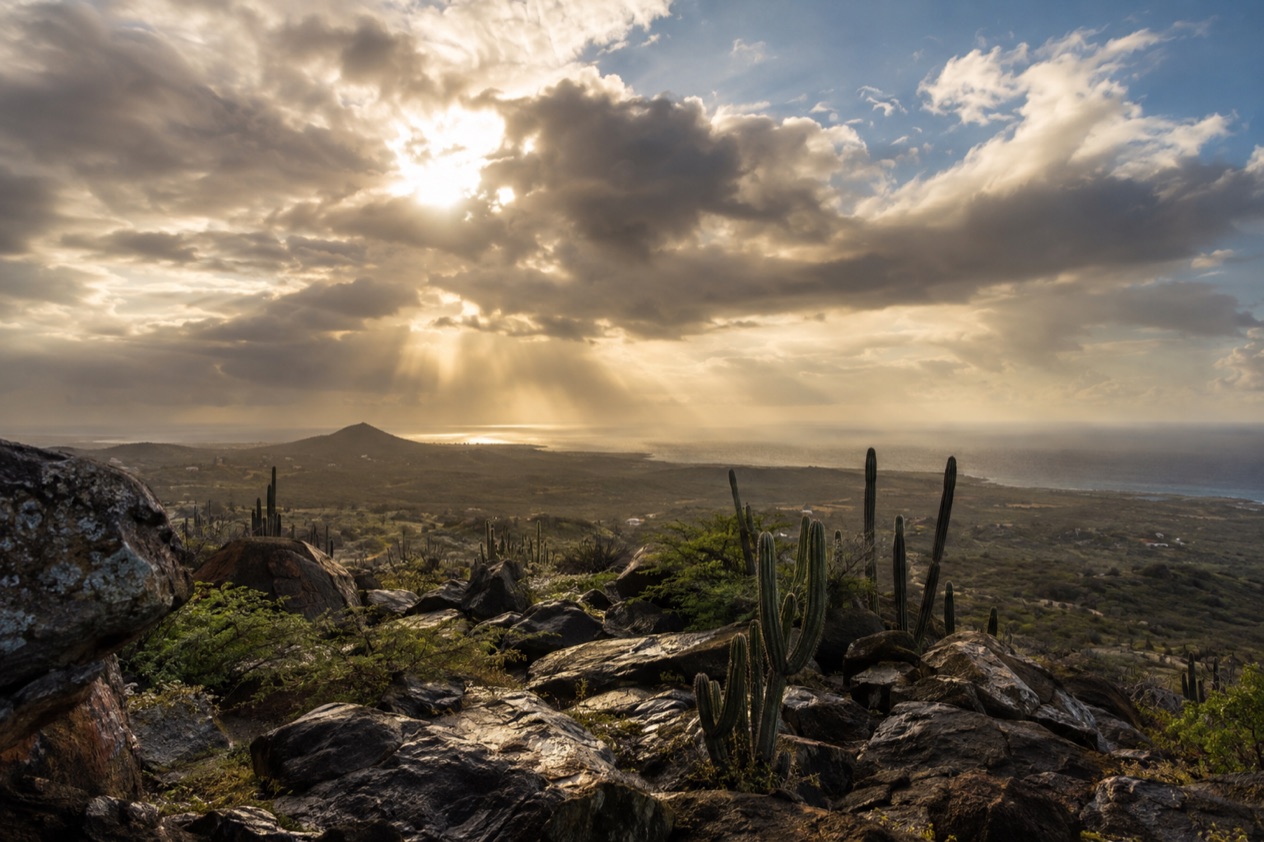
When is the rainy season in Aruba?
The rainy season in Aruba falls in the autumn and early winter, with the wettest stretch running from October through December and the edges reaching into September and January. Everything else on the island is dry by comparison. The island has a hot, semiarid climate, the kind where cacti and divi-style scrub cover the interior, and even the “wet” months are modest next to what a rainforest island would see.
Sources draw the line a little differently, some starting the wet months in September and some ending them in January, which is normal for a season with soft edges. What matters for planning is the rhythm: showers become more frequent as autumn deepens, peak in the last quarter of the year, and fade again in the new year. By February the island is back to its familiar run of bright, dry, windy days.
The wet months, one by one
September still feels like summer, with a few more clouds drifting in and the sea at its warmest of the year. delete November brings the most rain days of the autumn so far, and December carries on in the same vein, often with a shower or two between sunny stretches.
January is the tail end. It still counts a fair number of wet days, but they are lighter, and the sky clears steadily as the month goes on. Carnival season, which fills January and February with parades and costumes in Oranjestad and San Nicolas, usually plays out under a sky that is drying out by the week.
How the dry and windy seasons fit around it
The dry season is the mirror image. It stretches roughly from February through the early summer, with sunshine nearly every day and only the odd passing sprinkle. Some sources place the dry months from January to April, others from December, and again the exact edges shift, but the pattern is the same: the further you get from the end of the year, the less rain you meet.
The windy season overlaps the dry one and runs on into October. The trade wind blows from the east all year, but it is strongest in spring and early summer, when kiteboarders and windsurfers gather for the Hi-Winds competition in May. In the rainy months the breeze eases, which is why the island can feel stiller and a touch stickier than the postcards suggest.
Hurricane season and the rainy season
The two are not the same thing. The Atlantic hurricane season runs from June 1 to November 30, so it covers the whole rainy season and several dry months before it. Aruba sits on the southern fringes of the hurricane belt, and damaging storms are rare: the island has seen a direct hit of real consequence only about once in a century.
Storms passing to the north in the Caribbean can still bring more rain, gusty winds, a day with no breeze at all, or a muggier feel. Beach erosion and some coastal flooding are possible when a system passes north of the island.
If a disturbance is in the area, follow the tropical storm warnings on your phone and the official weather platforms. In general, though, weather during hurricane season stays much as it is the rest of the year, with sunny days and breezy trade winds.
How much does it rain in Aruba?
Very little: the island gets just 18 inches of rain in a whole year, and most of it comes in the last three months. That makes Aruba one of the sunniest islands in the Caribbean, and the rainy season is only rainy relative to the rest of its calendar. A wet day here usually means a shower, not a washout.
What a shower looks like
Rain tends to arrive in the early morning hours. In the rainy season it can also come in the early to late evening, so a dinner outdoors may be briefly interrupted while the morning beach hours stay open. A typical shower passes over and moves on, leaving the tarmac steaming and the air a little fresher.
Because the land is flat and the wind keeps clouds moving, a cloudy sky rarely settles in for a full day. Bring along a light layer for an evening shower, and expect to dry out quickly. Along Palm Beach and Eagle Beach, the sunsets continue between the clouds, and on clear evenings after a shower the light over the water can be especially soft.
The month-by-month picture
| Month | Rain (inches) | Rain days | Average high / low (°F) | Wind (mph) | Sea (°F) |
|---|---|---|---|---|---|
| January | 1.73 | 10.8 | 86.5 / 76.6 | 16 | 81.0 |
| February | 0.77 | 4.5 | 87.1 / 76.6 | 17 | 80.3 |
| March | 0.39 | 2.0 | 88.0 / 77.5 | 18 | 80.2 |
| April | 0.34 | 1.5 | 89.4 / 78.8 | 18 | 80.8 |
| May | 0.56 | 1.7 | 89.6 / 80.1 | 19 | 82.1 |
| June | 0.69 | 2.8 | 90.5 / 80.4 | 20 | 82.6 |
| July | 1.24 | 4.1 | 90.3 / 80.1 | 18 | 82.2 |
| August | 0.77 | 3.1 | 91.8 / 81.0 | 18 | 83.7 |
| September | 1.69 | 3.3 | 91.8 / 81.1 | 15 | 85.3 |
| October | 3.01 | 7.3 | 90.3 / 80.1 | 13 | 86.5 |
| November | 3.43 | 9.6 | 88.7 / 78.8 | 13 | 85.0 |
| December | 3.15 | 11.0 | 87.3 / 77.5 | 15 | 82.4 |
The table tells the story at a glance. From March through June the island is nearly rain-free. October, November and December carry the heaviest totals, and December and January are the months with the most days on which at least a little rain falls. Note that December is a peak-season month for visitors even though it is one of the wetter ones, so a few showers are part of the holiday package.
Heat, sea and wind in the wet months
Temperatures hardly move: the island sits between the low 80s and the low 90s all year, so the rainy season is not cooler, just a little stickier. With the trade wind at its gentlest in October and November, the air can feel heavier on a cloudy afternoon, and the shade of a palapa matters more than usual.
The sea is at its warmest of the year in the early autumn, which is one of the quiet pleasures of the season. Water that warm makes a swim after a shower feel natural, and snorkelers and divers find the sea inviting in the lull between squalls. As always, how a given coast behaves depends on its exposure, and the windward north and east shores stay rough in any month.
Is it worth going to Aruba in the rainy season?
Yes, for most travelers, because the rain is light, the sea is at its warmest and the crowds thin out. September through November is the off-season, and the low-crowd months are the ones when you can have a stretch of Eagle Beach nearly to yourself. The trade-off is a few more clouds and the occasional evening shower.
Who the rainy season suits
It suits travelers with flexible plans who like a quieter island: couples who want long dinners without the holiday crush, divers and snorkelers who want warm water, and anyone who would rather trade a guaranteed cloudless sky for a calmer pace. Early autumn in particular works well, since the first weeks are still close to summer in feel.
It suits a little less well anyone planning a wedding on the sand, a day built entirely around a sunset photo, or a week where every hour is outdoors. For those trips, the dry months from February onward are the safer choice, and the island’s peak season, which runs from December to April, is built around exactly that reliability.
What changes on the ground
In the off-season some businesses and restaurants may close for renovations or vacations, so a favorite spot can be dark for a few weeks. That is the main practical difference. Peak season is the time when reservations for restaurants, rental cars and tours are advisable, and in the quieter months that pressure eases.
Streets and beaches feel more relaxed, and the rhythm in Oranjestad slows to a local one: lunch at a counter with a pastechi, the Dutch-colored facades of the harbor front shining after a rain, the hum of conversation in Papiamento, the island’s own language. Hotels and restaurants simply have more room for you.
If a shower catches you out
A passing shower is a good excuse to change the order of the day. Wander the shops and cafés of Oranjestad, linger over keshi yena, the baked cheese dish stuffed with spiced meat that is one of the island’s classics, or take a slow drive to San Nicolas to see its painted murals when the clouds break and the colors look freshest.
Then go back to the beach. Because the rain is brief and the sun returns quickly, the best habit is to hold plans loosely and let the sky decide the hour. Mornings and the stretch after a shower are often the brightest part of an autumn day.
Good to know before you go
The U.S. State Department rates Aruba Level 1, ‘Exercise normal precautions,’ and says Aruba is generally a safe destination for travelers, with petty crime the main concern in popular tourist areas.
Hurricane season officially covers the whole rainy season, but Aruba’s position on the southern fringes of the belt keeps the odds of serious damage low, and the weather usually stays sunny and breezy. If a tropical system does pass nearby, follow the warnings on your phone. Pack a light rain layer for an evening shower and a hat for the hours after it clears, because the sun comes back strong.
Sources
- Departamento Meteorologico Aruba, Climate Data (https://www.meteo.aw/climate.php), checked October 9, 2026
- Aruba Tourism Authority, Weather and climate (https://www.aruba.com/us/our-island/island-facts/weather-and-climate), checked October 9, 2026
- Aruba Tourism Authority, Best time to visit (https://www.aruba.com/us/our-island/one-happy-island/when-is-the-best-time-to-visit-aruba), checked October 9, 2026
- Aruba Tourism Authority, Aruba hurricane season (https://www.aruba.com/us/blog/aruba-hurricane-season), checked October 9, 2026
- Meteorological Department Aruba (meteo.aw), Summary Climatological Normals 1991-2020, Queen Beatrix Airport station (http://www.meteo.aw/files/Download/climatnormals19912020.pdf), checked October 9, 2026
- Open-Meteo Marine API, average 2015-2024, checked October 9, 2026
- U.S. Department of State, Aruba Travel Advisory, Level 1, issued August 19, 2026 (https://travel.state.gov/content/tsg_aem/us/en/home/international-travel/travel-advisories/destination.abw.html), checked October 9, 2026
To plan your stay
- Things to Do in Aruba: Beaches, Arikok National Park, Island Tours and Food
- Where to Stay in Aruba: Palm Beach, Eagle Beach, Oranjestad and All-Inclusives
- Aruba Airport (AUA): Arrival, Getting to Your Hotel, U.S. Preclearance and Departure
- Know Before You Go to Aruba: Entry Forms, Money, Water and Local Customs