
Midweek in Aruba, the trade wind is pushing the fofoti trees sideways at Eagle Beach, a rock-strewn trail in Arikok is giving way to a view of the open sea, and a sailboat is heading out from Palm Beach as the sky turns pink. The island is small enough to see in a week without rushing, yet varied enough that no two days look alike. This route moves from the resort beaches to the capital, the boulder fields, the wild windward coast, the northwest tip and the quiet south.
Is 7 Days enough for Aruba?
Yes, a week is enough for a first visit, and it suits travelers who like to alternate a beach day with a day of looking around. The island covers 70 square miles, so the route below never asks you to pack up and move. You can keep one base and head out each morning toward a different corner.
What the week covers is the core of the island. You spend time on the long white sand of Palm Beach and Eagle Beach, walk the colorful harbor streets of Oranjestad, wander the tonalite boulders of Casibari, and spend a full day in Arikok National Park with its caves, rock drawings, lava formations and secluded bays.
You also reach the California Lighthouse at the northwest tip, the murals of San Nicolas in the south, and the shallow water of Baby Beach. A sunset sail and a few animal stops, among them the Donkey Sanctuary and the ostrich farm, fill the gaps.
What it leaves for another trip is depth rather than breadth. Scuba divers will want more time for the shipwrecks, the Spanish Lagoon and the Barcadera Reef, and a snorkeler who falls for the Antilla wreck could spend several mornings on the water alone. Anyone drawn to the old gold-rush story could linger over the ruins on the north coast. A week gives each of these a taste, not a deep dive.
The weather barely changes the shape of the plan. The wind blows from the east all year, which keeps the heat bearable on the hottest afternoons and gives the windward coast its rough, wild look.
The sea stays warm in every season, in the low 80s, so a swim never feels like a gamble on the date. That makes the order of days flexible, and you can swap a rainy-looking morning with a museum afternoon without losing anything.
Think of the week as three rhythms. Two beach days at the start let you settle in and find your favorite stretch of sand. Four days of exploring follow, each pointed at a different part of the island.
The last day is deliberately loose, for whatever you want to repeat or finally try. If you have only a few days, keep Arikok, Oranjestad and one beach day. If you have more, add boat time and the south.
The itinerary stage by stage
Days 1 and 2: Palm Beach and Eagle Beach
Start by learning the west coast. Palm Beach is a two-mile strip of white sand backed by high-rise hotels, casinos, piers, beach bars and water sports concessions, and its waters are described as calm, a comfortable place for swimmers and snorkelers.
Eagle Beach, a little farther along, is the widest beach on the island, with soft white sand and a handful of low-rise hotels nearby or just across the road. The leaning fofoti trees there make the classic Aruba photograph.
Spend the first day doing very little. Walk the sand at both ends, eat lunch at a beach bar, and swim when you feel like it.
On the second day, add the Butterfly Farm, a tropical garden across from the Aruba Divi Phoenix where you can follow butterflies from egg to caterpillar to chrysalis. A sunset sail from Palm Beach, where over a dozen catamarans and sailboats are based, closes the day with a sky that turns pink, purple and orange.
Sleep in the Palm Beach or Eagle Beach area for these nights and keep the same base for the rest of the week. Complimentary water taxis run to Renaissance Island every 15 minutes if you want a different stretch of sand for an afternoon.
Day 3: Oranjestad and the boulders
Oranjestad is the capital, a colorful harbor city of boutiques, jewelry stores and international luxury retailers. Begin on Main Street, now a remodeled pedestrian mall, and hop on the downtown trolley, which links the cruise terminal with the center of town and stops near monuments, museums and shopping areas. The green stadhuis houses the City Hall, and Fort Zoutman, named for a Dutch admiral who never set foot on the island, anchors the old part of town.
The Archaeological Museum sits in a restored townhouse downtown and is the place to meet the Arawak story before you see the drawings in the field. Lunch can be a pastechi, the fried pastry filled with cheese or meat, or a plate of keshi yena, baked cheese stuffed with spiced chicken.
In the afternoon, head to Casibari, just off the main road to Santa Cruz. Giant tonalite boulders are scattered across desert terrain, with winding trails between them and stairways carved into the stone that lead to the top. Hooiberg, the haystack, rises 540 feet from the middle of the island and makes a good landmark to watch from the road.
Day 4: Arikok National Park
Give Arikok a whole day. The park holds caves, lava formations, quartz diorite, limestone and the secluded bays of Moro, Boca Prins and Dos Playa, and a ticket is required at the entrance. Arawak drawings and carvings can be seen in the Fontein cave, and the rock drawings at the Ayo Rock Formation tell the same story outdoors, among spheroidally weathered tonalite boulders with round and concave shapes.
The Natural Pool, known locally as Conchi or Cura di Tortuga, is the high point. Volcanic stone circles a small depression on a deserted stretch of the northeast coast, and the site is inaccessible by regular car, so a 4×4 is needed on the rough, rocky terrain. Boca Prins along the same coast shows how rough the windward side is. Plan the day around the sea views rather than swimming.
Day 5: The northwest tip
The northwest is where the island turns quiet. Malmok has reefs and sunken wrecks nearby that make it good for diving, and Boca Catalina, a small secluded bay there, is reached by steps from a parking area beside the road. On weekdays the bay can be all to yourself, while weekends bring local families and island guests. Malmok and Boca Catalina are both on the list of the best snorkeling beaches.
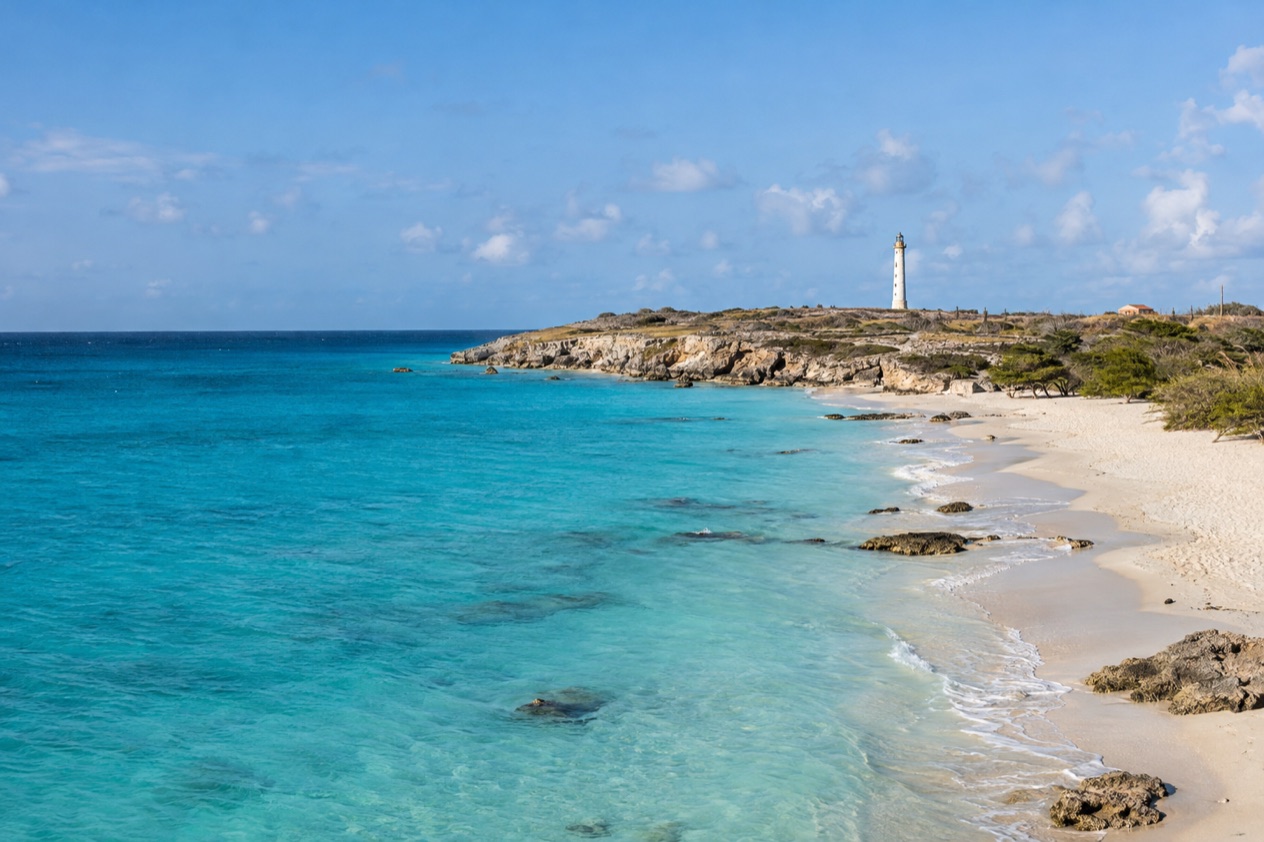
Continue to Arashi Beach, just beyond Malmok on the road to the lighthouse, with white sand and clear, gentle water. Then finish at the California Lighthouse in the area known as Hudishibana, which offers 360-degree views of the island. Time the visit for late afternoon and the sea and the dry hills glow.
Day 6: San Nicolas and the south
San Nicolas, the Sunrise City, is Aruba’s second largest town and sits twelve miles southeast of Oranjestad. It is quiet by day and known for its murals. The tour starts at the ArtisA gallery and shows an average of 20 to 40 murals depending on the route, so it becomes a walking gallery of the town’s colors and stories.
For the afternoon, go to Baby Beach in the south, close to San Nicolas. Its shallow water lets swimmers wade out a long way and still touch bottom, which makes it ideal for families with small kids. Rodger’s Beach lies about a minute’s drive away, and Boca Grandi is a five-minute drive from the center of San Nicolas, a wilder stretch for a look at the coast.
Day 7: Animals and a last beach
Use the last day for the things you want to repeat or still have not seen. The Donkey Sanctuary in Bringamosa houses 130 donkeys, animals that have been part of Aruba’s culture for 500 years. The ostrich farm has over 80 animals, including emus, and from its lodge you can enjoy panoramic views of the northern coast.
If you prefer history, the Bushiribana gold mill ruins on the north coast recall the gold rush that began in 1824, and Alto Vista Chapel, a small whitewashed place of worship on a hilltop, dates back to a Spanish missionary in 1750. End on a beach you liked, or on Mangel Halto for snorkeling, kayaking or paddle boarding in calm, shallow water.
Getting between stops
| Leg | How | Time |
|---|---|---|
| Oranjestad to Savaneta | Car | About 20 minutes |
| San Nicolas to Boca Grandi | Car | About 5 minutes |
| Baby Beach to Rodger’s Beach | Car | About 1 minute |
| Palm Beach hotels to Renaissance Island | Complimentary water taxi | Every 15 minutes |
| Island-wide routes, 5:45 a.m. to 6 p.m. | Arubus bus | Every 15 minutes |
| Island-wide routes, 6 p.m. to 11:30 p.m. | Arubus bus | Every 40 minutes |
Queen Beatrix International Airport is where you can rent a vehicle, and the roads are described as safe and modern. Driving is on the right, overtaking is on the left, and the speed limit is lower in towns than on the faster roads.
The Natural Pool is the exception, because it requires a 4×4. Buses start from the central station in downtown Oranjestad, next to the cruise terminal and Royal Plaza, and the trolley covers the city center.
What to book before your 7 Days in Aruba
The one entry you must have in hand is the Arikok National Park ticket, since visitors need to buy one to go in. The fee is small and supports preservation, educational programs and the animals. The Natural Pool leg also needs the right vehicle, because a regular car cannot make it over the rough, rocky terrain, so sort out a 4×4 before the park day.
| Activity | Departures | Starting point |
|---|---|---|
| Murals tour in San Nicolas | Every day at 9:00 AM, 11:30 AM, 2 PM and 4 PM | ArtisA (Art is Aruba) gallery |
The ostrich farm encourages a guided tour, which covers the natural behavior and survival instincts of ostriches and emus and includes personal encounters with the birds. Sailing excursions are the other choice to settle early. Palm Beach has over a dozen catamarans and sailboats offering snorkel cruises, sunset sails, booze cruises and dinner cruises, and the snorkel tours stop at the Antilla wreck.
Leave the rest open. The beach days, the walk through Oranjestad, Casibari, the lighthouse and Baby Beach need no tickets, so keep them as fillers that can slide around the weather. A week is better with a few unplanned hours.
Adapting the route
For a shorter trip, keep Oranjestad, Arikok and one beach day and drop the rest. A longer stay lets you add a full day on the water, with a sail and a snorkel stop, or a dive at the Spanish Lagoon or the Barcadera Reef. You could also spread the north coast over two mornings, with the Bushiribana ruins on one and Alto Vista Chapel on the other.
The seasons change little. January runs warm, with highs in the mid-80s, and about eleven days bring at least a little rain, so a shower is a reason to swap days rather than cancel them.
July is hotter, with highs around 90, and far fewer rainy days. The trade wind is steady in both months, a touch stronger in July. October, when the Autentico food event is held, is a good time to taste Aruba’s fusion of flavors.
For families, Baby Beach is the anchor, since the shallow water lets swimmers wade out a long way. The Butterfly Farm, the Donkey Sanctuary and the ostrich farm give children something to do between beach days. Boca Catalina on a weekday can be quiet, while the murals tour in San Nicolas turns a walk into a treasure hunt.
For a slower pace, pick one stop a day and spend the rest on Eagle Beach or Palm Beach. Mornings suit the north, where the sea views are wide, and late afternoons suit the lighthouse and the sunset sail. On a wet day, the Archaeological Museum and the shops of Oranjestad fill the hours, and the trolley carries you between them.
If a day turns hot, use it for the water. Mangel Halto is a secluded beach with calm, shallow water and some of the island’s best snorkeling, kayaking and paddle boarding. It leaves Arikok for a cooler moment of the trip.
Good to know before you go
The U.S. State Department rates Aruba Level 1, ‘Exercise normal precautions,’ and says Aruba is generally a safe destination for travelers, with petty crime the main concern in popular tourist areas.
The east wind blows all year, so a hat that stays on and a light layer for boat rides are useful, and the sea stays warm enough that every beach day can end in the water. Keep the Arikok ticket and the vehicle sorted for the park day, and let the rest of the week bend around the weather. Most of all, leave an afternoon open on Eagle Beach, where the fofoti trees lean over the sand and nothing is scheduled.
Sources
- Aruba Tourism Authority, Where is Aruba (https://www.aruba.com/us/our-island/island-facts/where-is-aruba), checked October 9, 2026
- Aruba Tourism Authority, Getting around Aruba (https://www.aruba.com/us/plan-your-visit/getting-around-aruba), checked October 9, 2026
- Aruba Tourism Authority, Arikok National Park (https://www.aruba.com/us/explore/arikok-national-park), checked October 9, 2026
- Aruba Tourism Authority, Natural Pool (Conchi) (https://www.aruba.com/us/explore/natural-pool), checked October 9, 2026
- Aruba Tourism Authority, California Lighthouse (https://www.aruba.com/us/explore/california-lighthouse), checked October 9, 2026
- Aruba Tourism Authority, Casibari Rock Formations (https://www.aruba.com/us/explore/casibari-rock-formations), checked October 9, 2026
- Aruba Tourism Authority, Ayo Rock Formation trail (https://www.aruba.com/us/ayo-rock-formation-trail), checked October 9, 2026
- Aruba Tourism Authority, Hooiberg (https://www.aruba.com/us/explore/hooiberg), checked October 9, 2026
- Aruba Tourism Authority, Bushiribana Gold Mill Ruins (https://www.aruba.com/us/explore/bushiribana-gold-mill-ruins), checked October 9, 2026
- Aruba Tourism Authority, Alto Vista Chapel (https://www.aruba.com/us/explore/alto-vista-chapel), checked October 9, 2026
- Aruba Tourism Authority, Oranjestad region (https://www.aruba.com/us/our-island/regions/oranjestad), checked October 9, 2026
- Aruba Tourism Authority, San Nicolas region (https://www.aruba.com/us/our-island/regions/san-nicolas), checked October 9, 2026
- Aruba Tourism Authority, Baby Beach (https://www.aruba.com/us/explore/baby-beach), checked October 9, 2026
- Aruba Tourism Authority, Eagle Beach (https://www.aruba.com/us/explore/eagle-beach), checked October 9, 2026
- Aruba Tourism Authority, Palm Beach (https://www.aruba.com/us/explore/palm-beach), checked October 9, 2026
- Aruba Tourism Authority, Arashi Beach (https://www.aruba.com/us/explore/arashi-beach), checked October 9, 2026
- Aruba Tourism Authority, Boca Catalina (https://www.aruba.com/us/explore/boca-catalina), checked October 9, 2026
- Aruba Tourism Authority, Mangel Halto (https://www.aruba.com/us/explore/mangel-halto), checked October 9, 2026
- Aruba Tourism Authority, Sailing (https://www.aruba.com/us/things-to-do/on-the-water/sailing), checked October 9, 2026
- Aruba Tourism Authority, Scuba and snorkel (https://www.aruba.com/us/things-to-do/on-the-water/scuba-snorkel), checked October 9, 2026
- Aruba Tourism Authority, Local Aruba cuisine (https://www.aruba.com/us/things-to-do/dining/local-aruba-cuisine), checked October 9, 2026
- Aruba Tourism Authority, Donkey Sanctuary (https://www.aruba.com/us/explore/donkey-sanctuary), checked October 9, 2026
- Aruba Tourism Authority, Aruba Ostrich Farm (https://www.aruba.com/us/explore/aruba-ostrich-farm), checked October 9, 2026
- Aruba Tourism Authority, Butterfly Farm (https://www.aruba.com/us/explore/butterfly-farm), checked October 9, 2026
- Aruba Tourism Authority, Aruba mural tours (San Nicolas) (https://www.aruba.com/us/explore/aruba-mural-tours), checked October 9, 2026
- Aruba Tourism Authority, Downtown trolley, Oranjestad (https://www.aruba.com/us/explore/downtown-trolley), checked October 9, 2026
- Aruba Tourism Authority, Driving in Aruba (https://www.aruba.com/us/plan-your-visit/getting-around-aruba/driving-in-aruba), checked October 9, 2026
- Aruba Tourism Authority, Public transportation (https://www.aruba.com/us/plan-your-visit/getting-around-aruba/public-transportation), checked October 9, 2026
- Aruba Tourism Authority, Museums (https://www.aruba.com/us/things-to-do/arts-and-culture/museums), checked October 9, 2026
- Meteorological Department Aruba (meteo.aw), Summary Climatological Normals 1991-2020, Queen Beatrix Airport station (http://www.meteo.aw/files/Download/climatnormals19912020.pdf), checked October 9, 2026
- Open-Meteo Marine API, average 2015-2024, checked October 9, 2026
- Aruba Tourism Authority, Passports and visas (https://www.aruba.com/us/plan-your-visit/getting-to-aruba/passports-and-visas), checked October 9, 2026
- Aruba Tourism Authority, Rodgers Beach (https://www.aruba.com/us/explore/rodgers-beach), checked October 9, 2026
- Aruba Tourism Authority, Historic Gold Mines (https://www.aruba.com/us/explore/historic-gold-mines), checked October 9, 2026
- Aruba Tourism Authority, Natural Bridges (https://www.aruba.com/us/explore/natural-bridges), checked October 9, 2026
- Aruba Tourism Authority, Aruba Aloe museum and factory (https://www.aruba.com/us/explore/aruba-aloe-museum-and-factory), checked October 9, 2026
- Aruba Tourism Authority, Malmok Beach (https://www.aruba.com/us/explore/malmok-beach), checked October 9, 2026
- Aruba Tourism Authority, Savaneta region (https://www.aruba.com/us/our-island/regions/savaneta), checked October 9, 2026
- Aruba Tourism Authority, Boca Grandi (https://www.aruba.com/us/explore/boca-grandi), checked October 9, 2026
- Aruba Tourism Authority, Andicuri Beach (https://www.aruba.com/us/explore/andicuri-beach), checked October 9, 2026
- Aruba Tourism Authority, Boca Prins (https://www.aruba.com/us/explore/boca-prins), checked October 9, 2026
- Wikipedia, San Nicolaas, Aruba (https://en.wikipedia.org/wiki/San_Nicolaas,_Aruba), checked October 9, 2026
- Aruba Tourism Authority, Fort Zoutman Historical Museum (https://www.aruba.com/us/explore/fort-zoutman-historical-museum), checked October 9, 2026
- Aruba Tourism Authority, Renaissance Island (https://www.aruba.com/us/explore/renaissance-island), checked October 9, 2026
- U.S. Department of State, Aruba Travel Advisory, Level 1, issued August 19, 2026 (https://travel.state.gov/content/tsg_aem/us/en/home/international-travel/travel-advisories/destination.abw.html), checked October 9, 2026
To plan your stay
- Best Time to Visit Aruba: Weather by Month, Peak Season and Festivals
- Where to Stay in Aruba: Palm Beach, Eagle Beach, Oranjestad and All-Inclusives
- Aruba Airport (AUA): Arrival, Getting to Your Hotel, U.S. Preclearance and Departure
- Know Before You Go to Aruba: Entry Forms, Money, Water and Local Customs