
In June, the trade wind keeps the palm fronds clattering along Palm Beach, and in the evening Oranjestad smells of grilled fish and fried pastechi (the pastry turnovers sold all over the island). Around the middle of the month the talk turns to Dera Gai, the festival of St. John, when music and dancing mark a very old Aruban harvest tradition. This is a sunny, breezy month on a small, dry island, with warm sea on the resort coast and a rough, wild shore on the other side.
What is the weather like in Aruba in June?
June is hot, sunny and windy across the island, with only a few short showers. The resort coast on the west side stays sheltered by the island itself, while the north and east shores take the full force of the trade wind.
| Place | Region | Average high (°F) | Average low (°F) | Rain (in) | Rain days | Sea (°F) |
|---|---|---|---|---|---|---|
| Oranjestad | Leeward coast | 90.5 | 80.4 | 0.69 | 2.8 | 82.6 |
Afternoons are properly hot, and nights barely cool off, so evenings on a restaurant terrace need nothing more than a short-sleeved shirt. The wind blows from the east all year and in June it averages 20 mph, which takes the edge off the heat on a beach towel but can whip up sand on an open stretch of shore.
The sea at Palm Beach is as warm as the water off Oranjestad, and off San Nicolas, at the southern end of the island, it reads 82.4°F. In other words, the water is warm everywhere you might put a mask on.
The windward north and east coast is a different world, with a rough sea that is for looking at rather than planning a beach day around. Rain, when it comes, is a brief shower that passes quickly, and the real rainy season does not begin until October.
Where to go in Aruba in June
The leeward coast: Oranjestad, Palm Beach and Eagle Beach
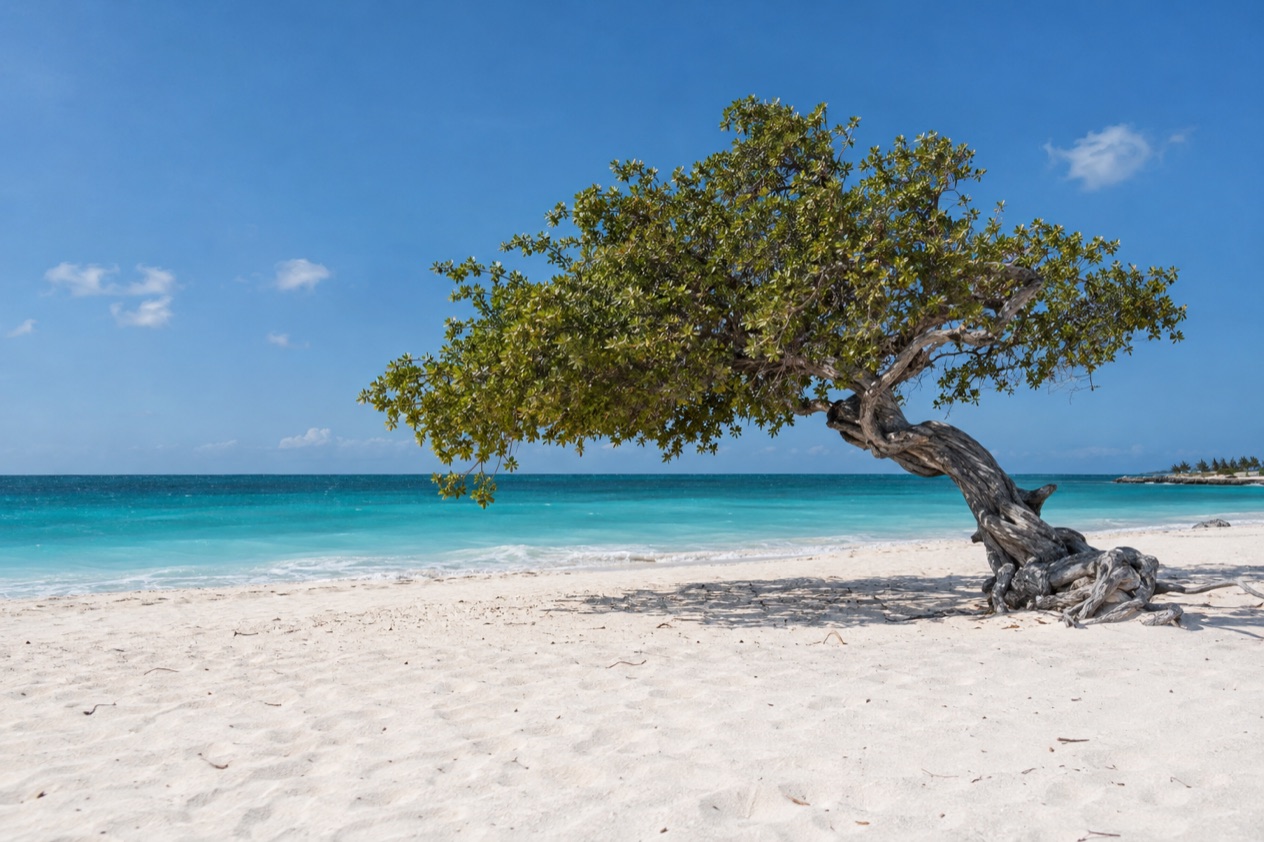
The west and southwest coast carries the resort beaches, and in June it is where most of the island’s days begin and end. Palm Beach, in the Noord district, is the strip of resorts, beach bars and restaurants. Eagle Beach, a little to the south, is known for its fofoti trees, the wind-bent trees that lean over the sand and make the best shade for a book.
Oranjestad, the capital, is a good place for the hours when the sun is too strong. Dutch colonial façades painted in candy colors line the harbor, and the shops and cafés are a reason to stroll. Sunset is the time to be back on the beach, since the sun drops into the sea on this side of the island.
For snorkelers, the beaches the island is known for include Malmok Beach, Boca Catalina and Mangel Halto. The clear water lets you see the reefs, and the tours that visit the Antilla, the World War II shipwreck, take advantage of it. With the wind blowing, the leeward side is where you will want to be on the water.
The south: Savaneta, San Nicolas and Baby Beach
At the southern end, San Nicolas is the island’s second town, and it has gone from refinery town to street-art destination, with murals covering walls across the center. A walk through its streets is a change from beach life, with painted façades, small bars and local cooking.
Baby Beach lies in the south near San Nicolas and is one of the snorkeling beaches the island recommends. The sea here is as warm as off the resort coast in June. Savaneta, a fishing village on the way, is the kind of place to sit down to a plate of the day’s catch and watch boats on the water.
The wild windward coast and the interior
The north and east shores are rough and wild, a landscape of cactus, rock and crashing waves rather than resort sand. Bushiribana, on the north coast, is the ruin of an old gold smelter, and its stone walls stand over a shoreline battered by surf. Arikok National Park covers a large part of this rugged side of the island.
Hooiberg, the odd, steep hill in the middle of the island, is a landmark you will spot from many places. At the northwest tip, the California Lighthouse watches over the point where the island meets the open sea. June brings little rain to this dry landscape, so the cactus scrub looks as parched and golden as ever.
What to do in Aruba in June
Dera Gai and the festivals of the month
The big date of the month is June 24, the feast of St. John, which Arubans celebrate as Dera Gai, around the time of the corn harvest. The old custom, with roots in the island’s rural past, brings together music, dancing and food, and it is one of the island’s most characteristic traditions. The exact events change from year to year, so it is best to look for what is on in the days around it.
Father’s Day, which falls on a Sunday in June, is also a day when restaurants along the coast fill with families. It gives the month a pleasant, relaxed feel, and a long lunch by the water is a fine way to spend it.
On the water and under it
Aruba’s ocean is warm year-round, and the clear water is the reason to bring a mask. Snorkelers head for Malmok Beach, Boca Catalina, Mangel Halto and Baby Beach, and boat trips stop at the Antilla wreck. Divers explore the reefs and wrecks offshore.
The steady east wind also shapes what you do on the water. It is the reason the island draws windsurfers and kiteboarders, and it gives a boat trip on the leeward side a fresh, breezy feel. After a morning in the sea, an afternoon in the shade is hard to resist.
Eating your way around the island
Aruban home cooking blends Amerindian, European, African and Asian influences, and you can taste them all. Freshly caught fish and conch, which fed the island’s first people, the Caquetio, are still on menus today. Keshi yena, a hollowed-out cheese filled with spiced meat and baked, is the dish to try, and a pastechi in the morning is a fine start to the day.
Papiamento, the island’s own language, gives menus a flavor of their own, and a waiter will gladly explain a dish in English. Evenings in Oranjestad and along Palm Beach are for terraces, with the breeze and a cold drink doing what air conditioning cannot.
Exploring the wild side
With little rain and long days of about thirteen hours of daylight, June gives plenty of time to see the rugged north and east. Arikok National Park, the ruins at Bushiribana and the California Lighthouse make a varied outing of rock, sea and desert scrub. The mood changes completely from the resort coast, and that is the point.
Is Aruba busy in June?
June is outside the peak season, which runs from December to April, so the island has a more relaxed feel than in winter. It sits in the stretch that stretches from February to August, which is considered the best time to visit in general, and that mix of good weather and a calmer mood is what draws many travelers.
School vacations in the United States begin around this time, and families with children are among the visitors you will meet on Palm Beach and Eagle Beach. The resort strip is where most of the activity concentrates, with beach bars and restaurants lively in the evening, while the rest of the island stays calm.
Away from the resorts, the places that feel least busy are the wild north and east coast, the interior around Hooiberg, and the southern end near San Nicolas and Savaneta. These are places for wandering rather than lounging. The main events of the month, Dera Gai around June 24 above all, are local celebrations that add color rather than crowds to the calendar.
The off-season, which runs from September to November, comes later in the year, so June does not yet have that deeper lull. It is a middle ground, with the winter crowds gone and the autumn rains still months away.
What to pack for Aruba in June
The resort coast calls for beachwear and light clothing, while the rugged north and east coast and the interior call for sturdier shoes and protection from the sun and wind. Evenings stay warm everywhere, so there is no need for heavy layers.
- Light cotton or linen clothes, since afternoons are hot and the nights stay warm.
- Strong sun protection: a hat, sunglasses and plenty of sunscreen for the long days.
- A mask and snorkel for the clear water at Malmok Beach, Boca Catalina, Mangel Halto or Baby Beach.
- Closed shoes with good grip for the rocky ground around Arikok National Park and Bushiribana.
- A light layer or a windbreaker for the constant east wind, especially on a boat or the windward coast.
- A light rain jacket for the odd short shower, though June is mostly dry.
Good to know before you go
The U.S. State Department rates Aruba Level 1, ‘Exercise normal precautions,’ and says Aruba is generally a safe destination for travelers, with petty crime the main concern in popular tourist areas.
June 1 marks the start of the hurricane season, which runs to November 30, and the first named storm of the Atlantic season typically forms in mid to late June. Aruba lies on the southern fringes of the hurricane belt, where damaging storms are rare, though storms passing in the Caribbean can bring more rain, gusty winds or a spell without wind.
U.S. citizens do not need a visa. They do need a passport valid for the whole stay, the Aruba ED Card (Embarkation and Disembarkation Card) completed within 7 days before travel, proof of return or onward travel, and enough money to cover the stay.
Is June a good time to visit Aruba?
Yes, June suits beach lovers, snorkelers and anyone who wants sun and sea without the winter peak, and the leeward coast around Palm Beach, Eagle Beach and Oranjestad is the best place to be. The water is warm, the days are long and showers are brief, so the island is at its sunniest and most relaxed for a summer break.
Compared with May, the air is a touch warmer, the sea is a little warmer and the showers are slightly more frequent, though still brief. The difference is small enough that the two months feel nearly alike, with June adding a little more heat and the first days of the hurricane season on the calendar.
July is very similar in temperature, but rain days climb and the showers are heavier than in June. If you want the driest of the three, June sits between the two and is a pleasant compromise. The wind keeps blowing the whole time, and it is as much a part of the island’s summer as the sun.
What marks June in Aruba is Dera Gai on June 24, a harvest celebration of music and dance that gives the month a local flavor beyond the beach. Pair it with a snorkeling morning at Boca Catalina, a pastechi from a morning stop and a sunset over the leeward coast, and you have the shape of a June day on the island.
Sources
- Meteorological Department Aruba (meteo.aw), Summary Climatological Normals 1991-2020, Queen Beatrix Airport station (http://www.meteo.aw/files/Download/climatnormals19912020.pdf), checked October 9, 2026
- Open-Meteo Marine API, average 2015-2024, checked October 9, 2026
- sunrise-sunset.org, sunrise and sunset calculated for the 15th of the month, checked October 9, 2026
- Aruba Tourism Authority, Weather and climate (https://www.aruba.com/us/our-island/island-facts/weather-and-climate), checked October 9, 2026
- Aruba Tourism Authority, Best time to visit (https://www.aruba.com/us/our-island/one-happy-island/when-is-the-best-time-to-visit-aruba), checked October 9, 2026
- Aruba Tourism Authority, Where is Aruba (https://www.aruba.com/us/our-island/island-facts/where-is-aruba), checked October 9, 2026
- NOAA National Hurricane Center, Climatology (https://www.nhc.noaa.gov/climo/), checked October 9, 2026
- Aruba Tourism Authority, Aruba hurricane season (https://www.aruba.com/us/blog/aruba-hurricane-season), checked October 9, 2026
- Aruba Tourism Authority, Passports and visas (https://www.aruba.com/us/plan-your-visit/getting-to-aruba/passports-and-visas), checked October 9, 2026
- Aruba Tourism Authority, Sustainability (https://www.aruba.com/us/our-island/island-facts/sustainability), checked October 9, 2026
- Aruba Tourism Authority, Beaches and coves (https://www.aruba.com/us/things-to-do/beaches-and-coves), checked October 9, 2026
- Aruba Tourism Authority, On the water (https://www.aruba.com/us/things-to-do/on-the-water), checked October 9, 2026
- Aruba Tourism Authority, Scuba and snorkel (https://www.aruba.com/us/things-to-do/on-the-water/scuba-snorkel), checked October 9, 2026
- Aruba Tourism Authority, Local Aruba cuisine (https://www.aruba.com/us/things-to-do/dining/local-aruba-cuisine), checked October 9, 2026
- U.S. Department of State, Aruba Travel Advisory, Level 1, issued August 19, 2026 (https://travel.state.gov/content/tsg_aem/us/en/home/international-travel/travel-advisories/destination.abw.html), checked October 9, 2026
To plan your stay
- Things to Do in Aruba: Beaches, Arikok National Park, Island Tours and Food
- Where to Stay in Aruba: Palm Beach, Eagle Beach, Oranjestad and All-Inclusives
- Aruba Airport (AUA): Arrival, Getting to Your Hotel, U.S. Preclearance and Departure
- Know Before You Go to Aruba: Entry Forms, Money, Water and Local Customs