
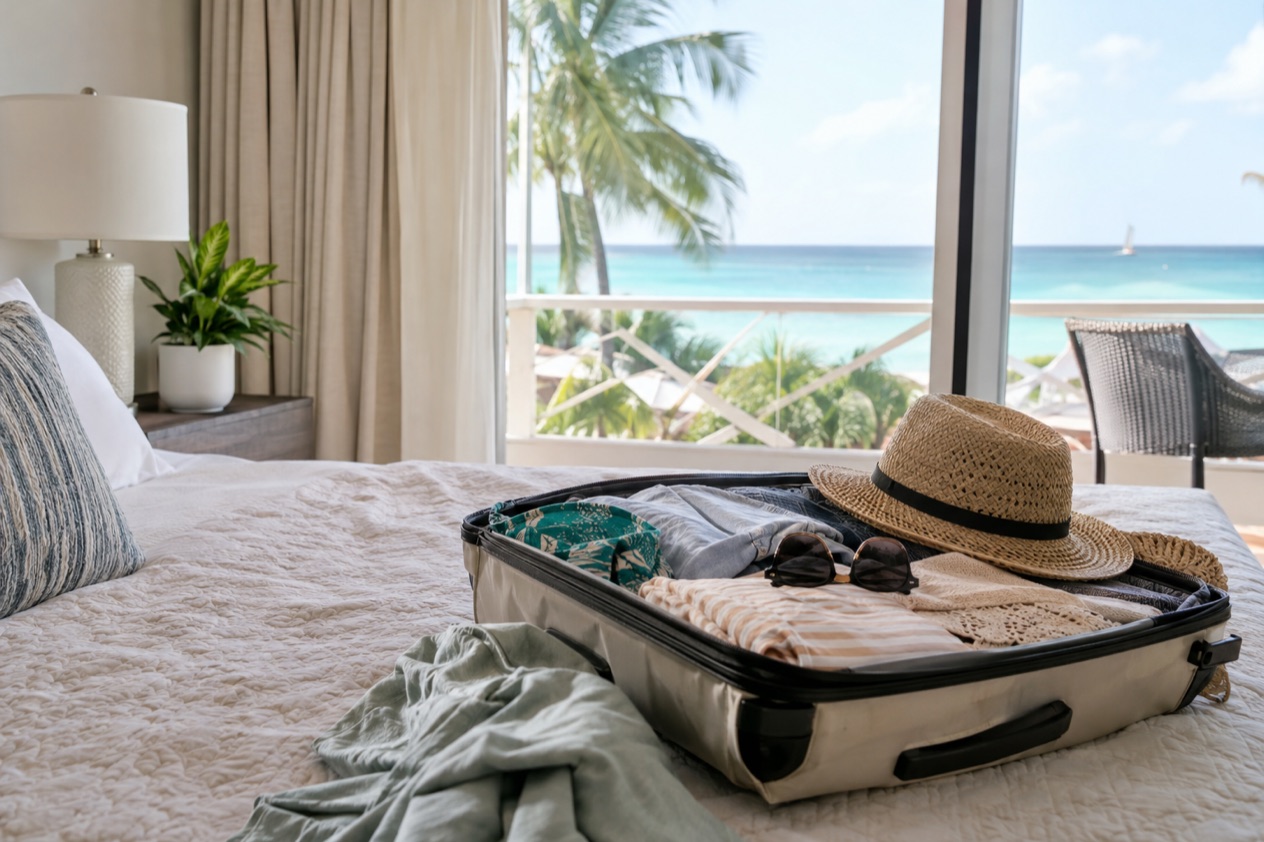
At the check-in counter, with a suitcase that looks a little too full, is where the Aruba packing question usually gets answered. The island asks for very little: swimwear, sandals, a wide-brimmed hat, a mineral sunscreen and a refillable bottle. A light layer for the evening and a few items to leave at home complete the list.
What should you pack for Aruba?
Pack light, beach-ready clothes and treat everything else as an extra. Aruba is a small island of less than 70 square miles, so a single wardrobe covers the beach, the town and the evening. You will spend most of the day in swimwear with something thrown over it.
Daywear for the beach and the coast
Bring bathing suits, flip-flops, sandals, a cover-up, a wide-brimmed hat and sunglasses. Two swimsuits make life easier, since one can dry on the balcony rail while you wear the other. A cover-up that works as a shirt for a beach lunch saves a lot of changing.
Add water shoes for rocky areas. Parts of the coast, especially the wilder shores, are stones and sharp edges rather than powdery sand, and a pair of grippy shoes makes those stretches far more comfortable. Avoid stepping on seagrass, corals or mangroves while you wade, which is another reason to keep sturdy footwear in the beach bag.
Evenings, air-conditioning and casinos
Tuck in a light jacket, sweater or shawl. Restaurants and casinos are air-conditioned, and some nights are cool and breezy once the sun is down, especially at a table close to the water. Nothing heavy is needed, just a layer you can drop over your shoulders between the table and the car.
Health items and medicine
Bring any medication you rely on, in enough quantity for the whole stay. Prescriptions from doctors abroad are generally not honored at local pharmacies, which may require you to see a local doctor, so a refill on the island is not something to count on.
U.S. health insurance is not accepted on Aruba, and you should be prepared to pay with cash or a credit card at medical facilities. If you need a wheelchair, walker, crutches or other special equipment, rental is available through Labco at +297 582-6651, which means these bulky items do not have to travel in your luggage.
Documents and money
Keep your passport, the completed and signed ED-card and your return or onward ticket together in a carry-on pocket. On the island, U.S. currency, major credit cards and traveler’s checks are widely accepted, so there is no need to change money before you leave.
A few merchants may refuse $50 and $100 bills because of worldwide counterfeiting, so smaller notes are handier. ATM cards with a Cirrus, MasterCard, Maestro or Visa logo can withdraw cash at banks and more than 50 island locations.
What sun and wind gear do you need?
A wide-brimmed hat, sunglasses and a mineral-based reef-safe sunscreen are the core of it. The sun is strong in Aruba, with peak hours between 11 a.m. and 2:30 p.m., and the breeze on the beach can make you forget how much of it you are taking.
Sunscreen that the island allows
Aruba has banned sunscreens containing oxybenzone since 2019, because the chemical contributes to coral bleaching. Check the ingredient list before you pack the bottle that has been in the bathroom cabinet for years. Mineral-based reef-safe sunscreens are the ones to look for, as they are more likely to be biodegradable and have less impact on the environment.
You do not need to carry a whole summer supply. Sunscreen can be bought on the island from local companies, including Aruba Aloe and Arubalife Organics, both of which make reef-safe, mineral-based products. Aruba Aloe is a locally made brand sold everywhere, so a pharmacy or shop is rarely far away.
Reapplying through the day
Reapply often, especially between 10 a.m. and 3 p.m. A simple rhythm helps: put it on before you leave the room, again after a swim, and again after lunch. A long-sleeved lightweight shirt over your swimsuit gives your shoulders a break during the hours when the sun is strongest.
The wide-brimmed hat does more work here than anywhere else in your bag. A hat with a chin strap or a snug fit is a sensible companion on a day with the trade wind, since an open beach and a loose brim do not get along.
Water and staying hydrated
Bring a reusable bottle and fill it from the tap. Tap water in Aruba is safe to drink and known for its high quality and clean taste. Aruba has no natural rivers or freshwater sources, so drinking water is produced through a seawater desalination process, then purified, distilled and remineralized, and it meets the highest standard set by the World Health Organization.
You can drink confidently at hotels, restaurants and homes across the island, so there is no need to buy bottled water. Refilling your own bottle is an easy way to stay hydrated and cut down on single-use plastic, which matters on an island that has banned plastic bags, cups, plates, straws, stirrers, utensils and to-go containers.
What electronics and plugs do you need?
Bring your phone, camera and chargers, and keep the list of devices short. Aruba’s outlets and voltage vary by property, so pack a travel adapter and a waterproof pouch to protect your gear and your documents around the water and the beach.
Protecting gear at the beach
Most of the island’s thefts are crimes of opportunity, such as theft of unsecured property or vehicle break-ins, and petty crime is most likely in popular tourist locations. Leaving a phone, camera or wallet on a towel while you swim is the classic setup. Carry only what you need to the beach, and keep the rest out of sight.
A small waterproof pouch for your phone and cards is useful for a day around the shore. Water shoes, a hat and a pouch fit in one tote bag, which leaves your hands free for a cold drink and a book.
Cards, cash and ATMs
Major credit cards are widely accepted, and ATM cards with a Cirrus, MasterCard, Maestro or Visa logo can withdraw cash at banks and more than 50 island locations. Banks are generally open from 8 a.m. to 4 p.m., Monday through Friday, with some branches open later on Friday and Saturday morning.
Because U.S. health insurance is not accepted on Aruba, a credit card with room on it is the practical tool if you ever need a clinic. Keep a card and a little cash separate from the rest of your things, so a lost bag never leaves you stranded.
At the airport on departure day
Access to the U.S. Check-In Terminal is limited to 3 hours before departure. Most shops and food and beverage locations on the right side after security are closed for Gateway 2030 Phase 1B preparations, so charge your devices and fill your reusable bottle before you head through.
Mobile Passport Control is no longer available at Aruba Airport, and U.S. passport holders should use the EPP line. Keep your passport handy rather than buried under chargers.
What can’t you bring?
You cannot bring guns, ammunition or even spent shells and casings into Aruba without prior written authorization. Travelers who bring illegal items may face arrest and detention for long periods of time, so check the bottom of every bag, including a hunting jacket or a souvenir from an earlier trip.
What stays on the island when you leave
Taking sea shells, corals, white sand and sea life such as sand dollars or dried sea stars out of Aruba is against the law and could result in a fine at the airport. Collecting seashells from the beach is also unwanted behavior. If every visitor took one shell home, it would amount to over a million shells a year.
Take photographs instead. Sea stars depend on water to move and breathe, and even a brief time out of water can seriously harm or kill them, so a picture of one should be taken where it lies.
Food and the flight home
All food products must be declared to U.S. Customs and Border Protection to avoid monetary fines and flight delays. Permissible items include pasteurized or hard cheese, seafood, cooked poultry, bananas and bakery items without pork or beef.
Meals bought outside the airport must be eaten before you enter the Aruba CBP inspection area. Meals bought inside the airport are permissible for onboard consumption but should be declared. If you visited the Donkey Sanctuary, the Ostrich Farm, Philips Animal Garden or went horseback riding, you must declare it as well.
Carry-on and checked luggage
The Prohibited Items list applies to all passengers and luggage screening checkpoints at Aruba Airport. Several everyday objects are fine in both carry-on and checked bags: tennis rackets, tools, screwdrivers, wrenches and pliers of seven inches or less, and metal scissors with pointed tips and blades shorter than 4 inches from the pivot point.
Small compressed CO² cartridges for a life jacket, two inside and two spares, are allowed in both. Common lighters may go in carry-on luggage but not in checked luggage.
Habits to leave behind
Chasing, touching or feeding wildlife damages the island’s ecosystem. Feeding bread to fish and sea turtles can lead them to stop eating algae and seagrass, and unchecked algae can smother coral reefs. When you meet a sea turtle while swimming, keep your distance and do not chase it, since turtles surface for air about every 10 minutes and may struggle to breathe if stressed.
Touching turtles, sea stars and manta rays can damage their protective layer and make them vulnerable to infection. Driving through the backlands on high-speed off-roading adventures is also unwanted behavior.
Good to know before you go
The U.S. State Department rates Aruba Level 1, ‘Exercise normal precautions,’ and says Aruba is generally a safe destination for travelers, with petty crime the main concern in popular tourist areas.
Money is simple: U.S. dollars and major cards are widely accepted, and smaller bills go further than large ones. Before arrival, visitors fill out an online ED-card with Aruba’s sustainability fee attached. Keep the day’s valuables close and out of sight, since most crime here is opportunistic and aimed at unsecured property. Paying the entrance fee to Arikok National Park contributes to the protection of the island’s nature, a small way to leave the place a little better than you found it.
Sources
- Aruba Tourism Authority, What to bring (https://www.aruba.com/us/plan-your-visit/getting-to-aruba/what-to-bring), checked October 9, 2026
- Aruba Tourism Authority, Sustainability (https://www.aruba.com/us/our-island/island-facts/sustainability), checked October 9, 2026
- Aruba Tourism Authority, Drinking water (https://www.aruba.com/us/plan-your-visit/tips-for-visitors/drinking-water-in-aruba), checked October 9, 2026
- Aruba Tourism Authority blog, Responsible guest (https://www.aruba.com/us/blog/how-to-be-a-responsible-guest-protecting-arubas-beaches-and-marine-life), checked October 9, 2026
- U.S. Department of State, Aruba Travel Advisory (https://travel.state.gov/content/tsg_aem/us/en/home/international-travel/travel-advisories/destination.abw.html), checked October 9, 2026
- Aruba Airport Authority, Inadmissible items (https://www.airportaruba.com/inadmissible-items), checked October 9, 2026
To plan your stay
- Best Time to Visit Aruba: Weather by Month, Peak Season and Festivals
- Things to Do in Aruba: Beaches, Arikok National Park, Island Tours and Food
- Where to Stay in Aruba: Palm Beach, Eagle Beach, Oranjestad and All-Inclusives
- Aruba Airport (AUA): Arrival, Getting to Your Hotel, U.S. Preclearance and Departure