
Late in the afternoon in October, a gray cloud sometimes drifts in from the east, drops a quick shower on Oranjestad, and moves on before the cafés along the harbor have finished clearing their tables. Then the light turns copper over the water and the trade wind picks up again.
The island is hot, the sea is as warm as it gets all year, and the crowds of winter are still weeks away. October is a month for snorkeling, long beach days and slow dinners, with a few showers to plan around.
What is the weather like in Aruba in October?
October in Aruba is hot and breezy with a real chance of showers, and the whole island sits under the same rainy-season pattern. Afternoons are strong-sun hot, nights stay warm enough to eat outside in a T-shirt, and the east wind keeps the heat from feeling heavy. The rainy season runs from October to December, so this is where it begins.
| Place | Region | Average high (°F) | Average low (°F) | Rain (in) | Rain days | Sea (°F) |
|---|---|---|---|---|---|---|
| Oranjestad | Leeward (west) coast | 90.3 | 80.1 | 3.01 | 7.3 | 86.5 |
Rain in October comes mostly as short showers that cross the island and leave the sun behind them, rather than as all-day gray. Still, a week can include a few of these showers, and a passing tropical system in the wider Caribbean can bring heavier rain, gusty winds or, oddly, a day when the breeze disappears altogether. Plan one flexible day in a week for a museum, a long lunch or a slow morning.
The wind blows from the east all year and in October it is steady, enough to shake the palms and cool a terrace without turning a beach day into a battle. It matters most on the windward coast to the north and east, which is rough and wild, while the leeward coast on the west and southwest holds the resort beaches.
The sea is at its warmest of the year and feels nearly the same off Palm Beach and off San Nicolas. With nearly twelve hours of daylight in mid-October, there is plenty of time between breakfast and sunset.
Where to go in Aruba in October
The island is small, less than 70 square miles, so you can base yourself in one place and still see the rest. What changes in October is mood: fewer visitors, easier restaurant tables, and a rhythm built around mornings in the water and afternoons under shade.
Palm Beach and the northwest
Palm Beach is the strip of resorts in the Noord district, and in October it feels relaxed rather than packed. Mornings are the time for the sand and the water, when the sun is high but the day has not yet reached its peak heat. Evenings bring open-air restaurants, and a shower at dinner just means moving a table under the roof.
Malmok Beach is nearby and is one of the beaches named for snorkeling, along with Boca Catalina. At the northwest tip stands the California Lighthouse, a good place to watch the late light and feel the trade wind at full strength. It suits travelers who want hotels, dining and the water within a short stretch of each other.
Eagle Beach and Oranjestad
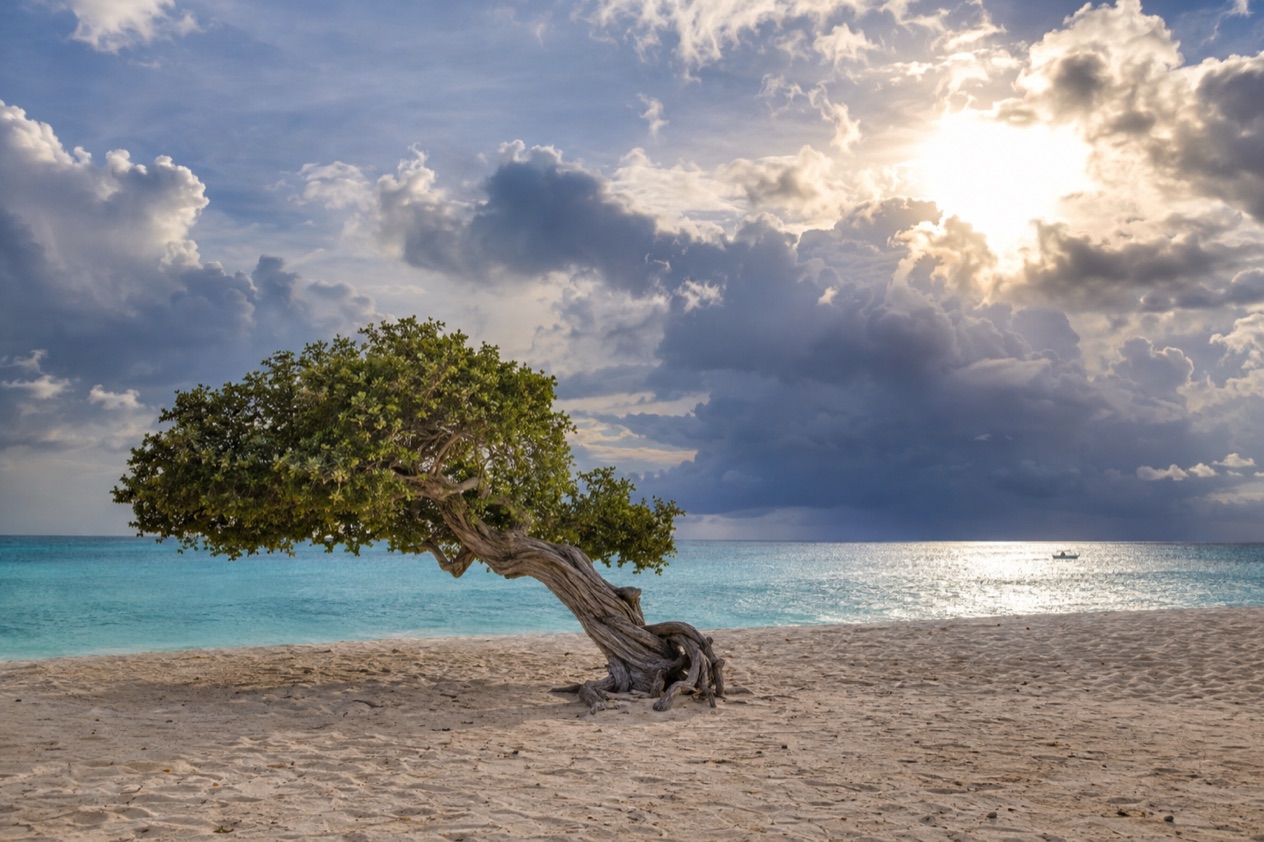
Eagle Beach is known for the leaning fofoti trees, shaped by the constant wind, and for a wide stretch of sand that gives the beach a quieter feel than the resort strip. In October the warm sea and the long evenings make it a pleasant place to end the day, with the sky going pink before dinner.
Oranjestad, the capital, is the place for a rainy hour. Its harbor, pastel Dutch-style buildings and shops make a good detour when a cloud sits overhead. Try a pastechi, the fried pastry filled with cheese, meat or fish, from a local counter, or order keshi yena, a baked cheese dish with a savory filling, at a sit-down lunch. Both come from the island’s mixed kitchen of Amerindian, European, African and Asian influences.
The south: Savaneta, San Nicolas and Baby Beach
The south is where Aruba feels least like a resort. San Nicolas has a mural tour, with big painted walls turning a former industrial town into an open-air gallery, and it is the right stop for a slow wander between showers. Savaneta is a fishing district with a more local pace and waterfront eating.
Baby Beach, near San Nicolas, and Mangel Halto are both among the beaches named for snorkeling. The sea off San Nicolas is as warm as anywhere on the island this month, so a morning here suits anyone who wants to spend hours with a mask rather than in a lounge chair.
The windward coast and the interior
The north and east coasts are rough and wild, a different Aruba from the postcard beaches. Here the land is cactus, limestone and wind, and the sea throws itself against the rocks. Bushiribana on the north coast shows the ruins of an old gold smelter beside the surf, and Arikok National Park covers a large part of the island’s wilder side.
Hooiberg, the lone hill in the middle of the island, is a landmark visible from many corners of Aruba. October heat is strong, so early mornings and late afternoons make the most sense for any outing in the interior, and a passing shower can change the light in a minute.
What to do in Aruba in October
October is a water month. The sea is warm and the clear water lets snorkelers and divers see reefs and wrecks, which makes the days built around boats, masks and beach time the easiest to plan. When a shower arrives, the island has plenty of indoor and roadside alternatives.
Snorkeling and diving
The beaches named for snorkeling are Malmok Beach, Boca Catalina, Mangel Halto and Baby Beach, spread between the northwest and the south. Each has its own character, from rocky edges to a sheltered cove, and you can easily visit two in one trip across the island. Fish, coral and clear water are the draw.
Snorkel tours often stop at the Antilla, the World War II shipwreck. Divers also come for the wrecks and reefs the clear water reveals. Boat trips set out toward the leeward coast, so a morning outing fits the usual October rhythm of sun first, clouds later.
Wind sports
Aruba is one of the most popular spots on earth for windsurfers and kitesurfers, thanks to trade winds that blow constantly at about 15 knots. October’s steady east wind keeps that tradition going. Even if you never touch a board, the colorful sails on the water are a fine thing to watch from the sand with a cold drink.
Eating, markets and rainy-hour plans
The first people on the island, the Caquetio, ate fresh fish and conch, and both still appear on menus today. Order whatever the kitchen caught that morning, then follow with a pastechi at a bakery counter or keshi yena at dinner. The local language, Papiamento, mixes Spanish, Portuguese, Dutch and African influences, and you will hear it in markets and shops.
Rain in October tends to be brief, so one good approach is to schedule your outdoor time early and keep the afternoon loose. Oranjestad’s harbor and shops, the murals of San Nicolas and a long seafood lunch all work when clouds roll in. October has no major island-wide festival to organize a trip around, which leaves the days open for the sea.
Is Aruba busy in October?
No, October is among the quieter months, part of the off-season that runs from September to November. The peak season comes later, from December to April, so beaches, restaurants and boat trips have a looser feel this month.
That calm shows most on the resort strips, Palm Beach and Eagle Beach, where winter brings the heaviest traffic. October visitors tend to spread out through the day, with beaches in the morning and terraces in the evening, and the island’s small size means you never feel far from a quiet corner. The windward coast and the southern towns, San Nicolas and Savaneta, are quiet in any month because they are not built around resort life.
What keeps October lively is the sea and the wind. Snorkelers, divers, kitesurfers and windsurfers still come for the conditions, and the water sports side of the island keeps moving. If you want a more relaxed trip with the same warm water that winter visitors enjoy, this month fits.
What to pack for Aruba in October
Packing for October is about heat, sun, wind and the odd shower, and the whole island asks for the same kit, with the windward coast adding a layer of spray and gusts. Think light, quick-drying and easy to rinse.
- Light, breathable clothes for afternoons that reach the low 90s, plus something a little warmer for a breezy evening on a terrace.
- A compact rain jacket or a small umbrella for the short showers that cross the island this month.
- Swimwear, a mask and a snorkel if you have your own, since the water is warm and the reefs are the main attraction.
- Sun protection, including a hat and sunglasses, because the sun is strong and the wind hides how hot it is.
- Sandals for the beach and sturdy closed shoes for rocky stretches of the north and east coasts.
- Your passport, valid for the entire stay, and your completed ED Card.
Good to know before you go
The U.S. State Department rates Aruba Level 1, ‘Exercise normal precautions,’ and says Aruba is generally a safe destination for travelers, with petty crime the main concern in popular tourist areas.
October falls inside the hurricane season, which runs from June 1 to November 30. Aruba sits on the southern fringes of the hurricane belt where damaging storms are rare, but passing systems in the Caribbean can bring more rain, gusty winds, a day with no wind at all, or a hotter feel. The U.S. State Department rates Aruba Level 1, Exercise normal precautions, and says it is generally a safe destination for travelers, with petty crime the main concern in popular tourist areas.
U.S. citizens do not need a visa. You need a passport valid for the whole stay, the Aruba ED Card (Embarkation and Disembarkation Card) completed within 7 days before travel, proof that you can return to your country of departure or continue through another country, and enough money to cover your stay.
Is October a good time to visit Aruba?
Yes, October is a good time for travelers who care more about warm water, a relaxed pace and open tables than about guaranteed dry days. The best place is the leeward coast, Palm Beach, Eagle Beach and Oranjestad, with the south for snorkeling and local flavor. It suits snorkelers, divers, wind-sport fans and anyone who likes the island without winter crowds.
Compared with September, October brings noticeably more rain. September is much drier, with only a few rainy days, and it is slightly hotter. Compared with November, October is still a touch warmer and has fewer rainy days, since November is wetter and the rainy season is well established by then. October sits in the middle, with showers arriving but not yet dominating the days.
The sea is the strongest argument. It is warm all year, and in October it is at its warmest, which makes every boat trip, snorkel stop and beach morning pleasant. The trade wind keeps blowing and keeps the heat bearable, and the evenings are long enough for a slow dinner after a day on the water.
What is special about October in Aruba is the quiet season feel on an island built for the sea. You can snorkel off Boca Catalina in the morning, eat a pastechi in Oranjestad at midday, watch the kitesurfers in the wind, and finish at the California Lighthouse as the copper light fades.
Sources
- Meteorological Department Aruba (meteo.aw), Summary Climatological Normals 1991-2020, Queen Beatrix Airport station (http://www.meteo.aw/files/Download/climatnormals19912020.pdf), checked October 9, 2026
- Open-Meteo Marine API, average 2015-2024, checked October 9, 2026
- sunrise-sunset.org, sunrise and sunset calculated for the 15th of the month, checked October 9, 2026
- Aruba Tourism Authority, Weather and climate (https://www.aruba.com/us/our-island/island-facts/weather-and-climate), checked October 9, 2026
- Aruba Tourism Authority, Best time to visit (https://www.aruba.com/us/our-island/one-happy-island/when-is-the-best-time-to-visit-aruba), checked October 9, 2026
- Aruba Tourism Authority, Where is Aruba (https://www.aruba.com/us/our-island/island-facts/where-is-aruba), checked October 9, 2026
- NOAA National Hurricane Center, Climatology (https://www.nhc.noaa.gov/climo/), checked October 9, 2026
- Aruba Tourism Authority, Aruba hurricane season (https://www.aruba.com/us/blog/aruba-hurricane-season), checked October 9, 2026
- Aruba Tourism Authority, Passports and visas (https://www.aruba.com/us/plan-your-visit/getting-to-aruba/passports-and-visas), checked October 9, 2026
- Aruba Tourism Authority, Sustainability (https://www.aruba.com/us/our-island/island-facts/sustainability), checked October 9, 2026
- Aruba Tourism Authority, Beaches and coves (https://www.aruba.com/us/things-to-do/beaches-and-coves), checked October 9, 2026
- Aruba Tourism Authority, On the water (https://www.aruba.com/us/things-to-do/on-the-water), checked October 9, 2026
- Aruba Tourism Authority, Scuba and snorkel (https://www.aruba.com/us/things-to-do/on-the-water/scuba-snorkel), checked October 9, 2026
- Aruba Tourism Authority, Local Aruba cuisine (https://www.aruba.com/us/things-to-do/dining/local-aruba-cuisine), checked October 9, 2026
- Aruba Tourism Authority, Kite and windsurfing (https://www.aruba.com/us/things-to-do/on-the-water/kite-windsurfing), checked October 9, 2026
- U.S. Department of State, Aruba Travel Advisory, Level 1, issued August 19, 2026 (https://travel.state.gov/content/tsg_aem/us/en/home/international-travel/travel-advisories/destination.abw.html), checked October 9, 2026
To plan your stay
- Things to Do in Aruba: Beaches, Arikok National Park, Island Tours and Food
- Where to Stay in Aruba: Palm Beach, Eagle Beach, Oranjestad and All-Inclusives
- Aruba Airport (AUA): Arrival, Getting to Your Hotel, U.S. Preclearance and Departure
- Know Before You Go to Aruba: Entry Forms, Money, Water and Local Customs