
At a beach bar on Eagle Beach, the bill arrives in a little folder. The total may be printed in florins while the cash in your wallet is in dollars, and nobody at the table thinks twice about it. Aruba’s official currency is the Aruban florin, but U.S. dollars are taken so widely that a trip can run on greenbacks, a card and a few coins for souvenirs.
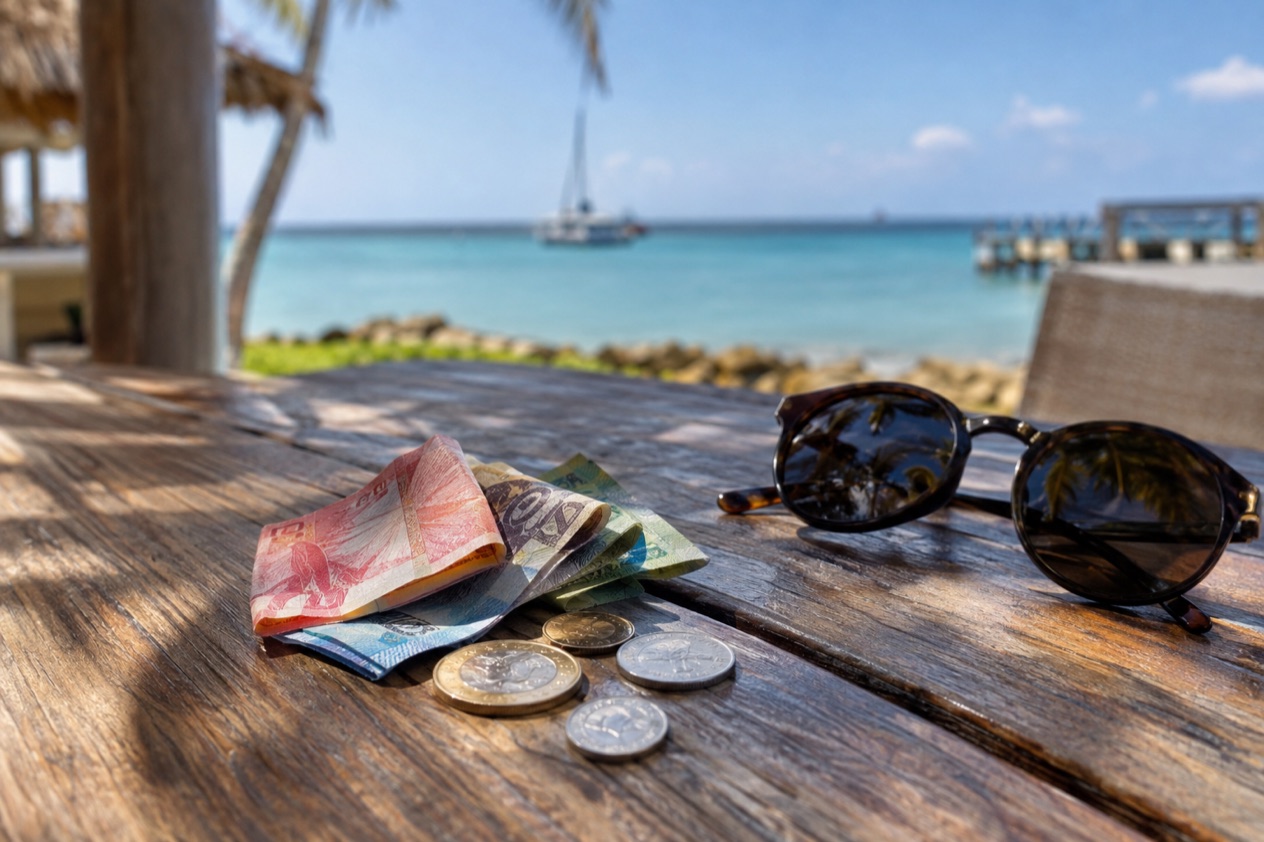
What currency does Aruba use?
The official currency of Aruba is the Aruban florin, written Afl on price tags, menus and receipts. It is divided into cents, and the coins are the part travelers tend to remember: the 50-cent piece is square, which makes it an easy keepsake to slip into a pocket after a bar tab or a grocery run.
In daily life on the island the florin sits next to the dollar rather than replacing it. Gas stations, supermarkets, snack stands in San Nicolas and restaurants in Oranjestad all deal in both, and prices you see may be posted in either currency. What matters for your wallet is the rate each business applies.
The exchange rates you will meet
There is no single rate across the island. Banks and exchange counters quote one figure for cash and a slightly different one for traveler’s checks, while supermarkets, gas stations, restaurants and shops each apply their own convenient rate when you pay in dollars.
| Where | Rate for U.S. dollars (Afl per U.S. $1) |
|---|---|
| Exchange for cash | Afl 1.77 |
| Exchange for traveler’s checks | Afl 1.78 |
| Most supermarkets and gas stations | Afl 1.75 |
| Many restaurants and shops | Afl 1.80 |
The gaps are small, so a dollar bill spent on a bottle of water and a dollar spent on a dinner are not treated quite the same way. For a week of ordinary spending the difference is a matter of loose change, not a reason to plan your day around it.
Florins in your pocket
When you pay cash in dollars, change often comes back as a mix of U.S. dollars and florins. That is how most visitors end up with a few florin coins without ever visiting a bank, and it is the simplest way to collect the square coin.
Florins are spent like any other money on the island, so leftover coins can go toward a pastechi (a fried pastry filled with cheese or meat) from a snack counter or a cold drink on the way to the airport. Banks are the places to change larger amounts, and the staff at most of them speak English fluently, so a question about a rate gets a plain answer.
Can you use U.S. dollars in Aruba?
Yes, U.S. dollars are widely accepted in Aruba, and you can pay in dollars as well as in Aruban florins. For a visitor from the United States this means a trip without any currency exchange is entirely workable, from the first taxi ride to the last souvenir.
Paying in dollars, getting change in both
At a shop counter or a restaurant table you simply hand over dollars. The cashier converts the florin price at the rate the business uses and may return your change in dollars, in florins or in both. Seeing a few florin coins land in your palm alongside a dollar bill is normal and not a sign that anything went wrong.
This is why prices on the island can feel familiar. The cost of living is quite similar to that in the United States, and the dollar is the currency most visitors think in anyway. You only feel the conversion when you pay.
Large bills and checks
A few things work less well than plain dollars. Some businesses will not accept the two largest U.S. bills, the fifty and the hundred, so smaller notes are the ones that travel smoothly from hand to hand. This can matter at a small shop or a roadside stand where the cash drawer holds little change.
Personal checks from abroad are generally not accepted. Traveler’s checks, on the other hand, are accepted, and banks exchange them at their own rate, a touch different from the cash rate. Most visitors will find a card or a few dollars in cash covers everything a check would have done.
When a florin price shows up
Some menus, supermarket shelves and local snack stands show only a florin price. You pay the equivalent in dollars at the rate the business applies, which explains why a supermarket and a restaurant may land on slightly different totals for similar amounts. Staff and cashiers handle this every day and have the rate in their heads.
Do credit cards work and where are the ATMs?
Yes, all major credit cards are accepted in Aruba, and cash is within reach too, since ATM cards with a Cirrus, MasterCard, Maestro or Visa logo can withdraw money at banks and at more than 50 locations and ATMs across the island. Many stores take cards, so a beach day, a dinner in Palm Beach and a supermarket run can all be paid for with plastic.
Using your cards
One step belongs before the flight: contact your credit card provider before departure and tell them your travel plans. Otherwise overseas charges may be questioned or denied, which is an unpleasant surprise at a restaurant table on the first night.
Cards work for hotels, restaurants, shops and larger purchases, and traveler’s checks are accepted as well. Smaller outlets may suit a few dollars in cash better, which is one more reason to keep some low-value U.S. bills with you alongside the card.
Banks and ATMs
Banks keep weekday daytime hours, and some branches stay open later on Friday and on Saturday morning. Staff at most banks speak English fluently, so a withdrawal problem or a question about exchanging checks is settled in a few minutes. Three names turn up often on the island.
| Bank | Open | ATMs and branches |
|---|---|---|
| Aruba Bank | Weekdays, 8:00 am to 4:00 pm | More than 20 ATMs across the island |
| Banco di Caribe | Monday to Friday, 8:00 am to 4:00 pm | Branch in Oranjestad, ATM in Paradera |
| RBC Royal Bank | Weekdays, 8:00 am to 2:00 pm | More than 10 branches, over 20 ATMs, available at any time |
RBC Royal Bank stands out for its machines, which are available at any time, so a withdrawal does not have to wait for the next morning. Banco di Caribe’s Oranjestad branch is handy if you are in town for the shops, and its machine in Paradera serves the inland side of the island.
How much should you tip in Aruba?
A tip of 15% to 20% is customary in Aruba, and tipping is encouraged but not mandatory. All service workers on the island appreciate tips, from servers and bartenders to the people who carry your bags, so the habit you have at home carries over almost unchanged.
Restaurants, bars and the service charge
Some restaurants and bars add a service charge to the bill for groups. You will find it at the bottom of the receipt, so a quick glance at the last lines tells you whether it is already there. That charge is not a tip for the server.
The money is collected into a pool and shared among the entire staff, including the kitchen. The highest percentage goes to the highest-ranked staff and the smallest share to the server who took your order. If your server did a good job, you may leave an additional tip on top of the service charge, and that extra goes to the person who looked after you.
Taxis and other service workers
Rates for Aruba taxis are fixed, so the fare you are quoted is the fare you pay. A tip for the driver is optional and reserved for when you feel the service was great, for instance help with heavy luggage or a driver who shared good advice on where to eat.
The same spirit applies to hotel staff, tour crews and anyone else who made your day smoother. Dollars are fine for tipping, and a few small bills in your pocket make it easy to say thanks without a trip to the front desk for change.
| Situation | What to do |
|---|---|
| Restaurant or bar, individual bill | Tip the customary range, encouraged but not mandatory |
| Restaurant or bar, group bill | A service charge of about 15% may be added, shown at the bottom of the receipt, not a tip for the server |
| Taxi | Fixed rate, tip optional for great service |
| Other service workers | Tips are appreciated |
Good to know before you go
The U.S. State Department rates Aruba Level 1, ‘Exercise normal precautions,’ and says Aruba is generally a safe destination for travelers, with petty crime the main concern in popular tourist areas.
Money on the island is straightforward: florins and dollars both work, cards are widely accepted and the cost of living is quite similar to that at home. Groceries run 5 to 6% higher than in the United States because almost all food is imported, though tap water is perfectly safe to drink and saves you the price of bottled water.
Petty crime is the main concern in busy tourist areas, so the usual habits with wallets and phones apply. A vacation here is as affordable as you want it to be, with room for any budget.
Sources
- Aruba Tourism Authority, Currency (https://www.aruba.com/us/plan-your-visit/tips-for-visitors/currency), checked October 9, 2026
- Aruba Tourism Authority, Tipping (https://www.aruba.com/us/plan-your-visit/tips-for-visitors/tipping), checked October 9, 2026
- Aruba Tourism Authority, Banks (https://www.aruba.com/us/plan-your-visit/tips-for-visitors/banks-in-aruba), checked October 9, 2026
- Aruba Tourism Authority, Cost of living (https://www.aruba.com/us/plan-your-visit/tips-for-visitors/cost-of-living), checked October 9, 2026
- Aruba Airport Authority, Arriving passengers (https://www.airportaruba.com/arriving-passengers), checked October 9, 2026
- Aruba Tourism Authority, Duty-free shopping (https://www.aruba.com/us/things-to-do/shopping/duty-free), checked October 9, 2026
- U.S. Department of State, Aruba Travel Advisory, Level 1, issued August 19, 2026 (https://travel.state.gov/content/tsg_aem/us/en/home/international-travel/travel-advisories/destination.abw.html), checked October 9, 2026
To plan your stay
- Best Time to Visit Aruba: Weather by Month, Peak Season and Festivals
- Things to Do in Aruba: Beaches, Arikok National Park, Island Tours and Food
- Where to Stay in Aruba: Palm Beach, Eagle Beach, Oranjestad and All-Inclusives
- Aruba Airport (AUA): Arrival, Getting to Your Hotel, U.S. Preclearance and Departure