
On Aruba, the afternoon belongs to the fofoti trees of Eagle Beach, bent by the east wind, and to a long stretch of pale sand with a cold drink in reach. On Curaçao, it belongs to the pastel gables of Willemstad, where the floating pedestrian bridge swings open for boats and the harbor smells of fried fish and diesel.
Both are Papiamento-speaking islands of the Dutch Kingdom, only a short hop apart. Aruba and Curaçao sit side by side for anyone choosing one for a Caribbean vacation.
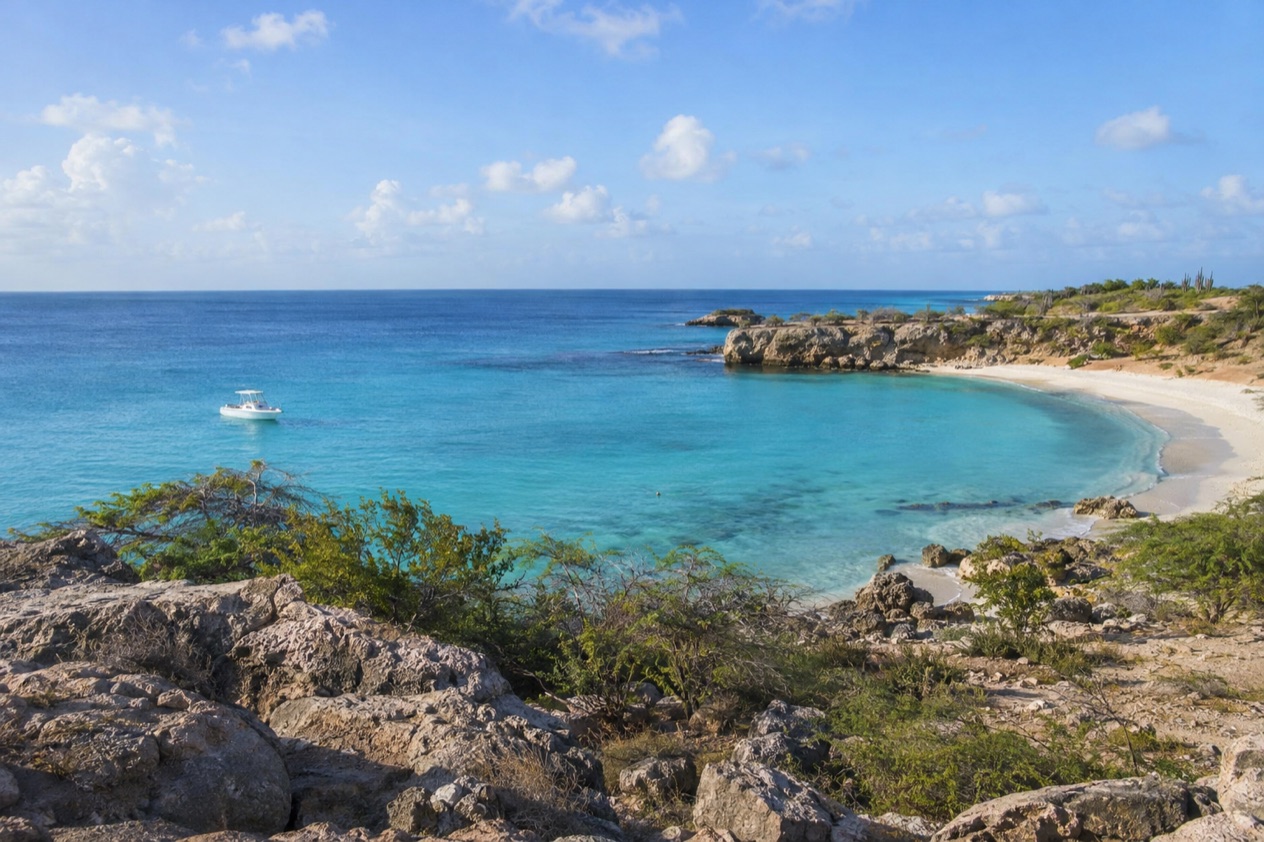
Which is better, Aruba or Curacao?
Aruba suits travelers who want long, easy beach days and a polished resort setting, while Curaçao suits those who want a colorful old city, small coves and a bit more wandering. Neither island is the better one in general. They differ in shape, in rhythm and in what you do between swims.
Aruba is compact and dry, built around the resort strips of the west coast and the capital Oranjestad. Curaçao is more than twice as large, with a lived-in capital, a ragged coastline and a countryside of old plantation houses and cactus fences. The table gives the quick comparison, and the sections after it fill in the details.
| Category | Aruba | Curacao |
|---|---|---|
| Size | 69.1 sq mi | 171 sq mi |
| Beaches | Every beach is public. Resort sand on the west and south coasts, wild surf on the north and east | Public beaches mostly on the south coast, especially the western side. Much of the east coast is private |
| Vibe | Resort polish, Palm Beach evenings, a small harbor capital | Willemstad’s colorful waterfront, a larger island with more room to roam |
| Things to do | Snorkeling, wreck dives, windsurfing, island and boat tours | Town walks, cove-hopping, diving, caves, plantation houses, a boat trip to a small outlying island |
| Nightlife | Resort-strip restaurants and bars around Palm Beach and Oranjestad | Waterfront cafés and bars in Willemstad’s old districts |
| Weather | Dry, sunny, with the east wind blowing all year | Hot and semi-arid, with the wet months starting in October |
| Getting there | Queen Beatrix Airport, near Oranjestad | Curaçao International Airport, near Willemstad |
| Best for | First-time Caribbean beachgoers, snorkelers, wind sports | City strolls, cove explorers, travelers who like variety |
Beaches and the sea
Aruba has the easier beach vacation, with more than 20 public beaches and coves, and every one of them is public. The west and south coasts are the calm, protected side, the kind of shoreline built for swimming and snorkeling. The north and east coasts are another world, with stronger winds, crashing waves and dramatic scenery that is better admired from a viewpoint than from the water.
Eagle Beach, with its leaning fofoti trees, was voted number three Best of the Best Beach in the Caribbean in the TripAdvisor Travelers’ Choice Awards. Baby Beach, a shallow lagoon-style bay on the southeast tip, is described as ideal for kids and beginner snorkelers.
For snorkeling from the sand, Boca Catalina, Arashi Beach and Mangel Halto have reefs close to shore. Boca Grandi is the wind-sport beach, great for windsurfing and kitesurfing, but its current is strong, so it is not the place to swim.
Curaçao’s beaches work differently. The public ones are concentrated on the southern coast, especially the western side from Rif St. Marie up to Westpunt, and they tend to be small coves tucked below limestone cliffs rather than long ribbons of sand.
The eastern coast is the catch. Much of it is privately owned, with access prohibited and private security patrolling, so the open, wave-battered shoreline that Aruba lets you stand beside is mostly off limits on Curaçao. The reefs just offshore are a big part of the island’s reputation, and divers and snorkelers often plan their days around a favorite cove.
For a classic beach vacation with plenty of choice and an easy rhythm, Aruba wins. Curaçao rewards people who enjoy hunting for a cove, packing a cooler and spending a day moving between small bays. If you are traveling with young children, Aruba’s Baby Beach is the one named spot on either side that the sources single out for kids.
Things to do
Aruba’s days revolve around the water. The island is considered one of the best in the Caribbean for snorkeling, thanks to its weather, clear water and sea life, and four species of sea turtle may turn up in front of your mask. Snorkel tours often stop at the Antilla, a famous World War II shipwreck. Divers have more wrecks to choose from, plus the Spanish Lagoon and the Barcadera Reef.
If you want to see the reef without full dive gear, SNUBA lets you breathe underwater while the tank stays in a boat on the surface. It requires no prior diving or snorkeling experience, and the minimum age is 8.
The SEABOB, a powerful underwater scooter, is another way to glide over the bottom. On land, Aruba gives you the lighthouse at the northwest tip, the rocky north coast with the ruins of Bushiribana, the odd boulder of Hooiberg in the middle of the island and the mural-covered streets of San Nicolas.
Curaçao’s attractions lean toward town and countryside. Willemstad is the main event, with its Dutch-style waterfront houses in candy colors, the pontoon bridge that opens for ships and the two sides of the harbor, Punda and Otrobanda, that you walk between. Pietermaai and the harbor-front cafés fill up with diners and drinkers in the evening, and there is a market where vendors from Venezuela once sold produce from their boats.
Beyond the capital, you can visit old plantation houses (landhuizen), hike the hills of a national park at the western end and look for the caves with their bat colonies. A boat trip to Klein Curaçao, the small uninhabited island offshore, is a favorite day out.
Food is a pleasure on both islands. Both serve keshi yena, a baked cheese dish, and both fry pastechi, the crisp turnovers eaten for breakfast. Curaçao adds slow-cooked goat stew (kabritu) and the liqueur flavored with local orange peel.
If your idea of a good day is a morning in the water and an evening at a beachfront table, Aruba delivers cleanly. If you want to alternate swimming with a city walk, a market and a drive through cactus country, Curaçao has more to fill the in-between hours.
Weather and the best time to go
The two islands share the same basic climate, hot and dry with a steady trade wind from the east, but the rhythm of the year differs a little. Aruba has a dry, arid landscape that stands in contrast to the humid tropics of much of the Caribbean.
Curaçao is hot and semi-arid, with temperatures that barely move through the year. Its average hovers around 81°F, with January the coolest month and September the hottest.
On Aruba, the peak season runs from December to April, which is also the dry stretch, with abundant sunshine and very little rain. February to August is the best time to visit in general, and the off-season falls from September to November.
In January, afternoons reach the mid-80s, nights stay in the upper 70s and the wind blows at a steady 16 mph. Showers do show up, on about eleven days, but they are brief and light. July is hotter, with highs around 90°F, just four days of rain and the wind at its strongest, a breeze that makes the heat easier to bear.
Curaçao’s wet season starts in October, with showers that mostly fall at night and are usually short. That means a visit now, in early October, can still feel sunny by day with the odd passing downpour after dark. The island also lies outside the hurricane belt, and no hurricane has made landfall since the National Hurricane Center started tracking them.
Aruba’s hurricane season runs from June 1 to November 30, so the quieter months from September to November sit inside it. That stretch brings the fewest visitors, as does the summer of July and August.
If crowds matter to you, those are the months to aim for. If you want the most reliable sun and the liveliest evenings, pick the winter peak, and if you simply want warm water and a breeze, the long middle of the year works on either island.
Getting there and getting around
Both islands are reached by air, each through a single main airport near its capital. On Aruba that is Queen Beatrix Airport in Oranjestad, and the resort strips and beaches lie along the island’s west and south coasts. On Curaçao, flights land near Willemstad, and the beach coves and diving spots are spread along the southern and western coast.
Aruba is small enough to understand quickly, about 20 miles from end to end and 6 miles across at its widest point. Public transportation reaches the major beaches, but a car gives you the freedom to explore smaller coves and the island’s coastline. The rough north and east coasts, the lighthouse and the inland landmarks are all spread across that compact map.
Curaçao is a much larger island, and its sights are spread out. The public beaches are concentrated on the southern coast, especially the western side toward Westpunt, while the privately owned east coast is closed to you. That geography means the best of the island lies along one long southern and western corridor, with Willemstad near its center.
Aruba is the simpler island to organize, because the resort areas, the capital and the best-known beaches sit close together. Curaçao asks for a little more planning, because the capital and the coves are in different places, and a day often means choosing a direction. Language is easy on both. Papiamento and Dutch are official on both islands, English is official on Curaçao, and on Aruba English and Spanish are widely spoken.
Who should choose which
Choose Aruba if you want a beach vacation where the main decisions are which stretch of sand and which snorkel spot. It suits snorkelers, windsurfers and kitesurfers, families drawn to a gentle lagoon bay, and couples who want sunsets, dinners and a resort setting close at hand. It also suits anyone who likes a dry, sunny island and a steady breeze, and who prefers to unpack once and stay put.
Choose Curaçao if you want the beach to be one part of the trip rather than all of it. It suits travelers who enjoy walking a historic harbor city, finding a small cove with a reef offshore and driving past old plantation houses, cactus fences and salt flats.
Divers, history lovers and people who like to eat their way through a town will find more to do here. Those who need the wild open east coast to be accessible will find that Aruba offers more of it.
You can combine the two, since they sit about 50 miles apart, with Aruba to the northwest. A split trip works best when you give each island its own character: a few days of beach and snorkeling on Aruba, and a few of town life and cove-hopping on Curaçao. Keep in mind that this means two separate airports and two bases, so a single-island trip is easier if time is short.
Good to know before you go
The U.S. State Department rates Aruba Level 1, ‘Exercise normal precautions,’ and says Aruba is generally a safe destination for travelers, with petty crime the main concern in popular tourist areas.
Aruba’s currency is the Aruban florin (AWG). Keep your usual travel habits for beaches and parking areas, such as not leaving valuables in sight in a parked car. Aruba’s hurricane season runs from June 1 to November 30, which covers the quiet months of early autumn, while Curaçao lies outside the hurricane belt. On both islands, the sun and the wind are strong, so plan your outdoor days around that.
Sources
- Wikipedia, Aruba (https://en.wikipedia.org/wiki/Aruba), checked October 9, 2026
- Wikivoyage, Curaçao (travel guide) (https://en.wikivoyage.org/wiki/Cura%C3%A7ao), checked October 9, 2026
- Wikipedia, Curaçao (https://en.wikipedia.org/wiki/Cura%C3%A7ao), checked October 9, 2026
- Wikivoyage, ABC Islands (https://en.wikivoyage.org/wiki/ABC_Islands), checked October 9, 2026
- Aruba Tourism Authority, Beaches and coves (https://www.aruba.com/us/things-to-do/beaches-and-coves), checked October 9, 2026
- Aruba Tourism Authority, Scuba and snorkel (https://www.aruba.com/us/things-to-do/on-the-water/scuba-snorkel), checked October 9, 2026
- Aruba Tourism Authority, Where is Aruba (https://www.aruba.com/us/our-island/island-facts/where-is-aruba), checked October 9, 2026
- Aruba Tourism Authority, Best time to visit (https://www.aruba.com/us/our-island/one-happy-island/when-is-the-best-time-to-visit-aruba), checked October 9, 2026
- Meteorological Department Aruba (meteo.aw), Summary Climatological Normals 1991-2020, Queen Beatrix Airport station (http://www.meteo.aw/files/Download/climatnormals19912020.pdf), checked October 9, 2026
- U.S. Department of State, Aruba Travel Advisory, Level 1, issued August 19, 2026 (https://travel.state.gov/content/tsg_aem/us/en/home/international-travel/travel-advisories/destination.abw.html), checked October 9, 2026
To plan your stay
- Best Time to Visit Aruba: Weather by Month, Peak Season and Festivals
- Things to Do in Aruba: Beaches, Arikok National Park, Island Tours and Food
- Where to Stay in Aruba: Palm Beach, Eagle Beach, Oranjestad and All-Inclusives
- Aruba Airport (AUA): Arrival, Getting to Your Hotel, U.S. Preclearance and Departure