
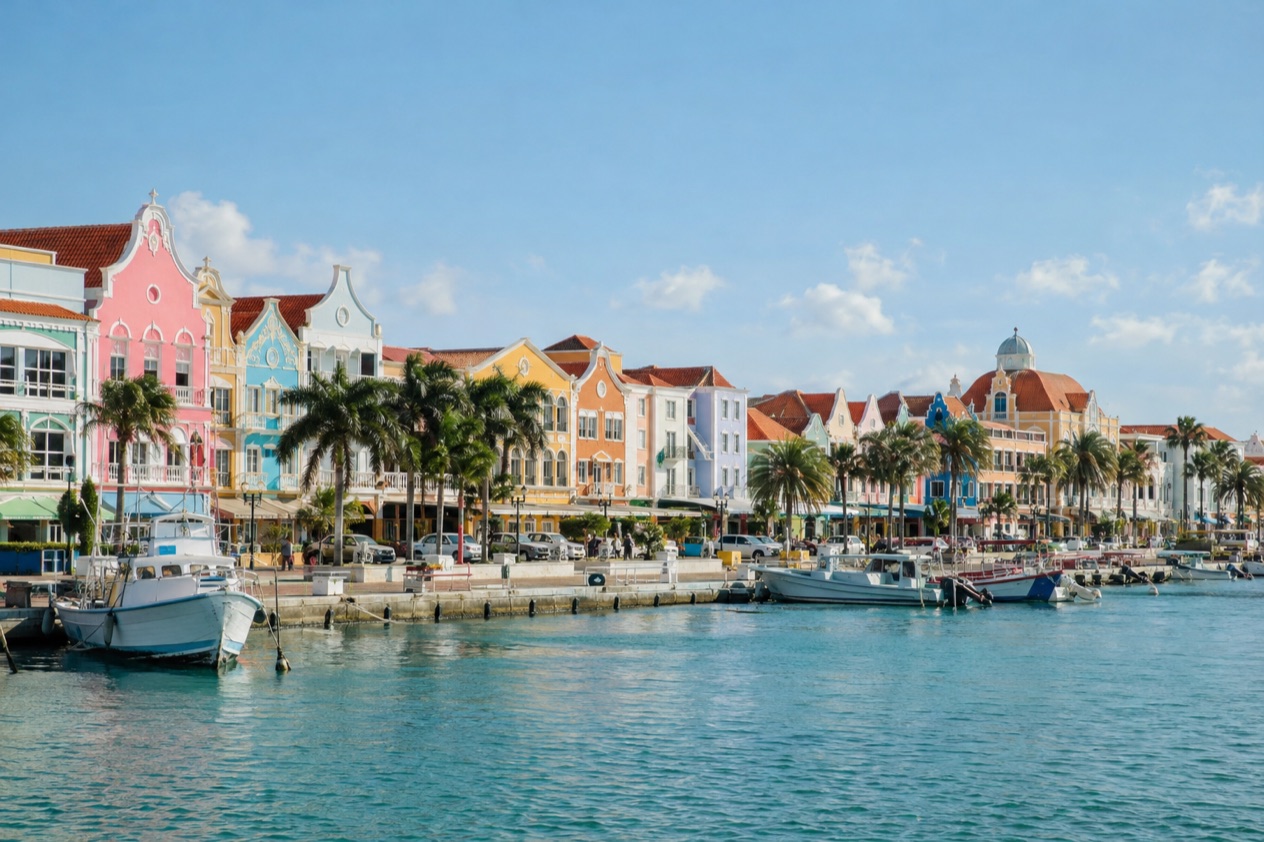
Early in the morning in Oranjestad, the pastel facades along the harbor take on the light before the shops lift their shutters, and the first cruise ship slides in toward the quay. Dutch gables, a green town hall and a small red fort share the waterfront with jewelry windows and sidewalk cafés. This is the capital of Aruba, a harbor town with history, shopping and a good table to sit at, for travelers who like to wander a city between beach days.
Where is Oranjestad and what is it like?
Oranjestad sits on the southwestern coast of Aruba, on the leeward side of the island, facing a sea that the trade wind from the east leaves comparatively sheltered. It is the capital and the island’s working harbor, a colorful town of Dutch colonial facades, shopping streets and waterfront promenades. The airport lies a short way from the center, and the resort strip of Palm Beach stretches along the coast to the northwest.
The town was founded around the end of the 1790s and takes its name from the Dutch royal house of Orange-Nassau. You feel that heritage in the architecture, in the candy colors painted on old merchant houses, and in the way street names slide between Dutch, Spanish and Papiamento, the local language that blends them with Portuguese and African influences.
About twenty-nine thousand people live here, which makes it a small capital with a lived-in rhythm. Office workers take their lunch at snack counters, and families gather in the evening near the water.
The harbor is called Paardenbaai, meaning Bay of Horses, and it is the largest passenger port on the island, able to take up to five vessels at once. On days when ships are in, the streets near the quay fill with visitors, and the pace picks up around Main Street and the shopping arcades. On days with fewer ships, the town breathes more slowly, and the museums and cafés feel like your own discovery.
Oranjestad suits travelers who like to walk through a place with a past, who enjoy browsing shops, and who want a meal and a museum on the same afternoon. It is a city rather than a beach resort, so those who want a day entirely on sand will find the best beaches along the coast to the northwest and not in the center. Wind sweeps through town all year, and shade and a cold drink are never far when the afternoon heats up.
What is there to do in Oranjestad?
The big reasons to come are the old fort and its neighbors, the museum of the island’s first peoples, the shops of Main Street and the harbor itself. What sets Oranjestad apart from the resort strip is that it has a past you can touch, and a place where Aruba goes about its daily business.
Fort Zoutman, Willem III Tower and the Historical Museum
Fort Zoutman is the oldest remaining building in Oranjestad, raised in the late 1790s to guard the coast against pirates. It carries the name of a Dutch rear admiral who never set foot on Aruba but had beaten the English in the North Sea. In the courtyard, a replica kitchen shows how meals were cooked in old Aruba, with the sort of detail that helps you picture the household behind the walls.
Beside it stands the Willem III Tower, which once marked the fort’s entrance and served as both lighthouse and public clock. Its lamp was put out in 1963 after ninety-five years of service.
Between the fort and the tower, the Historical Museum keeps a permanent exhibition on Aruban history, a good way to understand the island before you head out to its coasts.
The Archaeological Museum on Schelpstraat
The Archaeological Museum stands at Schelpstraat 36-38, inside the renovated home of the Ecury family. It preserves the Amerindian heritage of Aruba, the story of the people who lived here long before the Dutch arrived. The building itself tells a tale: the oldest section is a cunucu house, the traditional countryside dwelling of the island, built in 1870, and the newest is a large mansion from 1929.
Boy Ecury, a young Aruban hero of World War II, grew up in this house, which adds a human thread to the visit. It suits travelers who like their sightseeing with context, and it pairs well with the fort since both speak of the island’s layers of history. Take it as a quiet counterpoint to the shopping streets.
Main Street and duty-free shopping
Main Street is now a remodeled pedestrian mall, lined with jewelry stores, fragrance shops, Dutch delicacies, aloe products and local souvenirs. Aruba is often called the shopping paradise of the Caribbean, and the town has international brands, restored historic buildings and a modern bus station close to the center. Shops carry fine watches, perfumes, electronics, beach and resort wear, linens, china and handicrafts.
Duty-free means no import taxes, with prices set by the manufacturer, and the island’s prices run lower than in the United States by a margin the tourism trade puts between ten and thirty-five percent. Travelers returning to the United States are entitled to an exemption of $800 per person. For a break from browsing, the Aloe Vera factory offers free tours at frequent intervals during its opening hours, with no booking needed.
The harbor and the downtown tram
A hop-on hop-off tram links the cruise terminal with the center of town, rolling through Main Street and making six stops at monuments, museums and shopping areas. It is a gentle way to get your bearings on a first morning, and you can step off wherever something catches your eye. Along the quay, boats come and go, and the promenade is a pleasant place to watch the light change on the water in the late afternoon.
Within a mile of the tram route you will find a spa, a few boutiques and several sport-fishing outfits, among them Driftwood Fishing Charters and Adventure Ola Sport Fishing. The Mopa Mopa Culture gallery is also in that radius, and it makes a good detour for local craft.
How many days do you need in Oranjestad?
A single full day covers the center of Oranjestad, and two days let you see it without hurrying and add a beach afternoon on the side. The town is compact, so the question is less how much there is than how slowly you like to travel.
With one day, start at the fort, the tower and the Historical Museum while the morning is cool, then continue to the Archaeological Museum. Lunch can be taken somewhere along the harbor or in one of the cafés around the pedestrian mall.
In the afternoon, spend time on Main Street with its shops, and ride the tram if you want to cover the ground with a seat under you. Dinner by the water closes the day.
A second day gives room for the Aloe Vera factory tour, a stroll through the quieter side streets with their colored facades, and a visit to the harbor for a look at a fishing charter or a boat outing. If you are staying on the island for a week, Oranjestad makes a pleasant half-day or full-day anchor rather than a base, with the rest of your time going to the beaches and the island’s wild coast.
With more time, extend your trips from the capital. San Nicolas, on the south of the island, offers colorful art galleries and local shops with authentic Aruban pieces, and it is a different Aruba from the harbor town.
Palm Beach, on the northwest coast, has shopping centers, restaurants, movie theaters and nightly entertainment, and it makes a natural evening outing. Both fit around a stay in the capital without trouble, given that the island covers only seventy square miles.
Where to stay in Oranjestad
The main choice is between staying in the capital itself and staying on the resort strip of Palm Beach to the northwest. Staying in town puts the harbor, the tram, the museums and the shops at your door, which suits travelers who want to walk to dinner and see a working Aruban city in the evening, when the day’s visitors have thinned out. You trade the sand at your doorstep for the feel of a place with its own daily life.
Palm Beach is built around shopping centers, restaurants, movie theaters and nightly entertainment, and it suits those who want a resort evening within reach. From there, Oranjestad is a short trip along the coast, convenient for a morning at the fort and an afternoon of browsing. Eagle Beach lies between the capital and Palm Beach and is known for its leaning fofoti trees, a good landmark if you want your beach time with a little more room.
If your interest is art and everyday local life, San Nicolas offers a different base on the south side of the island, with galleries and shops of authentic Aruban work. It is a longer way from the capital’s harbor and from Palm Beach, so it appeals to travelers who prefer to spend their days in that part of the island.
Choose based on your rhythm. If your days are built around museums, meals and shopping, the capital makes sense. If you want evenings with entertainment close by, Palm Beach fits. If beaches come first, the coast to the northwest is where the resort sand is found, and Oranjestad becomes a day out instead of a home base.
How do you get to Oranjestad and get around?
Most visitors arrive by air at Queen Beatrix International Airport, which lies only 1.6 miles from the center of Oranjestad. Others arrive by sea, since Paardenbaai harbor is the island’s largest passenger port and cruise ships dock almost in town. Either way, the capital is reached within moments of landing or stepping off the ship.
On the way home, note that U.S.-bound passengers can only enter the U.S. Check-In Terminal up to three hours before departure because of construction connected to the Gateway 2030 project. Since the start of May 2026, most shops and food and beverage locations on the right side after security have also been closed during preparation for the next phase, so plan your last purchases and snacks before the terminal.
In town, you can get around on foot, since Main Street is a pedestrian mall and the main sights cluster around the harbor. The downtown tram runs between the cruise terminal and the center, stops at monuments, museums and shopping areas, and lets you hop on and off as you like. It is a pleasant way to see the town if you are tired or the sun is high.
For farther trips, Arubus buses run every fifteen minutes from 5:45 a.m. until 6 p.m. After 6 p.m., buses come every forty minutes until 11:30 p.m., so an evening out in Palm Beach has a way back. Aruban roads are described as safe and modern, which is useful to know whichever way you choose to travel across an island of seventy square miles.
When is the best time to visit Oranjestad?
The best months for Aruba in general run from February to August, and Oranjestad follows the same rhythm. The temperature hardly moves through the year, hovering around 82°F, so the choice has less to do with heat than with rain, wind and crowds. Mornings are warm and bright from the first light, and the sea breeze softens the afternoons.
January brings average highs in the mid-80s, and rain falls on about ten days that month, usually as short showers that pass quickly. July is hotter, with highs around 90°F, and it is much drier, with rain on only a handful of days. The trade wind blows from the east all year and picks up in the summer, which makes the harbor promenade feel cooler than the thermometer suggests but can make an exposed afternoon on the coast blustery.
The peak season runs from December to April, when the shopping streets, the museums and the tram are at their liveliest and the town is busy with visitors from the north. The off-season stretches from September to November, a quieter time in which you may find the fort’s courtyard and the museum rooms nearly to yourself. Spring and early summer offer a balance, with the bright, dry weather of the better months and a little more room than the winter weeks.
Good to know before you go
The U.S. State Department rates Aruba Level 1, ‘Exercise normal precautions,’ and says Aruba is generally a safe destination for travelers, with petty crime the main concern in popular tourist areas.
Oranjestad is a place where Dutch order meets a relaxed island manner, and visitors generally move around the town without fuss. The legal drinking age is 18, though not every bar enforces it strictly.
Bring a hat and sunscreen for the walk between the fort and the shops, since the sun is strong and the shade comes mainly from the buildings. If you plan to buy electronics, watches or perfume, compare prices at home before you leave to see what the duty-free savings really mean for your purchase.
Sources
- Aruba Tourism Authority, Oranjestad region (https://www.aruba.com/us/our-island/regions/oranjestad), checked October 9, 2026
- Wikipedia, Oranjestad, Aruba (https://en.wikipedia.org/wiki/Oranjestad,_Aruba), checked October 9, 2026
- Wikivoyage, Oranjestad (Aruba) travel guide (https://en.wikivoyage.org/wiki/Oranjestad), checked October 9, 2026
- Aruba Tourism Authority, Fort Zoutman Historical Museum (https://www.aruba.com/us/explore/fort-zoutman-historical-museum), checked October 9, 2026
- Aruba Tourism Authority, Archaeological Museum (https://www.aruba.com/us/explore/archaeological-museum), checked October 9, 2026
- Aruba Tourism Authority, Downtown trolley, Oranjestad (https://www.aruba.com/us/explore/downtown-trolley), checked October 9, 2026
- Aruba Tourism Authority, Shopping (https://www.aruba.com/us/things-to-do/shopping), checked October 9, 2026
- Aruba Tourism Authority, Duty-free shopping (https://www.aruba.com/us/things-to-do/shopping/duty-free), checked October 9, 2026
- Aruba Tourism Authority, Getting around Aruba (https://www.aruba.com/us/plan-your-visit/getting-around-aruba), checked October 9, 2026
- Aruba Tourism Authority, Public transportation (https://www.aruba.com/us/plan-your-visit/getting-around-aruba/public-transportation), checked October 9, 2026
- Aruba Airport Authority, By car (https://www.airportaruba.com/by-car), checked October 9, 2026
- Aruba Tourism Authority, Best time to visit (https://www.aruba.com/us/our-island/one-happy-island/when-is-the-best-time-to-visit-aruba), checked October 9, 2026
- Meteorological Department Aruba (meteo.aw), Summary Climatological Normals 1991-2020, Queen Beatrix Airport station (http://www.meteo.aw/files/Download/climatnormals19912020.pdf), checked October 9, 2026
- U.S. Department of State, Aruba Travel Advisory, Level 1, issued August 19, 2026 (https://travel.state.gov/content/tsg_aem/us/en/home/international-travel/travel-advisories/destination.abw.html), checked October 9, 2026