
At the check-in counter in your home airport, or in the line at Queen Beatrix International, there is always a moment when someone pats every pocket and asks what exactly they were supposed to have ready. For Aruba the short answer is simple: yes, you need a current passport, and U.S. citizens do not need a visa. A few smaller papers go with the passport, and each is easy to prepare at home.
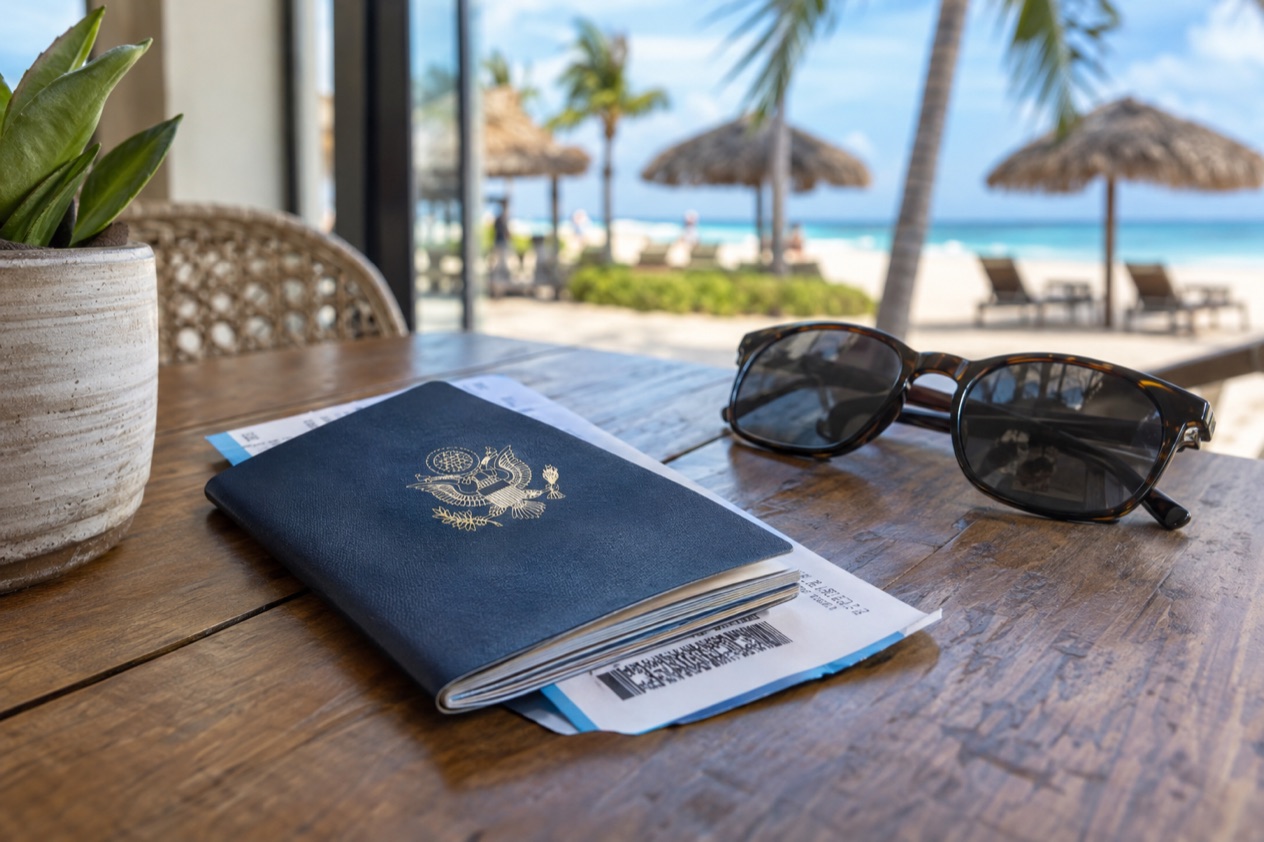
Do you need a passport to go to Aruba?
Yes, every passenger entering Aruba must hold a current passport, and a driver’s license or a birth certificate will not take its place. Aruba is a foreign island, so the booklet you would carry to Europe or Asia is the one you need here, whether you arrive by air or step off a ship.
The passport is the first thing the immigration officer looks at, and it works together with the other items covered further down: the ED Card, your onward ticket and the proof of why you are visiting. Treat them as one small folder, and keep it in your carry-on rather than in checked luggage.
How much validity you need
The rule is that the passport must be valid for the entirety of your stay in Aruba. If you fly home on a Sunday and the passport expires on the Saturday before, you do not meet it. That is the minimum, and it is the one that counts at the border.
The recommendation is more cautious: have at least six months of validity left beyond your travel dates. Airlines and border officers around the world like that margin, and it protects you if a flight is delayed or you decide to stay longer. If your passport is close to the line, renewing it before you book is simpler than hoping for the best at the counter.
The age of the passport
There is a second test that surprises people with a passport that still looks fine: it cannot be more than 10 years old. A passport with plenty of time before its printed expiry date can still fail this check if it was issued long ago. Look at the issue date, not only the expiry date.
Most adult U.S. passports are valid for a long time, so this matters mainly for older booklets you have kept in a drawer. Check both dates the week you start planning, well before you pay for flights.
A bonus for Global Entry applicants
If you have been conditionally approved for Global Entry, your interview can take place while you travel to the United States from Aruba. That spares you a trip to an enrollment center at home, and it is a small perk worth knowing about if your application is in progress. It is a convenience for the trip home and has nothing to do with getting into Aruba.
Do U.S. citizens need a visa for Aruba?
No, U.S. citizens do not require a visa to enter Aruba. You arrive with your passport, your completed ED Card and the proof described below, and the immigration officer decides on admission at the airport or the port. There is nothing to apply for at an embassy and no visa fee to pay beforehand.
The word “visa” does come back in one other place. The proof that you can leave Aruba again can be a passport, a residence permit or a visa for another country, so a U.S. citizen simply shows the passport. The visa-free rule is not the same as an automatic right to enter, which is why the officer’s role matters.
The officer has the last word
The final authorization for admission stays with the local Immigration Officer at the border-crossing or port of entry. That officer has exclusive authority to grant or refuse admission, whatever you have booked or paid. In practice the conversation is short for a vacationer whose papers are in order.
What helps is having each document ready in the order it is asked for: passport, ED Card confirmation, onward ticket, then the hotel booking or the invitation that explains your stay.
Other nationalities
Visa exemption is not limited to U.S. citizens. Most South Americans, including Colombians and Venezuelans, do not require a visa either. If you are traveling with someone who holds a different passport, they should check the rule for their own nationality, because the visa rules for Aruba apply to U.S. citizens and to the South American groups named.
A mixed family, with a U.S. parent and a relative from another country, can find that each person has a slightly different list. Sorting that out at home is far easier than at the counter.
How long can you stay?
The standard maximum period you can be admitted to Aruba as a guest is 30 days, and U.S. nationals get a longer allowance without asking for anything. Longer stays are possible on request, and the table sets the cases side by side.
| Situation | Maximum stay |
|---|---|
| Standard admission as a guest | 30 days |
| U.S. nationals, without requesting an extension | 90 days |
| Extension on request | 180 days per calendar year |
For most vacations a week or two, even a month on the island, sits comfortably inside the first limit, and nothing needs to be done. The longer allowances matter to snowbirds, remote workers and anyone building a slow season on the island.
Asking for an extension
If you plan to stay longer than the first month, you must comply with the extension-of-stay requirements upon entry. Do not leave it for the last week. Extension is a request, not a right, and it is dealt with by the immigration authorities.
The rules also cover people who own property. Nationals who are exempt from visa requirements can request an extension up to 180 consecutive days if they own a house, condominium, time-share or apartment in Aruba.
Without property: the guarantor
A visitor with no property on the island needs a declaration of guarantee from a resident of Aruba. That resident acts as guarantor and is liable for any costs incurred during your stay. It is a serious commitment for the person who signs, so it suits long-time friends or family more than a casual acquaintance.
Long stays also bring other questions. For information on work and residence permits, the office to contact is the Directorate of Alien Integration, Policy and Admission, known as DIMAS. Aruba does welcome digital nomads and remote workers for extended stays, and most Arubans speak at least four languages, so you will likely be understood in yours while you settle in.
What else do you need to show on arrival?
Besides the passport, you need a completed and approved ED Card, a return or onward ticket, proof of the reason for your stay and enough money to cover it. Air arrivals also pay a sustainability fee. Together these are what the officer expects when you reach the desk.
The ED Card
ED stands for Embarkation and Disembarkation, and the card is mandatory for every passenger, infants and children included. It is required at both air and seaports. The form is web-based, you can fill it in from home in a few minutes, and the official platform is edcardaruba.aw. Some outside services charge a fee for assistance, but you can complete it on your own.
Complete it within 7 days before travel, which means up to a week before your departure date. Afterward you can view your status online, and it is recommended to print the application and the confirmation. A printed page in your folder is a useful backup if your phone dies in the line.
Ticket, reason for your stay and funds
You must show a return or onward ticket, and proof of the reason for your stay, such as a hotel reservation or an invitation from family or friends. The officer must also be satisfied that you can pay for your accommodations and food. The expected amounts depend on where you sleep.
| Where you stay | Funds per person per day (US dollars) |
|---|---|
| Hotel | 150 to 200 |
| With family | 100 |
The immigration rules also list valid medical insurance that covers at least 15,000 US dollars in medical expenses, including hospital care, emergency treatment and repatriation. Travel insurance as such is not required but is strongly advised, and many travelers use a single policy to cover both the trip and the medical side.
The sustainability fee
| Fee | Amount | Who pays |
|---|---|---|
| Sustainability fee | $20 | Air arrivals |
The fee supports local conservation efforts, so it goes to the island’s nature rather than to paperwork. Keep it in mind when you budget, since it is paid in addition to the other costs of getting there. The fee is collected on the ED Card platform while you complete the card, and cash is not accepted on arrival.
Yellow fever, only for some routes
Since March 2018, travelers coming from a select group of countries must show proof of yellow fever vaccination. If that group does not include your route, it does not concern you. If it does, the vaccine must be given at least 10 days before entering, and the proof must be an International Certificate of Vaccination or Prophylaxis, the yellow book, presented to immigration officers.
Several exemptions exist. Passengers in transit for less than 24 hours, including those on cruise ships, are exempt, as are travelers who spent less than 12 hours in transit through countries at risk. So are children under 9 months and people 60 and older. Those who stayed at least 6 days in a country not at risk before arriving, and developed no fever, are also exempt.
Immunocompromised people, those with a thymus disorder and those with a history of acute hypersensitivity to a vaccine component need an up-to-date medical waiver. Pregnant or breastfeeding women should consult a doctor, and a letter on official letterhead with a stamp is required if the vaccine is not recommended. Argentina is temporarily exempt until further notice, and Aruba residents leaving the island are not required to be vaccinated.
Good to know before you go
The U.S. State Department rates Aruba Level 1, ‘Exercise normal precautions,’ and says Aruba is generally a safe destination for travelers, with petty crime the main concern in popular tourist areas.
Once the folder is ready, the rest of the trip is about the island itself. Most Arubans speak at least four languages, so asking for directions or a dish in English is rarely a problem, and Papiamento, the local language, adds a few friendly words to learn. The official entry rules are not known to include any HIV/AIDS restrictions for visitors, according to the U.S. Department of State.
If your stay is long enough to look beyond the resort strip, locals spend their weekends at Arikok National Park and Mangel Halto Beach, and the island’s caves make a good adventure outing.
Sources
- Aruba Tourism Authority, Passports and visas (https://www.aruba.com/us/plan-your-visit/getting-to-aruba/passports-and-visas), checked October 9, 2026
- Aruba Tourism Authority, Immigration regulations (https://www.aruba.com/us/plan-your-visit/getting-to-aruba/immigration-regulations), checked October 9, 2026
- U.S. Department of State, Aruba Travel Information, Entry and exit requirements (https://travel.state.gov/content/travel/en/international-travel/International-Travel-Country-Information-Pages/Aruba.html), checked October 9, 2026
- Aruba Tourism Authority, Extended stay (https://www.aruba.com/us/plan-your-visit/tips-for-visitors/your-extended-stay-in-aruba), checked October 9, 2026
- Aruba Tourism Authority, Yellow fever vaccine (https://www.aruba.com/us/plan-your-visit/getting-to-aruba/do-i-need-a-yellow-fever-vaccine), checked October 9, 2026
- Aruba Tourism Authority, Online ED card (https://www.aruba.com/us/plan-your-visit/getting-to-aruba/online-ed-card), checked October 9, 2026
- U.S. Department of State, Aruba Travel Advisory, Level 1, issued August 19, 2026 (https://travel.state.gov/content/tsg_aem/us/en/home/international-travel/travel-advisories/destination.abw.html), checked October 9, 2026
To plan your stay
- Best Time to Visit Aruba: Weather by Month, Peak Season and Festivals
- Where to Stay in Aruba: Palm Beach, Eagle Beach, Oranjestad and All-Inclusives
- Aruba Airport (AUA): Arrival, Getting to Your Hotel, U.S. Preclearance and Departure
- Know Before You Go to Aruba: Entry Forms, Money, Water and Local Customs