
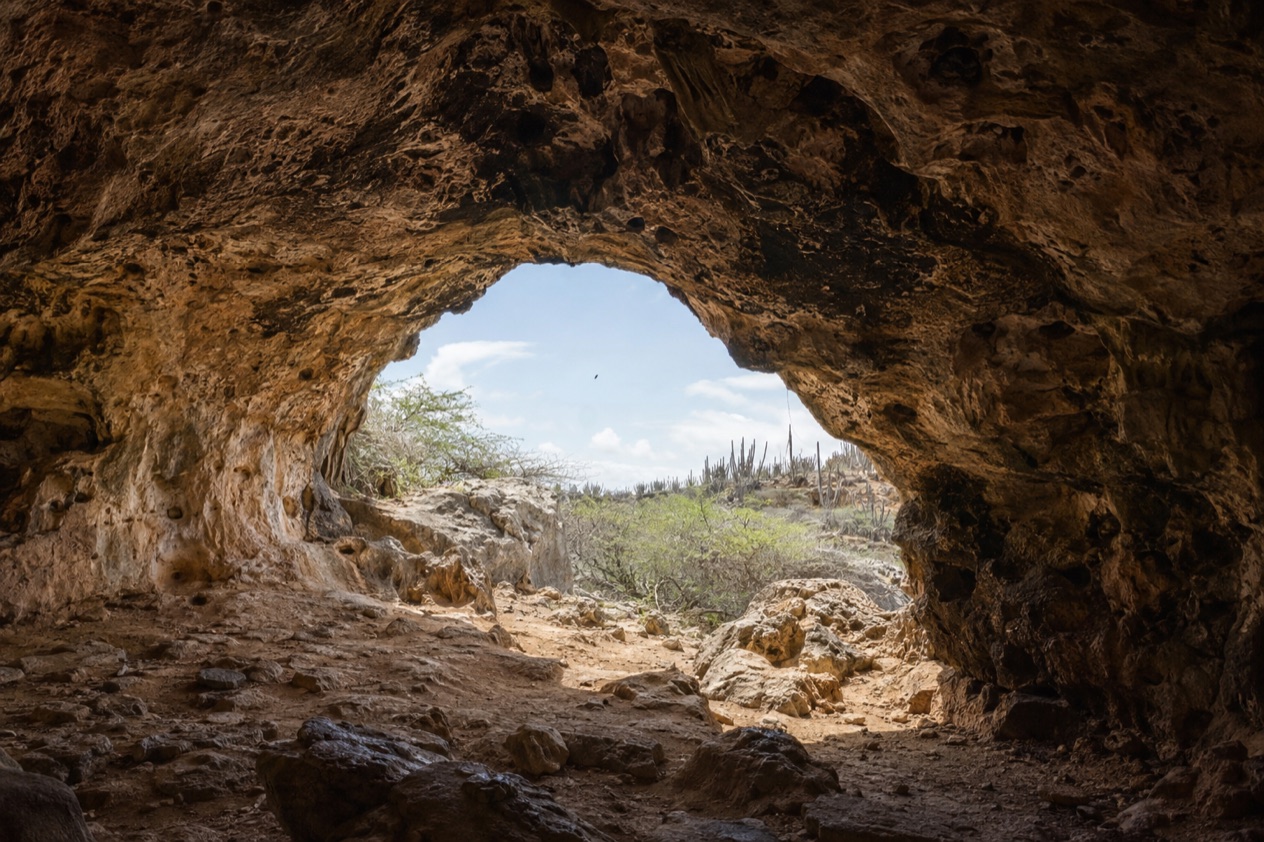
The dry brush of Arikok National Park, the sound of the wind in the cactus, and then a dark opening in the rock where the air turns heavy and warm. Fontein Cave sits in the park near Santa Cruz, and what you see first is a slice of daylight giving way to stone walls marked by people who lived on the island long before any hotel. It is a short, atmospheric visit into the underground, best taken as one stop in a longer day in the park.
Is visiting Fontein Cave worth it?
Yes, if you like your sightseeing to carry a bit of history and a little mystery, Fontein Cave is worth the stop, and it suits curious adults, families with older children and anyone who has already had enough beach time. It is not a place for a swim or a sunset. It is a dark, hot, humid chamber of limestone where the main reward is looking closely at what is on the walls.
What sets it apart from the other caves in the park is the art. Aruba’s caves share stalactites, stalagmites and bats, and Quadirikiri Cave is known for two chambers lit by sunlight falling through holes in the roof.
Fontein is the most popular of them and the only one with Arawak drawings on the ceilings. So where Quadirikiri is about light, Fontein is about the marks left by the island’s first inhabitants, and that is a different kind of visit.
It also fits comfortably into the rest of Arikok. The park has lava formations, quartz diorite, limestone and secluded bays such as Moro, Boca Prins and Dos Playa, so the cave works well as the cool, shadowy chapter in a day that is otherwise bright and open. Those who only want a quick look will find it satisfying, and those who like to linger over details can spend a good while reading the walls.
What to see at Fontein Cave
The drawings and etchings on the walls
This is the reason to come. The walls carry ancient drawings and etchings made by Amerindians, and they can be seen from floor to ceiling, so your eyes keep moving up and sideways as you walk. Aruba’s earliest inhabitants belonged to the Arawak world, and the marks are a rare, direct line to people who knew this island as a place of dry scrub and sea.
Take your time. Some figures are plain at first glance and others only appear when you stop and let your eyes adjust to the dim light. Look at the ceiling as well as the walls, since the ceiling drawings are what no other cave on the island can show.
Stalactites, stalagmites and shifting colors
The cave also has the classic underground shapes: stalactites hanging from above and stalagmites rising from below, formed drip by drip over a very long time. They give the chamber its sculpted, slightly theatrical look, and they are easy to appreciate even if you know nothing about geology.
Then there is the color. Algae on the stone makes the walls change from yellow to green, so the cave is not the uniform gray you might expect. The cave spans almost 312 feet, which is enough for these shades to change as you move deeper in.
The residents: bats, crabs and insects
You are visiting somebody’s home. Bats, crabs, insects and other creatures live in the cave, and the dark corners and high spots are where you may spot them. Sightings are never guaranteed, but looking up and along the floor edges gives you the best chance.
The setting is hot, dark and humid, exactly the conditions these animals like. Move quietly and let your eyes adapt, and the cave begins to feel alive rather than just empty.
Talking with the park rangers
Park rangers are often available to provide extra information about the cave, and at the cave entrances they can give tours with details on the rock drawings and the cave formations. A ranger can point out figures that you would walk right past, and explain how the formations came to be.
If a ranger is there, a few minutes of conversation changes the visit from looking at marks on a wall to understanding who made them. Rangers are not always on hand, so treat it as a welcome extra.
Hours, tickets and rules
The caves are open to the public during the day, within the opening hours of Arikok National Park, so you cannot visit at night or after the park closes in the late afternoon. There is no separate cave ticket: you buy a ticket to enter the park, and that gets you to the cave. The small entrance fee supports preservation, educational programs and the animals.
| Site | Open | Ticket |
|---|---|---|
| Fontein Cave (Arikok National Park) | Daytime, within park hours of 8:00 am to 4:00 pm | Arikok National Park entrance ticket required |
The one firm rule is the ticket: visitors must buy a ticket to enter Arikok National Park to reach the cave. The park is protected by the Aruba Tourism Authority, and every visitor contributes to its preservation by paying the entrance fee.
How to get to Fontein Cave
Fontein Cave is inside Arikok National Park, in the Santa Cruz area of Aruba. That tells you what the trip really is: you are heading into the park, not to a roadside attraction, and the cave is one of the places you reach once you are there. The park’s entrance and ticket come first, and the cave follows.
Santa Cruz is in the interior of the island, away from the resort strips, so the journey takes you out of the beach scene and into drier, more rugged country. The landscape changes as you go, with cactus, rock and open sky taking over from hotels and palm trees. That shift is part of the experience and a good reminder of how varied the island is.
Since the park is large, plan the cave as part of a wider day there. Organized tours led by park rangers are highly recommended to fully experience the park’s flora, fauna and viewpoints, and a private guided hike is also available for visitors who want to explore birds, flowers and geology at their own pace. Either option can shape the way you reach and combine the cave with other stops.
When to visit Fontein Cave
The cave can only be visited in daylight, between the park’s opening and closing times, so the real choice is which part of the day you spend there. Whatever the hour, the cave itself is hot, dark and humid, which means the time of day matters more for the rest of your park outing than for the cave. Aruba is a dry, windy island, and the park’s open landscapes feel very different from the enclosed air underground.
Because the park closes in the late afternoon, it is wise to plan the cave while you still have plenty of daylight left for other stops. Arriving with time in hand lets you read the walls without feeling rushed, and lets you add a ranger conversation if one is available.
As for the season, the best time to visit Aruba in general runs from February to August, and the island’s peak season falls from December to April. Those months are the general guide for the island, and they overlap in the early part of the year. The cave itself does not change with the calendar, so you can plan the visit around the rest of your trip rather than around the cave.
Tips for your visit
Plan the cave as part of a bigger day in Arikok. The park is a great place to spend an entire day among dramatic landscapes, and that is the best way to use your ticket. Pair the cave with the park’s other highlights, such as the lava formations, the limestone and quartz diorite, and the secluded bays of Moro, Boca Prins and Dos Playa.
Inside, expect heat, darkness and humidity, and dress and pack with that in mind. Bring something that lets you see the walls properly, since the drawings are the point of the visit, and take your time rather than walking straight through. Look up as often as you look ahead.
If you are weighing a tour, the ranger-led options are the ones the park recommends, and a ranger at the cave can explain the rock drawings and the formations. For a contrast, think about Quadirikiri Cave, also in the park, with its two chambers lit by sunlight through the roof and hundreds of harmless bats in the darker parts.
For families, the cave suits children who enjoy a bit of adventure, with bats, crabs and old drawings to spot. Because the cave is dark and humid, it may feel intense for some, so judge by how your own group handles enclosed places. Anyone with mobility concerns should weigh the cave’s conditions for themselves, since we do not describe the path inside.
Good to know before you go
The U.S. State Department rates Aruba Level 1, ‘Exercise normal precautions,’ and says Aruba is generally a safe destination for travelers, with petty crime the main concern in popular tourist areas.
Remember that the cave belongs to a protected national park, and your ticket helps pay for preserving it, educating visitors and caring for the animals. Treat the walls, the formations and the creatures with the same respect you would give a museum. Petty crime is the main concern in popular tourist areas of the island, so keep your belongings with you as you would anywhere.
Sources
- Aruba Tourism Authority, Fontein Cave (https://www.aruba.com/us/explore/fontein-cave), checked October 9, 2026
- Aruba Tourism Authority, Caves of Aruba (https://www.aruba.com/us/explore/caves), checked October 9, 2026
- Aruba Tourism Authority, Arikok National Park (https://www.aruba.com/us/explore/arikok-national-park), checked October 9, 2026
- Aruba Tourism Authority, Best time to visit (https://www.aruba.com/us/our-island/one-happy-island/when-is-the-best-time-to-visit-aruba), checked October 9, 2026
- U.S. Department of State, Aruba Travel Advisory, Level 1, issued August 19, 2026 (https://travel.state.gov/content/tsg_aem/us/en/home/international-travel/travel-advisories/destination.abw.html), checked October 9, 2026
To plan your stay
- Best Time to Visit Aruba: Weather by Month, Peak Season and Festivals
- Where to Stay in Aruba: Palm Beach, Eagle Beach, Oranjestad and All-Inclusives
- Aruba Airport (AUA): Arrival, Getting to Your Hotel, U.S. Preclearance and Departure
- Know Before You Go to Aruba: Entry Forms, Money, Water and Local Customs