
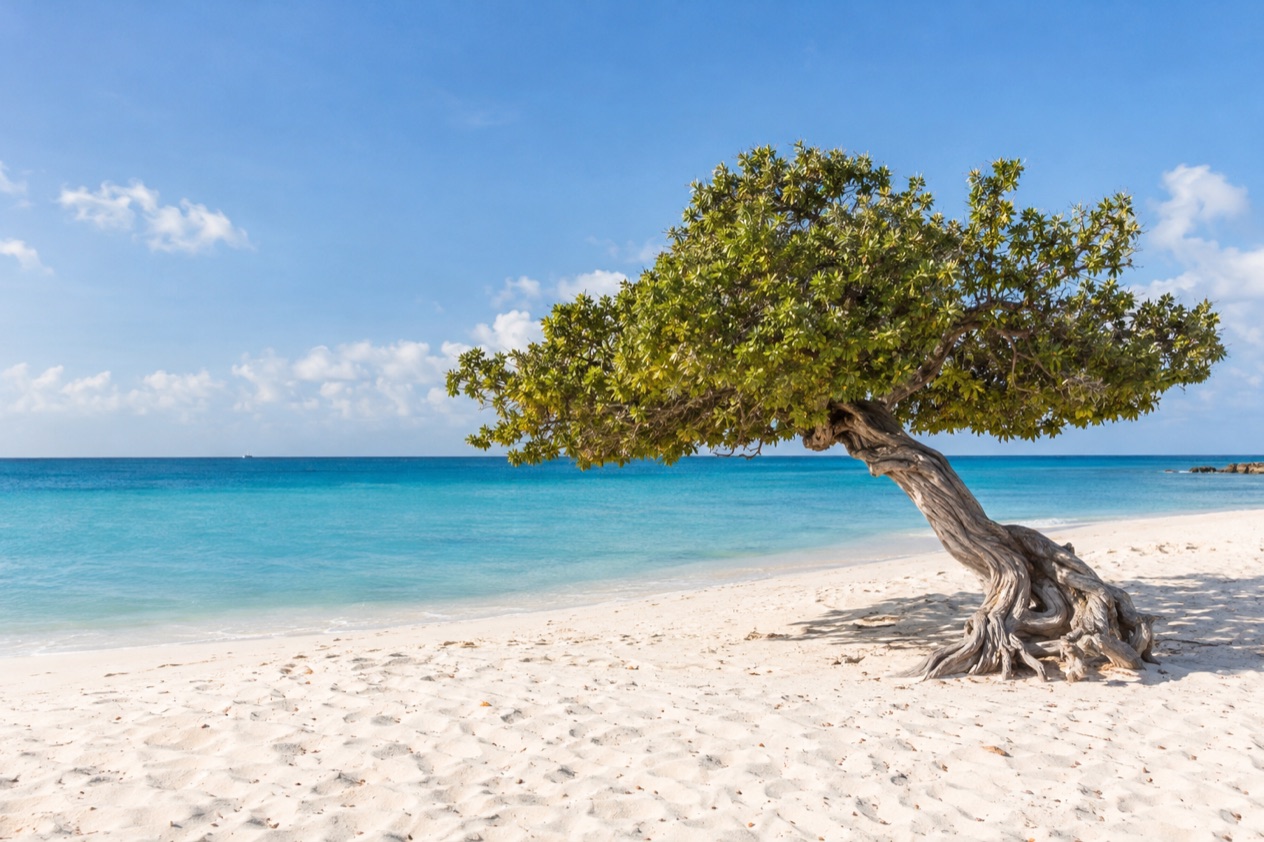
Early morning on Eagle Beach, the fofoti trees lean over the sand at their famous angle, the first walkers pass at the waterline, and the Caribbean turns from gray to turquoise as the sun climbs. Down the coast, fishermen anchor painted boats in a quiet bay, while on the north shore waves crash against limestone cliffs. Aruba’s beaches run from soft white resort sand to rugged cove, and all of them are open to everyone.
What are the best beaches in Aruba?
The best beaches in Aruba are Eagle Beach, Palm Beach and Baby Beach, with a handful of quieter coves worth the detour. The island has more than 20 public beaches and coves, and every one is public and free to reach. The west and south coasts are the calm, protected ones, while the north and east coasts face stronger winds and bigger waves.
Eagle Beach
Eagle Beach has the widest stretch of white sand on the island, which means there is room to spread out even when the sun loungers fill. It is the home of the fofoti trees, the wind-bent trees that appear on so many Aruba postcards. Soft, pale sand, open ocean views and a variety of water sports give the day its shape.
Several low-rise hotels stand nearby or just across the road, so the beach feels like a neighborhood more than a wall of towers. Travelers voted it #3 Best of the Best Beach in the Caribbean in the 2026 TripAdvisor Travelers’ Choice Awards. Walk it early for the light, then come back near sunset when the sky turns orange over the water.
Palm Beach
Palm Beach is the lively one, a two-mile strip just north of Eagle Beach with palm trees, white sand, high-rise hotels, casinos, piers, beach bars, restaurants and shops. Water sports concessions line the sand, and you can try kite or windsurfing classes or Stand Up Paddle boarding. The mood is polished and social, a good fit if you like to have a cocktail within reach of your towel.
Evenings are the draw. Bars and restaurants on the piers run Happy Hour, tangerine sunsets paint the water, and some restaurants set candle-lit tables right on the sand for barefoot dinners. A walk at dawn or sunset is the quiet counterpart to the daytime buzz.
Druif Beach and Surfside Beach
Druif Beach is a long, oval stretch of ivory sand in the Eagle Beach area, joined directly to its neighbors to form a miles-long ribbon of white sand. Casual low-rise resorts sit steps from the water, and although downtown Oranjestad is not far, Druif stays quiet and relaxed. The Caribbean here is relatively calm.
Surfside Beach lies on the other side of town, a 2-minute drive from the airport or a 20-minute walk from downtown Oranjestad. It is one of the best places to watch planes glide in overhead. Surfside Beach Bar, the official Corona Bar, sits right on the sand with a front-row view of the sea, serving wood-fired pizzas and crisp salads, with happy hour three times a day.
Which beaches are best for swimming?
The best beaches for swimming are on the calm, protected west and south coasts: Baby Beach, Palm Beach, Rodger’s Beach and Arashi Beach. Palm Beach has calm water that makes it a comfortable haven for swimmers, and the sea off Oranjestad in October is at its warmest of the year, around 86.5°F at its daily peak.
Baby Beach
Baby Beach is a shallow, lagoon-style bay on the southeast tip of the island, close to San Nicolas. The water is so shallow that swimmers can wade out a long distance and still touch the bottom, which is why families with small children and nonswimmers love it. The water is a clear turquoise.
A refreshment stand sells hamburgers and hotdogs, and Big Mama’s Grill serves BBQ and seafood platters, so a whole day here needs no packing of lunch. Snorkelers can head to where the bay opens to the ocean and should stay within the marked snorkel area.
Rodger’s Beach
Rodger’s Beach is about a minute’s drive from Baby Beach, a narrow strip of powdery white sand on a bay with calm, clear water protected for swimming. Fishermen anchor their colorful boats in the bay, which gives it a lived-in, authentic feel that the resort beaches do not have.
It pairs well with Baby Beach in a single southern outing. Spend the morning at one and move to the other for a change of scenery and a quieter patch of sand.
Arashi, Boca Catalina and Druif
Arashi Beach sits on the northern tip, just beyond Malmok on the road to the California Lighthouse, with white sand and calm, clear, gentle water. A beach bar, shaded huts and chair rentals make a full day comfortable.
Boca Catalina is a small, secluded bay in the Malmok area, reached by steps from a spacious parking area beside the road. Its easy access to crystal clear water makes it a good fit for families of all ages. On weekdays you may have the bay to yourself, while weekends bring local families and island guests. Makeshift huts offer shade. Druif Beach, mentioned above, is the relaxed option near Eagle Beach.
Which beaches are best for snorkeling?
The best snorkeling beaches are Malmok Beach, Mangel Halto and Baby Beach, all on the calm western and southern shores. The clear, shallow water of Malmok and the mangrove-fed reef life at Mangel Halto are the two to put first on your list.
Malmok Beach
Malmok is a narrow sandy stretch on a limestone and rocky terrace along the coast. Its water is described as crystal clear and among the best on the island, and its shallow Caribbean waters make it a popular snorkeling spot.
Catamarans and sailboats stop just off the shoreline for daytime snorkeling, so you may see the boats anchored while you float above the reef. Reefs and sunken wrecks nearby also make for excellent diving, which gives divers a reason to base themselves on this coast.
Mangel Halto
Mangel Halto is a secluded beach with some of Aruba’s best snorkeling, kayaking and paddle boarding. The water is calm and shallow, and the mangroves support rich sea life, so you may spot plenty beneath the surface. Sunbathers who like quiet and privacy tend to gravitate here.
Just offshore, the edge of the reef plunges to depths of 110 feet, which is the reason scuba divers come. Snorkelers stay in the shallows while divers explore the drop-off, so the beach suits a mixed group.
Baby Beach and Palm Beach
Baby Beach offers snorkeling where the bay opens out to the ocean, and it is ideal for kids and beginner snorkelers according to local descriptions. Visitors should stay within the marked snorkel area.
Palm Beach has calm water as well, a comfortable place for swimmers and snorkelers who want a beach with bars and restaurants close at hand. Whichever you choose, use mineral-based, reef-safe sunscreen, because it protects the reef you came to see.
Which beaches are wild?
The wild beaches are on the north and east coasts, where Dos Playa, Andicuri and Westpunt trade calm water for cliffs, surf and space. Strong winds and crashing waves shape this side of Aruba, and the scenery is the reason to go.
Dos Playa
Dos Playa lies on the rugged northeastern coast and is one of the island’s least populated beaches, a peaceful retreat away from resort crowds. Dramatic limestone cliffs rise behind it, with sea caves carved into the rock.
It is a place for looking and photographing rather than lounging with a drink. Expect wind and surf, and bring your own sense of quiet.
Andicuri Beach
Andicuri Beach sits on the windward coast, just south of the collapsed Natural Bridge. Dramatic bluffs flank a sandy cove, and body-boarders love it for its stronger surf. Experienced swimmers can enter the water but must be aware of currents.
A little further along the dirt road you reach Black Stone Beach and a triple-arch limestone natural bridge. The bridges on this coast were chiseled by thousands of years of pounding waves and strong winds.
Westpunt and Hadicurari
Westpunt Beach, on the rugged northwestern tip, is known as Aruba’s pink sand beach, its tint caused by tiny coral particles mixed with white sand. It is a different kind of beach picture from the resort strips.
Hadicurari Beach, also called Fisherman’s Huts or The Huts, is a rocky strip past the Marriott Aruba Resort and the most popular spot on the island to learn and practice wind and kite surfing. Many schools, plus paddle board and other non-motorized water sports, operate here. The Aruba Hi-Winds, the largest windsurfing event in the Caribbean, is held off these beaches every year in June or July.
What should you know before you go to the beach?
Know that every beach is public and free, that sunscreen matters to the reef, and that nothing from the beach goes home in your suitcase. Aruba has banned sunscreens containing oxybenzone since 2019, and mineral-based reef-safe sunscreens are the ones to pack, since they are more likely to be biodegradable and minimize environmental impact.
If you run out, sunscreen is sold on the island by local companies such as Aruba Aloe and Arubalife Organics. The sea is warm for a swim in October, around 86.5°F at its daily peak.
Take photos, not shells
Taking sea shells, corals, white sand, or sea life such as sand dollars and dried sea stars from Aruba is against the law and could result in a fine at the airport. The reasoning is simple: if every visitor took one shell home, it would add up to over a million shells a year.
Leave the pink grains of Westpunt and the white sand of Eagle Beach where they lie. A photograph and a good memory are the allowed souvenirs.
Matching coast to mood
Pick your coast by what you want from the day. The west and south shores are calm and protected, suited to swimming and snorkeling, while the north and east have strong winds, dramatic landscapes and scenic viewpoints. Only experienced swimmers should consider the water at Andicuri, where the currents are strong.
For a full day with food and drink, Palm Beach, Arashi and Baby Beach all have places to eat or drink within reach. For privacy, Mangel Halto and a weekday at Boca Catalina are the quiet picks.
Good to know before you go
The U.S. State Department rates Aruba Level 1, ‘Exercise normal precautions,’ and says Aruba is generally a safe destination for travelers, with petty crime the main concern in popular tourist areas.
Beaches cost nothing to enter, so money goes mostly to food, drinks, chair rentals and water sports. Petty crime is the main concern in popular tourist areas, so keep valuables close at Palm Beach and Eagle Beach. Aruba sits on the southern fringes of the hurricane belt, where damaging storms are rare.
Sources
- Aruba Tourism Authority, Beaches and coves (https://www.aruba.com/us/things-to-do/beaches-and-coves), checked October 9, 2026
- Aruba Tourism Authority blog, Top 10 beaches (https://www.aruba.com/us/blog/my-top-10-aruba-beaches), checked October 9, 2026
- Aruba Tourism Authority blog, 8 beaches (https://www.aruba.com/us/blog/8-beaches-you-must-visit-on-your-aruba-vacation), checked October 9, 2026
- Aruba Tourism Authority, Eagle Beach (https://www.aruba.com/us/explore/eagle-beach), checked October 9, 2026
- Aruba Tourism Authority, Palm Beach (https://www.aruba.com/us/explore/palm-beach), checked October 9, 2026
- Aruba Tourism Authority, Arashi Beach (https://www.aruba.com/us/explore/arashi-beach), checked October 9, 2026
- Aruba Tourism Authority, Malmok Beach (https://www.aruba.com/us/explore/malmok-beach), checked October 9, 2026
- Aruba Tourism Authority, Druif Beach (https://www.aruba.com/us/explore/druif-beach), checked October 9, 2026
- Aruba Tourism Authority, Baby Beach (https://www.aruba.com/us/explore/baby-beach), checked October 9, 2026
- Aruba Tourism Authority, Boca Catalina (https://www.aruba.com/us/explore/boca-catalina), checked October 9, 2026
- Aruba Tourism Authority, Mangel Halto (https://www.aruba.com/us/explore/mangel-halto), checked October 9, 2026
- Aruba Tourism Authority, Rodgers Beach (https://www.aruba.com/us/explore/rodgers-beach), checked October 9, 2026
- Aruba Tourism Authority, Andicuri Beach (https://www.aruba.com/us/explore/andicuri-beach), checked October 9, 2026
- Aruba Tourism Authority, Hadicurari Beach (https://www.aruba.com/us/explore/hadicurari-beach), checked October 9, 2026
- Aruba Tourism Authority, Surfside Beach (https://www.aruba.com/us/explore/surfside-beach), checked October 9, 2026
- Aruba Tourism Authority blog, Aruba wild beach (https://www.aruba.com/us/blog/aruba-wild-beach), checked October 9, 2026
- Aruba Tourism Authority blog, Responsible guest (https://www.aruba.com/us/blog/how-to-be-a-responsible-guest-protecting-arubas-beaches-and-marine-life), checked October 9, 2026
- Open-Meteo Marine API, average 2015-2024, checked October 9, 2026
- Aruba Tourism Authority, Bushiribana Gold Mill Ruins (https://www.aruba.com/us/explore/bushiribana-gold-mill-ruins), checked October 9, 2026
- Aruba Tourism Authority, Historic Gold Mines (https://www.aruba.com/us/explore/historic-gold-mines), checked October 9, 2026
- Aruba Tourism Authority, California Lighthouse (https://www.aruba.com/us/explore/california-lighthouse), checked October 9, 2026
- Aruba Tourism Authority, Natural Pool (Conchi) (https://www.aruba.com/us/explore/natural-pool), checked October 9, 2026
- Aruba Tourism Authority, Natural Bridges (https://www.aruba.com/us/explore/natural-bridges), checked October 9, 2026
- Aruba Tourism Authority, Hooiberg (https://www.aruba.com/us/explore/hooiberg), checked October 9, 2026
- Aruba Tourism Authority, Casibari Rock Formations (https://www.aruba.com/us/explore/casibari-rock-formations), checked October 9, 2026
- Aruba Tourism Authority, Ayo Rock Formation trail (https://www.aruba.com/us/ayo-rock-formation-trail), checked October 9, 2026
- Aruba Tourism Authority, Alto Vista Chapel (https://www.aruba.com/us/explore/alto-vista-chapel), checked October 9, 2026
- Aruba Tourism Authority, Donkey Sanctuary (https://www.aruba.com/us/explore/donkey-sanctuary), checked October 9, 2026
- Aruba Tourism Authority, Aruba Ostrich Farm (https://www.aruba.com/us/explore/aruba-ostrich-farm), checked October 9, 2026
- Aruba Tourism Authority, Aruba Aloe museum and factory (https://www.aruba.com/us/explore/aruba-aloe-museum-and-factory), checked October 9, 2026
- Aruba Tourism Authority, Butterfly Farm (https://www.aruba.com/us/explore/butterfly-farm), checked October 9, 2026
- Aruba Tourism Authority, Savaneta region (https://www.aruba.com/us/our-island/regions/savaneta), checked October 9, 2026
- Aruba Tourism Authority, Boca Grandi (https://www.aruba.com/us/explore/boca-grandi), checked October 9, 2026
- Aruba Tourism Authority, Boca Prins (https://www.aruba.com/us/explore/boca-prins), checked October 9, 2026
- Wikipedia, San Nicolaas, Aruba (https://en.wikipedia.org/wiki/San_Nicolaas,_Aruba), checked October 9, 2026
- Aruba Tourism Authority, Fort Zoutman Historical Museum (https://www.aruba.com/us/explore/fort-zoutman-historical-museum), checked October 9, 2026
- Aruba Tourism Authority, Renaissance Island (https://www.aruba.com/us/explore/renaissance-island), checked October 9, 2026
- U.S. Department of State, Aruba Travel Advisory, Level 1, issued August 19, 2026 (https://travel.state.gov/content/tsg_aem/us/en/home/international-travel/travel-advisories/destination.abw.html), checked October 9, 2026
To plan your stay
- Best Time to Visit Aruba: Weather by Month, Peak Season and Festivals
- Where to Stay in Aruba: Palm Beach, Eagle Beach, Oranjestad and All-Inclusives
- Aruba Airport (AUA): Arrival, Getting to Your Hotel, U.S. Preclearance and Departure
- Know Before You Go to Aruba: Entry Forms, Money, Water and Local Customs