
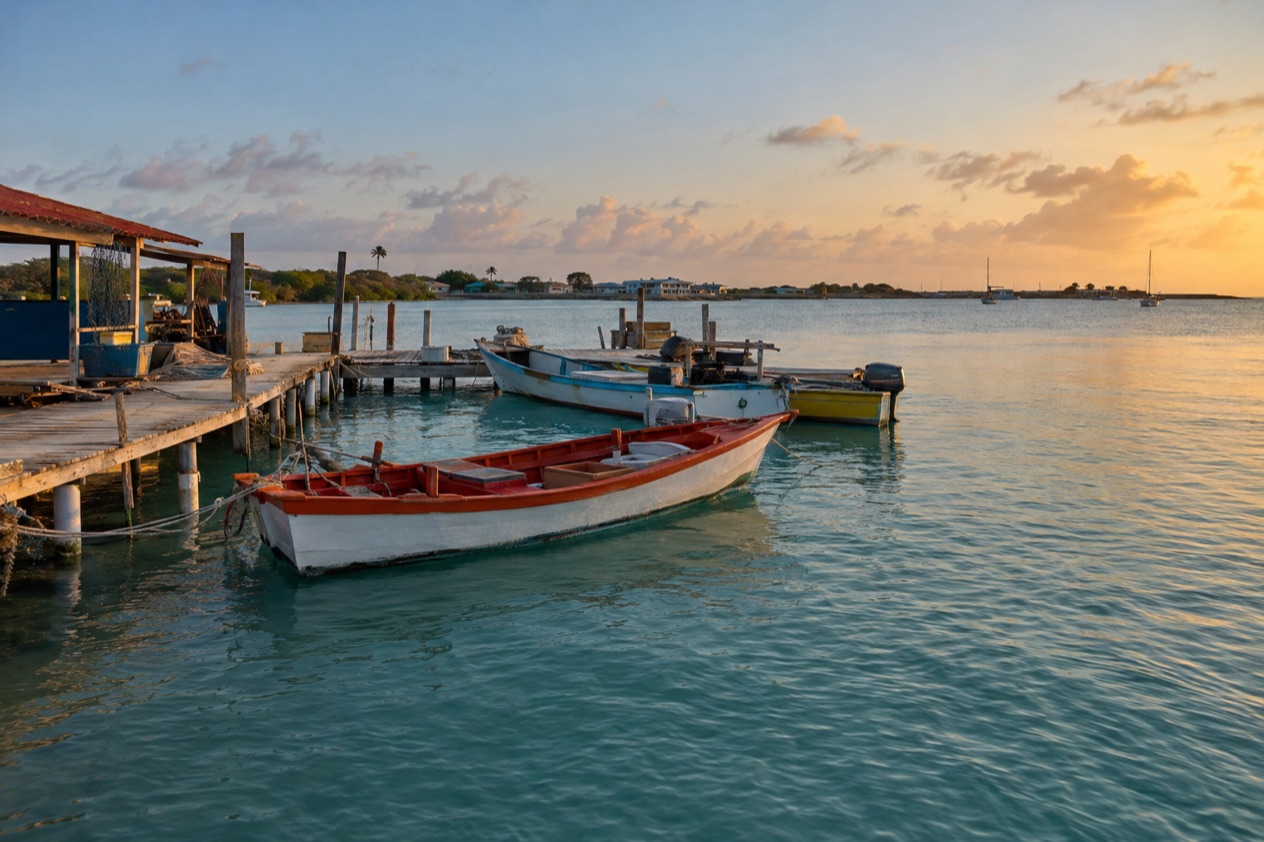
Early in the morning in Savaneta, small fishing boats ride at their moorings while pelicans watch from the rail and the east wind rattles the halyards. By lunchtime the catch of the day is being pan-fried and served with a tomato-based creole sauce.
This is a quiet stretch of Aruba’s southwest coast, built around the water, the mangroves and the table. It suits travelers who would rather paddle, snorkel and eat well than line up a row of resort pools.
Where is Savaneta and what is it like?
Savaneta sits on the southwestern coast of Aruba, about a 20-minute drive from Oranjestad, the island’s capital. Just to the north lies Mangel Halto, a beach tucked behind a tangle of mangroves, and the coast beyond it runs toward the Spanish Lagoon. It is a working fishing town first and a place for visitors second, and that order is the whole charm.
The pace is slow. Streets are low and residential, the harbor is the center of gravity, and the sea on this leeward side faces the open Caribbean rather than the wild surf of the north and east. Aruba is small, flat and dry, and here the dry landscape of cactus and scrub meets a shoreline of green mangrove roots, which is a combination you do not find in the resort strips.
The town is old. The oldest house in Aruba, a 150-year-old cas di torto (a traditional clay-and-wood country house), stands here, and it gives the place a sense of depth that newer beach districts lack. Locals still fish from these shores, and the restaurants close to the water draw on that daily catch.
Savaneta will not suit everyone. There is no wall of high-rise hotels and no promenade of shops and bars. If your ideal vacation is a lively evening scene within a few steps of your room, the beach strips of Palm Beach and Eagle Beach will feel more natural. If you like a coast where the main events are a snorkel, a paddle and a plate of fish, you will probably find Savaneta rewarding.
What is there to do in Savaneta?
The reasons to come here are the water, the mangroves and the fish. Each of them is concrete, and they combine well in a single day or spread over several. What sets Savaneta apart from its neighbors is that these things sit within reach of one another, without a resort in the middle.
Snorkeling and quiet time at Mangel Halto
Mangel Halto lies just north of the town and is known for calm, shallow water backed by an extensive network of mangroves. Snorkelers rate it among the best spots on the island, with clear water and coral reefs, and the mangroves feed a rich variety of sea life. You see the roots drop into the shallows, small fish gathering among them and reef life farther out.
It is also a secluded beach, and sunbathers who like quiet and privacy tend to end up here. There are public beach huts and shaded areas, so you can step out of the sun between snorkeling sessions. Kayaking and paddle boarding are among the other things people do on this same water.
Kayaking up the coast to the Spanish Lagoon
Organized kayak tours depart from Savaneta and paddle up the coast to Mangel Halto and the Spanish Lagoon. The tours typically include snorkeling, swimming, beach time and lunch, which turns the outing into a full day on the water rather than a short paddle. Kayaking lets you watch wildlife up close without disturbing it, so herons and other shore birds are often part of the scene.
The Spanish Lagoon is a narrow inner bay, well over a mile long, and it is protected under the Ramsar Convention because of its unusual wetland ecosystem. Gliding through that quiet corridor of mangroves is very different from the open sea, and many travelers find it the most memorable part of the trip.
Fresh fish at the table
Local fishermen supply many of Aruba’s restaurants with a daily catch, and a fishing town is the natural place to taste it. Dining ranges from elegant restaurants to casual roadside fish shacks. Look for mahi-mahi, snapper, grouper, wahoo, yellowfin tuna, Caribbean lobster and shrimp.
The local style is fish pan-fried and served with a tomato-based creole sauce. Traditional dishes include keri-keri (shredded, seasoned fresh fish), fish balls and fish soup. Fresh fish is a staple of the local community, so ordering it here is simply eating the way people on the island do.
Sport fishing and the old house
If you would rather catch your own, Aruba has about 18 sport fishing charter companies, offering half-day and full-day excursions. Charters go five to seven miles offshore for game fish such as mahi-mahi, yellowfin tuna, sailfish and blue marlin. Bottom fishing in shallower water, 100 to 300 feet deep, targets snapper, grouper, triggerfish and squirrelfish.
Back on land, the 150-year-old cas di torto is a reminder of how island families lived long before tourism. It is a short cultural stop that pairs well with a meal in town, and it gives the day some history between the snorkeling and the fish.
How many days do you need in Savaneta?
A day is enough to taste Savaneta, and two or three days let you do it properly without rushing. Because the town is small and the highlights sit close to one another, you do not need a long stay to see it all. The question is more how slowly you want to take it.
With one day, aim for a morning on the water and a long fish lunch. Either join a kayak tour, which typically fills a good part of the day with paddling, snorkeling, beach time and lunch, or spend the morning at Mangel Halto among the mangroves. In the afternoon, visit the oldest house in Aruba and settle in for dinner by the harbor, when the fishing boats are back.
With two or three days, you can separate the pleasures. Give one day to the kayak tour toward the Spanish Lagoon, another to a quiet stretch on the beach at Mangel Halto with its shaded huts, and another to a sport fishing charter if that appeals. A half-day charter fits easily around a beach afternoon, while a full day takes over the schedule.
Aruba is only 70 square miles, so a longer stay can reach beyond Savaneta without effort. Oranjestad is about 20 minutes away, and the resort beaches of Eagle Beach and Palm Beach make a natural change of scene, with plenty of activity providers renting canoes and kayaks along both. Many travelers split a week between a quiet southern base and the livelier strips farther along the coast.
Where to stay in Savaneta
Savaneta itself is the base for travelers who want to wake up close to the water where the kayak tours depart. Staying here puts Mangel Halto and the coast toward the Spanish Lagoon on your doorstep, and it keeps you in a working town rather than a resort zone. It suits people planning to spend their days snorkeling, paddling and eating fish.
Oranjestad is the nearest larger base, about a 20-minute drive away. It is the island’s capital, and it is where the bus line to Savaneta begins. Choosing it keeps you close to the city while still allowing a day on the south coast.
Eagle Beach and Palm Beach are the other two areas to consider. Many resorts and activity providers there rent canoes and kayaks, so you can paddle near your hotel and still come to Savaneta for the longer coastal tour. They suit travelers who want that beach-strip setting for most of the trip, with Savaneta as an excursion instead of a base.
A simple way to choose is to ask how you want your days to start. If you want your first view to be fishing boats, mangroves and open water, base yourself in Savaneta. If you want a bigger choice of things within walking distance, pick one of the resort areas and make Savaneta your day on the quiet side of the island.
How do you get to Savaneta and get around?
You reach Savaneta by road from Oranjestad in about 20 minutes, and the town is easily accessible by car. Aruban roads are safe and modern, and with the island only 70 square miles, no destination here is far. Savaneta lies on the southwestern coast, so the drive from the capital follows that side of the island.
Public transportation is also available, with buses traveling regularly between Oranjestad and Savaneta. Arubus keeps a steady rhythm through the day and a thinner one in the evening.
| Period | Bus frequency | Hours |
|---|---|---|
| Daytime | Every 15 minutes | 5:45 a.m. to 6 p.m. |
| Evening | Every 40 minutes | 6 p.m. to 11:30 p.m. |
Once in Savaneta, the distances between the harbor, the old house and Mangel Halto, which lies just north of town, are small. The kayak tours depart from the town and go up the coast by water, so that outing needs no transfer at all.
If you are staying at Eagle Beach or Palm Beach, you can think of Savaneta as a day out. Getting to the south coast and back fits within the bus hours above, so a late dinner by the harbor still leaves a way home until the last evening bus.
When is the best time to visit Savaneta?
The best time to visit Aruba in general is from February to August, and that holds for Savaneta. Those months suit a coast built around the water, with the sea and the mangroves as the main attractions. The peak season runs from December to April, so February to April is the busiest part of the good stretch, and May to August is the part with more breathing room.
Heat and wind shape the experience. January afternoons reach the mid-80s with nights in the upper 70s, and the east wind blows steadily, so the air feels fresh on the water. July is hotter, with highs around 90 and a slightly stronger breeze. January is also the wetter of the two, with showers on about ten days, usually short, while July brings rain on only a handful of days.
September to November is the off-season. The town is quieter and the pace even slower, which suits the village atmosphere of Savaneta well. Fishing continues all year, so the fish on your plate does not follow a tourist calendar, and a table by the harbor in the off-season has its own appeal.
Good to know before you go
The U.S. State Department rates Aruba Level 1, ‘Exercise normal precautions,’ and says Aruba is generally a safe destination for travelers, with petty crime the main concern in popular tourist areas.
Savaneta keeps early hours, because the fishing boats and the kayak tours both start with the day. The east wind blows all year and is a constant companion, so the open water feels breezy even when the afternoon is hot.
Keep the beach at Mangel Halto for a quiet stretch of shade between snorkeling sessions, since the public huts offer some cover. In a destination where petty crime is the main concern in popular tourist areas, ordinary habits are enough: keep your belongings with you on the beach and in the car.
Sources
- Aruba Tourism Authority, Savaneta region (https://www.aruba.com/us/our-island/regions/savaneta), checked October 9, 2026
- Aruba Tourism Authority, Mangel Halto (https://www.aruba.com/us/explore/mangel-halto), checked October 9, 2026
- Aruba Tourism Authority, Kayak and canoe (https://www.aruba.com/us/things-to-do/on-the-water/kayak-canoe), checked October 9, 2026
- Aruba Tourism Authority, Seafood restaurants (https://www.aruba.com/us/things-to-do/dining/seafood), checked October 9, 2026
- Aruba Tourism Authority, Deep sea fishing (https://www.aruba.com/us/things-to-do/on-the-water/deep-sea-fishing), checked October 9, 2026
- Aruba Tourism Authority, Getting around Aruba (https://www.aruba.com/us/plan-your-visit/getting-around-aruba), checked October 9, 2026
- Aruba Tourism Authority, Public transportation (https://www.aruba.com/us/plan-your-visit/getting-around-aruba/public-transportation), checked October 9, 2026
- Aruba Airport Authority, By car (https://www.airportaruba.com/by-car), checked October 9, 2026
- Aruba Tourism Authority, Best time to visit (https://www.aruba.com/us/our-island/one-happy-island/when-is-the-best-time-to-visit-aruba), checked October 9, 2026
- Meteorological Department Aruba (meteo.aw), Summary Climatological Normals 1991-2020, Queen Beatrix Airport station (http://www.meteo.aw/files/Download/climatnormals19912020.pdf), checked October 9, 2026
- U.S. Department of State, Aruba Travel Advisory, Level 1, issued August 19, 2026 (https://travel.state.gov/content/tsg_aem/us/en/home/international-travel/travel-advisories/destination.abw.html), checked October 9, 2026
To plan your stay
- Best Time to Visit Aruba: Weather by Month, Peak Season and Festivals
- Where to Stay in Aruba: Palm Beach, Eagle Beach, Oranjestad and All-Inclusives
- Aruba Airport (AUA): Arrival, Getting to Your Hotel, U.S. Preclearance and Departure
- Know Before You Go to Aruba: Entry Forms, Money, Water and Local Customs