
On a San Nicolas morning the sun comes up over the east side of the island, and the first light catches the painted walls along the main street while shopkeepers roll up their shutters. Someone is frying pastechi (the crisp, filled pastries of Aruba) in a snack shop, and the talk in the doorways is in Papiamento, the island’s own language.
This is Aruba’s Sunrise City, a former refinery town that has turned its walls into an open-air gallery and sits close to some of the island’s most relaxed beaches. It suits travelers who like their vacations with a bit of local texture, not high-rise glitz.
Where is San Nicolas and what is it like?
San Nicolas lies at the southeastern end of Aruba, about twelve miles from Oranjestad, the capital, and it is the island’s second largest city. Baby Beach and Rodger’s Beach are close by to the south. Locals call this the Sunrise Side, and the nickname fits a town that faces the morning and moves at a quieter pace than the resort strip on the other side of the island.
For much of the twentieth century the town was defined by oil. The Lago Oil and Transport Company opened its refinery here in 1924, and workers came from across the Caribbean and beyond to run it, which is one reason the town’s culture feels so layered. Exxon closed the refinery in 1985, and the years that followed were hard on the streets around it.
The refinery came back to life more than once. Coastal Corporation reopened it in 1991 and ran it until 1995, and Valero later operated it from 2004 until closing it in 2009. Today the town looks to art and visitors rather than industry, and you feel that in the cafés, the galleries and the pride people take in showing their neighborhood.
What you find is a working Aruban town, not a resort. Zeppenfeldstraat, the main street, has a quaint promenade with shops, snack shops, restaurants, bars, an art gallery and a handful of historic buildings. The mood is Caribbean in the unpolished sense: music from a bar doorway, a conversation across the street, a mural around the corner.
San Nicolas is for travelers who want to see how Aruba lives, who enjoy walking a town with a camera, and who would rather spend an afternoon at a beach with fishing boats than at a pool with a swim-up bar. It offers beautiful beaches and island charm far removed from the glitz of the Palm Beach high-rise resorts and malls. If you want nightlife of the resort kind, or a long list of malls and big restaurants within a few steps, this is not that place, and the island’s other side will suit you better.
What is there to do in San Nicolas?
The big reasons to come are the murals that cover the town, a small community museum in a restored building, and two beaches a short way south. What sets San Nicolas apart from its neighbors is the mix: you can spend the morning among painted walls and local history and the afternoon at the water, all in the same corner of the island.
The murals of the Art District
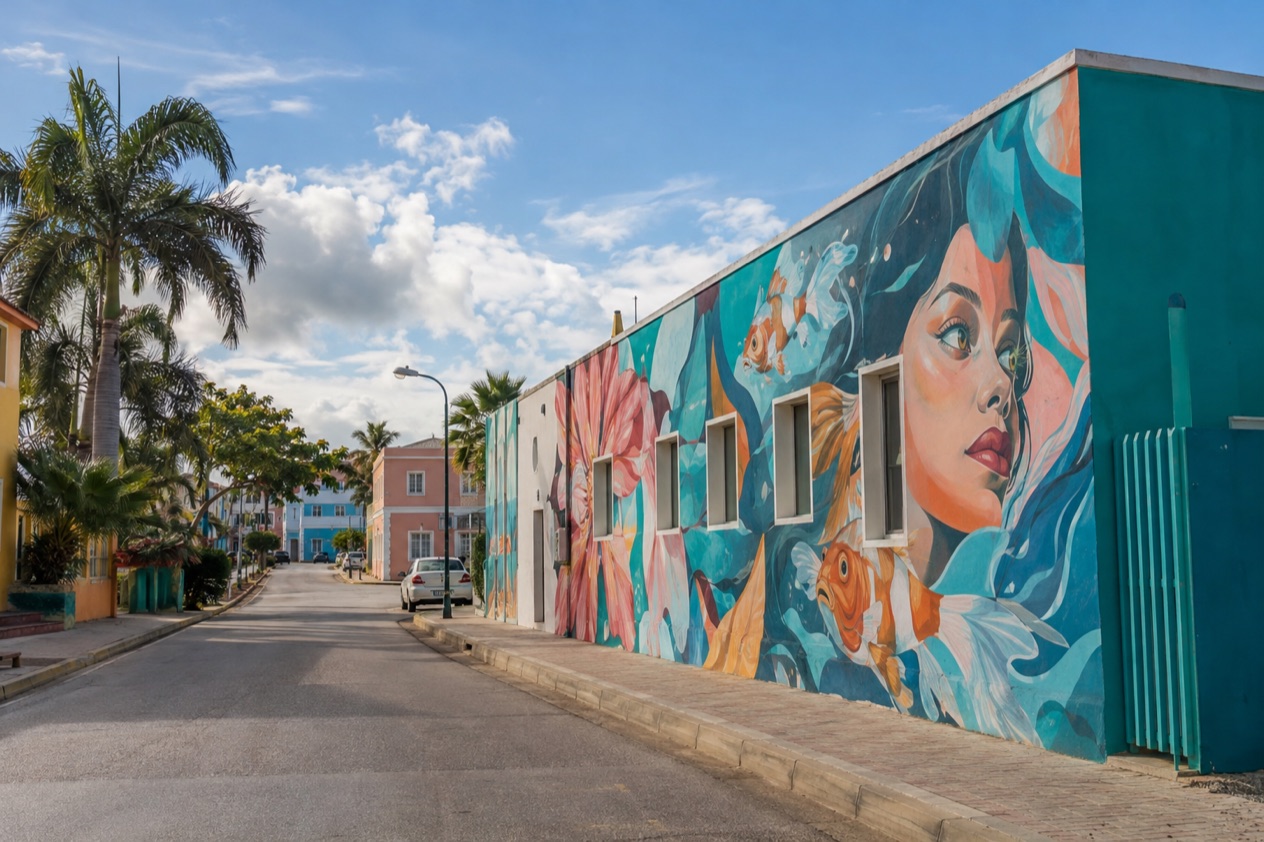
Since 2016 San Nicolas has been the Art District of Aruba, and the walls show it. Murals by top local and international artists from all over the world cover building fronts, side streets and courtyards, so you can wander without a plan and still keep running into something new. Colors are bold, subjects range from island faces to abstract patterns, and the paint turns the former refinery town into something close to a street museum.
The guided tour starts at the ArtisA (Art is Aruba) gallery and is led by the curator of all the murals, who also organized the Aruba Art Fair. It shows an average of 20 to 40 murals depending on which tour you book. Having the person who arranged the work tell you who painted what, and why it sits on that particular wall, turns a stroll into a story about the town.
| Site | Open |
|---|---|
| Mural tour, starting at the ArtisA gallery | Every day at 9:00 AM, 11:30 AM, 2 PM and 4 PM |
Zeppenfeldstraat and the Community Museum
The main street is the natural spine of a day on foot. The San Nicolas Community Museum stands at Zeppenfeldstraat 27, in the Nicolaas Store, a former book store in the center of the city that has been restored as a monument. Its exhibition focuses on specific, authentic aspects of the community’s past life, which makes it a good way to understand the refinery years before you walk out into the streets they shaped.
The building itself is part of the visit, with its original flooring, wooden doors and a second-floor terrace that gives 360-degree views over the city. Close by, at number 33 on the same street, the San Nicolas Visitor Information Center is staffed by trained community members who know the town and the island well. They can share local tips and tailor information to what you want from your day, and Wi-Fi is provided near the office if you want to post a photo.
Between the museum and the visitor center you pass the snack shops, bars and restaurants that give the street its character. This is a good place to stop for a pastechi or a cold drink and to watch the town go about its day. Mornings fit best if you want to follow the mural tour first and finish at the museum.
Baby Beach and Rodger’s Beach
Baby Beach lies in the southern part of Aruba, close to San Nicolas, and it is described as ideal for families with small kids. The shallow water lets swimmers wade out a long distance and still touch the sea bottom. Snorkeling is possible where the bay opens out to the ocean, and visitors should stay within the marked snorkel area.
Food is simple and close to the sand: a refreshment stand serves hamburgers and hotdogs, and Big Mama’s Grill offers BBQ and seafood platters. Beach beds, windscreens and snorkel gear can be rented for a fee, and complimentary huts give shade from the sun. Bring a hat anyway, because the east wind blows over this coast all year.
Rodger’s Beach is about a minute’s drive from Baby Beach. It is a narrow strip of powdery white sand on a bay with calm, clear water, protected for swimming. Fishermen anchor their colorful boats in the bay, which gives the beach an authentic feel, and during the week it is very quiet and suitable for reading or swimming.
How many days do you need in San Nicolas?
One full day covers the essentials of San Nicolas, and a second day lets you slow down. The town and its murals fill a morning, the beaches fill an afternoon, and a longer stay is for people who want to settle into the Sunrise Side instead of rushing through it.
In a short stay, start with the mural tour from the ArtisA gallery at one of its daily departure times. The guided walk gives you a sense of the town, and afterward you can drop into the Community Museum, step up to the terrace for the view, and eat lunch on Zeppenfeldstraat. By early afternoon you can be at Baby Beach, with rented snorkel gear if you like, and still have time for a stop at Rodger’s Beach as the light softens and the fishing boats rock in the bay.
With more time, spread it out. Spend a morning on the murals without a guide, walking the side streets at your own pace and returning to the ones that stopped you. Keep one weekday for Rodger’s Beach, when it is very quiet, and bring a book. Another day can go to just sitting at Baby Beach, trying the snorkel area, and eating grilled seafood.
Beyond the town, the rest of Aruba is within reach of a base here. Oranjestad, the capital, is a short stretch up the coast, and Arikok National Park and the island’s other beaches make good outings that you can pair with a quiet night in San Nicolas. Many travelers use the town as a counterweight to a stay in the resort area, adding a day or two on the Sunrise Side to see another face of the island.
Where to stay in San Nicolas
The main choice is between sleeping in or near San Nicolas itself and staying on the resort side of the island, and the two give you very different trips. San Nicolas puts you on the Sunrise Side, within walking distance of Zeppenfeldstraat and its murals, its museum and its snack shops, and a short drive from Baby Beach and Rodger’s Beach. It suits travelers who want mornings of local life, quiet evenings and a town that feels lived in.
From the town, the main street is your starting point. The San Nicolas Visitor Information Center sits right on it, and it is described as a perfect departure point to discover the city on foot. Staying near it means the murals, the gallery where the tours begin and the restaurants and bars are all on your doorstep, and you can adjust your plans with the advice of the people behind the desk.
Palm Beach, the strip of resorts in the Noord district, is a different world. It is home to the high-rise resorts and malls that San Nicolas deliberately stands apart from, and it suits travelers who want that kind of beach holiday with everything close at hand. If that is your plan, San Nicolas is a day visit across the island, with the murals in the morning and Baby Beach in the afternoon.
Many visitors want some of both, and the island is small enough, at 70 square miles, to make that practical. A few nights near San Nicolas and a few on the resort side lets you wake up to the sunrise on one coast and watch the evening on the other. Whichever you pick, think about how you want your days to feel: busy and polished, or unhurried and a little rough around the edges.
How do you get to San Nicolas and get around?
San Nicolas is about twelve miles southeast of Oranjestad, so you reach it by heading down the island from the capital and the airport area. Aruban roads are safe and modern, and the trip crosses a landscape of low scrub, cactus and wind-bent trees that gets drier and emptier as you move toward the southeastern end.
Once in town, walking is the natural way to see it. The visitor center is on the main street, and the museum, the promenade, the snack shops and many of the murals are laid out close together along and around it. Wear comfortable shoes and give yourself time to stop, because the point of the place is to look at things at a walking pace.
Arubus buses run every 15 minutes from 5:45 a.m. until 6 p.m. After 6 p.m. they run every 40 minutes until 11:30 p.m. If you plan an evening in town, those hours show when the buses run often and when they thin out.
The beaches to the south are a short way from the town. Rodger’s Beach is about a minute’s drive from Baby Beach, so the two pair naturally in a single outing. The mural tour begins at the ArtisA gallery, and the visitor center on Zeppenfeldstraat can answer questions about the area and help you shape the day around it.
When is the best time to visit San Nicolas?
The best time to visit Aruba in general is from February to August, and that holds for San Nicolas too. Those months give you the island’s sunshine and sea days, with enough room in the calendar to pick between the cooler start of the year and the hotter middle of it. Heat is a constant here, and so is the east wind, which keeps a bit of movement in the air all year.
January is warm, with highs in the mid-80s, and it has more rainy days than the middle of the year, with passing showers. July is hotter, with highs around 90, much less rain and a slightly stronger wind. For a town you explore on foot, the milder, breezier months of the early year are kinder in the middle of the day, while in summer the mural tour times at 9:00 AM and 4 PM keep you out of the strongest sun.
The peak season runs from December to April, when the island is at its busiest, and the off-season runs from September to November. In the busy months expect more people on the beaches and in the restaurants, and Carnival season at the start of the year brings parades and costumes to Aruba, with San Nicolas holding its own celebrations. In the off-season the town is quieter, which suits the unhurried character of the Sunrise Side.
Good to know before you go
The U.S. State Department rates Aruba Level 1, ‘Exercise normal precautions,’ and says Aruba is generally a safe destination for travelers, with petty crime the main concern in popular tourist areas.
The most common crime against tourists is theft, aimed at valuables left unattended on beaches, in cars and in hotel lobbies, so keep your belongings with you at Baby Beach and Rodger’s Beach and out of sight in a parked car. San Nicolas is a place to enjoy in daylight, when the murals are at their brightest and the streets have their liveliest feel. If you are unsure of anything, the staff at the visitor center on Zeppenfeldstraat are glad to help, and you can use the Wi-Fi near the office to look things up or share a photo.
Sources
- Aruba Tourism Authority, San Nicolas region (https://www.aruba.com/us/our-island/regions/san-nicolas), checked October 9, 2026
- Wikipedia, San Nicolaas, Aruba (https://en.wikipedia.org/wiki/San_Nicolaas,_Aruba), checked October 9, 2026
- Aruba Tourism Authority, Aruba mural tours (San Nicolas) (https://www.aruba.com/us/explore/aruba-mural-tours), checked October 9, 2026
- Aruba Tourism Authority, San Nicolas Community Museum (https://www.aruba.com/us/explore/san-nicolas-community-museum), checked October 9, 2026
- Aruba Tourism Authority, San Nicolas visitor center (https://www.aruba.com/us/explore/san-nicolas-visitor-information-center), checked October 9, 2026
- Aruba Tourism Authority, Baby Beach (https://www.aruba.com/us/explore/baby-beach), checked October 9, 2026
- Aruba Tourism Authority, Rodgers Beach (https://www.aruba.com/us/explore/rodgers-beach), checked October 9, 2026
- Aruba Tourism Authority, Getting around Aruba (https://www.aruba.com/us/plan-your-visit/getting-around-aruba), checked October 9, 2026
- Aruba Tourism Authority, Public transportation (https://www.aruba.com/us/plan-your-visit/getting-around-aruba/public-transportation), checked October 9, 2026
- Aruba Airport Authority, By car (https://www.airportaruba.com/by-car), checked October 9, 2026
- Aruba Tourism Authority, Best time to visit (https://www.aruba.com/us/our-island/one-happy-island/when-is-the-best-time-to-visit-aruba), checked October 9, 2026
- Meteorological Department Aruba (meteo.aw), Summary Climatological Normals 1991-2020, Queen Beatrix Airport station (http://www.meteo.aw/files/Download/climatnormals19912020.pdf), checked October 9, 2026
- U.S. Department of State, Aruba Travel Information, Safety and security (https://travel.state.gov/content/travel/en/international-travel/International-Travel-Country-Information-Pages/Aruba.html), checked October 9, 2026
- U.S. Department of State, Aruba Travel Advisory, Level 1, issued August 19, 2026 (https://travel.state.gov/content/tsg_aem/us/en/home/international-travel/travel-advisories/destination.abw.html), checked October 9, 2026