
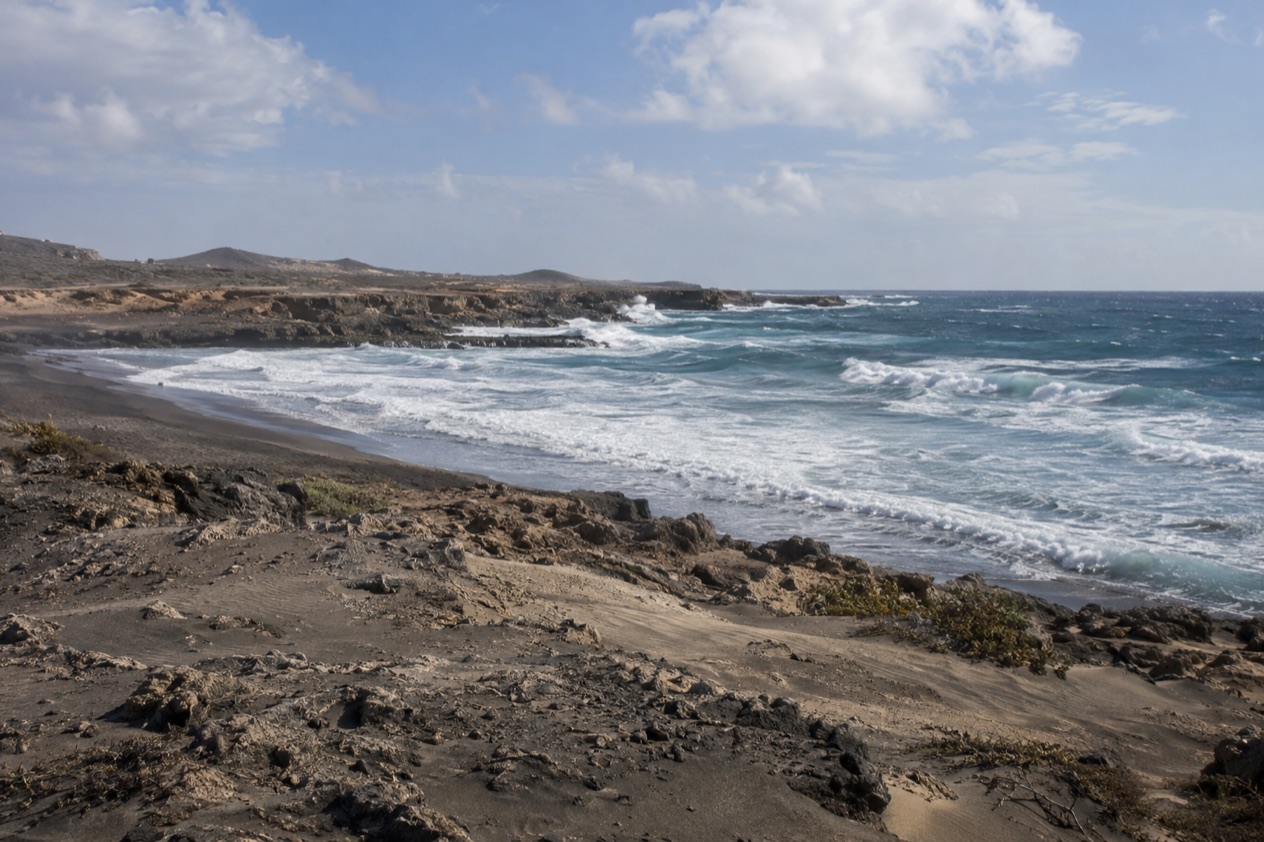
Past the dry scrub and cactus of the island’s wild side, the land opens onto Boca Prins, where a pale curve of sand dunes meets a dark, broken coastline and the sea comes in hard. The wind is steady, the surf is loud, and the whole bay feels far from the resort beaches on the other coast. This is a viewing and wandering stop inside Arikok National Park, best for travelers who like landscape more than lounging.
Is visiting Boca Prins worth it?
Yes, if you like wild coastline, big skies and a place to stand and watch the sea work, and it suits photographers, walkers and anyone tired of calm resort sand. It is a poor match for travelers who mainly want a swim, because swimming here is strongly advised against due to very strong and always present undertows.
What sets it apart from the beaches along the leeward coast is the mood. Those stretches of sand are set up for sun chairs and sunset drinks.
Boca Prins is a bay in a national park, on the rough northeast side, with white dunes behind it and rugged rock around it. You come to look, to walk down the wooden stairs, and to feel the wind. The sea is the main show here, and it is a powerful one.
It also fits neatly into a larger day. The park holds caves, Indian rock drawings, lava formations and other secluded bays such as Moro and Dos Playa, so Boca Prins works as one chapter in a longer story about the island’s wilder half. If you only have a short window, it still gives you a strong picture of what Aruba looks like away from the hotels.
Go with the right expectations and it rewards you. Come for dunes, rock and surf, bring a hat and reef-safe sunscreen, and treat the water as something to admire from the sand.
What to see at Boca Prins
The wooden stairs and the bay
Wooden stairs give access to the beach area, and they are your first view of the bay. From the top you see the whole shape of it at once: the sweep of pale sand, the rock on either side, and the line where the swell breaks.
Take the stairs slowly and stop on the way down. The angle shows the colors best, the white of the dunes against the deep blue of open water and the browns and grays of the cliffs. Going down puts you at the level of the surf, and you hear it before you reach the sand. Coming back up, you get the view again, this time with the wind at your back.
The white sand dunes
The beach features pristine white sand dunes, and they are the part of Boca Prins that surprises people. On an island better known for flat, dry land, these soft hills of sand rise behind the bay and shift shape with the wind.
Look at the surface of the sand for the fine ripples the trade wind draws, and at the way the dunes meet the low, tough vegetation behind them. The light matters here. Early and late in the day the sand turns warm and soft, and the shadows make the dunes look sculpted. Midday light flattens them into a bright glare, so sunglasses help.
The rugged coastline
Around the sand runs a rugged coastline of dark rock, shaped by waves that arrive after crossing open sea with nothing to slow them. This is the windward side of the island, and it looks the part: spray, foam, and stone worn into rough edges.
Stand back and watch the sets roll in. You will notice how the water pulls out again across the sand, which is exactly the undertow the warnings describe. It is strong and always present, and watching it from a distance explains the advice better than any sign. Swimming is strongly advised against, so the coast is for looking, listening and photographing.
The old plantation name
The bay is named after the former plantation Prins. The name is a small reminder that this empty-looking stretch of coast was once part of a working landscape, in an island where farming was always a struggle against thin soil and little rain.
Think of it as you walk. The scrub, the wind and the dry ground that feel so wild today were also the setting for a hard agricultural past. It adds a layer to what could otherwise be only a pretty view, and it connects the bay to the park’s wider mix of nature and history.
Hours, tickets and rules
Boca Prins lies inside Arikok National Park, so the park’s ticket is what gets you in. Visitors need to purchase a ticket to enter, and there is a small entrance fee that supports preservation, educational programs and the animals. In effect, your visit to the bay helps pay for the care of the place you are looking at.
| Site | Entry |
|---|---|
| Boca Prins (inside Arikok National Park) | Park ticket required, small entrance fee |
The rules to keep in mind are few and clear. Swimming at Boca Prins is strongly advised against because of the very strong and always present undertows. Aruba has banned sunscreens containing oxybenzone since 2019, and visitors should use mineral-based reef-safe sunscreens, which are more likely to be biodegradable and minimize environmental impact. Sunscreen can be bought on the island from local companies such as Aruba Aloe and Arubalife Organics.
Since the park is protected, your ticket is also a contribution. Visitors help preserve it by visiting and paying the entrance fee, and that is the whole arrangement.
How to get to Boca Prins
Boca Prins sits along the northeast coast, within Arikok National Park. That puts it on the opposite side of the island from the leeward coast, where the resort beaches line up along calm-looking shores. Heading to Boca Prins means leaving that side behind and moving toward the rough, windward edge of Aruba.
Because it is inside the park, your route runs through the park, and the ticket comes first. Once inside, the bay is reached by the wooden stairs that lead down to the beach area. It is worth thinking of the visit as part of a park day rather than a quick stop from the hotel, since the park rewards time and holds several other bays and sights.
Organized tours led by park rangers are highly recommended to fully experience the park’s flora, fauna and viewpoints, and they give you someone who knows the ground. A private guided hike is also available for visitors who want to explore birds, flowers and geology at their own pace. Either option turns a drive into a deeper visit, with explanations of what the rock, plants and birds around you actually are.
There is also a restaurant nearby called Boca Prins Restaurant, which makes a handy landmark when you are looking for the area and a place to think about when planning the shape of your day.
When to visit Boca Prins
The best time to visit Aruba in general is from February to August, and that window suits Boca Prins well. The peak season runs from December to April, so a visit in the later part of that stretch, or in the months after it, lets you enjoy the bay during a period when the island is generally in good form for travelers.
Time of day matters more than the month for how the place feels. The trade wind blows from the east all year, and this coast faces it directly, so you always get wind and surf. Early in the day and late in the afternoon the light is softer and kinder to the white dunes, while the middle of the day is bright and strong, with little cover on open sand and rock.
Because the park is a place for spending an entire day among dramatic landscapes, it helps to start early and let Boca Prins be one stop in a longer loop. Arriving with plenty of time means you are not rushing the stairs, the viewing, or the photographs.
Whatever the month, the sea here is rough and the undertow is always present. The season does not change that, so plan your swimming elsewhere and let Boca Prins be the part of the trip for scenery.
Tips for your visit
Bring a hat, sunglasses and water, and use a mineral-based reef-safe sunscreen. The bay is open to sun and wind, and the dunes reflect the light. Wear shoes that grip, since you will be on wooden stairs and uneven ground around the rock.
Think of the park as a day out. Arikok holds caves, Indian rock drawings, lava formations, quartz diorite, limestone and secluded bays such as Moro, Boca Prins and Dos Playa, so Boca Prins combines naturally with the other sights inside the park. A ranger-led tour is highly recommended and brings the flora, fauna and viewpoints to life, and a private guided hike suits travelers who want to take in birds, flowers and geology at their own pace.
Families and anyone with limited mobility should know that the beach area is reached by wooden stairs, so plan around that. Take your time on the way down and back up, and keep children close near the water’s edge, where the undertow is very strong and always present.
For a meal, Boca Prins Restaurant is nearby, which lets you pair the bay with lunch or a drink after the walk. Use the time at the bay to watch the surf, look along the coastline and photograph the dunes, and leave swimming for another stretch of Aruba.
Good to know before you go
The U.S. State Department rates Aruba Level 1, ‘Exercise normal precautions,’ and says Aruba is generally a safe destination for travelers, with petty crime the main concern in popular tourist areas.
Boca Prins is a place to admire rather than to swim, so keep your beach day for the calmer-looking resort shores and give this bay your curiosity, camera and a good hat. Mineral-based reef-safe sunscreen protects both you and the water, and your park ticket helps look after the dunes and the coast you came to see. Petty crime is the main concern in popular tourist areas, so keep your belongings with you.
Sources
- Aruba Tourism Authority, Boca Prins (https://www.aruba.com/us/explore/boca-prins), checked October 9, 2026
- Aruba Tourism Authority, Arikok National Park (https://www.aruba.com/us/explore/arikok-national-park), checked October 9, 2026
- Aruba Tourism Authority, Best time to visit (https://www.aruba.com/us/our-island/one-happy-island/when-is-the-best-time-to-visit-aruba), checked October 9, 2026
- Aruba Tourism Authority blog, Responsible guest (https://www.aruba.com/us/blog/how-to-be-a-responsible-guest-protecting-arubas-beaches-and-marine-life), checked October 9, 2026
- U.S. Department of State, Aruba Travel Advisory, Level 1, issued August 19, 2026 (https://travel.state.gov/content/tsg_aem/us/en/home/international-travel/travel-advisories/destination.abw.html), checked October 9, 2026
To plan your stay
- Best Time to Visit Aruba: Weather by Month, Peak Season and Festivals
- Where to Stay in Aruba: Palm Beach, Eagle Beach, Oranjestad and All-Inclusives
- Aruba Airport (AUA): Arrival, Getting to Your Hotel, U.S. Preclearance and Departure
- Know Before You Go to Aruba: Entry Forms, Money, Water and Local Customs