
Long before sunrise in downtown San Nicolas, the street is still full of people who have been dancing since the night before, faces streaked with paint, a truck loaded with speakers rolling slowly ahead of them. Whistles, steel drums and soca beats bounce off the low buildings, and the first gray light finds the whole crowd still jumping. Carnival is the loudest, most colorful stretch of the Aruban year, and it runs from November into February, with its biggest parties in the first weeks of the new year.
When is Carnival in Aruba?
Carnival in Aruba is a season rather than a weekend: it officially opens on the eleventh of November, at eleven minutes past eleven in the morning, and closes on Shrove Tuesday, the day before Ash Wednesday, with the midnight burning of King Momo. In between, the island fills with rehearsals, elections, concerts and parades. Most visitors who plan a trip around it aim for January and February, when most of the events, celebrations and parades take place.
Because the finish line is tied to Ash Wednesday, the closing weekend moves from one year to the next with the Easter calendar. Think of the final parade as arriving in mid-February or thereabouts, and look for the exact weekend once the organizers publish the schedule. The start of the season, by contrast, never moves.
From the November opening to the new year
The long run-up is the part most travelers never see, and it is where the island’s own Carnival lives. Groups spend the autumn sewing feathers, welding costume frames and practicing dance routines, while bands tune up for the road marches and the music competitions that fill the first weeks of the year. If you arrive in November or December, you are in the quiet build-up: the mood is anticipation rather than party.
That makes the early season a good fit if you like to catch a place before its big moment, and it suits anyone who prefers to hear a rehearsal drifting out of a neighborhood hall to standing in a parade crowd. It is not the time for the full spectacle, though. For floats, feathers and street parties, wait for the new year.
January and February, when the calendar fills
Once January begins, something happens nearly every weekend. The Carnival season of 2026 is a useful example of the rhythm: events ran from early January right through to the middle of February, with music contests and children’s parades first, then the overnight Jouvert jump-up, and finally the grand parades. A trip of a week in late January or early February will usually let you catch at least one big night out.
If you want only one weekend, the closing one is the natural choice, because the Grand Carnival Parade in Oranjestad is the finale of the whole season. If you would rather see how the island celebrates among its own neighborhoods, pick the weekend of the Jouvert jump-up in San Nicolas, which is a very different, more informal party.
| Event | Date in the 2026 season |
|---|---|
| Season of events begins | January 3 |
| 54th Adult Tumba Festival | January 17 |
| Children’s Noord Parade | January 31 |
| Soca Monarch Finals Contest | January 31 |
| Pre-Jouvert and Jouvert Morning, downtown San Nicolas | From 8 p.m. February 6 until sunrise February 7 |
| Grand Parade in Oranjestad | February 15 |
| Season of events ends | February 16 |
What happens during Aruba Carnival?
During Carnival, Aruba stages a string of parades, music contests and royal elections that build toward two grand parades and a midnight fire. The main parades are the Lighting Parade, the Children’s Parades, the Jouvert Morning Pajama Party, the Grand Carnival Parade in San Nicolas and the Grand Carnival Parade in Oranjestad. Each has its own mood, from glowing and festive to sleepy and silly to full-throttle feathers and drums.
The Lighting Parade
The Lighting Parade is the night parade, and the one that gives the season its glow. Tivoli has produced it since 1981, and the idea is simple and effective: costumes, floats and dancers lit up with bulbs and LEDs, so that the whole procession seems to float through the dark. The music is loud, the costumes are built to shine, and the crowd tends to dance along on the sidewalk.
It is a good first parade if you want the full Carnival atmosphere without a sunrise start. Wear something you can move in, bring your phone for photos, and expect the best pictures from the floats rather than from the dancers, who rarely stand still.
Jouvert Morning in San Nicolas
Jouvert (from the French for “daybreak”) is the Carnival tradition of dancing through the night into the dawn, and in Aruba it is called the Jouvert Morning Pajama Party. The Pre-Jouvert and Jouvert jump-up in downtown San Nicolas starts at eight in the evening and carries on until sunrise. A jump-up is exactly what it sounds like: no stands, no ticketed seats, just a crowd moving behind music trucks.
Pajamas are part of the fun, so people turn up in nightshirts, slippers and silly hats, and many get splashed with paint or powder along the way. Wear clothes you are happy to lose, and shoes you do not mind getting colored. It is the most hands-on way to experience Carnival, and it suits people who like to be in the middle of the crowd rather than watching from the edge.
Children’s parades and the grand parades
The Children’s Parades are the sweetest part of the season. Small dancers in sequins, tiny kings and queens and school groups march through their neighborhoods, with parents shooting video from the roadside. The Children’s Noord Parade is one of them, and if you travel with a family it is probably the easiest way to see Carnival at a child’s pace.
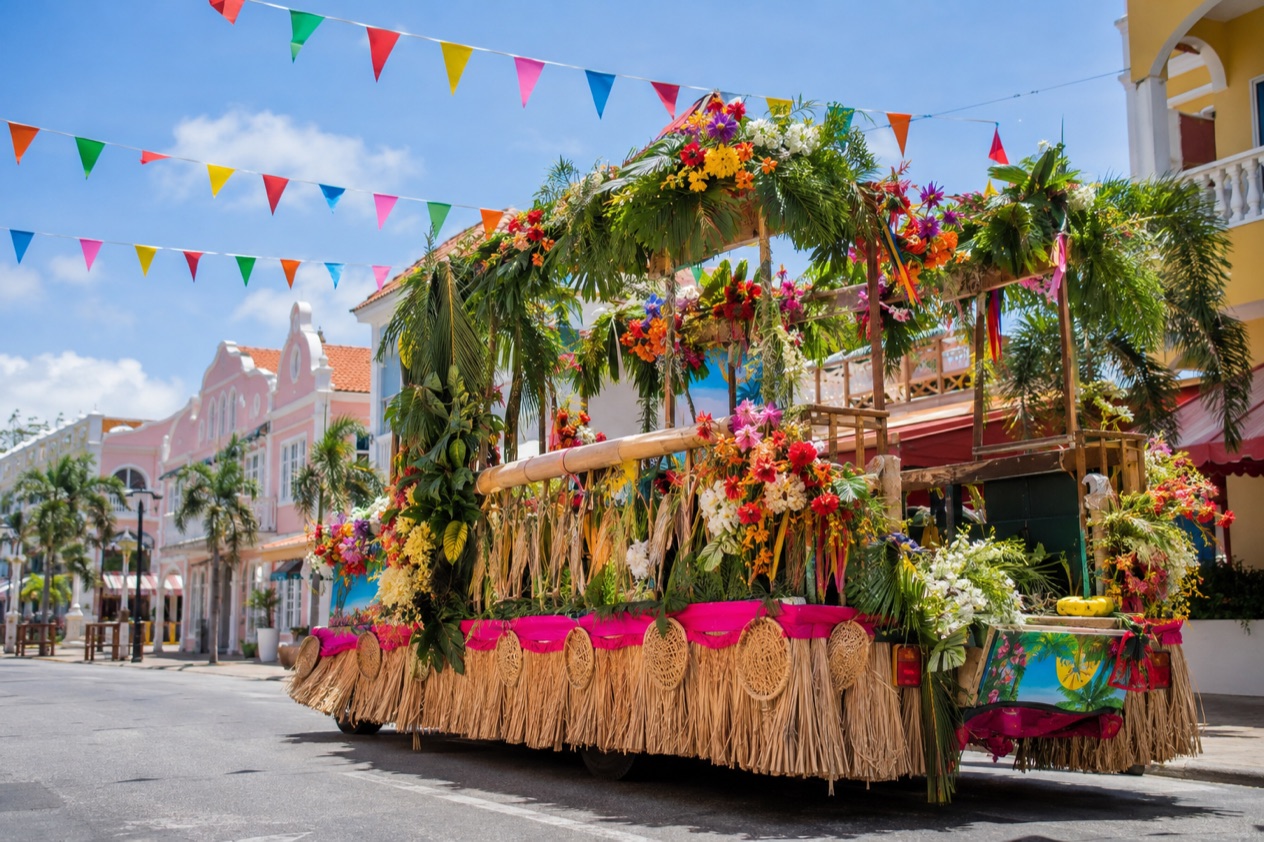
The Grand Carnival Parade in San Nicolas and the Grand Carnival Parade in Oranjestad are the big ones. Troupes in elaborate feathered and beaded costumes dance behind floats and bands, and the Oranjestad parade is the exciting finale of the season. The tradition of the grand parades had become a mainstay of the festival by 1957, so you are watching something that has been part of island life for generations.
How do locals celebrate?
Locals celebrate Carnival as a months-long community project, with neighborhood groups, school children, musicians and families all taking part, not only as spectators. The roots go back to 1954, when the first small street festivals were organized, and the first public Carnival followed in 1955. Today the festival still feels like a family event, with grandparents who remember the early parades watching grandchildren march.
Tumba, soca and the music contests
Music is the heartbeat of the season. The Adult Tumba Festival, now in its fifty-fourth edition, is a contest for the tumba, the island’s own Carnival rhythm, a lively beat with Caribbean and African roots that has its own songs, composers and loyal fans. Hearing it live, with a crowd that knows every lyric, tells you more about Aruban Carnival than any parade.
The Soca Monarch Finals Contest is the other musical landmark, and a different flavor: soca is the fast, bright, dance-driven sound of the wider Caribbean, and the finals are a showcase of the performers who ride it. Caribbean Carnival draws on African and indigenous influences, and you can hear that mix in the drums, the call-and-response singing and the rhythm of the road marches.
Queens, kings and costumes
Carnival has its own royalty. The Children’s Carnival Queen Election features contestants aged 6 to 9, while the Aruba Carnival Queen Election welcomes participants between 17 and 25 years old. These elections are community occasions, with families, friends and sponsors in the audience, and the winners lead the parades in the costumes that took months to make.
The costumes are the craft side of the season. Seamstresses, welders and designers spend weeks on feathered headdresses, beaded bodices and the wire frames that hold the largest pieces, and troupes often work from a theme that is revealed at the parade. If you see a group in the street in the weeks before, they may be fitting or rehearsing, and the work is as much a part of the celebration as the finished look.
The burning of King Momo
The season ends with a fire. At midnight on Shrove Tuesday, King Momo, the figure who has presided over the festivities, is burned. The burning symbolizes the burning of the Spirit of Carnival, who will rise again next season, so it is both an ending and a promise, a moment where the party stops and everyone looks forward to the next one.
It is also a reminder of the festival’s long history. Carnival’s origins can be traced back to ancient Roman pagan festivals like Saturnalia and Lupercalia, and the idea of a final night of excess before a quieter season has traveled a long way, from Rome through Europe to the Caribbean. On Ash Wednesday, the island moves on.
Good to know before you go
The U.S. State Department rates Aruba Level 1, ‘Exercise normal precautions,’ and says Aruba is generally a safe destination for travelers, with petty crime the main concern in popular tourist areas.
Because the end of the season follows Ash Wednesday, the closing weekend shifts a little each year, so look for the published schedule before you book a trip around the grand parades. Jouvert and the big parades are the loudest, busiest moments, and for those, plan to dress for dancing and for getting a little paint on your clothes. The island’s music festivals, such as Soul Beach on Memorial Day weekend, are separate events and do not belong to the Carnival calendar.
Sources
- Aruba Tourism Authority, Carnival in Aruba (https://www.aruba.com/us/our-island/history-and-culture/carnival-in-aruba), checked October 9, 2026
- Aruba Tourism Authority, Aruba Carnival (https://www.aruba.com/us/calendar/aruba-carnival), checked October 9, 2026
- Aruba Tourism Authority, Festivals (https://www.aruba.com/us/things-to-do/nightlife/festivals), checked October 9, 2026
- U.S. Department of State, Aruba Travel Advisory, Level 1, issued August 19, 2026 (https://travel.state.gov/content/tsg_aem/us/en/home/international-travel/travel-advisories/destination.abw.html), checked October 9, 2026
To plan your stay
- Best Time to Visit Aruba: Weather by Month, Peak Season and Festivals
- Where to Stay in Aruba: Palm Beach, Eagle Beach, Oranjestad and All-Inclusives
- Aruba Airport (AUA): Arrival, Getting to Your Hotel, U.S. Preclearance and Departure
- Know Before You Go to Aruba: Entry Forms, Money, Water and Local Customs