
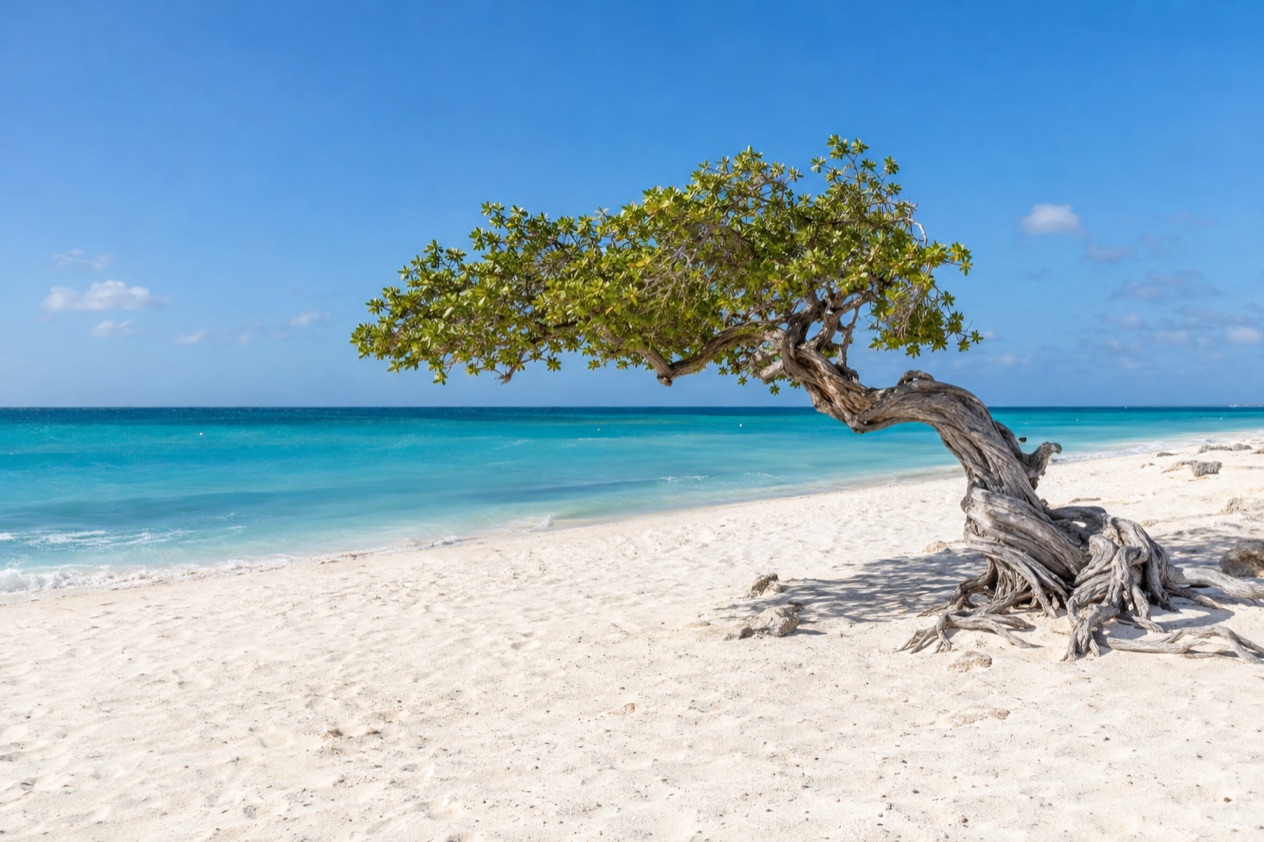
In May the trade wind keeps the fofoti trees on Eagle Beach leaning west, and the sun is already high and bright by breakfast. Pastechi, the fried turnovers filled with cheese or meat, come out of bakery counters in Oranjestad, and the water along the resort coast is warm enough that nobody hesitates at the edge. It is the quiet turn between the long winter high season and the summer, a month of dry days and steady breeze for beach time, snorkeling and slow evenings on the island.
What is the weather like in Aruba in May?
May is hot, dry and windy across the island: afternoons feel like midsummer, nights stay warm, and rain is a rare event that usually passes within minutes. Aruba is small and flat, so the island feels much the same wherever you go, and the sea is the part that changes by shoreline.
| Place | Region | Average high (°F) | Average low (°F) | Rain (in) | Rain days | Sea (°F) |
|---|---|---|---|---|---|---|
| Oranjestad | Leeward (southwest) coast | 89.6 | 80.1 | 0.56 | 1.7 | 82.1 |
The sea off Palm Beach, the strip of resorts in the Noord district, reads the same as Oranjestad in May. Off San Nicolas, at the southeastern end, it is a shade cooler at 82.0°F, a difference you will not feel when you wade in. Along the north and east coasts, the windward side, the wind meets open water head on, and that shoreline is rough and wild rather than a place for lounging.
The wind is the real weather story. It blows from the east all year and averages 19 mph this month, which takes the edge off the heat in the shade and keeps humidity from feeling heavy.
Days run about twelve hours and forty-five minutes long in mid-May, so there is plenty of light for a late snorkel and an unhurried dinner outside. Showers, when they come, tend to be brief and followed by sun.
Where to go in Aruba in May
With dry days and a steady breeze, May suits both the resort beaches and the wilder parts of the island. The west and southwest coast is where most people spend their days, while the north and east reward a day of looking rather than lounging.
The leeward coast: Palm Beach, Eagle Beach and Oranjestad
This is the stretch that carries the resort beaches. Palm Beach lines up hotels, beach bars and water sports along a wide strip of sand in the Noord district, and Eagle Beach lies closer to Oranjestad with its leaning fofoti trees, the island’s best-known photo. Farther along the northwest, Malmok Beach and Boca Catalina are named among the best beaches for snorkeling in Aruba.
Oranjestad, the capital, is worth a slow walk in the cooler early morning or after sunset, with its pastel Dutch colonial facades, the harbor and the cafés where you can try a pastechi. In May the wind is steady, so a bit of sand blowing across the beach is normal, and the sun is strong from mid-morning on. Afternoons are the time for shade, a cold drink and a long lunch.
The south: San Nicolas, Savaneta and Baby Beach
The south is where the island slows down. San Nicolas, the old refinery town, has a street-art scene with murals on its walls, and the mural tour there is a good way to spend a morning before the heat builds. Savaneta, a fishing village toward the middle of the south coast, is the kind of place for a seafood lunch with the water in view.
Baby Beach and Mangel Halto are both on the list of favorite snorkeling beaches in Aruba, and the sea here is a touch cooler than at Palm Beach, though still warm. This end of the island suits travelers who prefer a local feel to a hotel strip, and it works well as a full day out from the resort area.
The windward coast and the interior
On the north and east side the sea arrives with the wind and breaks on black rock, and here you simply look rather than plan a swim. Bushiribana, the ruin of a gold smelter on the north coast, sits against that surf, and the rocky coast inside Arikok National Park is a landscape of cactus, limestone and wind-sculpted shoreline.
In the middle of the island Hooiberg rises as a lone hill above the plain, and at the northwest tip the California Lighthouse watches over the point where the island ends. Dry May weather gives these places clear views and strong light, but the sun is intense and the breeze is no cure for it, so go early or late.
What to do in Aruba in May
The month starts with Labor Day on May 1, a public holiday known locally as Dia di Labor, and Ascension Day also falls in May, with the date moving each year. Neither turns the island upside down, but you may find shops and some businesses closed on those days, and families head to the beaches. Outside those days, May is mostly about the sea, the food and the landscape.
Snorkeling and boat trips
The clear water lets snorkelers and divers explore reefs and wrecks, and the sea is warm in every season. Snorkel tours often stop at the Antilla, the World War II shipwreck lying off the northwest coast. On land, Malmok Beach, Boca Catalina, Mangel Halto and Baby Beach are the beaches named for snorkeling.
Boat trips along the leeward coast catch the breeze at its steadiest in the morning, and the long daylight hours of May leave room for a sunset sail afterward. Plan sun protection, since the light is strong and the wind makes it easy to underestimate.
Island tours and the wild side
An island tour is the way to see the rough north and east coasts, Arikok National Park, Bushiribana and the California Lighthouse in a single outing. Dry weather means the roads and trails are in good shape and the cacti stand out against pale rock. Because there is very little shade on the island, the early part of the day is the more comfortable time for exploring.
Eating your way around
Aruban home cooking draws on Amerindian, European, African and Asian roots, and the first people, the Caquetio, ate freshly caught fish and conch, both still on menus today. Keshi yena, a hollowed round of Dutch cheese baked with a spiced meat or chicken filling, is the dish that tells the island’s story best. Papiamento, the island’s language, shows up on menus and signs, so a few words go a long way.
Is Aruba busy in May?
May is calmer than the winter months, because the peak season runs from December to April and the island begins to exhale once April ends. Visitors still arrive, since the best time to visit Aruba runs from February to August, but the beaches and restaurants lose the full-house feeling of winter.
The resort strips at Palm Beach and Eagle Beach stay the liveliest part of the island at any time of year, with beach bars, water sports and restaurants close together. Oranjestad has a steady pulse of cruise and city life, while San Nicolas and the south keep their local rhythm whatever the month. The north and east coasts and the park have always felt empty, because they are wild and exposed rather than built for crowds.
U.S. Memorial Day weekend at the end of the month brings extra American travelers, and holiday days such as Labor Day and Ascension Day bring local families to the shore. Beyond those moments, the month reads as a relaxed stretch between the winter rush and the summer.
What to pack for Aruba in May
Packing is the same for the whole small island: the heat and the wind are what you dress for, with a little more sun protection along the open leeward beaches and a layer for the windward coast, where the breeze meets the sea head on.
- Light, breathable clothing for days in the upper 80s and nights that stay warm.
- A hat that fits snugly, since the east wind blows steadily at nearly 20 mph.
- Sunscreen and sunglasses for long, bright days of about twelve and three-quarter hours.
- A mask and snorkel if you want your own gear for the clear water at the beaches named for snorkeling.
- Sturdy sandals or shoes for the rocky ground of Arikok National Park and the north coast.
- A thin layer for a rare shower, since rain falls on only a couple of days in May.
Good to know before you go
The U.S. State Department rates Aruba Level 1, ‘Exercise normal precautions,’ and says Aruba is generally a safe destination for travelers, with petty crime the main concern in popular tourist areas.
The hurricane season runs from June 1 to November 30, so May falls just before it begins. Aruba lies on the southern fringes of the hurricane belt, where damaging storms are rare. For entry, U.S. citizens need a passport valid for the whole stay, the Aruba ED Card (Embarkation and Disembarkation Card) completed within 7 days before travel, proof of return to the country of departure or transit through another country, and enough money to cover the stay.
Is May a good time to visit Aruba?
Yes, May suits beach lovers, snorkelers and anyone who wants dry, sunny days with a steady breeze, and the leeward coast around Palm Beach, Eagle Beach and Oranjestad is the best base for that. Travelers who like to explore will find the dry weather good for the north and east coasts and for the park.
Compared with April, the air is almost the same, with nights a touch warmer and the sea a degree or so warmer too. April is still part of the dry season and the peak season, and May keeps the dry feeling while the crowds ease. June brings the start of the hurricane season, slightly more frequent showers and a sea that is a little warmer again, but the heat and the wind barely change.
That makes May a good middle point. It has the dry, bright conditions of the winter months, the long days of the approach to summer and a more relaxed pace on the beaches.
The sea is warm for snorkeling at Mangel Halto and Baby Beach in the south, the breeze keeps afternoons comfortable on Eagle Beach, and the evenings stay warm enough for dinner outdoors in Oranjestad. Keshi yena in a small restaurant after a day on the water is the kind of simple pleasure the month is made for.
Sources
- Meteorological Department Aruba (meteo.aw), Summary Climatological Normals 1991-2020, Queen Beatrix Airport station (http://www.meteo.aw/files/Download/climatnormals19912020.pdf), checked October 9, 2026
- Open-Meteo Marine API, average 2015-2024, checked October 9, 2026
- sunrise-sunset.org, sunrise and sunset calculated for the 15th of the month, checked October 9, 2026
- Aruba Tourism Authority, Weather and climate (https://www.aruba.com/us/our-island/island-facts/weather-and-climate), checked October 9, 2026
- Aruba Tourism Authority, Best time to visit (https://www.aruba.com/us/our-island/one-happy-island/when-is-the-best-time-to-visit-aruba), checked October 9, 2026
- Aruba Tourism Authority, Where is Aruba (https://www.aruba.com/us/our-island/island-facts/where-is-aruba), checked October 9, 2026
- Aruba Tourism Authority, Passports and visas (https://www.aruba.com/us/plan-your-visit/getting-to-aruba/passports-and-visas), checked October 9, 2026
- Aruba Tourism Authority, Sustainability (https://www.aruba.com/us/our-island/island-facts/sustainability), checked October 9, 2026
- Aruba Tourism Authority, Beaches and coves (https://www.aruba.com/us/things-to-do/beaches-and-coves), checked October 9, 2026
- Aruba Tourism Authority, On the water (https://www.aruba.com/us/things-to-do/on-the-water), checked October 9, 2026
- Aruba Tourism Authority, Scuba and snorkel (https://www.aruba.com/us/things-to-do/on-the-water/scuba-snorkel), checked October 9, 2026
- Aruba Tourism Authority, Local Aruba cuisine (https://www.aruba.com/us/things-to-do/dining/local-aruba-cuisine), checked October 9, 2026
- U.S. Department of State, Aruba Travel Advisory, Level 1, issued August 19, 2026 (https://travel.state.gov/content/tsg_aem/us/en/home/international-travel/travel-advisories/destination.abw.html), checked October 9, 2026
To plan your stay
- Things to Do in Aruba: Beaches, Arikok National Park, Island Tours and Food
- Where to Stay in Aruba: Palm Beach, Eagle Beach, Oranjestad and All-Inclusives
- Aruba Airport (AUA): Arrival, Getting to Your Hotel, U.S. Preclearance and Departure
- Know Before You Go to Aruba: Entry Forms, Money, Water and Local Customs