
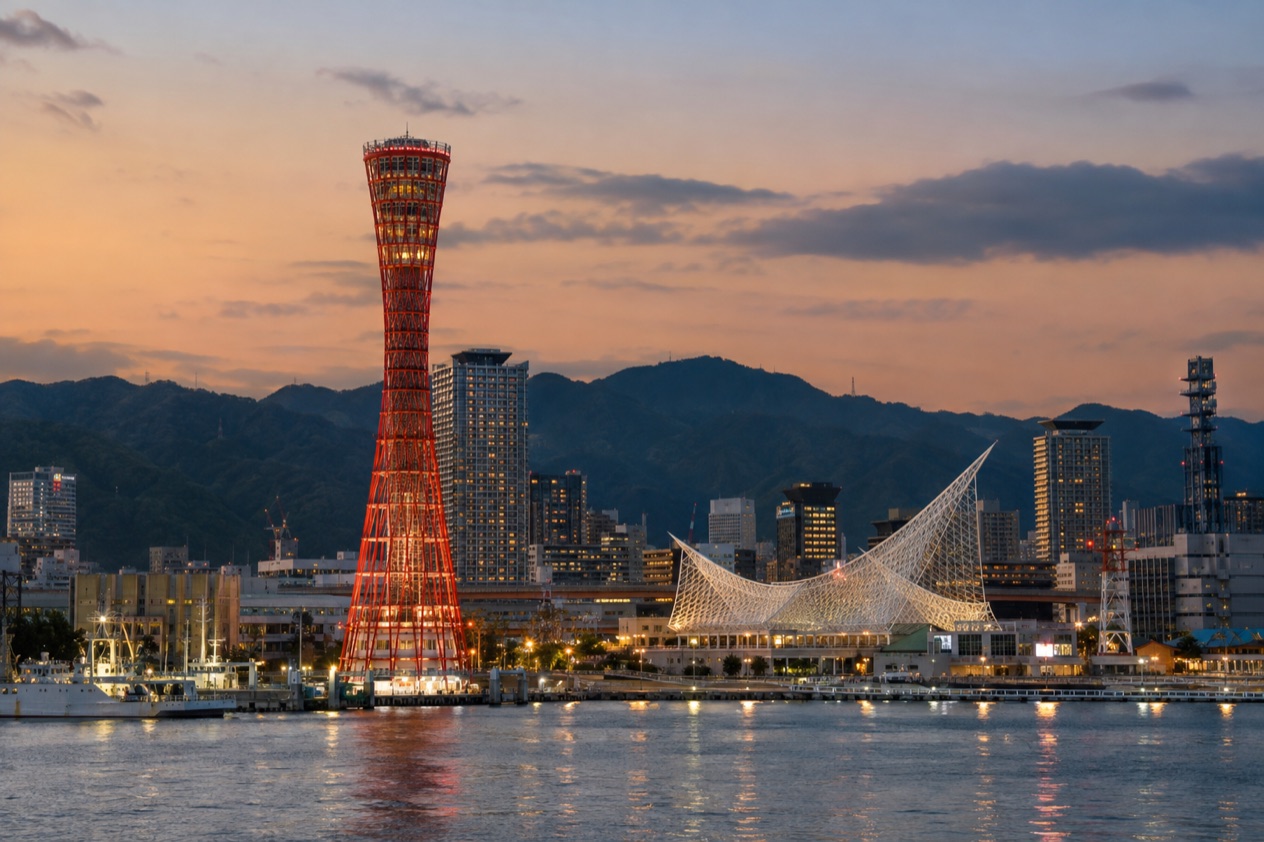
Down by the harbor in Kobe, the red lattice of the Port Tower catches the last light while ferries slide past the waterfront and the smell of fresh bread drifts out of a bakery on a side street. Behind the city, the Rokko mountains close the horizon, so hills, sea and old foreign houses all share one view. Kobe is a port city for travelers who like to eat well, wander between the water and the slopes, and use it as a base for the rest of the Kansai region.
Kobe has been a harbor town for a long time, and its mix of Japanese, Chinese and Western influences shows in the streets, the cooking and the buildings. It sits across the bay from Osaka and serves as the capital of Hyogo Prefecture. A day here can start with a hillside of old residences, continue with a plate of the city’s beef, and end with a long look at lights on the water.
What are the best things to do in Kobe?
The best things to do in Kobe are to eat its beef, climb the hillside of foreign residences, stroll the harbor front, take the mountain air above the city and soak in a hot spring resort that belongs to the city itself. Each of these shows a different side of a place that is at once a port, a hillside town and a gateway to the Kansai countryside.
- Sit down to Kobe beef, served as steak, sukiyaki, shabu-shabu or teppanyaki, and taste why a regional label became a household name.
- Climb through Kitano, the hillside district of Western-style houses built for foreign residents, and step into the ones open to visitors.
- Walk the harbor at Meriken Park and Harborland, where the Port Tower, the maritime museum and the shopping arcades face the water.
- Eat a steamed pork bun in Nankinmachi, the Chinese quarter, and browse the lantern-lit lanes around it.
- Ride up into the Rokko mountains for forest air, herb gardens and wide views over the bay.
- Soak at Arima Onsen, a hot spring resort in the hills of Kita-ku that Kobe and Osaka residents have long used for a getaway.
- Watch the city light up from an observation deck or a mountain lookout once the sun goes down.
None of these needs a rigid plan. Kobe rewards a loose schedule, with a morning in the old foreign quarter, a lunch built around a grill, an afternoon on the waterfront and an evening wherever the view is best.
Add a day trip or two and the city becomes a base for castles, sake country and island scenery. The sections below take each part in turn, from the landmarks to the night scene.
Sights and landmarks in Kobe
The sights of Kobe fall into three groups: the hillside residences of Kitano, the waterfront around the harbor and the lanes of Nankinmachi and the old downtown. Kobe is the third-largest port city in Japan after Tokyo and Yokohama, and that history of ships, traders and foreign settlers is the thread that ties them together.
Kitano and the foreign residences
Kitano is the slope where merchants and diplomats from abroad once built their homes, and a good part of the neighborhood still looks as if it were lifted from a European town. Wooden verandas, colored shutters, bay windows and small gardens line the lanes, and a handful of the houses are open as small museums, each furnished in the style of the country of its first owners.
The pleasure here is in wandering rather than ticking off houses. Streets climb and bend, cafés occupy former residences, and now and then a gap between buildings opens onto a view of the port below. It suits couples, photographers and anyone who likes architecture with a story, and it pairs well with a coffee stop, since Kobe takes its cafés seriously.
Wear shoes made for slopes and stairs, and leave room in the schedule for lingering. A visit works well as a morning or afternoon on its own, with lunch in the neighborhood afterward.
Harborland, Meriken Park and the Port Tower
The waterfront is where Kobe shows itself as a port. Meriken Park is a broad stretch of open space beside the water, where the Port Tower rises in its curved red form and the Maritime Museum sits beneath a white roof shaped like sails. Together they make a recognizable skyline that appears on postcards from the city.
Next door, Harborland gathers shops, restaurants and a ferris wheel in a brick-warehouse setting, and the promenade fills in the evening with couples and families looking at the water. In the daytime it is an easy place to browse, buy sweets and sit with a view of passing boats.
Nankinmachi and the downtown lanes
Nankinmachi is Kobe’s Chinese quarter, a compact grid of lanes behind a decorative gate, packed with stalls selling steamed buns, dumplings, sesame balls and skewers. Red lanterns hang overhead, and the sound of vendors and sizzling pans gives the district its energy. It is a place to graze standing up, trying a little from each stall rather than sitting for a full meal.
From there the downtown opens out toward Motomachi’s covered shopping arcades and the area around Sannomiya Station, the city’s main crossroads for stores and restaurants. Ikuta Shrine, with its vermilion gate and a patch of wooded calm in the middle of the commercial streets, gives a pause between the shops.
The City Hall observation deck
One of the simplest ways to get your bearings is to go up to the observation deck on the 24th floor of Kobe City Hall. From there, the city’s layout makes sense at a glance: the harbor, the grid of downtown, the mountains behind it and the bay beyond. The deck is a municipal facility, so it is a plain visit, but the view does the work.
| Site | Open |
|---|---|
| Kobe City Hall observation deck (24th floor) | Monday to Friday 08:15-22:00. Saturdays, Sundays and holidays 10:00-22:00. |
Outdoor things to do in Kobe
Kobe’s outdoors is above all the mountain behind the city. The Rokko range lies in the southeastern part of Hyogo Prefecture, and its highest point reaches 3,060 feet, high enough for the air to feel different from the harbor below. For a city of this size, having a ridge of forest, gardens and viewpoints so close is a large part of its character.
The Rokko mountains
Rokko is where Kobe residents go to breathe. The slopes are wooded, the paths run through forest and over ridgelines, and the lookouts face the bay, so on a clear day the whole port and the opposite shore spread out below.
Up top, the experience is about walking among trees, stopping at lookouts and eating something simple at a mountain café. The mood changes with the seasons, from fresh green growth to the colors of autumn leaves, and each visit looks different. Wear walking shoes, since many of the paths are uneven and the weather on a ridge can differ from the weather at the harbor.
Herb gardens and waterfalls on the hillside
On the hillside above the central station area, a ropeway carries visitors up to the Nunobiki Herb Garden, a slope planted with herbs and seasonal flowers and fitted with glass-roofed greenhouses and tea rooms. The lower part of the route passes along walking paths and a set of waterfalls, so it is possible to ride up and wander down, taking in the garden, the falls and the town below.
It is a good pick for visitors who enjoy plants and quiet strolls, and for anyone who wants a green interlude between city sights. The gardens change with the months, so what blooms on one visit may be gone on the next. Bring a light layer, since it can feel cooler on the slope.
Waterfront walks and parks
Back at sea level, the harbor promenade and Meriken Park are open-air places for a stroll, with benches facing the boats and wide views across the water. Locals use them for evening walks, jogging and simple sitting, and the open space gives a break from the busier streets around Sannomiya.
Other pockets of green sit within the city, including the grounds around shrines such as Ikuta Shrine, where trees and gravel paths soften the shopping district around them. A morning with a coffee and a bench is a different way to see the city than any museum visit.
Day trips from Kobe
Kobe sits in the Keihanshin agglomeration with Kyoto and Osaka, and that makes it a handy base for day trips. The Tokyo link is direct too: the Hikari Shinkansen from Tokyo Station reaches Shin-Kobe Station in 3 hours 20 minutes, covered by the Japan Rail Pass. From the Kansai side, the choices run from a hot spring in the city’s own hills to a castle town in the rest of the prefecture.
Arima Onsen
Arima Onsen is a hot spring resort in Kita-ku, in the hills of Kobe near Mount Rokko. It draws many Japanese visitors because it is easy to reach from the busy cities of the Kansai area, including Osaka and Kobe, and that sums up its appeal: a hot spring town you can reach without leaving the metropolitan region.
What you do here is slow. You soak in a bath, stroll between small streets lined with shops, try local sweets and treats and sit with a warm drink. Ryokan, the traditional inns, give an overnight version of the same pleasure, with a bath, a yukata robe and a meal served in the room or dining hall. It suits couples, those who need a rest from sightseeing and anyone curious about hot spring culture.
If you plan to bathe, remember that the usual custom is to wash before getting into the shared bath, and that towels stay out of the water. Take the time for a second soak, since the first is often just the warm-up.
Himeji
Himeji lies in Hyogo Prefecture, the same prefecture as Kobe, and it is the city people think of for its white castle, an elegant complex that rises over the town. Wandering the grounds and the interior gives a clear sense of how a castle was laid out for defense, with gates, baileys and winding approaches that slow an attacker.
It suits history lovers and photographers, and it gives a counterpoint to Kobe’s port-and-foreigners story with a stronger feudal flavor.
Osaka across the bay
Osaka lies across the bay and offers a bigger, louder city for an outing. It is known as a place to eat, with street food such as takoyaki octopus balls and okonomiyaki savory pancakes, and its neon-lit entertainment districts offer a loud contrast to Kobe’s more composed streets.
A day there fits those who want castle views, food-hunting and nightlife. Because Kobe and Osaka form part of one urban region, travelers combine the two, sleeping in one and spending the day in the other.
Kyoto, Nara and Awaji Island
Kyoto and Nara, the other two corners of Kansai travel, can also be reached as day outings from Kobe. Kyoto brings temples, gardens and old merchant streets, and Nara offers its great temple halls and the deer of its park. Each has enough to fill a day, so choose one rather than trying both in a single trip.
Awaji Island, a large island in the Seto Inland Sea, is a quieter option for those who want countryside, coastal views and farm produce. It is the day trip for travelers who have already seen the big sights and want a change of scene.
What to eat in Kobe
Kobe is above all a city to eat beef in, but its food story runs well beyond one dish. Chinese snacks, European-style bread and pastries, regional sake and local noodle and pancake dishes all come from the same history as a port where cooks and ingredients arrived from elsewhere.
Kobe beef
Kobe beef is the dish that defines the city on a menu. To carry the label in Japan, the Tajima cattle must be born and fed in Hyogo Prefecture and be processed at one of a few designated slaughterhouses, including those in Kobe, Nishinomiya, Sanda, Kakogawa or Himeji. It belongs to the Wagyu family, the Japanese beef known for fine marbling, and the Japanese Black breed accounts for most of that Wagyu.
The meat is served in several styles. Steak and teppanyaki are cooked on an iron griddle in front of you, sukiyaki simmers thin slices in a sweet-savory broth, shabu-shabu swishes them through hot water and sashimi serves them raw.
Each style shows a different side of the beef, from the seared crust of a steak to the delicate melt of a thin slice. Because the meat is rich, small portions go a long way, and many diners pair it with rice, vegetables and a cup of sake or tea.
Nankinmachi snacks and harbor-town bakeries
In Nankinmachi, the stalls sell steamed pork buns, dumplings, spring rolls and fried sesame sweets, eaten standing in the lane with a paper tray. It is food for grazing and comparing, and the best approach is to share a few items rather than commit to a single big meal.
Kobe also has a long tradition of bread and sweets, a legacy of the foreign communities that settled in the port. Bakeries sell crusty loaves, filled rolls and pastries, and cake shops produce delicate cakes, puddings and chocolates that would hold their own in a European city. A bakery breakfast or a coffee and pastry in a hillside café is a good way to taste that side of the city.
Sake, noodles and savory favorites
The region around Kobe is also a sake-producing area, and the waterside breweries of the nearby Nada district are the sort of place where a tasting teaches you how rice, water and fermentation shape each bottle. Even without a brewery visit, a small cup of local sake alongside a meal rounds out an evening.
For everyday eating, look for izakaya, the casual Japanese pubs where small plates arrive one after another, and for noodle shops and okonomiyaki grills. Akashiyaki, soft octopus dumplings dipped in a light broth, comes from the Hyogo coast and offers a gentler cousin to the takoyaki of Osaka. A pot of green tea, a bowl of udon or a grilled skewer is often as satisfying as the grand meal.
Things to do in Kobe at night
Kobe at night is about lights on the water, lively streets around Sannomiya and quiet corners with a glass in hand. The mountain behind the city and the harbor in front of it give the evening a natural stage, and the combination of the two is why people talk about the night view here.
Night views of the port and the city
The classic evening plan is to look at the lit-up city from above. The observation deck at Kobe City Hall stays open until late evening, and the mountain lookouts on Rokko spread the whole bay out below once the lights come on. From either vantage point, the harbor curves into the dark, the ships carry their own small lights and the grid of downtown glows.
At sea level, the Port Tower and the buildings of Harborland are lit after dark, and the promenade fills with couples, families and groups of friends. It is the kind of evening that does not need money or an agenda, only a bench or a rail and a few minutes of looking. A warm layer helps, since breezes off the water cool the waterfront.
Izakaya, bars and live music
Around Sannomiya and Motomachi, the evening belongs to izakaya, small bars and restaurants. Grilled skewers, sashimi, fried chicken and cold beer or sake make a relaxed meal with friends, and the mood runs from lively to hushed depending on the door you choose. Many places seat only a handful of guests at a counter, and that closeness is part of the charm.
Kobe also has a long association with jazz, tied to its port-city history, and small clubs and bars host live sets for those who like their evenings with a soundtrack. Listening to a quartet over a drink in a basement room can be a better closing scene than another meal.
A quieter evening: hot springs and slow dinners
For a calmer night, a hot spring stay at Arima Onsen in the hills of Kita-ku replaces nightlife with a bath, a yukata and a long dinner. Ryokan evenings tend to be slow, with a set meal, a soak before bed and a futon laid out on the tatami floor.
In the city, a hotel bar with a harbor view, a late coffee in a Kitano café or a stroll around Meriken Park offers the same slow pace. Not every good evening needs a crowd, and in Kobe the quiet ones are often the ones people remember.
Things to do in Kobe with kids
Kobe suits children best through its waterfront and its open spaces, where there is room to run and boats and towers to look at. Plan around a few anchor outings rather than a long list, and let the rest of the day be loose.
Harborland and the waterfront
The harbor front gives children plenty to look at. Meriken Park has open grass for running around, the Port Tower stands tall enough to draw a child’s eye and the Maritime Museum tells the story of the port with models and displays of ships. The ferris wheel at Harborland adds a ride with a view.
Harborland also holds a children’s museum and shopping mall themed around Anpanman, the bread-headed cartoon hero beloved by young Japanese children, which makes a natural fit for a city so proud of its bakeries. It is a good place to pair with a snack stop, since sweets and baked goods are never far away.
Mountain air and gardens
A ropeway ride is an adventure in itself for many children. The trip up to the Nunobiki Herb Garden gives them a view out of the window, a garden to run through and a waterfall path to follow on the way down. Rokko offers more of the same on a larger scale, with forest paths, lookouts and cable cars.
With children, keep in mind that the hillsides involve stairs and slopes, and that distances on foot add up faster than they look on a map. A stroller can be hard work on the steep lanes of Kitano.
Food that children enjoy
The stalls of Nankinmachi offer small, hand-held snacks like steamed buns and sweet fried treats, and the city’s bakeries produce soft rolls, cream-filled breads and pastries that are easy to share on a bench.
Noodle shops and okonomiyaki grills, where a pancake cooks on a hot plate at the table, offer a bit of theater for younger diners. For a treat, a Kobe-style pudding or cake from a pastry shop works as an end to a day of walking.
Good to know before you go
Kobe is a city of about 1.5 million people on the north shore of Osaka Bay, and its Shin-Kobe bullet train station links it to the Shinkansen network. Wear comfortable shoes, since the best parts of the city, from Kitano to the harbor, are explored on foot and on slopes.
Sources
- Japan National Tourism Organization, Kobe (https://www.japan.travel/en/destinations/kansai/hyogo/kobe-and-around/), checked October 11, 2026
- Visit Kobe, the official travel guide (https://www.feel-kobe.jp/en/), checked October 11, 2026
- Wikipedia, Kobe (https://en.wikipedia.org/wiki/Kobe), checked October 11, 2026
- Wikivoyage, Kobe (https://en.wikivoyage.org/wiki/Kobe), checked October 11, 2026
- Wikipedia, Wagyu (https://en.wikipedia.org/wiki/Wagyu), checked October 11, 2026
- Wikipedia, Mount Rokkō (https://en.wikipedia.org/wiki/Mount_Rokk%C5%8D), checked October 11, 2026
- Wikipedia, Arima Onsen (https://en.wikipedia.org/wiki/Arima_Onsen), checked October 11, 2026