
At a narrow wooden counter, the chef presses a small block of rice, brushes it, sets a slice of fish on top and slides it across to you on a plain plate. You eat it within seconds, while the rice is still just warm. In Japan, sushi runs from a conveyor belt where plates start at 100 yen to counters with a handful of seats, and every region has its own version of the dish.
What kinds of sushi restaurants are there?
Sushi restaurants in Japan fall mainly into two families: the conveyor belt places where you take plates as they pass, and the counter restaurants where a chef makes each piece after you ask for it. Between them sit a range of mid-range shops, and at the far end the omakase counters, where the chef chooses the whole meal. Which one suits you depends on how much you want to talk, point and pick, and how much you want to hand over.
A useful starting point is the word itself. Sushi means vinegared rice, not raw fish, and the name joins su (vinegar) and meshi (rice). The fish or other topping is called neta. That explains why the same word covers a hand-pressed piece of tuna, a roll with cucumber and a bowl of rice scattered with seafood.
Kaitenzushi, the conveyor belt restaurants
Kaitenzushi is where most first-time visitors feel at home. Plates circle past your seat, you lift what looks good, and the stack beside you grows. Plates start at 100 yen each, and these restaurants are generally cheap, with some mid-range options for those who want better neta.
The format has a history you can feel in Osaka. The first conveyor belt sushi restaurant, called Genroku Zushi, opened in Higashi-Osaka in 1958, started by Yoshiaki Shiraishi. It suits families, solo diners and anyone who wants to eat at their own pace without a conversation about the menu. Pair a few plates of nigiri with a small roll or two and finish with something sweet from the belt.
Edomae counters and omakase
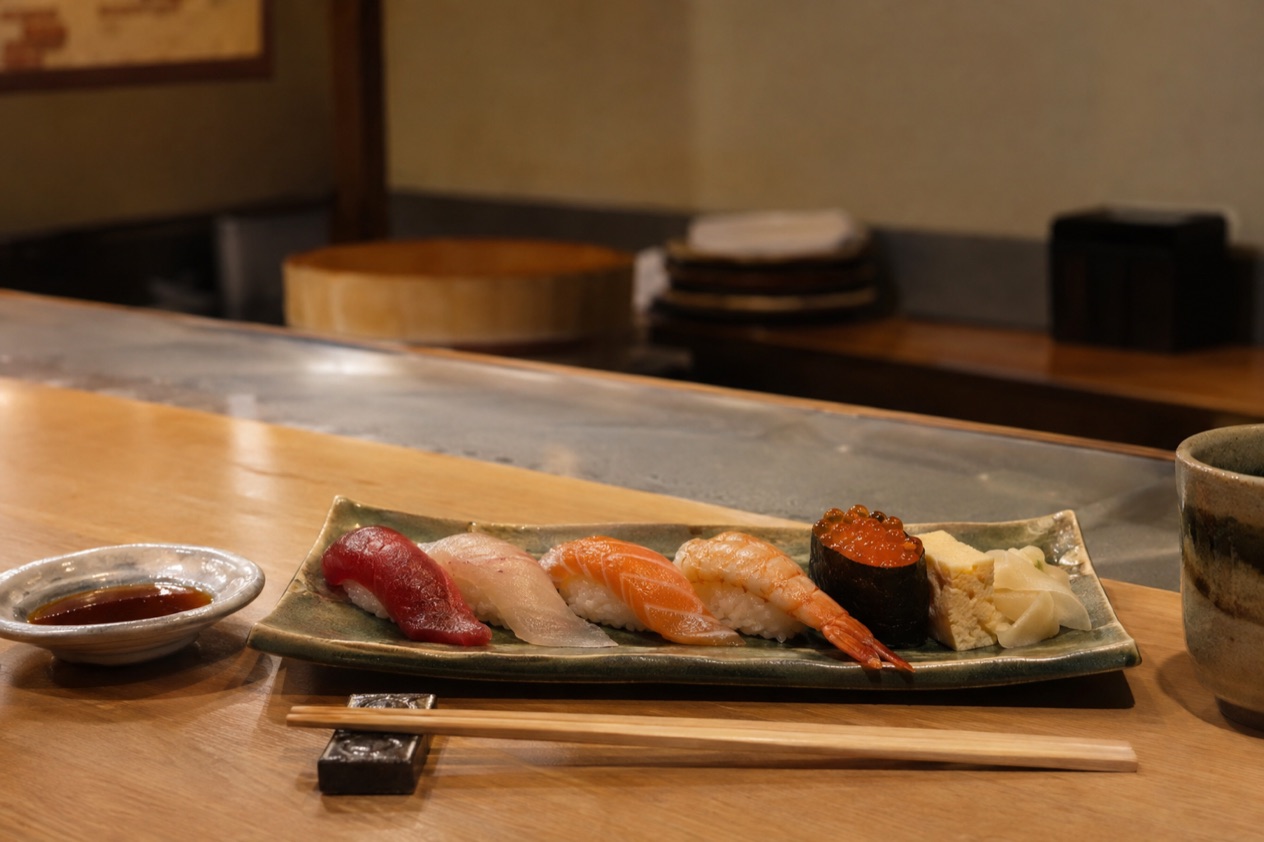
Edomae sushi restaurants typically have a counter where the chef prepares nigiri only after the customer orders. You sit within arm’s reach of the work: the knife, the rice, the quick press of the hands. Pieces arrive one at a time, and the rhythm of the meal is set by the chef.
The word means roughly that you leave it to the chef, so the meal unfolds in the order he or she decides. Some popular restaurants may have only eight counter seats and are hard to enter without a reservation, so the small room becomes part of the experience, with everyone watching the same pair of hands.
Regional and home-style sushi
Not all sushi is nigiri. Oshizushi, pressed sushi made by compressing rice and neta in a bamboo mold, is a Kansai specialty and a favorite of Osaka. In Nara, oshizushi wrapped in persimmon leaves is called kakinohazushi and is a local specialty.
Inarizushi, rice in a pocket of fried tofu, changes shape across the country. It is usually rectangular in the Kanto region and triangular in the Kansai region. Chirashizushi, neta served on a bowl of rice instead of rolled in nori, is eaten annually on Hinamatsuri in March and Children’s Day in May, so it often belongs to family tables and celebrations as much as to restaurants.
Older forms of sushi
The oldest relative of today’s sushi is narezushi, a fermented fish packed with rice. It originated in Southeast Asia, possibly in the Mekong River basin, which includes Laos, Cambodia, Thailand and Vietnam.
A descendant still made in Japan is funa-zushi, which can be eaten after six months of fermentation and remains edible for another six months or more. Its flavor is strong and sour, closer to a cheese than to the fresh pieces on a sushi counter, and it is a curiosity for travelers who like to taste the roots of a dish.
How do you order?
How you order depends on the restaurant: at a conveyor belt you simply take plates, while at a counter you ask the chef for pieces one at a time or leave the choice to him with omakase. Knowing the names of the main forms makes either setting easier, because the menu and the chef will use them.
Learn the shapes on the menu
Nigirizushi is a hand-pressed block of rice topped with neta, and it is what most people picture. Makizushi is rolled sushi, made by placing neta on rice and rolling it tightly with a bamboo mat. Temakizushi is a hand-rolled cone of nori filled with rice and neta, usually eaten straight away so the seaweed stays crisp.
Chirashizushi arrives as a bowl, with the neta laid over the rice. Gunkan-maki, the little boat of rice wrapped in a strip of nori and loaded with soft toppings, was invented at the Ginza Kyubey restaurant in 1941. Seeing these names on a menu lets you build a meal: a few nigiri, a roll for contrast, a bowl if you want something filling.
Ordering at a counter
At an Edomae counter the chef prepares nigiri only after you order, so you can order a piece or two at a time and watch it made. Start with lighter neta and move toward richer ones, and tell the chef when you want to stop. Pointing at what sits in the glass case in front of you works when the names escape you.
If you choose omakase, the decisions are taken out of your hands, which many diners find a relief. The reservation is the real work here. With only eight seats at some popular counters, the booking secures a place at what is essentially a small private performance, and the rest of the evening is about eating what is placed in front of you.
Ordering at the conveyor belt
At kaitenzushi, you take what passes and eat. Plates start at 100 yen each, so you can try a lot of different neta without committing to a large bill. Take a plate of nigiri, then a roll, then perhaps a cone of temaki, and see what you like. It is an easy place to learn what you enjoy before you try a counter.
Seasonal and holiday dishes appear in their own time. In the Kansai region, on the evening of the festival of Setsubun, it is traditional to eat a particular kind of futomaki in its uncut cylindrical form, called ehomaki. If you are in Osaka or Kyoto that evening, look for it in shops and supermarkets, where it is sold ready to eat.
What are the etiquette rules?
Sushi etiquette is mostly a matter of habits that show respect for the food and the person making it, and the one firm rule the sources give is about chopsticks: never stick them upright in food. Place them flat on the bowl or on the chopstick rest instead. Beyond that, a few well-known habits help you settle into the meal.
Chopsticks and hands
Chopsticks standing upright in a bowl of rice are avoided, so set them down flat when you pause. A chopstick rest, when one is provided, is the natural place for them between bites. Nigiri is a hand-pressed block of rice with neta on top, and it is the kind of sushi people often pick up with their fingers at a counter, while chopsticks are fine too.
Rolled forms such as temakizushi are made to be held. A hand-rolled cone of nori filled with rice and neta is eaten from the hand, and the sooner the better, because the nori softens as it sits. Treat each piece as something the chef has just made for you, and eat it while it is fresh.
Behaving at a counter
At a small counter, the room is part of the meal. With as few as eight seats at some popular restaurants, you sit shoulder to shoulder with strangers and watch the same hands work. Arriving as planned for your reservation matters, since omakase and the most sought-after counters require one and the whole evening is arranged around the booked seats.
Because Edomae chefs prepare nigiri only after you order, the pacing is shared between you and the chef. Eat each piece as it arrives rather than letting a row of them wait on the plate. Speaking quietly, asking about the neta if you are curious and thanking the chef at the end all fit the mood of a small room.
At the conveyor belt and at home
A conveyor belt restaurant is more relaxed, but the same sense of respect for the food applies. Take what you intend to eat, and keep your chopsticks flat on a rest or on your plate rather than standing in a bowl. Because plates start at 100 yen each, it is easy to keep a running count of what you have taken.
If you are invited to a home or a celebration, expect sushi tied to the calendar. Chirashizushi is eaten on Hinamatsuri in March and Children’s Day in May, and the bowl is passed around a family table. Accept what is offered, eat it with the same attention you would give a counter piece, and the etiquette largely takes care of itself.
Good to know before you go
Money is simple at the cheap end: plates at a conveyor belt restaurant start at 100 yen each, and the bill grows with the stack beside you. Omakase and popular counters ask for a reservation, so plan those meals before the trip rather than on the day. One note for the home kitchen: in the United States, Food and Drug Administration regulations require raw fish served there to be frozen before serving to kill parasites, so sushi at home follows its own rules.
Sources
- Japan National Tourism Organization, sushi (https://www.japan.travel/en/guide/sushi-in-japan/), checked October 11, 2026
- Wikipedia, Sushi (https://en.wikipedia.org/wiki/Sushi), checked October 11, 2026
To plan your stay
- Best Time to Visit Japan: Cherry Blossoms, Autumn Colors, Weather and Festivals
- Where to Stay in Japan: Ryokan, Temple Stays, Capsule Hotels and the Best Cities to Base In
- Sending Luggage from the Airport in Japan: Hands-Free Travel, Hotel Delivery and Coin Lockers
- Know Before You Go to Japan: Entry, Money, Etiquette and Getting Around