
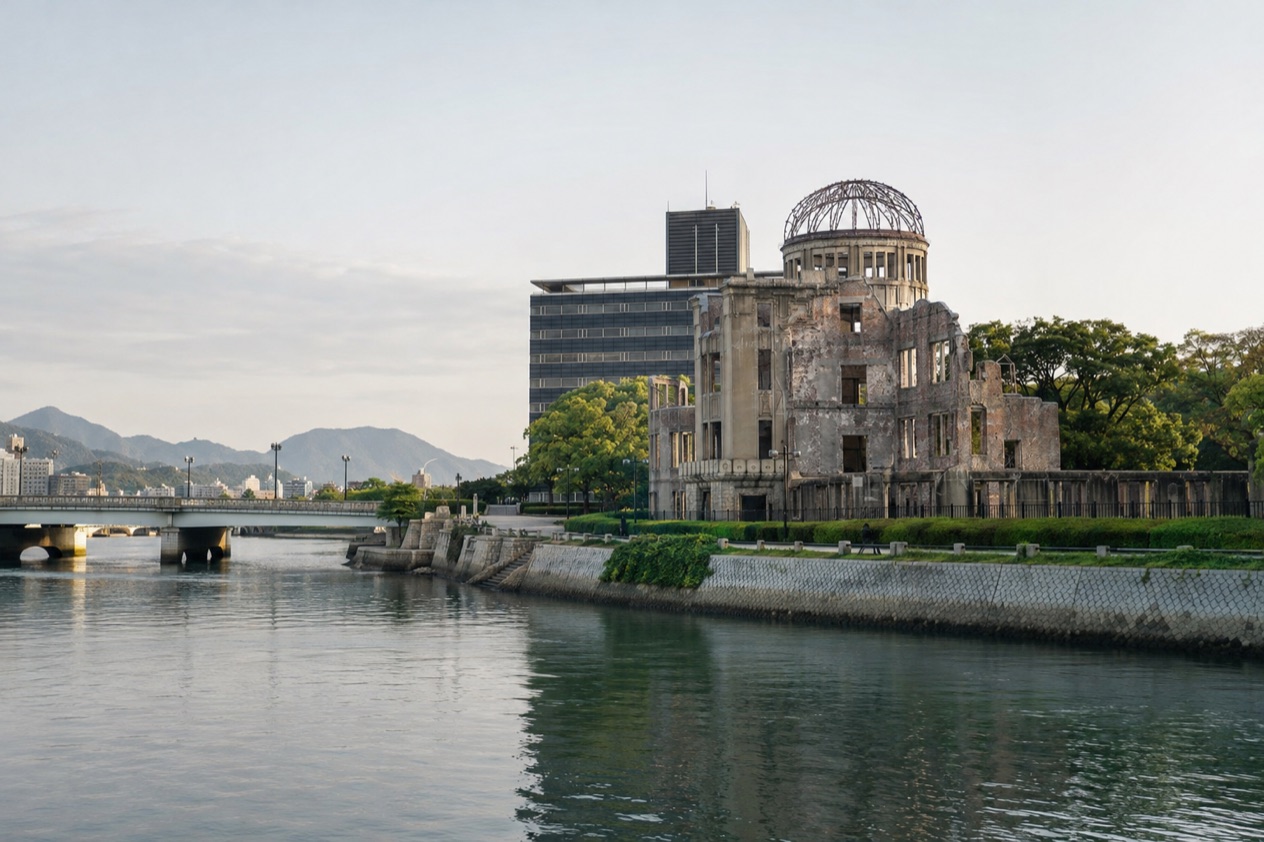
On summer evenings along the river beside the Atomic Bomb Dome, paper lanterns drift past carrying messages written by hand, and the streetcars rattle over the bridges behind them. Hiroshima is a working city of rivers, trams and griddles, and it is also the place where the world’s first nuclear attack is remembered with great care. It suits travelers who want history that is felt on the spot, a very good meal, and an island shrine within reach for a day.
What are the best things to do in Hiroshima?
The best things to do in Hiroshima start with the Peace Memorial Park and its museum, then widen to a floating shrine on Miyajima, a plate of local okonomiyaki, and a ride on the city’s old streetcars. Each of these gets a fuller treatment further down. Here are the essentials in short.
- Walk Peace Memorial Park, where monuments, a memorial hall and the river set the tone for the whole visit.
- Stand outside the Atomic Bomb Dome, the one structure left standing near the hypocenter, which can only be viewed from the outside.
- Go through the Peace Memorial Museum, where belongings of victims and survivor testimonies tell the story in personal terms.
- Cross to Miyajima Island for the red torii gate standing in the sea and the deer that wander the shore.
- Eat okonomiyaki, the layered savory griddle dish that Hiroshima has made its own.
- Look at Hiroshima Castle, rebuilt on foundations first laid by Mori Terumoto.
- Ride a Hiroden streetcar, one of the old trams in what is nicknamed a moving museum.
- Take a day trip to Okunoshima for its wild rabbits or to Sandankyo for autumn color.
Beyond the list, the city rewards a slow pace. Much of what stays with visitors is not a single sight but the sequence: the park in the morning light, a long lunch over a hot iron plate, a tram ride to somewhere with no plan. Hiroshima also sits on the Seto Inland Sea, among wooded mountains and clear waters, so the countryside is never far from the city’s streets.
Travelers pair the city with Miyajima and treat the two as one trip, with the solemn part first and the shrine island second. Others stay longer and add the rabbits of Okunoshima or the gorge at Sandankyo.
Sights and landmarks in Hiroshima
The landmarks of Hiroshima cluster around a single idea: remembering what happened on a morning in 1945 and building a city that speaks for peace. Two sites here are UNESCO World Cultural Heritage, the Atomic Bomb Dome and the adjacent Peace Memorial Park, and a third, Itsukushima Shrine, was registered in 1996 as well. Around them are a rebuilt castle, rivers and tram lines.
Peace Memorial Park and the Atomic Bomb Dome
The park lies in the center of the city and is dedicated to the victims of the bombing and to Hiroshima’s legacy as the first city to suffer a nuclear attack. Paths cross lawns and bridges between many monuments, among them the Children’s Peace Monument, where paper cranes are often hung in colorful strings, and the Hiroshima National Peace Memorial Hall for the Atomic Bomb Victims. It is a place to walk slowly and read the inscriptions.
The Atomic Bomb Dome, also called the Genbaku Dome, stands inside the park beside the river. Its skeleton of bent steel and broken brick is the only structure still standing near the hypocenter, and it has been left in its ruined state on purpose. You cannot go inside, so you take it in from the riverbank, from different angles and in different light, which is how people experience it.
The bomb fell on August 6, 1945, at 8:15 a.m., and the city marks that moment every year. For a visit, it helps to give the park a generous block of time instead of treating it as a photo stop. Pair it with the museum in the same outing, since the two are meant to be read together.
The Peace Memorial Museum
The museum opened in the park in 1955 and conveys the horrors of nuclear weapons through belongings left by victims, artifacts that survived the blast, and the testimonies of survivors. Its message, ‘No More Hiroshimas’, is spoken plainly, and the exhibits are personal: a child’s lunch box, scorched clothing, a stopped watch. Expect it to be an emotional visit, and leave yourself time afterward to sit by the river.
The museum stands at 1-2 Nakajima-cho, in Naka-ku, within the park grounds. Admission is set by category of visitor, and the museum is free for junior high school students and younger.
| Visitor | Admission |
|---|---|
| Adults | ¥200 |
| Adult groups of 30 or more (per person) | ¥160 |
| High school students | ¥100 |
| High school student groups of 20 or more | Free |
| Junior high school students and younger | Free |
Hiroshima Castle
Hiroshima Castle was first built between 1589 and 1599 by Mori Terumoto, a warlord whose choice of this river delta set the city on its path. The castle seen today is a reconstruction, a reminder that almost everything in central Hiroshima had to be rebuilt. Dark walls, a moat and old stone foundations make it a counterpoint to the memorial sites, a look at the city before the bomb.
It suits travelers who like Japanese castles and want a different note after the park and museum. The grounds are a place to stretch your legs and think about what the city has carried through different eras.
Streetcars, bridges and the river
Hiroshima’s trams are a sight in themselves. The operator, Hiroshima Electric Railway, known as Hiroden, runs trams built across Japan and in Europe, which has earned it the nickname ‘The Moving Streetcar Museum’. A car with older styling may roll up beside a modern one at the same stop. The rivers that split the city into islands add the bridges, which you cross constantly without noticing.
Riding a streetcar with no destination is a pleasant way to see ordinary neighborhoods, away from the memorials. Watch the scenery change from shopping streets to residential blocks and back to the water.
Outdoor things to do in Hiroshima
The best outdoor time in Hiroshima is spent along its rivers and in its parks, with the countryside of the prefecture just beyond. The prefecture features the Seto Inland Sea, wooded mountains and clear waters in addition to its peace sites, shrines and museums, and the city is a starting point for all of it.
Walking Peace Memorial Park and the riverbanks
Peace Memorial Park is the city’s central open space, and it works as a long walk as much as a memorial. Lawns, trees and water frame the monuments, and the river by the Atomic Bomb Dome gives the park its sense of openness. People sit on the steps by the water, read, or simply look at the Dome across the river.
Each year on August 6, thousands of people write peace messages on lanterns that are lit at sunset and floated along the river in front of the Dome. Outside that ceremony, the riverbank is an everyday place for a pause. Follow the water from one bridge to the next and the city opens up around you.
Autumn color at Sandankyo
Sandankyo, a gorge in Hiroshima Prefecture, is known for its autumn leaves from late October to late November. This is the season when the wooded slopes turn red and gold, and visiting then is the reason to come. Outside those weeks, the gorge is still a river valley among hills, though it has a different character.
It suits travelers who plan around the foliage and enjoy being in the countryside, away from the city. Treat it as a full outing rather than a quick stop, and pair it with a meal in town afterward.
The Seto Inland Sea and the islands
The Seto Inland Sea shapes the whole region, with its clear waters and scattered islands. Miyajima is the best known of them, and the sea is part of what makes the shrine there so striking, since its red torii gate stands in the water. Looking out across the sea from the shore is one of the pleasures of the day.
The sea also feeds the local table, from oysters to the saltwater eel called anago. If you take a day by the water, plan a seafood meal around it.
Day trips from Hiroshima
The day trip that nearly everyone takes from Hiroshima is Miyajima, and two others, Okunoshima and Sandankyo, suit travelers with a little more time. All three are in Hiroshima Prefecture, and each has its own mood.
Miyajima and Itsukushima Shrine
Miyajima is an island excursion from Hiroshima, and its great attraction is Itsukushima Shrine, where a red torii gate stands in the sea. The shrine was registered as a World Heritage Site in 1996. At high tide the gate appears to float, and at low tide the shore around it opens up, so the scene changes through the day.
Deer wander the island and are part of the visit, so expect them near the paths. Along the shopping street you can try the local snacks, among them maple-leaf shaped cakes called momiji manju and grilled seafood. Walk the shrine’s wooden corridors, then spend the remaining time on the shore or in the streets behind it.
It suits nearly everyone, from first-time visitors to travelers returning to Hiroshima. Give the island a full day so you are not rushing the shrine or the meal that goes with it.
Okunoshima and its rabbits
Okunoshima, a small island in the Seto Inland Sea, is known for its wild rabbits, which come up to visitors looking for food. The island rewards a slow wander along the shore and through its trees, with rabbits appearing at nearly every turn. For animal lovers it is the highlight of the prefecture outside the city.
There are rules about how to behave. Visitors must not chase or pick up the wild rabbits, and any food should be given in a safe place and be appropriate for them. Follow those habits and the experience stays pleasant for people and animals alike.
Sandankyo gorge in autumn
Sandankyo makes sense as a day trip in the weeks from late October to late November, when its autumn leaves are the draw. The gorge is a place for those who want scenery and color rather than monuments, a counterweight to the memorial sites in the city.
It suits travelers who time their stay to the foliage and are happy to spend a day outdoors. Pair it with a return to the city for dinner, since the evening in Hiroshima is a pleasure of its own.
What to eat in Hiroshima
Hiroshima eats okonomiyaki, and it does so with real commitment: the city has over 2000 okonomiyaki restaurants, and the prefecture has more per capita than any other place in Japan. The dish is a savory crepe layered on a hot iron plate, and the local version is the one people travel for.
Okonomiyaki, Hiroshima style
Hiroshima’s okonomiyaki is built in layers rather than mixed into a batter. A thin crepe goes down first, then a mound of cabbage, bean sprouts and pork, then noodles, an egg and a thick glaze of sweet-savory sauce. The cook assembles it on a griddle in front of you, pressing it flat with a spatula, and it arrives sizzling.
Sitting at the counter is part of the pleasure. You watch the cooking, eat straight from the hot plate with a small spatula, and take your time. Many shops specialize in the dish and have their own sauce and their own take on toppings, so trying more than one is a fair plan if you stay several days.
Anago, oysters and the sea
Anago, the saltwater eel, is one of the delicacies Hiroshima is famous for. It is usually grilled or steamed until soft and served over rice or as sushi, with a sweet tare sauce. Near the sea, you also find oysters, a staple of the region, served grilled, fried or in a hot pot in colder months.
If you take a day on Miyajima, the island’s shopping street gives a chance to try seafood and sweets in one stroll, from grilled shellfish to maple-leaf cakes. It is a pleasant lunch outing between shrine visits.
Where and how to eat
Eating in Hiroshima ranges from counter-seat griddle shops to small izakaya, the Japanese pubs where plates are shared alongside drinks. Sake from the region and local beer turn up on most menus. A meal can be built from small dishes, ordered one after another, and the pace is unhurried.
For a first visit, a plate of okonomiyaki and a tray of grilled seafood cover the essentials. Add a sweet from Miyajima and you have tasted the city and the island in a day.
Things to do in Hiroshima at night
Evenings in Hiroshima revolve around the table and the riverbank, with a pace that is more relaxed than a big city’s. After the memorial sites, travelers welcome a long dinner and a stroll along the water.
Dinner and izakaya
Night is when okonomiyaki shops and izakaya fill with locals and visitors. Order a few plates to share, such as grilled anago, oysters in season and skewers, and pair them with beer or local sake. Counter seats let you chat with the cook and watch the food being made.
If you prefer a lighter evening, a bowl of noodles or a small set meal is an equally good way to end the day. The city’s food scene is built on small, casual places rather than formal dining.
The river and the Dome after dark
Walking by the river near the Atomic Bomb Dome in the evening gives the monument a different feeling than by day. The ruin is still viewed only from the outside, and the water beside it reflects the lights of the city. It suits those who want a reflective moment away from the daytime visits.
On August 6, the lantern ceremony turns the river into the evening’s main event. Thousands of people write messages on lanterns that are lit at sunset and floated past the Dome, a ritual that gives the night its meaning.
Trams after dinner
A Hiroden streetcar ride after dinner is a low-key way to see the city lit up. The nickname ‘The Moving Streetcar Museum’ fits, since the trams vary in style, and you can watch the streets slide by from your seat. Riders get off wherever a street catches their eye.
Pair the ride with a late stroll in the area around your hotel. Hiroshima’s evenings do not demand a plan, and following the tracks is as good as any itinerary.
Things to do in Hiroshima with kids
Children in Hiroshima get a mix of heavy history, animals and everyday city pleasures, and parents choose how much of each. The animals, the trams and the food tend to carry the lighter side of the trip.
Animals on the islands
Deer on Miyajima and wild rabbits on Okunoshima are the animal highlights. Children often love seeing them up close, but the rules matter. On Okunoshima, visitors must not chase or pick up the rabbits and should offer appropriate food in a safe place, which is a good habit to explain to children before arriving.
Miyajima adds the floating torii gate and a shopping street with snacks to taste. It makes for a full day, so build in rest stops and keep an eye on little ones near the water.
The museum and the park with children
The Children’s Peace Monument in Peace Memorial Park is a gentle entry point for young visitors, a place linked with paper cranes and the memory of children who died. It is a way to introduce the subject at a child’s level before or instead of going into the museum.
The Peace Memorial Museum is free for junior high school students and younger. Its exhibits include belongings of victims and survivor testimonies, and parents decide whether it suits their children’s age and temperament. Some families visit the park first and judge from there.
Trams, castle and open space
A streetcar ride is an adventure for many children, with old and new cars sharing the rails. Hiroshima Castle gives them walls, a moat and grounds to explore, and the open lawns of the park let them run between visits.
Distances in a city like this add up on foot, so pace the days and mix a sight with a meal or a ride. Okonomiyaki, cooked in front of you, tends to be a hit at the table.
Good to know before you go
Hiroshima is reached by shinkansen, about four hours from Tokyo and 90 minutes from Osaka, or by plane from Haneda Airport to Hiroshima Airport. In the city, Hiroden streetcars and buses run in and around the prefecture, and the operator replaced its PASPY smart card with the QR code ticketing system MOBIRY DAYS in spring 2025. Check the rainy and typhoon seasons when planning, since they shape the outdoor days.
Sources
- Japan National Tourism Organization, Hiroshima (https://www.japan.travel/en/destinations/chugoku/hiroshima/), checked October 11, 2026
- Visit Hiroshima, the official guide (https://visithiroshima.net/), checked October 11, 2026
- Hiroshima Peace Memorial Museum (https://hpmmuseum.jp/?lang=eng), checked October 11, 2026
- Wikipedia, Hiroden (https://en.wikipedia.org/wiki/Hiroden), checked October 11, 2026
- Wikipedia, Hiroshima (https://en.wikipedia.org/wiki/Hiroshima), checked October 11, 2026
- Wikipedia, Okonomiyaki (https://en.wikipedia.org/wiki/Okonomiyaki), checked October 11, 2026
To plan your stay
- Best Time to Visit Hiroshima: Cherry Blossoms, Autumn Weather, Rainy Season and Festivals
- Where to Stay in Hiroshima: Peace Park, Station Area, Castle District and Miyajima Island
- Hiroshima from Osaka: Shinkansen, Local Trains and a Day at the Peace Park
- Know Before You Go to Hiroshima: Entry, Money, Getting Around and Local Etiquette