
Snow falls on Niseko in thick, soft flakes, and the lifts hum above villages where skis lean against every doorway and steam rises from outdoor baths. Evenings end over bowls of ramen and glasses of Hokkaido sake while the mountain disappears into the dark. This is a ski town in southwestern Hokkaido for anyone who wants deep winter, hot springs and northern food in one trip.
What are the best things to do in Niseko?
The best thing to do in Niseko is ski or snowboard on Niseko United, then finish the day in a hot spring and a warm restaurant. Around that core, the town offers villages to wander, mountain scenery, Hokkaido cooking and a few outings to nearby towns and cities.
- Ride Niseko United, one mountain with four resorts, for the powder snow the area is known for.
- Walk the lanes of Grand Hirafu, where the lifts, shops, bars and restaurants gather.
- Look up at Annupuri and the volcanic range, much of it inside a quasi-national park.
- Soak in an onsen (a hot spring bath) once the cold has settled into your shoulders.
- Eat soup curry, miso ramen, grilled lamb and fresh seafood, the dishes Hokkaido does best.
- Spend a day in Sapporo, with its food halls, beer and city lights.
- Take the road toward Otaru and the Shakotan coast for harbor views and sushi.
- Spend an evening in an izakaya (a Japanese pub) trading stories with skiers from all over the world.
Each of these is easy to slot into the others, because the ski area, the villages and the baths all sit within the same stretch of mountain country. The sections below fill in what each one feels like on the ground.
That shows in the welcoming atmosphere in the villages, where you will hear many languages at the lift line and at dinner. It also means the town is set up for people who have never been to Japan before.
Sights and landmarks in Niseko
Niseko has few monuments in the usual sense. Its landmarks are the mountains themselves and the villages that grew up at their feet. The government-recognized Niseko Tourism Zone covers three municipalities, Kutchan, Niseko and Rankoshi, so the sightseeing spreads across more than one town.
A good way to see it is to treat the four resort areas as four neighborhoods, each with its own mood and its own slopes. Moving between them takes you past snowbanks taller than the parked cars, farmhouses and cedar-lined roads.
Grand Hirafu, the village at the center
Grand Hirafu is where visitors base themselves, and it is the part of Niseko with the densest cluster of restaurants, bars, rental shops and lodges. Lanes are lined with wooden chalets, glowing lanterns and snow-covered signs in Japanese and English. In the evening the street fills with people in ski jackets heading for dinner.
Walking through it is a sightseeing outing in its own right. You pass bakeries, coffee counters, ramen shops and small izakaya, and look up to see the lifts climbing into the cloud. A slow loop on foot, with a stop for hot coffee or a sweet bun, shows you the character of the place before you ever click into your bindings.
Niseko Village and Annupuri
Niseko Village, formerly known as Higashiyama, is another of the four ski areas. Annupuri is the fourth side of the mountain, and it forms the eastern part of the Niseko volcanic group, with a summit of 1,308 meters. Annupuri sits at the end of the chain, where the ski area meets the wider range.
Each village has its own lifts and its own cluster of lodges, so it is worth riding from one to the next to see how the landscape changes.
Hanazono and the village streets of Kutchan
Hanazono is the fourth resort area on the mountain, and it adds another base with lodging, dining and a lift of its own. Beyond the resorts, Kutchan is a working town with the daily rhythm of Hokkaido: groceries, farm trucks, a post office, local diners. It is where a visit to Niseko stops feeling like a resort and starts feeling like northern Japan.
Poking into a local bakery, a supermarket or a small shop gives you a different picture from the ski villages. You see what local people eat for breakfast, the vegetables sold from farms in the area and the tools used to cope with a very snowy winter.
Outdoor things to do in Niseko
Outdoors in Niseko means snow first and everything else around it. Kutchan, close to Niseko, receives an average of 363 inches of snow in a year, which is why the slopes and the surrounding forests are built around winter. The mountains also sit largely within a quasi-national park, so the scenery goes beyond the lift lines.
Skiing and snowboarding on Niseko United
Niseko United describes itself as one mountain with four resorts: Annupuri, Niseko Village, Grand Hirafu and Hanazono. It is the largest ski complex in Niseko, and the lifts and trails connect the four bases so you can ride from one village to another during the day. The slopes are best known for powder snow, the kind that people travel across the Pacific to ride.
Niseko United publishes live lift and weather status for every resort on its website, and that is where you can see what is running before you head out. Lift passes can be bought online, which the resort says helps you beat the lines and save money. The trail map lays out all four resorts, so you can plan a route from base to base.
If you are new to snow, a lesson in the morning and a slow afternoon on the gentler runs is a classic way to begin. Experienced skiers and riders tend to chase fresh tracks on the open slopes and in the trees. Either way, a day on the mountain ends with hot food, sore legs and a lot of stories.
The volcanic range and the quasi-national park
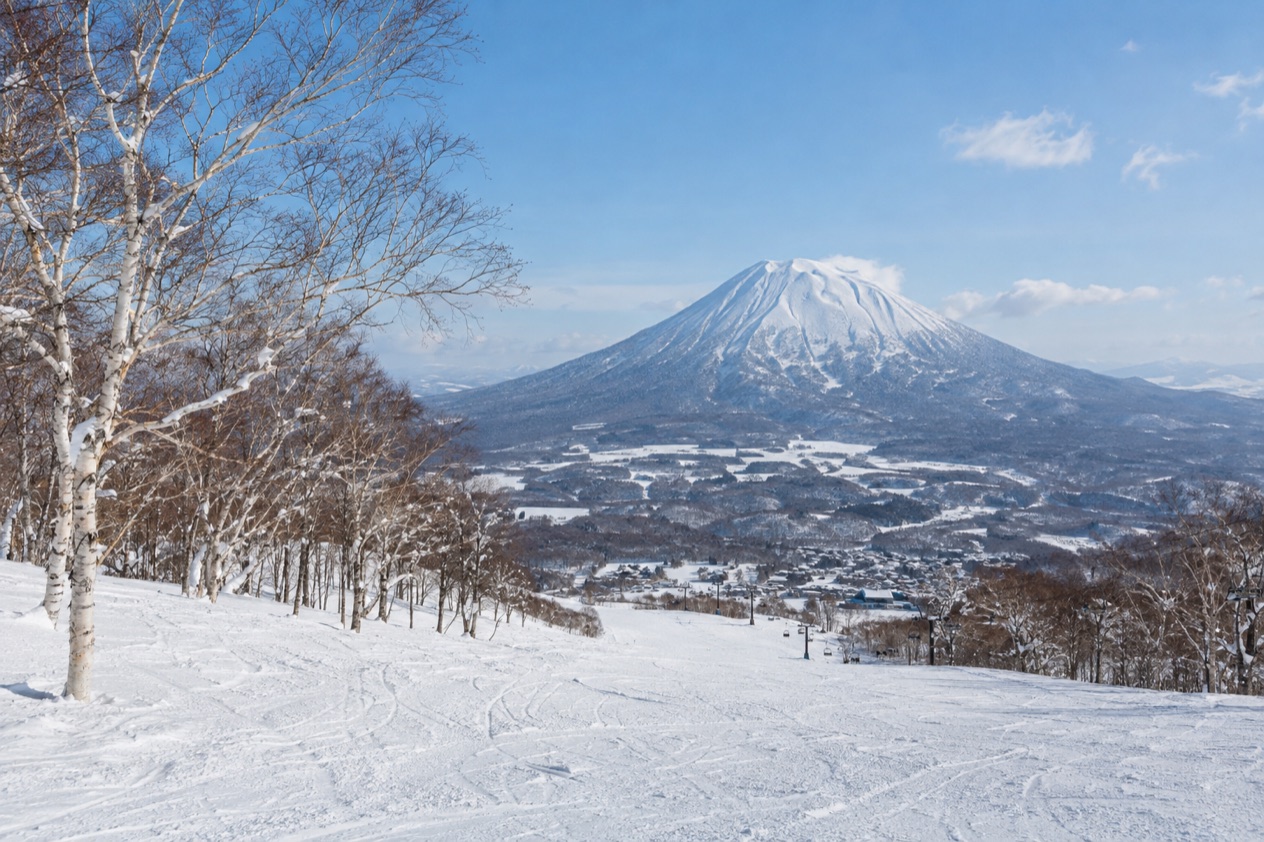
Much of the Niseko mountain range lies within the Niseko-Shakotan-Otaru Kaigan Quasi-National Park. Annupuri rises above the eastern end of the volcanic group, and from the slopes you see white ridges rolling off in several directions, birch and fir forests heavy with snow, and farmland in the valleys below.
Even if you are not skiing, the lifts and the villages put you in the middle of that scenery. Looking up from the village street at a snowy summit with clouds sliding over it is one of the quietest pleasures of a Niseko stay. Bring a camera, because the light on fresh snow changes constantly.
Hot springs after the snow
A hot spring bath is the natural companion to a day of skiing in Hokkaido, and Niseko has onsen where you can soak while snow falls on your head. Bathing is the classic way to loosen tired muscles, with steam rising into the cold air and the mountains dark against the sky.
Japanese bathing culture has its own habits, such as washing before you enter the shared bath and leaving towels outside the water. Many ryokan, the traditional inns, serve a dinner after the bath, so the evening unfolds in a slow order: soak, change into a yukata, the light cotton robe, and eat.
Day trips from Niseko
Niseko is a ski area in southwestern Hokkaido, southwest of Sapporo, and by car it is about a three-hour drive from both Sapporo and New Chitose International Airport. That makes Sapporo the obvious city to pair with the mountains, and the national park’s name points to Otaru and the Shakotan coast as other places on the map.
Sapporo for food, beer and city lights
Sapporo is Hokkaido’s big city, and it offers a very different day from the ski villages. You can wander food halls, eat a bowl of miso ramen in a narrow shop, and drink a beer in a brewery tied to the city’s history. After the white silence of the slopes, the neon and the crowds make a satisfying contrast.
It suits travelers who want a rest day from skiing, or who want to see more of the island before flying home. Because the city is a hub, it is also the place where people begin or end a trip. A day in the streets, a long lunch and an evening in the entertainment district fit together well.
Otaru and the Shakotan coast
The Niseko mountains belong to a quasi-national park whose name includes Shakotan and Otaru Kaigan, the coast. The coast is a very different kind of outing, with the sea and sushi counters taking the place of snow and lifts. Otaru is known for its old canal, its glass shops and its seafood.
Winter on the Hokkaido coast feels raw and bright, with gray waves, sharp wind and steaming bowls of seafood. It suits people who like harbor towns and want to see the island’s edge. A sushi lunch and a stroll along the water, with a sweet pastry from a bakery, make a satisfying day.
Kutchan and Rankoshi
The Niseko Tourism Zone includes Kutchan, Niseko and Rankoshi, and you can explore all three without going far from the ski area. Kutchan and Rankoshi are working towns, and visiting them lets you see farms, markets, shrines and the plain streets where people live all year.
A drive or ride between them is a good rest-day activity. You pass fields under snow, small shrines with red torii gates and roadside stands. It is a chance to see Niseko as a region rather than just a resort.
What to eat in Niseko
Eating in Niseko means Hokkaido cooking: hearty, warming and built on seafood, dairy and vegetables grown in cold soil. After a day in the snow, the appetite you bring to the table is half the pleasure.
Soup curry, ramen and other warming bowls
Soup curry is a Hokkaido specialty, a spiced, brothy curry loaded with big pieces of chicken and whole vegetables. It arrives steaming, and it is the kind of meal that thaws you from the inside after a cold lift ride. Miso ramen, with its rich, slightly sweet broth and curly noodles, is the other northern classic.
Both dishes are easy to find around the ski villages, and each shop has its own style. Try them with a bowl of rice or a side of gyoza, the pan-fried dumplings, and you have a very satisfying dinner after the slopes.
Seafood, lamb and farm produce
Hokkaido is known across Japan for its seafood, and sushi counters and seafood rice bowls, kaisendon, show it off with scallops, crab, salmon roe and sea urchin. Grilled lamb, jingisukan, is cooked on a domed pan at the table and is another northern favorite, with the smoke and smell filling the room.
The cold fields of Hokkaido also produce potatoes, corn, squash and dairy, and you see them in butter-topped potatoes, creamy soups, ice cream and soft serve. Eating soft serve in the cold sounds odd, but it is a Hokkaido habit that visitors enjoy.
Sake, beer and sweets
A cold evening goes well with warm sake, and Hokkaido has its own breweries. Sapporo is the name travelers know in beer, and a cold glass goes with fried chicken, grilled meat and just about everything on an izakaya menu.
For something sweet, look for bakeries selling cream-filled pastries, cheesecake and cakes made with Hokkaido milk. A hot drink and a small cake are a nice break between runs or on a rest day.
Things to do in Niseko at night
Evenings in Niseko revolve around eating, drinking and soaking, and the center of it all is Grand Hirafu, where the lanes light up as the lifts close. The mood is relaxed, with skiers still in their jackets and boots and with bars full of people from many countries.
Izakaya, bars and après-ski
You order a few things, share them, and keep ordering as the night goes on. Grilled chicken skewers, fried foods and salads are all part of the format.
Bars in the villages serve beer, cocktails and whisky, and the crowd is as international as the ski area itself. Because Niseko is especially popular with foreign visitors, you will often find English spoken and menus that make sense to first-timers.
Onsen and quiet evenings
Soaking outdoors with snow drifting down is one of the most memorable things to do in Hokkaido in winter, and travelers make it the end of every ski day.
At a ryokan, dinner is often a multicourse meal of local ingredients served in your room or a dining hall. After that, a book, a pot of tea and a futon laid out on the tatami floor make for a slow end to the day.
If you prefer something more social, a ramen shop or a late-night cafe fills the gap between dinner and bed. Walk the village lanes once more before going in, and the snow underfoot and the lights overhead are a pleasure by themselves.
Things to do in Niseko with kids
Children enjoy Niseko for the snow itself, which turns the whole town into a playground. Building snowmen, throwing snowballs and sliding down snowbanks are part of the fun, and the villages are full of other families doing the same thing.
Snow play and the slopes
For children who ski or snowboard, Niseko United offers four resorts to explore, and a trail map covers them all. Younger children who are new to snow often start with lessons, then spend free time playing in the snow beside the lodge.
Checking the live lift and weather status on the Niseko United website helps you plan a family day. If the wind is strong or the snow is heavy, a rest day with hot chocolate and a movie is a fine choice.
Food, baths and rest days
Children are often happy with Hokkaido food, from the buttered potatoes and corn to the soft serve ice cream, noodles, rice bowls and fried chicken. Ramen and gyoza are usually a hit, and bakeries have sweet buns that make a good snack.
Keep in mind that days in a snowy mountain place are long, cold and tiring. Warm layers, a break for lunch and an early dinner help everyone. A hot bath after the slopes can also help children settle in for the night, and a trip to a town like Kutchan gives a calm change of pace.
Good to know before you go
Niseko lies in southwestern Hokkaido, and the nearest airport is Sapporo’s New Chitose Airport, which receives flights from all over Japan and from some international destinations. The bus trip from the airport takes 3½ to 4 hours, depending on road conditions.
Lift passes can be bought online through Niseko United, and the same website shows live lift and weather status for each resort. The ski season is the main reason people come, and the surrounding mountains are quasi-national park land that you can enjoy even without skis.
Sources
- Japan National Tourism Organization, Niseko (https://www.japan.travel/en/destinations/hokkaido/hokkaido/niseko-and-nearby-ski-resorts/), checked October 11, 2026
- Niseko United, winter (https://www.niseko.ne.jp/en/winter/), checked October 11, 2026
- Wikipedia, Niseko (https://en.wikipedia.org/wiki/Niseko), checked October 11, 2026
- Wikivoyage, Niseko (https://en.wikivoyage.org/wiki/Niseko), checked October 11, 2026