
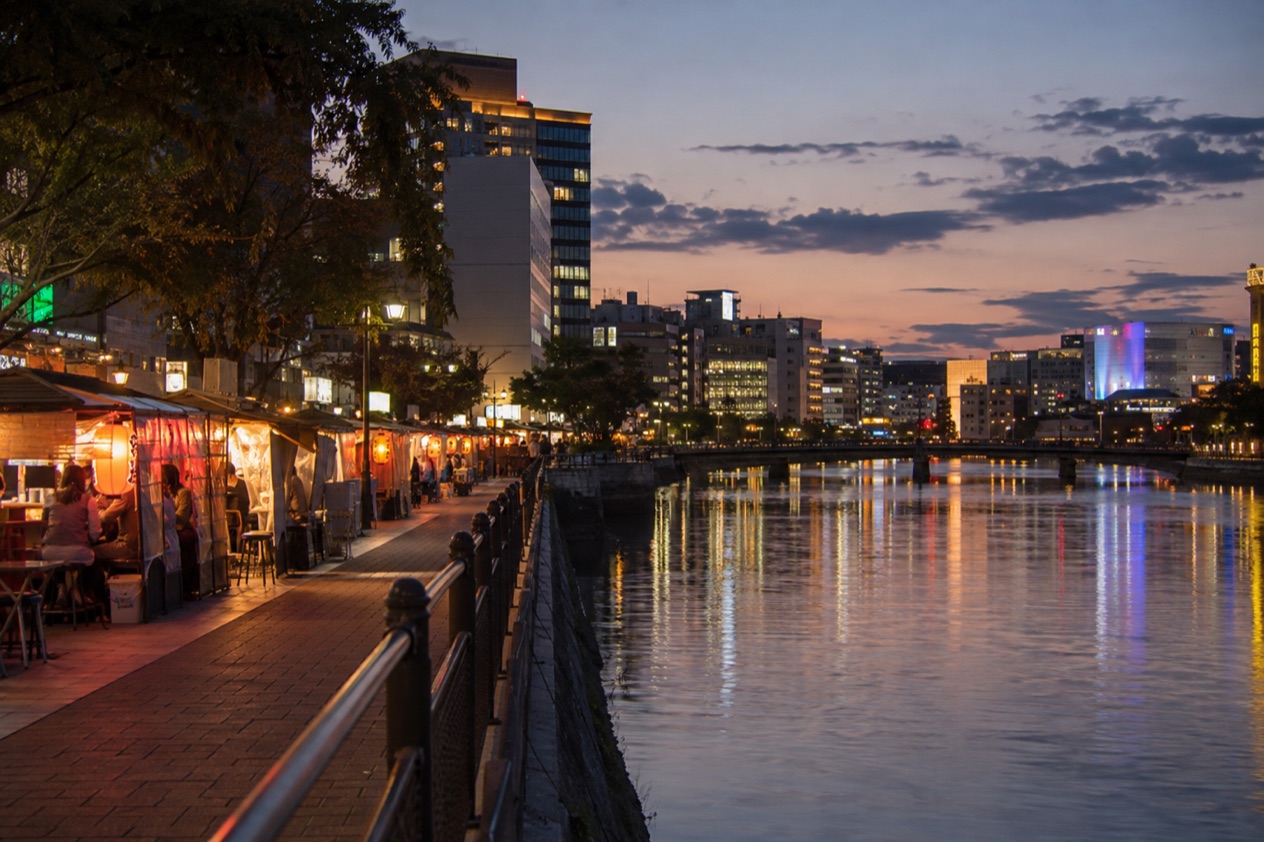
As the evening light fades along the walkways of Hakata, canvas-roofed stalls roll into place, lanterns come on, and the smell of pork-bone broth drifts over the river. Office workers squeeze onto stools beside travelers, everyone elbow to elbow over a steaming bowl. Fukuoka is a port city on the north coast of Kyushu, and it suits travelers who like to eat well, wander a lake park, add a temple town or two, and finish the day among the lanterns.
What are the best things to do in Fukuoka?
The best things to do in Fukuoka center on eating at the open-air stalls and ramen counters, walking around Ohori Park, and taking a half day out to Dazaifu Tenmangu, with a few festivals that change the whole mood of the city when they arrive.
- Eat at a yatai, the small food stalls that set up on the walkways in the early evening and sell ramen and other dishes, for a meal eaten shoulder to shoulder with strangers.
- Order a bowl of Hakata ramen, the tonkotsu style that locals simply call by the old name of central Fukuoka.
- Walk the path around Ohori Park, a registered Place of Scenic Beauty with a lake, islands and one of the city’s major art galleries.
- Spend a half day at Dazaifu Tenmangu, the shrine known for its plum trees, and wander the lane of shops that leads to it.
- Try the local specialties, motsunabe offal hotpot and gomasaba, mackerel coated in sesame sauce, that you will not find cooked the same way elsewhere.
- Time a visit for Hakata Dontaku in May or Hakata Gion Yamakasa in July, when the streets fill with parades and racing floats.
- Travel out to Nanzoin, the temple with a giant reclining Buddha, for a very different kind of afternoon.
- Cross to the Asian mainland in spirit at least: the city has long looked across the water, and its museums, markets and food all show it.
Fukuoka rewards slow days. It is the largest city on Kyushu and the capital of its prefecture, yet most of what you will remember is small: a stool at a counter, a bench by the lake, a bowl of noodles with a second helping ordered on a whim. The sections below sort the city by mood, from the landmarks to the night streets.
Sights and landmarks in Fukuoka
Fukuoka’s landmarks are less about monuments than about layers of a port city that has traded with its neighbors across the sea for centuries. Temples and shrines sit between office towers, old castle stones stand in a park, and a lakeside gallery shares the view with joggers and rowboats.
Ohori Park and its art gallery
Ohori Park lies in Chuo-ku, in the middle of the city, and it is a registered Place of Scenic Beauty. A broad lake fills most of it, crossed by causeways and dotted with small islands, and a path rings the water so you can walk a full circuit without leaving the shade of the trees.
One of Fukuoka City’s major art galleries stands in the park, which makes it a natural place to pair a museum visit with a stroll. Inside you will find the kind of collection that a regional capital builds over decades, and the windows look out over the greenery. Afterward, the lake edge is where people sit with a canned coffee, feed the ducks or simply watch the herons.
The park suits almost anyone who wants a few unhurried hours, and it works as a pause between the shopping districts and the old quarter. Rowboats and swan-shaped pedal boats are part of the scene on the water.
Dazaifu Tenmangu
Dazaifu Tenmangu is a shrine dedicated to a scholar-courtier who became a god of learning, so you will see students and parents writing wishes on wooden plaques before exams. It is known for 6,000 ume (Asian plum) trees, and the grounds are arranged around pools, arched bridges and the approach path under tall camphor trees.
Those plums belong to 167 varieties, which means the shrine looks different on different visits, and the trees are the reason people come at the turn of winter into spring. The honden, the main hall, is undergoing renovations that are expected to take about three years, so expect scaffolding or a temporary look around the central building.
The approach to the shrine is lined with small shops selling plum-flavored sweets and grilled rice cakes, and it is pleasant to graze your way up the lane.
Hakata, Kushida Shrine and the old town
Hakata is the historical name of central Fukuoka, and the old merchant district keeps a cluster of temples and shrines close together. Kushida Shrine is the spiritual home of Hakata Gion Yamakasa, and outside the festival it displays a towering decorated float that gives you a sense of the event’s scale.
Nearby temple grounds, quiet lanes and a few traditional shops give the neighborhood a different rhythm from the glass-and-steel district around the station. It is a good place to learn how the city thinks about itself: a merchant town first, a castle town second, and a port always.
Castle ruins, galleries and the waterfront
The stone walls and gate foundations of Fukuoka’s old castle remain in the park beside Ohori, and climbing among the ramparts gives you views over the lake and the roofs beyond. There is little left of the buildings themselves, but the scale of the stonework tells the story.
Elsewhere in the city, museums that look to the rest of Asia, a tower rising over the bay, and shopping complexes with fountains and canals fill out a day. Fukuoka sits closer to Busan, about 112 miles away, than to Tokyo, 684 miles off, and that geography explains why the city’s art, trade and food have so often looked across the water.
Outdoor things to do in Fukuoka
Outdoors in Fukuoka means lake paths, shrine grounds, a bay full of lights and, in the evening, the open-air stalls that turn a sidewalk into a dining room. The city sits on the coast, so water is never far from view.
Walking around Ohori Park
The loop around the lake is the simplest outdoor plan in the city. You pass willows trailing in the water, stone bridges linking the islands, and benches where residents read, practice instruments or doze. Because the park is a registered Place of Scenic Beauty, it is kept as a garden-like landscape rather than a sports field.
Take the causeways to the islands to see the water from the middle, then finish at the café or the gallery. Joggers and dog walkers share the path, so the pace is set by whoever is in front of you. Evening brings softer light across the lake, and the surrounding buildings glow on the surface.
Strolling among the plum trees of Dazaifu
The grounds of Dazaifu Tenmangu are as much a garden as a shrine. Paths wind past ponds with arched bridges, camphor trees stand over the approach, and the ume trees give the place its signature scent when they flower. Even outside bloom time the pools, lanterns and moss make it an outdoor outing rather than a single building to tick off.
With the main hall under renovation, the setting around it matters more, and you can spend a good while on the paths, the side shrines and the small teahouses. Wear shoes that suit gravel and stone steps, and bring a bit of patience for the slow flow along the approach lane.
Yatai along the walkways
A yatai is a small, mobile food stall, and in Fukuoka they are set up in the early evening on walkways and removed late at night or in the early morning hours. That makes them an outdoor activity in themselves: you sit on a stool under a canopy, with the river or the street lights beside you, and watch the cook ladle broth or turn skewers.
The stalls in Hakata were chosen for The New York Times’ list of 52 Places to Go in 2023, which fits the way they look to a first-timer, the steam, the lanterns and the closeness. Order one dish, share a word with your neighbor, and move on to a second stall if you are still hungry. Many stalls seat only a handful, so the experience is intimate by design.
Other open-air options
- The castle ruins beside Ohori Park, for stone walls, old gate bases and views over the water.
- Waterfront promenades near the bay, where the city’s tower and ships create an evening skyline.
- The seaside parks on the bay, for picnics and wide-open lawns.
- Shrine grounds across Hakata, where old trees and stone lanterns hide behind modern streets.
Day trips from Fukuoka
Day trips from Fukuoka lean toward temples, shrines and small towns reached from the city, so you can sleep in the same hotel every night. Choose one or two rather than all of them, and let the rest of the stay be for eating and wandering.
Dazaifu
Dazaifu is the day trip nearly every visitor to Fukuoka thinks of first, because it packs a major shrine, a lane of snack shops and a museum district into a small area. The shrine, Dazaifu Tenmangu, is the draw, with its plum trees, ponds and arched bridges.
Walk the approach slowly and stop for umegae mochi, the grilled rice cakes stuffed with sweet bean paste that are the town’s signature snack. Then continue into the shrine grounds and let the renovation of the main hall be a reminder that these buildings are living places, repaired by each generation.
The outing suits students of history, families and anyone who wants a gentler contrast to the city. Allow a relaxed half day, and pair it with a coffee in one of the converted shops along the lane.
Nanzoin and its reclining Buddha
Nanzoin is a Buddhist temple located east of Fukuoka, founded in 1899, and it claims the largest statue of a reclining Buddha in the world. The figure lies on its side among hills, in a pose that represents the Buddha at the end of his life, and its size is the reason people make the trip.
The grounds hold more than the statue, with stone figures, paths through greenery and quiet corners for reflection. Photographs flatten the scale, so give yourself time to stand beside the figure and look up along its length.
This is a trip for travelers who like surprising sights and slower, rural scenery. Pair it with a countryside lunch rather than rushing back to the city.
Kurume, home of tonkotsu ramen
Tonkotsu ramen originated in Kurume, in Fukuoka Prefecture, so a trip there is a kind of pilgrimage for noodle lovers. The pork-bone broth that Fukuoka calls Hakata ramen has a sibling here, and tasting it at its source lets you compare the two styles on a single day.
Go with an empty stomach and plan the day around two or three bowls, shared if you like, rather than other sightseeing. The point of the outing is the broth, rich, milky and deeply savory, and the small shops that have worked on it for generations.
Further afield on Kyushu
Fukuoka is the largest city on Kyushu and a natural base for the island, but longer excursions to other prefectures are better treated as overnight trips, with a change of hotel. The island is known for hot springs, volcanoes and port towns, and each is its own destination. For a single day, stay with the closer places above and leave the far corners of Kyushu for a separate stay.
What to eat in Fukuoka
Fukuoka eats noodles, offal hotpot, sesame mackerel and street-stall skewers, and it does so with a confidence that earned the city a place in the Food category of Lonely Planet’s Best In Travel 2023. The cooking is rich, savory and deeply local, built around pork bones, fresh fish from the nearby sea and a fondness for sharing.
Hakata ramen
In Fukuoka, tonkotsu ramen is often called Hakata ramen, after the historical name of central Fukuoka. The broth is made by simmering pork bones until it turns milky and thick, and it is served with thin, firm noodles that cook quickly and stand up to the richness.
Ramen itself is a Japanese-Chinese fusion dish, with Chinese-style alkaline wheat noodles served in hot broth, and it traces back to Yokohama Chinatown in the late 19th century. Fukuoka has made it its own. Toppings tend to be simple, with scallions, slices of pork, pickled ginger and sesame, and tables often hold spicy mustard greens and garlic to crush into the bowl.
A habit that surprises newcomers is the extra helping of noodles. When you finish the first portion with broth left in the bowl, you can ask for another. In some restaurants a bowl of tonkotsu ramen costs no more than 280 yen, which makes a ramen crawl an easy thing to plan.
Motsunabe and gomasaba
Fukuoka is famous for its own unique cuisine, including motsunabe, an offal hotpot, and gomasaba, mackerel coated in sesame sauce. Motsunabe arrives as a pot of beef or pork offal simmered with cabbage, chives and garlic in a savory broth, and it is the kind of dish that tastes better the longer a group lingers.
Gomasaba is lighter and sharper, with the fish served in a sesame-and-soy dressing that adds nuttiness. It is often eaten alongside rice or as a starter with drinks, and it shows how Fukuoka’s cooks make the most of fresh seafood from the coast. These two dishes together give a fair picture of how varied the local table is.
Yatai food and other local favorites
The yatai stalls sell ramen and other food, with skewered meats, grilled items, simple stews and small plates that suit sharing and a drink. Because each stall seats few people, you end up talking to the cook and the people on either side, which is half the pleasure.
Beyond the stalls, Fukuoka’s cooks work with mentaiko, the spicy pollock roe often eaten on rice, plus chicken hotpot, udon with soft noodles and a good deal of grilled fish. Convenience-store onigiri with mentaiko filling is a humble way to taste the flavor on a quick morning. Markets and food halls in the shopping districts offer a quieter place to sample local sweets and pickles, and department store basements are good for assembling a picnic for the park.
Things to do in Fukuoka at night
Fukuoka at night means yatai stalls, riverside lights and izakaya, the casual pubs where small dishes arrive in a steady stream. The city is a place where eating and drinking continue into the late hours, and the stalls set the tone.
An evening among the yatai
Yatai stalls are set up in the early evening on walkways and removed late at night or in the early morning hours, so the best plan is to arrive as the lanterns come on and stay for one or two stops. Pick a stall by instinct, look at what the cook is making, and slide onto a stool.
Standard etiquette is gentle: order a drink, order a dish, eat, and make room when you finish. The stalls were chosen for The New York Times’ ’52 Places to Go in 2023′, yet they remain what they have long been, small neighborhood counters where conversation is half the menu.
Some stalls hold only a handful of seats, so you may wait a moment. Use the time to look at the others around you and note the cooking styles, then choose your second stop.
Izakaya, riverside walks and late ramen
Izakaya fill the streets around the main stations and entertainment districts, serving grilled skewers, fried chicken, sashimi and regional dishes such as motsunabe and gomasaba. You order several small plates, share them, and keep the drinks coming. It is a relaxed way to try many tastes in one evening.
Between meals, the rivers and canals reflect the neon, and a walk along the water helps digestion. Then comes the tradition many locals follow, a final bowl of ramen after drinks, ordered at a counter or a stall as a way to close the night.
The mood throughout is social rather than showy. If you prefer quiet, many bars have only a few seats, and a cocktail or a glass of local shochu, a distilled spirit, makes a good nightcap.
Festival nights
If your dates line up, Fukuoka’s festivals change the night entirely. Hakata Dontaku is held on May 3 and 4, with parades, costumed groups and music through the streets of the city. Hakata Gion Yamakasa is a big summer event held in July, and its Oiyama parade float race takes place on July 15.
For Yamakasa, teams of men in loincloths carry heavy decorated floats through the streets, shouting as they go. Even outside the race, the float displays around the city are a reason to wander at night. These events make Fukuoka feel like a different place, with whole neighborhoods turned into stages.
Things to do in Fukuoka with kids
Children in Fukuoka get parks with boats, a tower to climb, aquarium-style outings and a city whose food is easy to share. The key is to mix one big outing per day with long breaks, since the best parts are the small ones, the stalls, the ponds and the snacks.
Ohori Park for boats, birds and space to run
Ohori Park gives families a lake with pedal boats and rowboats, bridges to cross and wide paths for scooters and small legs. Kids tend to enjoy counting the islands, spotting ducks and herons, and running along the causeways while adults catch their breath.
Bring a snack and make a morning of it, finishing at the art gallery if children are in the mood for something quiet. The park is large, so plan for stops on benches rather than a single push around the full loop.
Dazaifu snacks and shrine games
A trip to Dazaifu is more child-friendly than it sounds because of the snacks. Grilled rice cakes, plum-flavored treats and shaved ice appear along the lane, and the shrine grounds have ponds with arched bridges and old trees to explore. Children often like writing wishes on small wooden plaques.
The approach can fill with walkers, so hold hands near the steps. A stop at Nanzoin, with its giant reclining Buddha, adds a sense of scale that children remember, and the paths around the statue give them room to wander.
Eating with children
Ramen is a natural family meal, and the extra-noodle habit turns the end of a bowl into a game. Skewers, rice balls and sweet snacks suit small appetites, and the markets and food halls offer small portions for sampling.
Yatai stalls are small and busy, so younger children may be happier at a regular restaurant with a table. Aim for an early meal if the stall seating is tight, and keep a hand on little ones near the walkways, where lanterns, bicycles and crowds share the space.
Keeping the day comfortable
Fukuoka is a big city, and the day goes best when you alternate: a park in the morning, a shopping complex or museum in the afternoon, and an early dinner. Between sights, the subway keeps legs fresh. Airport arrivals are simple for families because the Domestic Terminal is served by the subway, just 2 stops from Hakata JR station.
Carry water, a hat and a light layer, and give children a say in the plan, perhaps the choice of the second ramen shop. A city built on eating and wandering suits families who like to move slowly.
Good to know before you go
Getting around Fukuoka is straightforward because the subway links the airport with Hakata JR station, and the main districts sit within reach of each other. Fukuoka is a port city on the north coast of Kyushu, so evenings off the water can feel breezy, and the rainy and typhoon seasons are worth keeping in mind when you pick your dates. Hakata Dontaku, on May 3 and 4, and Hakata Gion Yamakasa in July bring crowds and a festive mood, so choose them on purpose if you want the parades.
Food is a good way to meet the city on a small budget, since in some restaurants a bowl of tonkotsu ramen costs no more than 280 yen. Come hungry, carry a little curiosity, and let the stalls decide your evenings.
Sources
- Japan National Tourism Organization, Fukuoka (https://www.japan.travel/en/destinations/kyushu/fukuoka/fukuoka-city/), checked October 11, 2026
- Fukuoka City official tourist guide (https://yokanavi.com/en/), checked October 11, 2026
- Wikipedia, Fukuoka (https://en.wikipedia.org/wiki/Fukuoka), checked October 11, 2026
- Wikivoyage, Fukuoka (https://en.wikivoyage.org/wiki/Fukuoka), checked October 11, 2026
- Wikipedia, Dazaifu Tenmangū (https://en.wikipedia.org/wiki/Dazaifu_Tenmang%C5%AB), checked October 11, 2026
- Wikipedia, Yatai (food cart) (https://en.wikipedia.org/wiki/Yatai_(food_cart)), checked October 11, 2026
- Wikipedia, Hakata ramen (https://en.wikipedia.org/wiki/Hakata_ramen), checked October 11, 2026
- Wikipedia, Ramen (https://en.wikipedia.org/wiki/Ramen), checked October 11, 2026
- Wikipedia, Ōhori Park (https://en.wikipedia.org/wiki/%C5%8Chori_Park), checked October 11, 2026