
At low tide on Shodo Island, a sandbar called Angel Road surfaces from the water of the Seto Inland Sea and links a few small islets to the shore at Tonosho. Farther north, drift ice presses against the coast of Hokkaido, and far to the south, the night sky above Tokashiki Island fills with the Milky Way. Japan is a country of islands, from the large main islands to small ones with a single seaside village, and each has its own landscape, food and rhythm.
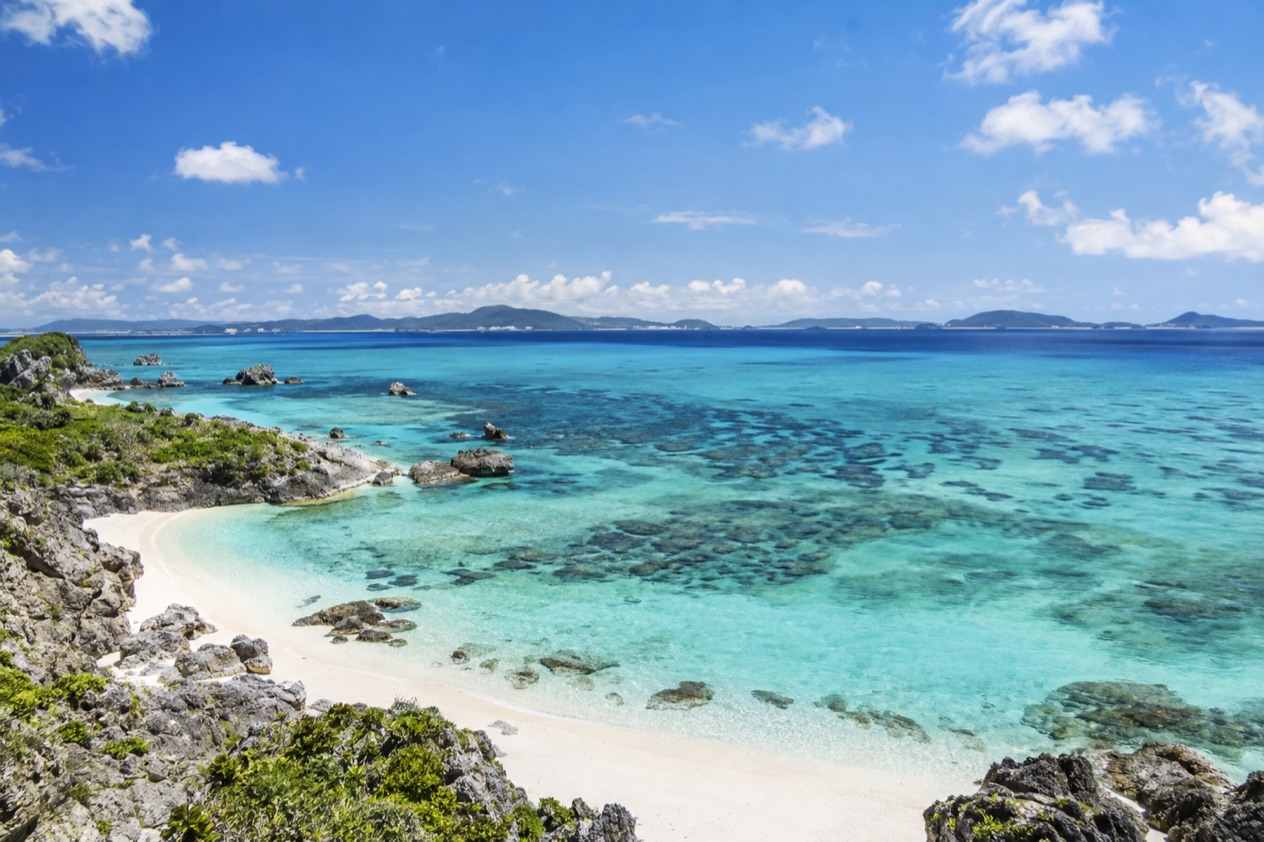
Which Japanese islands can you visit?
You can visit the five main islands and a long list of smaller ones, because Japan is an island country of 14,125 islands. About 260 of them are inhabited, and those are the ones with ports, villages, trails and places to stay. The rest are rocks, reefs and wooded islets that only appear on the map.
The smart way to think about the archipelago is in two layers. The first layer is the five main islands, which hold the cities, the rail network and most of the sights people plan a trip around. The second is the scatter of smaller islands, each with a single character: a mountain forest, a sandbar, a lighthouse coast, a dark sky.
The five main islands
The five main islands are Hokkaido, Honshu, Kyushu, Shikoku and Okinawa. Honshu is the largest and holds Tokyo and over 80% of the population, which is why so many journeys through Japan begin there. Kyushu is the third-largest main island and the second most populous, and it is the one nearest the Asian mainland.
Shikoku is the smallest and least populous of the main islands, tucked between Honshu and Kyushu. Hokkaido, in the far north, brings landscapes of its own: drift ice cruises leave from Abashiri, and Hell Valley (Jigokudani) at Noboribetsu is a volcanic hollow of steaming ground. At Lake Mashu, an observatory gives 360-degree views of the moon reflected on the lake on clear nights.
Okinawa lies in the south, in the Ryukyu chain. Tokashiki Island, in Okinawa, offers seaside stargazing with minimal light pollution and panoramic views of the Milky Way. In Yambaru National Park on Okinawa, a mountaintop observatory has a 350 mm telescope for watching faint stars.
Smaller islands worth a detour
Sado Island sits off the coast of Niigata, and Tsushima is the island nearest to the mainland of Asia on the sea side of Kyushu. In the Seto Inland Sea you find Awaji Island, where a cycling route circles the coast, and Shodo Island with its Angel Road sandbar. To the south, Yakushima belongs to the Osumi Islands and Amami Oshima to the Amami Islands, both in the northern part of the Ryukyu Islands.
These islands suit travelers who like to slow down and let one place fill several days. A single island can offer a coastline to walk, local seafood and a night sky with little glare, rather than a checklist of sights.
| Island | Area (square kilometers) |
|---|---|
| Okinawa Island | 1,207 |
| Sado Island | 855.26 |
| Amami Oshima | 712.35 |
| Tsushima Island | 708.7 |
| Awaji Island | 592.17 |
| Yakushima | 504.88 |
Which are best known?
The names that anchor most trips are the five main islands, with Honshu at the center because Tokyo and the Shinkansen lines belong to it. Beyond Honshu, each main island is linked to a particular kind of scenery. Hokkaido stands for volcanic and wintry landscapes, Kyushu for volcanoes and hot springs, Shikoku for its coast and mountain trails, and Okinawa for the sea and the southern sky.
Honshu: mountains, dunes and snow
Honshu carries the great landmarks. Mount Fuji, a volcano dormant since 1707, rises in Shizuoka Prefecture, and the Shinano River, the longest in Japan, winds through Nagano and Niigata Prefectures. In Tottori Prefecture, in the Chugoku region, the Tottori Sand Dunes give the island an unexpected desert-like stretch of coast.
Winter has its own spectacles. The Zao Snow Monsters occur in Zao, Yamagata Prefecture, and the Tateyama Snow Walls stand in Tateyama, Toyama Prefecture. In summer and autumn, the mountains turn to trails: routes lead to Mount Kiso-Komagatake by the Senjojiki Cirque, to Mount Tsubakuro, to Mount Asahi and around the Ozegahara loop from Hatomachi Pass.
Honshu also has several of the country’s best-organized night-sky experiences. At Kamikochi in Nagano, a guided hike at night leads through the valley’s forest to view the stars against the Japanese Alps.
In Chubusangaku National Park, a private chef prepares a dinner under the Milky Way built around Shinshu beef and local sake. The Jododaira Astronomical Observatory in Fukushima has the highest elevation of any Japanese public observatory and is often above cloud cover for viewing meteor showers.
Hokkaido and Kyushu: volcanic ground
Hokkaido gives you the drift ice cruises of Abashiri and the sulfurous Hell Valley at Noboribetsu, two scenes that could belong to different worlds. Hokkaido is where Japan feels most like a wide, open landscape, and the Lake Mashu observatory adds a night view to the days.
On Kyushu, Mount Unzen rises above Shimabara in Nagasaki Prefecture, where the Mount Unzen Disaster Memorial stands, and hikers can follow a route up Mount Unzen. In Kirishima-Kinkowan National Park, you can sleep in a tree tent suspended between two trees under the stars. Japan counts 108 active volcanoes, and many of these island landscapes owe their shape to them.
Shikoku, Okinawa and the southern islands
Shikoku has Mount Ishizuchi among its hiking routes in Ehime Prefecture, and Ashizuri-Uwakai National Park in Kochi offers guided stargazing in which you learn to identify stars and constellations while listening to the waves. The island’s cycling is covered by a route in Ehime Prefecture.
Okinawa, with its seaside stargazing and Yambaru observatory, adds a southern view of the sky. Yakushima and Amami Oshima extend the picture further down the Ryukyu chain, as islands you choose when you want a place of forest or shoreline rather than a city.
How do you get there?
Honshu is connected to Hokkaido, Kyushu and Shikoku by bridges and tunnels, so the three main islands beside it can be reached by land links rather than a boat alone. Okinawa sits outside that chain, in the Ryukyu Islands to the south.
Beyond the main islands, how you arrive depends on the island, and the sources describe the experiences more than the crossings. What they do give is what to do once you are there: ride a cycling route, follow a hiking trail, join a guided night walk or book a night under the sky.
Cycling the islands
Cycling is one of the clearest ways to see an island at its own pace. Awaji Island, in the Seto Inland Sea, has the Awaichi route around its coast, and the Biwaichi route circles Lake Biwa. Further routes include the Toyama Bay cycling road, cycling in Aomori, the Pacific cycling road, the Tokapuchi 400 and the Tsukuba Kasumigaura Ring Ring Road. Cycling in Ehime Prefecture is also listed.
Mountain biking exists too, with MTB excursions at Nozawa Onsen and on Mount Daisen. These suit travelers who want to cover ground along a shoreline or a mountain without a fixed schedule.
On foot: hiking routes
The hiking routes of the islands read like a list of volcanic and alpine names: Mount Ishizuchi, Mount Daisen, Mount Hakkoda, Mount Unzen, Mount Minobu and Mount Tanigawa among them. The Ozegahara loop begins at Hatomachi Pass, and the route to Mount Kiso-Komagatake passes through the Senjojiki Cirque.
Mount Daisen in Tottori also offers a star-filled night tour with a professional photographer, and Mount Tanigawa, on the border of Gunma and Niigata, has glamping where you sleep under the stars after a barbeque dinner. A walking day can end with a night under the sky.
Night sky stays
Several island and mountain stops are built around the dark. Kamikochi and Chubusangaku in the Japanese Alps, Mount Daisen in Tottori, Ashizuri-Uwakai in Kochi, Tokashiki in Okinawa and Kirishima-Kinkowan in Kyushu all offer a way to watch the stars, from a guided hike to a tree tent. The Jododaira and Yambaru observatories add telescopes for those who want a closer look.
Good to know before you go
Japan has 108 active volcanoes, and the Mount Unzen Disaster Memorial in Shimabara is a reminder that the landscapes you walk through were shaped by them. Forest covers 68.55% of the country, and that green shows in the island trails and mountain parks. The sources give no figures for island ferries or fees, so the best plan is to choose the island for what it offers, a trail, a coast or a night sky, and build the days around that.
Sources
- Japan National Tourism Organization, stargazing (https://www.japan.travel/en/guide/a-guide-to-stargazing-in-japan/), checked October 11, 2026
- Japan National Tourism Organization, adventure sports (https://www.japan.travel/en/sports/adventure/), checked October 11, 2026
- Japan National Tourism Organization, natural wonders (https://www.japan.travel/en/things-to-do/attraction/natural-wonder/), checked October 11, 2026
- Wikipedia, Geography of Japan (https://en.wikipedia.org/wiki/Geography_of_Japan), checked October 11, 2026
- Wikipedia, List of islands of Japan (https://en.wikipedia.org/wiki/List_of_islands_of_Japan), checked October 11, 2026
To plan your stay
- Best Time to Visit Japan: Cherry Blossoms, Autumn Colors, Weather and Festivals
- Where to Stay in Japan: Ryokan, Temple Stays, Capsule Hotels and the Best Cities to Base In
- Sending Luggage from the Airport in Japan: Hands-Free Travel, Hotel Delivery and Coin Lockers
- Know Before You Go to Japan: Entry, Money, Etiquette and Getting Around