
Steam rises off the round iron griddles where cooks flip takoyaki with two picks, and above the canal the Glico Man keeps his arms raised in a glow of LEDs. Osaka is a port city that talks loudly about its stomach, and its streets give you a reason to eat at nearly every corner. This is a city for travelers who want castles and shrines in the same day as a themed ride, a long evening of street food and a few easy-going hours by the water.
What are the best things to do in Osaka?
The best things to do in Osaka start with eating and wandering Dotonbori, then add the castle, a theme park, an aquarium and a handful of side trips into the Kansai region. Each of these gets room in the sections that follow, so here is the short version of what pulls people to the city.
- Walk Dotonbori along its canal, past the Glico Man billboard and the food stalls, because this is where Osaka’s appetite is on show.
- Visit Osaka Castle and its surrounding parks, a landmark that played a major role in the unification of Japan.
- Spend a day at Universal Studios Japan, home to the Wizarding World of Harry Potter and Super Nintendo World.
- See whale sharks and penguins at the Kaiyukan Aquarium, one of the largest aquariums in the world.
- Browse the Shinsaibashi shopping arcade, which runs all the way to Dotonbori.
- Look out over the city from the Floating Garden Observatory on top of the Umeda Sky Building.
- Wander Shinsekai, a neighborhood modeled on Coney Island and Paris, and eat fried skewers there.
- Take a day trip into Kansai for temples, deer and castles beyond the city limits.
Osaka sits in the center of Honshu, Japan’s main island, and it is usually described through three areas. Kita is the modern business and shopping district, Minami is the energetic downtown, and the Bay Area is the beachfront entertainment hub. Planning around those three gives each day a clear shape and keeps backtracking to a minimum.
Getting in is simple to picture. From Tokyo, the Tokaido-Sanyo shinkansen reaches Shin-Osaka Station in about two and a half hours, and a JR local line carries you on to Osaka Station. Flying in, travelers land at Kansai International Airport or at Itami, the airport closer to the city center.
Sights and landmarks in Osaka
Osaka’s landmarks are a mix of a rebuilt castle, a neon canal, an early twentieth century amusement district and a very old Shinto shrine, and together they say more about the city than any single museum could.
Osaka Castle
Osaka Castle stands in Chuo ward and is counted among Japan’s most famous landmarks. The first castle was raised between 1583 and 1598 by Toyotomi Hideyoshi, and the building you see today is a reconstruction of the castle later built by the Tokugawa shogunate. Its tiers of white walls and green copper roofs rise from heavy stone ramparts, and the moats around them are wide enough to make the whole place feel like a fortress island.
From Osaka or Umeda Station, the JR Osaka Loop Line runs to Morinomiya Station, which sits right beside Osaka Castle Park. Plan on walking the grounds as much as visiting the keep, since the stone walls, gates and moats are a large part of the experience. History buffs will enjoy tracing how Hideyoshi’s stronghold fits into the story of unifying the country in the sixteenth century.
Dotonbori
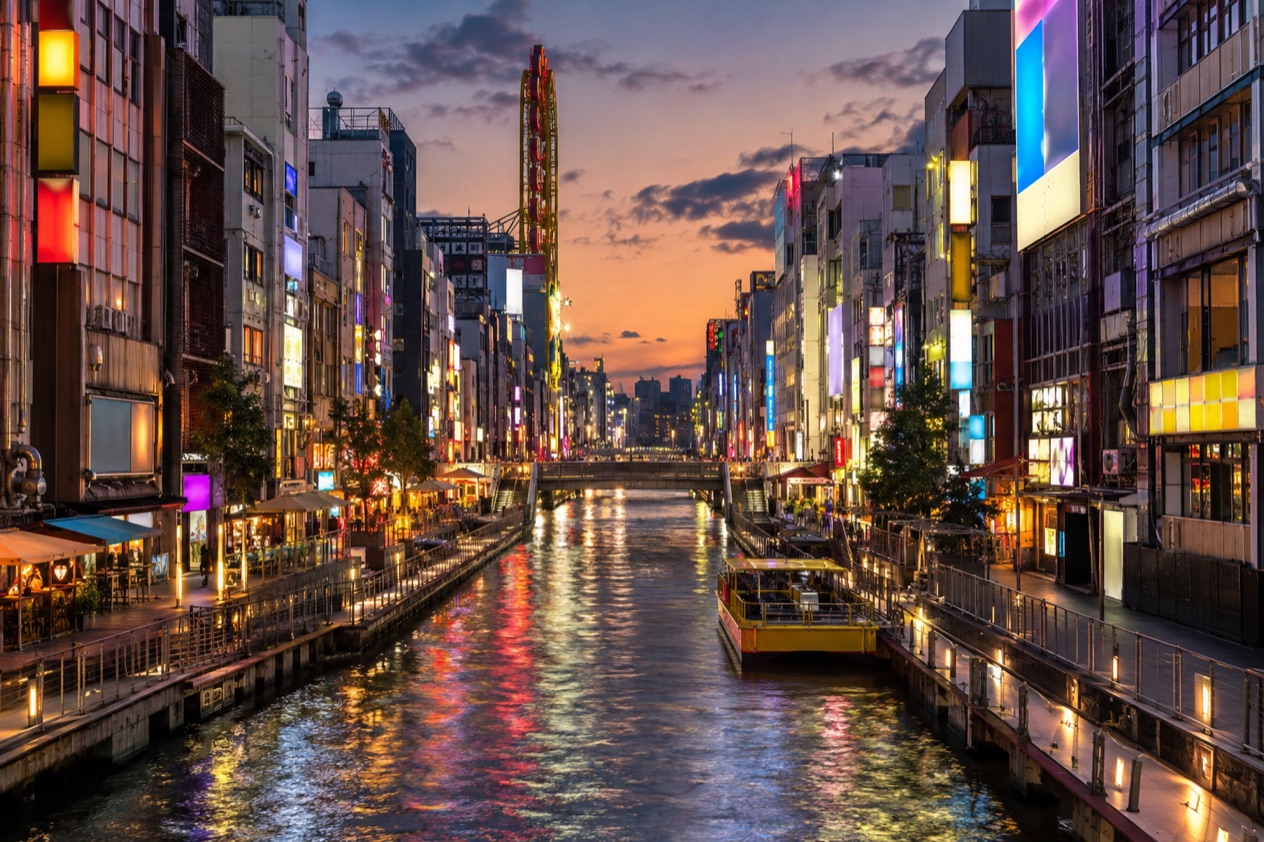
Dotonbori runs along the Dotonbori canal in the Namba district of Chuo ward, from Dotonboribashi Bridge to Nipponbashi Bridge. Signs here are three-dimensional and animated, and the restaurant fronts try to outdo each other with giant crabs, puffer fish and dragons. On the south bank of the canal, just west of Ebisubashi, the Glico Man stands with both arms raised, an LED billboard installed in October 2014 that has become the district’s emblem.
From Osaka or Umeda Station, the Midosuji Line goes to Shinsaibashi Station, or you can stay on the line to Namba Station and approach Dotonbori from that side. The canal walkway is where photographs are taken, and the lanes behind it are where meals are eaten. This is the most useful place in the city to simply drift without a plan.
Shinsekai
Shinsekai sits next to the Minami area in south Osaka. It was created in 1912 with New York’s Coney Island as a model for its southern half and Paris for its northern half, and that odd marriage still shows in its retro signs, its tower and its streets lined with old-fashioned eateries. It feels like a snapshot of a different era of Osaka entertainment.
Come here for the atmosphere more than for ticking off sights. Shops sell souvenirs, parlors click with pinball and arcade games, and the lanes are lined with restaurants that specialize in fried skewers. Pair a stroll here with Minami, since the two neighborhoods sit side by side.
Sumiyoshi-taisha and other quiet corners
Sumiyoshi-taisha, also called Sumiyoshi Grand Shrine, is a Shinto shrine in Sumiyoshi-ku. Its precincts have the stone lanterns, vermilion halls and arched bridge that make a shrine visit feel like stepping out of the city, and it gives you a different side of Osaka from the shopping streets. Visitors usually pass under a gate, rinse their hands at a water basin and bow before the main hall.
In Kita, the Nakanoshima area is a short walk from the malls and offices and has retro architecture along the waterfront. That brick and stone backdrop makes for an easy contrast with the glass towers nearby. Together, the shrine and the riverside give the page of Osaka’s sights some calm between the loud ones.
Outdoor things to do in Osaka
Osaka’s outdoor life is built around castle grounds, a waterfront district, a sky garden and a bayside amusement area, so the open air here is as much urban as it is green. These are places to walk, look and pause between meals.
Osaka Castle Park
The park around Osaka Castle is the city’s big open space, and the stone ramparts and moats give it a shape you do not find in a typical city park. Paths wander beneath the walls, past gates and across lawns, and Morinomiya Station is right next to it, so a visit begins the moment you step off the train.
Walking the outer grounds is a pleasure in its own right, with the castle keeping watch above the trees. Families, joggers and photographers all share the paths. If you want a long, unhurried afternoon outdoors, this is the obvious place to spend it, with the castle as a backdrop.
Nakanoshima and the Kita waterfront
Kita is a modern area of shopping malls, department stores and office buildings, but a short walk leads to Nakanoshima, where retro architecture sits beside the water. The contrast is the draw. One minute you are in a mall, the next you are looking at old stone buildings across a river.
Nakanoshima suits a slow stroll with no fixed destination. You can follow the waterfront, look at the buildings and sit by the river. It is a good outdoor break for anyone who has spent the morning indoors among the department stores of Kita.
The Floating Garden Observatory
The Umeda Sky Building is a two-tower mixed-use skyscraper, and at its top is the Kuchu Teien Observatory, also known as the Floating Garden Observatory. It is an open-air viewpoint, so you look over the city’s rooftops with the sky around you rather than through glass.
It is a good way to understand how Osaka is laid out, with Kita’s towers close at hand and the wider city stretching away. Visitors staying in Umeda can reach it without leaving the district, which makes it a useful stop when you are already shopping or changing trains there.
Osaka Bay waterfront
The Bay Area is a beachfront entertainment hub with theme parks, aquariums, Ferris wheels and sports facilities. It is reached from Osaka or Umeda stations by the JR Loop Line and the Chuo subway line, and it is where the city’s leisure spaces open out toward the harbor.
Even if you skip the rides, the open waterfront setting is a change from the dense downtown. Walk along the harbor, look at the Ferris wheel and take in the wider spaces that the city’s center does not have.
Day trips from Osaka
The day trips people take from Osaka lead into the rest of the Kansai region, where temples, deer, castles and mountain monasteries are within reach of the city’s rail network.
Kyoto
Kyoto is where visitors go for temples and shrines. Fushimi Inari is known for its long tunnels of vermilion torii gates winding up a wooded hillside, and Kiyomizu-dera is a hillside temple with a wide wooden terrace. Between them, the old lanes of Higashiyama and the geisha district of Gion show another side of Japan from Osaka’s neon.
Kyoto rewards a day of walking, with a temple in the morning, tea or sweets in a wooden machiya house and an evening stroll through the old streets. It suits travelers who want Japan’s traditional culture as a counterweight to Osaka’s food-first energy. Choose two or three sites rather than ten, since each one deserves time.
Nara
Nara is the day trip for deer and a very large Buddha. Todai-ji houses a huge bronze Buddha inside one of the biggest wooden halls in the country, and the park around it is home to deer that wander freely and bow for crackers sold at stalls. Kasuga Taisha, with its rows of stone and bronze lanterns, sits in the woods beyond.
The mood in Nara is slower than in Osaka. You wander between temple halls, pass deer on the paths and stop for a local treat such as kakinoha-zushi, sushi wrapped in persimmon leaves. It is a good choice for travelers who like parks, history and animals in one outing, and it pairs well with children.
Himeji and Kobe
Himeji Castle is the draw of the western day trip, a white castle with layered roofs that looks like a heron spreading its wings, which is why it is nicknamed the White Heron. Unlike Osaka Castle, it is not a modern rebuild of a lost keep, so you see a castle that has stood through the centuries. Its maze of walls and gates shows how a Japanese stronghold was meant to confuse attackers.
Kobe is the port city for a different kind of day, with a harbor, a hillside of old foreign residences and a name that is famous for beef. Travelers combine the two, visiting the castle first and then going on to Kobe for the waterfront and dinner.
Other places to consider
Koyasan is a mountain temple settlement where visitors walk through a vast forested cemetery and see monasteries that take overnight guests, a good pick for those who want a contemplative day. Wakayama, Himeji and Kobe round out the region for travelers who have more time, and each gives a very different feel from Osaka’s loud downtown.
What to eat in Osaka
Osaka eats fried, grilled, griddled and slathered in sauce, and the food is cheerful, filling and made to be shared at a counter or eaten on the street. The local saying is kuidaore, roughly meaning to eat until you drop, and the city treats that as an invitation. Start in Dotonbori and Shinsekai, then branch out.
Takoyaki and okonomiyaki
Takoyaki are golden balls of batter around a piece of octopus, cooked in special griddles with rows of round molds and turned by hand with picks. They arrive in a boat-shaped tray, glazed with a sweet-savory sauce, mayonnaise, dried bonito flakes that sway in the heat and a sprinkle of seaweed. The insides are molten, so wait a moment before the first bite.
Okonomiyaki is the other pillar, a savory pancake of cabbage and batter mixed with pork, seafood or other fillings and cooked on a hot griddle. In many restaurants it is cooked on the iron plate at your table, and then you brush on sauce and mayonnaise to taste. It is a meal made for sharing and for lingering.
Kushikatsu and Shinsekai
Kushikatsu are skewers of meat, seafood and vegetables dipped in batter, rolled in breadcrumbs and fried until crisp. Shinsekai is where this food is most closely tied, with restaurants that specialize in it and counters where you eat skewer after skewer. A shared pot of dipping sauce sits on the counter, and the habit is to dip each skewer once only.
A cold beer goes well with the crunch and the salt. Cabbage leaves are often set out for scooping extra sauce, a way of cleansing the palate between rich skewers. Shinsekai’s retro streets make a fitting setting for this kind of unfussy meal.
Noodles, sweets and street snacks
Udon is a gentler pleasure. Osaka’s version has a clear, savory broth with a deep seaweed and dried fish flavor, and kitsune udon comes topped with sweet fried tofu. It is a good meal when the fried food has been heavy and you want something warm and soft.
Along the arcades and canal you will also find steamed pork buns, grilled seafood on sticks, crepes and sweet pastries filled with custard or red bean. Eating while walking is part of the fun in places like Dotonbori, and the variety means you can graze through the afternoon. Sit-down meals at an izakaya, a casual pub with small plates, offer a calmer alternative in the evening.
Things to do in Osaka at night
Night in Osaka means neon, food and conversation in Minami, with quieter options in Kita and along the waterfront. The city is known for its entertainment and nightlife, and a good evening often means moving slowly from a snack to a drink to a second snack.
Dotonbori after dark
After the sun goes down, the signs along the Dotonbori canal light up and reflect in the water, and the Glico Man glows on the south bank. This is the postcard view of the city, and it is where visitors gather to take photographs, buy snacks and decide where to eat next.
Boats cruise the canal, and the bridges make good places to stop and look at the lights. The surrounding lanes are lined with izakaya and bars, so you can step off the main walkway and find a counter seat. It is a lively walk rather than a quiet one, so come ready for an energetic atmosphere.
Shinsaibashi and the Minami lanes
The Shinsaibashi shopping arcade is nearly two kilometers long and extends from Shinsaibashi Station to Dotonbori, so it makes a natural route from shops to the canal. The Minami area is described as an energetic downtown where tradition and fashion intersect, and that is clear in the mix of old shops and trendy boutiques.
Walk the arcade in the evening, duck into side streets for a bar or a snack counter and let the route take you to the canal. Cafés, karaoke rooms and game centers fill out the options for anyone who wants an activity after dinner rather than another meal.
Quieter evenings in Kita and Nakanoshima
Kita offers a calmer way to spend the evening. The towers and malls light up, and a short walk leads to Nakanoshima, where the retro architecture sits by the water. A stroll along the river is a gentle way to end a day of sightseeing.
The Floating Garden Observatory on the Umeda Sky Building is another option when you want to look at the city lights from above, and it is a rooftop experience rather than a street one. Pair it with dinner in Umeda and you have an evening that feels very different from Dotonbori’s bustle.
Things to do in Osaka with kids
Children in Osaka are well served by a theme park, an aquarium, a zoo, a castle with open grounds and a canal where boats run. Most of these are in the Bay Area or close to it, so a family can plan a day around one place at a time.
Universal Studios Japan
Universal Studios Japan opened on March 31, 2001, and features attractions like the Wizarding World of Harry Potter. Super Nintendo World, which opened to the public on March 18, 2021, is at the northern end of the park, west of the Harry Potter area. Fans of either franchise will find a lot to love.
A day here means a lot of walking between lands, so wear comfortable shoes and build in sit-down breaks. It is a good fit for children who love games, wizards or rides, and it gives older kids and parents a shared reason to be excited.
Kaiyukan Aquarium
The Osaka Aquarium Kaiyukan is in Minato ward near Osaka Bay, about a five-minute walk from Osakako Station on the Chuo subway line. It is one of the largest aquariums in the world and houses whale sharks and penguins in multi-story tanks, so children can look up at enormous fish from close range.
The tanks are tall and the exhibits are arranged so you move through them in sequence, which makes the aquarium easy for kids to follow. It is a good rainy-day choice for families, and it pairs well with the Ferris wheel and waterfront nearby in the Bay Area.
Castle grounds, canals and the zoo
Osaka Castle Park gives children room to run along the moats and walls, and the castle itself looks like something out of a storybook.
With children, the main thing to keep in mind is distance. Plan one major outing a day and leave space for snacks, because takoyaki and sweet pastries are easy to share.
Good to know before you go
Osaka is easy to cover by train, with the Midosuji Line linking Umeda, Shinsaibashi and Namba, the JR Loop Line reaching the castle and the bay, and the Chuo subway line serving the aquarium. From Kansai International Airport, the JR Kansai Airport Rapid and Nankai Railways run into the city, and limousine buses also go to Osaka and other areas, with a travel time of approximately 40 to 60 minutes. Itami Airport is closer to the center, and JAL and ANA frequently fly to Osaka from Tokyo’s Haneda and Narita airports.
Sources
- Japan National Tourism Organization, Osaka (https://www.japan.travel/en/destinations/kansai/osaka/), checked October 11, 2026
- Osaka official tourism guide, basic guide (https://www.osaka-info.jp/en/osaka/basic/), checked October 11, 2026
- Osaka official tourism guide, FAQ (https://www.osaka-info.jp/en/information/osaka-faq/), checked October 11, 2026
- Wikipedia, Osaka Castle (https://en.wikipedia.org/wiki/Osaka_Castle), checked October 11, 2026
- Wikipedia, Dōtonbori (https://en.wikipedia.org/wiki/D%C5%8Dtonbori), checked October 11, 2026
- Wikipedia, Universal Studios Japan (https://en.wikipedia.org/wiki/Universal_Studios_Japan), checked October 11, 2026
- Wikipedia, Super Nintendo World (https://en.wikipedia.org/wiki/Super_Nintendo_World), checked October 11, 2026
- Wikipedia, Osaka Aquarium Kaiyukan (https://en.wikipedia.org/wiki/Osaka_Aquarium_Kaiyukan), checked October 11, 2026
- Wikipedia, Shinsekai (https://en.wikipedia.org/wiki/Shinsekai), checked October 11, 2026
- Wikipedia, Umeda Sky Building (https://en.wikipedia.org/wiki/Umeda_Sky_Building), checked October 11, 2026
- Wikipedia, Sumiyoshi-taisha (https://en.wikipedia.org/wiki/Sumiyoshi-taisha), checked October 11, 2026
To plan your stay
- Best Time to Visit Osaka: Cherry Blossoms, Autumn Color, Weather and Festivals
- Where to Stay in Osaka: Kita, Minami, Tennoji, the Castle Area and the Bay
- Osaka from Tokyo: Shinkansen Services, Shin-Osaka Station and Where to Go on Arrival
- Know Before You Go to Osaka: Entry, Money, Getting Around, Weather and Etiquette