
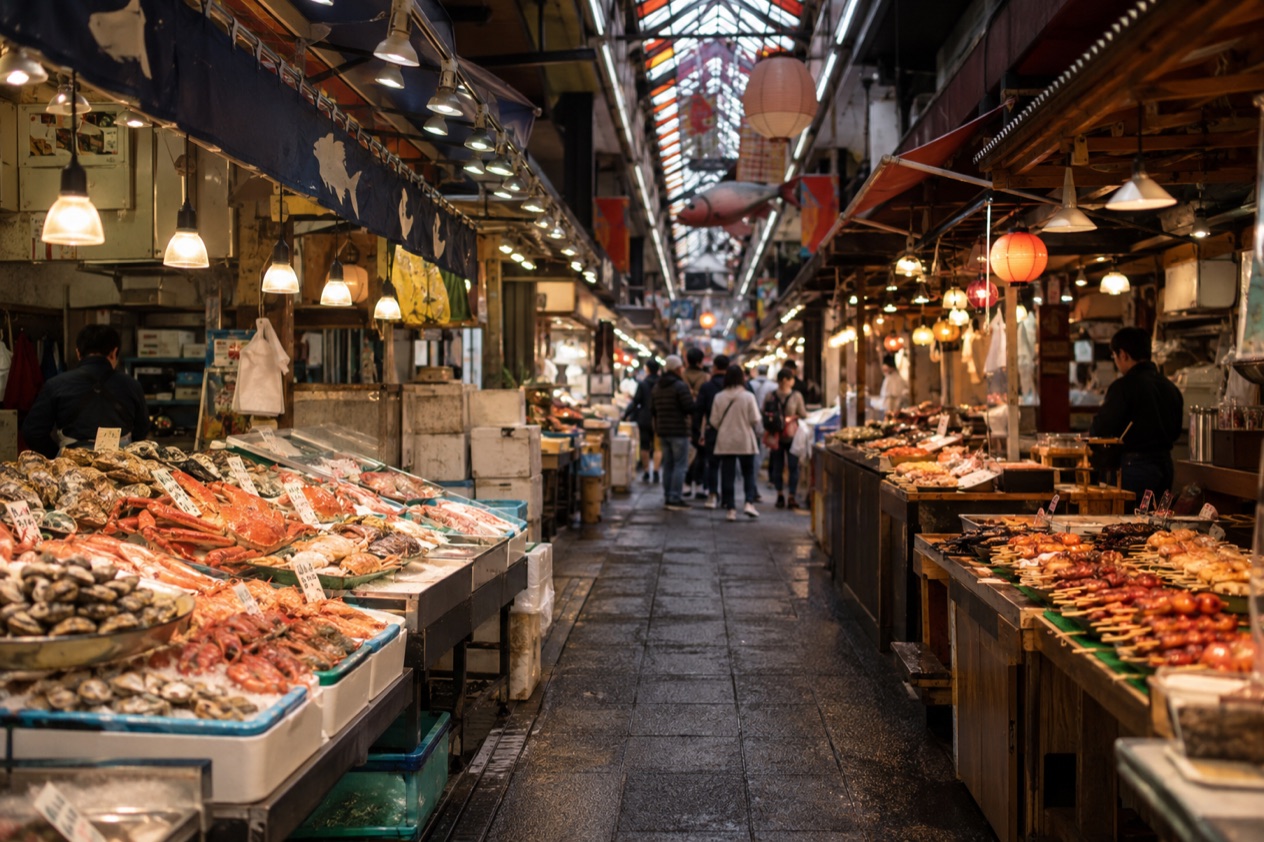
A young woman in a crisp uniform lifts a small tray of sweet bean cakes, bows slightly, and lets you take a toothpick sample of the one glazed with chestnut. Behind her, the counters run on in every direction, glowing with tempura, pickles in jewel colors and boxed lunches arranged like gifts.
This is the depachika, the food hall tucked beneath a Japanese department store. It is one of the most rewarding ways to eat in Japan’s cities, in any month you happen to visit.
What is a depachika?
A depachika is the food hall in the basement of a Japanese department store, and the word is a blend of depaato (department store) and chika (underground). The shops upstairs sell clothes, cosmetics and homewares, but the lowest floors belong to food, and they work like a covered market with the polish of a boutique. Counters are run by bakeries, delicatessens, tea sellers, confectioners and fishmongers, each with its own display and its own staff.
What sets the experience apart is how seriously the food is presented. A single rice ball, a slice of cake or a few pieces of pickled radish gets lighting, a small label and careful wrapping. Walking the aisles feels closer to visiting a gallery you are allowed to eat in.
Why travelers use them for a meal
For a visitor, a depachika solves a very ordinary problem: what to eat when you do not want a long sit-down meal or a menu you cannot read. Almost everything is on display behind glass, so you can point at what looks good. Prepared dishes are sold in small portions, which lets you assemble a lunch from several counters, a few pieces of fried chicken here, a seaweed-wrapped rice ball there, something sweet to finish.
People carry the food out to a park bench, a hotel room or a train seat. A boxed lunch from a depachika is also a familiar companion on long rail journeys in Japan, though the details of any particular train or station are best learned on the spot. The point is that you can eat well, and eat widely, without committing to a table.
What the atmosphere feels like
The sound is a layer of calls from the counters, a steady greeting from staff as you pass, and the rustle of paper bags. The smell shifts as you cross the floor, from toasting sesame and grilled eel sauce to browned butter and fresh bread. Lighting is bright and clean, and the displays are kept tidy to a degree that surprises first-time visitors.
Staff speak politely and often demonstrate a product with great care. You will see them cutting a sample with a small knife, wrapping a box in paper and ribbon, or sliding a cake into an insulated bag. It is easy to wander without buying anything, and the pleasure of looking is part of the visit.
How to do it well
Go with some appetite and a loose plan. Make one slow circuit of the floor before you buy, because the best-looking counters often turn out to be at the far end. Choose a few items rather than a full box of one thing, so you can taste across categories: something fried, something pickled, something fresh, something sweet.
Eating while walking is not the habit in Japan, so you carry your purchases to a spot where you can sit, whether that is a bench, a hotel room or a seating area if the store provides one. Keep the packaging and the little wet towel or chopsticks that come with your food, and take rubbish with you until you find a bin.
What can you buy?
You can buy almost every part of a Japanese meal at a depachika, from ready-to-eat dishes and boxed lunches to cakes, tea, sake and fruit packed as gifts. The range is wide enough that one visit can cover breakfast, lunch, a snack and a present for someone back home. The pleasure lies in the detail, because each counter tends to specialize in one thing and do it with great care.
Bento, sushi and fried things
The savory counters are the heart of the hall. Bento boxes come in a grid of small compartments, with rice, grilled fish or meat, a sliver of omelet, pickles and a few vegetables cooked in different ways. Sushi is sold in neat trays, sometimes in rolls and sometimes as individual pieces, and onigiri, the triangular rice balls wrapped in seaweed, come with fillings such as salmon, pickled plum or tuna with mayonnaise.
Then there is the fried food. Croquettes with a crackling crust, golden karaage chicken, tempura prawns and tonkatsu pork cutlets sit in warm trays, and a salad counter usually sits nearby with dishes dressed in sesame or vinegar. These are the items that travelers often choose first, since they are easy to point at, easy to share and generous in flavor.
Sweets, from wagashi to Western cakes
The sweets area can be the most beautiful part of the floor. Wagashi, the traditional Japanese confections, are made from rice flour, sweet bean paste and agar, and are shaped into flowers, leaves and small seasonal scenes. They are meant to go with bitter green tea, and the contrast of the soft sweetness and the tea is part of the idea.
Alongside them are the Western-style cakes, glossy strawberry shortcakes, cream puffs, roll cakes and delicate tarts, along with chocolates and baked sweets such as castella, a soft honey sponge. Sellers often arrange seasonal fruit on top, and packaging for gifts is part of the craft. If you are buying for yourself, a single slice in a little box is perfectly normal.
Pickles, tea, sake and gifts
Tsukemono, Japanese pickles, are sold at their own counters in a range of colors and textures, from crisp cucumber and radish to deep purple eggplant. Nearby you often find dried fish, seaweed, soy sauce, miso and other pantry items, and tea sellers with leaves of different grades displayed in tins. Sake and wine sections let you look at bottles and labels, while the fruit counters sell individual pieces presented as carefully as jewelry.
Gift-giving is a deep habit in Japan, and depachika are where people shop for it. Boxes of sweets, tea sets and sealed delicacies are wrapped to a high standard. If you want something to carry home, a packaged confection or a tin of tea is the sort of item that suits the cabin of a plane better than a fresh dish.
Which are best known?
The most useful answer is about where to look, not a ranked list of stores. Japan’s major cities each have districts where shopping and eating meet, and the Japan National Tourism Organization points to several of them on its shopping and cuisine pages. A department store with a food hall is the kind of place you find in districts like these, so they make a sensible starting point when you plan your day.
Ginza and Nihonbashi in Tokyo
Ginza and Nihonbashi are both highlighted by the Japan National Tourism Organization under its Cuisine theme, and both are known as shopping areas in Tokyo. That pairing, food and retail on the same streets, is just what a depachika trip looks like. You can spend a morning browsing counters, carry a boxed lunch out, and continue on to the other shops and cafés in the neighborhood.
These districts suit travelers who like to combine a meal with window-shopping, since the area around a food hall is usually full of other stores to explore. Walk the streets around the main avenues, look at what the department stores place in their windows, and then step inside and go down.
Dotonbori and Shinsaibashi in Osaka
In Osaka, the Japan National Tourism Organization lists Dotonbori and Shinsaibashi among its popular places. Osaka has a reputation among Japanese people as a city that loves to eat, and the area around these two districts is where that appetite meets shopping. Stalls and restaurants stand next to covered shopping arcades and department stores.
If you are building a day around food in Osaka, treat the depachika as one stop among several. You might sample snacks from a food hall, then walk to the canal-side streets to see the lit signs and the busy restaurant fronts. The two experiences complement each other, one polished and orderly, the other loud and playful.
Planning your search
The Japan National Tourism Organization offers a shopping guide on its official website, listed under Things to Do, and it is a useful place to see which districts are highlighted in each city. The site is available in English, including a United States English version, so there is no need to work through Japanese pages.
Beyond that, the simplest method is to pick a shopping district, find the large department stores and head for the lowest floors. Each store arranges its food hall in its own way, and no two feel quite alike. Part of the fun is that the same dish can look and taste different from one counter to the next.
Good to know before you go
A depachika works as a relaxed stop in any itinerary, and the habits are simple. Take your food somewhere you can sit, keep your voice low among the counters, and carry your rubbish with you until you find a bin. The Japan National Tourism Organization’s shopping guide, in English at its official site, is the place to see which districts are highlighted for each city before you set out.
Sources
- Japan National Tourism Organization, shopping (https://www.japan.travel/en/guide/shopping-in-japan), checked October 11, 2026
To plan your stay
- Best Time to Visit Japan: Cherry Blossoms, Autumn Colors, Weather and Festivals
- Where to Stay in Japan: Ryokan, Temple Stays, Capsule Hotels and the Best Cities to Base In
- Sending Luggage from the Airport in Japan: Hands-Free Travel, Hotel Delivery and Coin Lockers
- Know Before You Go to Japan: Entry, Money, Etiquette and Getting Around