
A bullet train slides out of Tokyo with a bento box open on the tray table, and a few stops later the window fills with rooftops, rice fields and the first glimpse of a mountain. Then comes a lantern-lit lane in Kyoto, and later a night of takoyaki and neon in Osaka. That chain of cities is the golden route, the first trip to Japan for a great travelers from the United States.
What is the golden route?
The golden route is the loose name travelers give to a first trip through Japan that links Tokyo, Kyoto and Osaka, with side stops added as time allows. It is not an official itinerary or a ticketed product. It is a way of stringing together the capital’s towers and crossings, the temples and wooden lanes of the old imperial city, and the food-obsessed streets of Osaka, all on one line of travel.
Japan is an island nation in East Asia, split into 47 prefectures, and the route touches only a thin slice of it. That slice happens to hold very different moods in a short stretch of rail.
The thread that ties it together: the Shinkansen
The Shinkansen is the world’s first high-speed rail line, and riding it is part of the experience rather than just a way to get from one place to the next. The trains are sleek and long-nosed, the stations sell regional bento boxes and snacks, and the scenery changes from dense city to patches of farmland and hills outside the window.
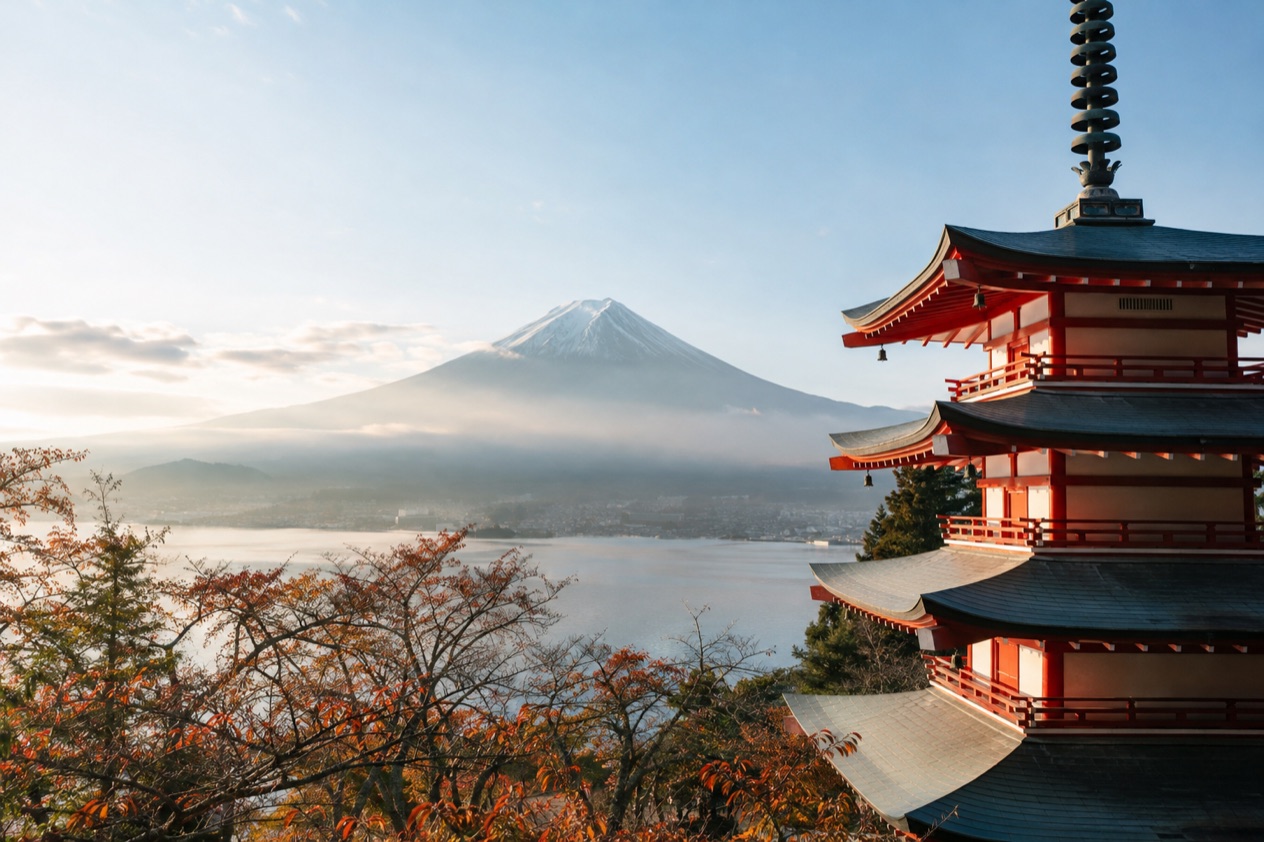
Travelers like to settle in with a boxed lunch, called an ekiben when it is bought at a station, and watch for the view of Mount Fuji, which sometimes appears and sometimes stays hidden behind cloud. Treat that view as a chance, not a promise. The route is built around the Tokaido corridor, the stretch of the network that connects the three big cities.
Who the route suits
The golden route fits travelers who want a first look at Japan with a mix of big city energy, temples and shrines, and a lot of eating. It works for couples, friends, families with older children and solo travelers alike, because the stops are varied enough that everyone finds something to hold onto. A fan of anime and electronics will gravitate to Tokyo, a lover of gardens and tea houses to Kyoto, and a food-first traveler to Osaka.
It also suits people who like moving. Each stop asks you to unpack, wander a new neighborhood and settle in again. If you would rather stay in one place for a week, a single city or region with day trips will feel better than a string of hotels.
Which cities does it include?
The core of the golden route is three cities, Tokyo, Kyoto and Osaka, and many itineraries add Nara, Hiroshima or Hakone as extra stops. Each one gives a different answer to the question of what Japan is like, and together they make a balanced first portrait.
Tokyo
Tokyo is where most itineraries begin, and it rewards wandering without a plan. Senso-ji draws you through a gate hung with a huge red lantern and down a lane of stalls selling rice crackers and sweet bean snacks, while Meiji Jingu sits among tall trees, with a gravel path leading to a shrine where wedding processions sometimes pass. In Shibuya, the crossing fills with people from every direction at once, and Shinjuku glows after dark with signs stacked up the sides of buildings.
Food here ranges from sushi counters and ramen shops to the tiny izakaya, the casual pubs under the railway tracks where small plates arrive one after another. Neighborhoods feel distinct from each other, so a day can move from a shrine to a record shop to a department store food hall without any sense of repetition.
Kyoto
Kyoto is the city travelers come for when they imagine temples, gardens and wooden townhouses. At Fushimi Inari, thousands of red torii gates, the shrine entrances that mark the border of a sacred space, form tunnels up a wooded hillside. Kiyomizu-dera hangs its wide wooden stage over the slope, Kinkaku-ji reflects its gold leaf in a pond, and the lanes of Gion hold tea houses where geisha and maiko, the apprentice entertainers, are part of the city’s living culture.
Meals lean toward the refined. Kaiseki, the multi-course seasonal dinner, is a tradition of the city, and tofu, pickles and matcha sweets turn up in small shops between the sights. Staying a night in a ryokan, a traditional inn with tatami rooms, yukata robes and a shared bath, gives the stop a different texture from the big hotels of Tokyo.
Osaka
Osaka is the city of eating, and the street food around Dotonbori is the reason people add a night here. Takoyaki, the battered octopus balls cooked in round molds, come piping hot with sauce and bonito flakes, and okonomiyaki, the savory pancake grilled on a hot plate, arrives with cabbage, pork and a zigzag of mayonnaise. Giant mechanical signs and neon reflect on the canal after dark.
Osaka Castle gives the city a stately counterpoint, with stone walls, a moat and a park around the keep. The mood is looser and funnier than in Kyoto, and locals are known for a joking, direct way of talking that fits the food stalls and crowded arcades.
Side stops: Nara, Hiroshima and Hakone
Nara is where Todai-ji holds its enormous bronze Buddha inside one of the great wooden halls, and where deer wander the park outside and bow for rice crackers sold by vendors. Hiroshima adds a more somber chapter, with its Peace Memorial Park and museum, and the city’s okonomiyaki is built in layers with noodles, quite unlike Osaka’s version.
Hakone offers hot springs, the onsen, and the chance of a mountain view in a different setting from the big cities. In an onsen, bathing is communal and by gender in many places, and the habit is to wash at a small stool before stepping into the water. Pick the extra stops that suit your interests rather than trying to fit them all in.
How long does it take?
The golden route takes as long as you give each city, and it stretches or shrinks depending on how many of the side stops you add. A trip that holds only Tokyo, Kyoto and Osaka can be one compact loop, while a trip that adds Nara, Hiroshima and Hakone becomes a longer journey with more hotel changes.
Shaping the route to your time
Think in terms of nights per place. Tokyo is wide and layered, so it asks for the most nights if you want to see more than a handful of districts. Kyoto spreads its sights across the city, with temples, gardens and shrines in different neighborhoods, so one day rarely covers all of them. Osaka fits a shorter stay, built around evenings of eating and one or two daytime sights.
A traveler with limited time can trim a city instead of dropping one. Spend a day less in Tokyo, or skip the side stops altogether, and the three-city skeleton still holds together. A traveler with more time can slow the pace, take an extra night in Kyoto for a ryokan stay, or add a day trip to Nara.
What a day on the route feels like
Moving days are part of the rhythm. You check out, carry your bags to the station, board the Shinkansen and arrive in a new city with the afternoon free. The pleasure is in stepping out of a station into an unfamiliar street, finding a lunch counter, and starting to learn another neighborhood.
Travelers mix full sightseeing days with looser ones. A morning at a temple can be followed by a wander through a covered shopping arcade, a long lunch and a coffee break in a tiny cafe. Evenings in Japan suit the izakaya, a ramen counter or a walk through lit streets, and Japan Standard Time keeps the whole country on one clock, so there are no time zone changes while you move from city to city.
Good to know before you go
Electricity in Japan runs at 100 volts, and the frequency is 50 hertz in some parts of the country and 60 hertz in others, which is worth remembering for chargers and small appliances. The country is in the Japan Standard Time zone, nine hours ahead of UTC. In an emergency, dial 119 for fire and 110 for police, and the Japan Coast Guard answers at 118.
Sources
- Wikivoyage, Japan (https://en.wikivoyage.org/wiki/Japan), checked October 11, 2026
To plan your stay
- Best Time to Visit Japan: Cherry Blossoms, Autumn Colors, Weather and Festivals
- Where to Stay in Japan: Ryokan, Temple Stays, Capsule Hotels and the Best Cities to Base In
- Sending Luggage from the Airport in Japan: Hands-Free Travel, Hotel Delivery and Coin Lockers
- Know Before You Go to Japan: Entry, Money, Etiquette and Getting Around